
Think of an AI model as a brilliant student. It’s capable of learning just about anything, but it can’t learn in a vacuum. It needs high-quality study materials—textbooks, practice problems, and real-world examples. AI training datasets are those study materials.
They are massive, carefully organized collections of data, whether it’s images, text, audio, or sensor readings. Each piece of data is labeled to give it context, allowing the AI model to learn to spot patterns, make predictions, and even create new content. This foundational process directly impacts the model’s accuracy, scalability, and ultimate business value.
What Are AI Training Datasets, Really?

Imagine trying to teach a child what a “dog” is by showing them a single photo of a golden retriever. They might think all dogs are large and have floppy ears. Now, what if you showed them thousands of pictures of Chihuahuas, Great Danes, Poodles, and mutts of every shape and size, each one clearly labeled “dog”?
That’s exactly how AI training datasets work. They are the comprehensive, structured libraries of information that teach an AI model about the world with precision and nuance.
An AI model on its own is just a sophisticated algorithm—an engine without fuel. The dataset is the high-octane fuel that powers its ability to learn and perform. The quality, diversity, and sheer scale of this data directly dictate how well the model will eventually perform. A model fed a small, biased, or sloppily labeled dataset will spit out inaccurate and useless results. It’s the classic “garbage in, garbage out” problem, and avoiding it is the first step toward building a scalable AI solution.
The True Core of AI Performance
Here’s a secret many people miss: the elegance of your algorithm is almost always secondary to the quality of your data. A relatively simple model trained on a world-class dataset will consistently outperform a complex model trained on mediocre data. Why? Because the dataset itself sets the ceiling for the model’s potential.
This brings us to the summary table below, which outlines the non-negotiable traits of a dataset built for high performance and measurable impact.
Key Characteristics of a Powerful AI Training Dataset
| Characteristic | Description | Why It Matters for AI Performance |
|---|---|---|
| Relevance | The data must directly address the problem the AI is being built to solve. | Training a medical diagnostic AI on stock photos won’t work. It needs thousands of expertly annotated medical scans to be effective and deliver accurate outcomes. |
| Diversity | The dataset must capture the variety and messiness of the real world. | An autonomous vehicle trained only on sunny-day footage will be a liability in the rain. Diversity prevents bias and ensures the model generalizes well, making it reliable in production. |
| Accuracy | The labels (or annotations) must be consistently correct. | Inaccurate labels are like giving a student an answer key full of typos. It teaches the wrong lessons and leads to costly, high-impact mistakes in production. |
| Scale | AI, especially deep learning, needs huge volumes of data to learn subtle patterns. | More high-quality data almost always leads to better performance, allowing the model to become more nuanced and reliable in its predictions, ensuring scalability. |
Ultimately, investing in a meticulously curated training dataset is a direct investment in the reliability and business value of your final AI model. It’s the most critical factor in turning a theoretical AI concept into a real-world solution that delivers measurable impact.
Understanding this principle is foundational. Recognizing that data quality is the real competitive edge in AI is the first step toward building systems that deliver real, measurable results—whether you’re personalizing an e-commerce experience or enabling life-saving diagnoses in a hospital. It all starts with the data.
Exploring Different Types of AI Datasets
Think of an AI model like a specialized professional. Just as a chef needs ingredients and a doctor needs medical records, an AI needs the right kind of data to learn its job. The type of AI training dataset you choose is the foundation—it determines what your model can see, hear, read, and ultimately, accomplish for your business.
The market reflects this need for specialized data. Valued at roughly USD 2.60 billion in 2024, the global AI training dataset market is expected to hit USD 8.60 billion by 2030. It’s no surprise that image and video datasets dominate, holding the largest market share at 41.0%. Visual data is powering everything from autonomous cars to your favorite e-commerce app, demonstrating a clear demand for high-accuracy visual intelligence.
Let’s dive into the main categories and see how they work in real-world use cases.
Image and Video Datasets for Visual Intelligence
Visual data is the lifeblood of computer vision, the branch of AI focused on teaching machines to interpret what they see. These datasets are packed with images or video frames, where every important object is carefully labeled to create a ground truth for the model.
- E-commerce Product Recognition: Imagine an online store training its AI on millions of product photos. Each image gets annotated with bounding boxes and tags like “t-shirt,” “running shoes,” or “handbag.” This is what powers visual search, letting you snap a picture of a product and find similar items in seconds. It’s a game-changer for customer experience and directly impacts sales.
- Medical Diagnostics: In a hospital, an AI might learn from thousands of MRI scans. Radiologists meticulously annotate these images to mark tumors or other abnormalities. The trained model then acts as a second pair of eyes, helping doctors spot potential issues faster and with greater accuracy, improving patient outcomes.
The quality of the annotation is everything. The precision offered by expert image annotation services is what ensures the model learns the right visual cues, leading to trustworthy results that can be scaled across an entire healthcare network.
Text Datasets for Language Understanding
Text datasets are the fuel for Natural Language Processing (NLP) models. They teach machines to understand, interpret, and even generate human language, turning everything from customer reviews and legal documents into structured, actionable insights.
Text data isn’t just about words; it’s about context, intent, and sentiment. A high-quality text dataset captures these nuances, allowing an AI to understand not just what is being said, but why, enabling more sophisticated and human-like interactions.
For instance, a financial firm could use a dataset of news articles and social media posts, with each entry labeled as having “positive,” “negative,” or “neutral” sentiment about a stock. This trains an AI to monitor market sentiment in real-time, giving traders a critical edge. Similarly, a customer service chatbot is trained on thousands of support tickets to learn how to resolve problems effectively, reducing resolution times and improving customer satisfaction metrics.
Audio Datasets for Conversational AI
From the voice assistant in your kitchen to the transcription service in a business meeting, audio datasets teach machines how to listen. These datasets contain thousands of hours of speech, usually paired with a written transcript and other critical metadata.
A solid audio dataset includes a few key components:
- Speech Samples: Recordings from a diverse range of speakers—covering different ages, genders, and accents—are crucial for building a model that works for everyone and avoids demographic bias.
- Transcriptions: A precise, word-for-word text version of everything spoken in the audio file, ensuring the highest accuracy.
- Speaker Diarization: Labels that identify who is speaking and when, which is essential for understanding conversations with multiple people.
Your smart speaker was trained on a massive dataset of voice commands to understand what you ask it to do. In a business context, call centers use audio datasets to train AI that analyzes a customer’s tone of voice. This helps identify frustrated callers automatically so they can be escalated for better service, a practical solution that directly improves customer retention.
How to Build a High-Impact AI Dataset
Building a powerful AI training dataset isn’t a one-and-done task; it’s a disciplined process that blends smart planning with painstaking execution. Think of it like building a house. You don’t just show up and start laying bricks. You need a detailed blueprint, top-notch materials, and a tough inspection at every single stage. Anything less and the whole structure is at risk.
The exact same logic applies here. It all starts with defining what you want your AI model to do. From there, you systematically find, clean, and label data that helps it achieve that goal. This foundational work has a direct line to your model’s accuracy, its reliability, and ultimately, its value to your business.
This visual flow shows the common data types that serve as the raw material for a dataset, from visual inputs like images and videos to text and audio for language-based AI.
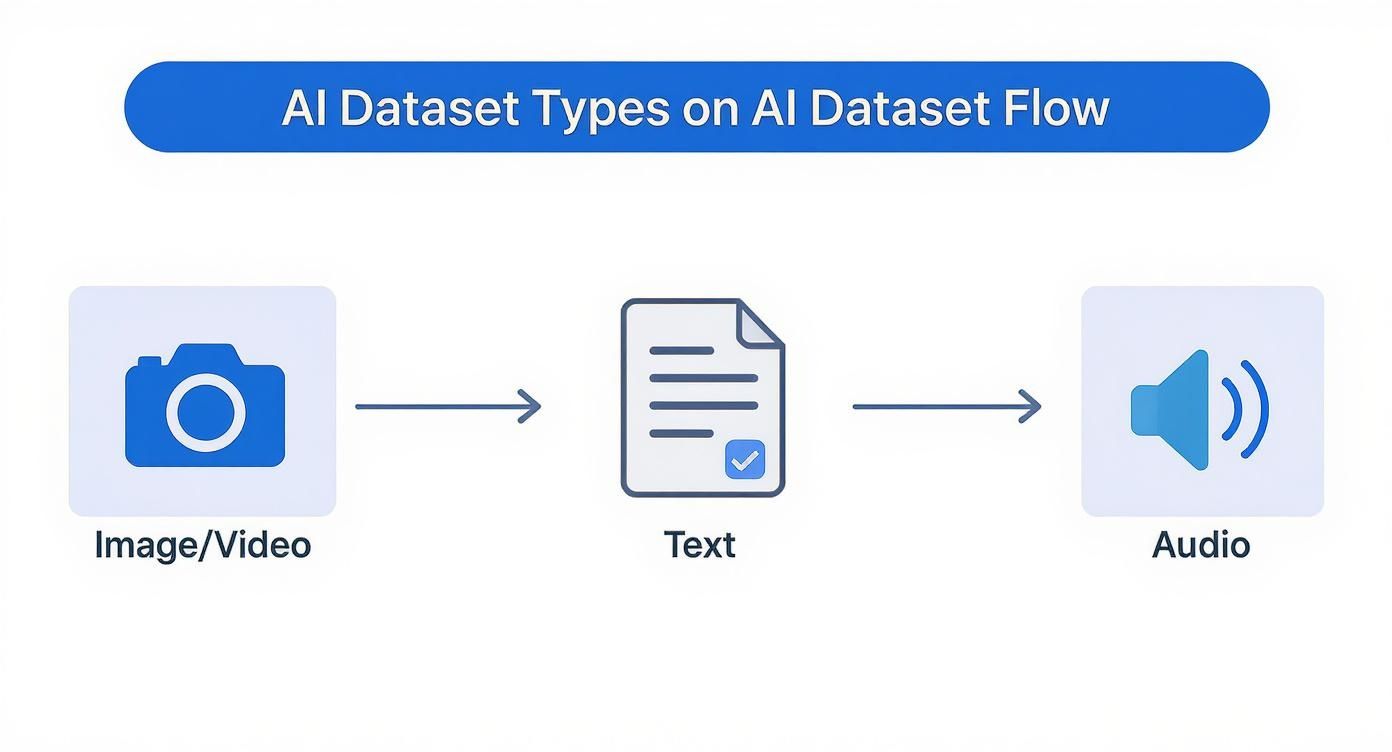
As you can see, the journey from raw information to a useful AI dataset begins by picking the right format for the problem you’re trying to solve.
The Core Stages of Dataset Creation
A truly robust dataset is built in sequential stages, and every single one is critical. If you rush or skip a step, you introduce flaws that are a nightmare to fix later on. A structured, human-centered approach from day one is the only way to ensure you get consistency and quality that can scale.
- Data Sourcing and Collection: This is where you gather your raw materials. The data might come from your own internal records, public datasets, or you might even generate it from scratch to fill specific gaps. The only thing that matters at this stage is that the data is relevant to what your AI needs to learn.
- Data Cleaning and Preprocessing: Raw data is almost always messy. This stage is all about rolling up your sleeves and fixing it—removing duplicates, correcting errors, dealing with missing values, and standardizing formats. For example, a fintech company might have to normalize date formats and currency symbols across millions of transaction logs.
- Data Annotation and Labeling: This is where raw data gets its meaning. Real humans add labels, or tags, that the AI model learns from. It could be as simple as drawing boxes around cars in a picture, transcribing an audio file, or identifying the sentiment in a customer review.
The Art and Science of Data Annotation
Data annotation is easily the most labor-intensive part of the entire process, but it’s also the most important. The quality of your labels sets the absolute ceiling for your model’s performance. There are a handful of techniques, each one suited for different AI goals.
- For Computer Vision: An e-commerce brand building a visual search feature would have annotators draw precise bounding boxes around products in photos. For a medical AI learning to read X-rays, you’d need something far more detailed like semantic segmentation, where every single pixel is labeled to show the exact shape of a tumor.
- For Natural Language Processing (NLP): A company creating a customer service chatbot would use named entity recognition (NER) to tag things like names, places, and products in a conversation. This is how the bot learns to pull out the key details from a user’s question, leading to a faster, more accurate response.
Modern AI models are incredibly data-hungry. Over the last decade, the size of training datasets has exploded, right alongside the capabilities of the models themselves. Today’s big language models are trained on trillions of words, while top-tier image models learn from datasets with around 14 million labeled images. This growth makes one thing crystal clear: the quantity, quality, and diversity of your data are what drive AI performance. You can explore more about this trend and its impact on AI development, which shows how bigger datasets help models pick up on finer details and reduce bias.
Ensuring Integrity with Multi-Layer Quality Assurance
One of the biggest mistakes teams make is treating quality assurance (QA) as a final step you check off before you’re done. That’s a recipe for disaster. Real quality has to be baked into the process from the very beginning. For building reliable AI training datasets, a multi-layer QA strategy isn’t just nice to have—it’s non-negotiable.
At its core, a multi-layer QA process is about building a system of checks and balances that catches errors early and often. It transforms annotation from a simple task into a reliable, repeatable, and scalable operation that delivers measurable accuracy.
Here’s what that process usually looks like in practice:
- Clear Guidelines: Give annotators a detailed instruction manual filled with examples of what to do and, just as importantly, what not to do. This ensures consistency from the start.
- Consensus Review: Have multiple people label the same piece of data. If their labels don’t match, you’ve found an ambiguity that a senior reviewer needs to resolve. This method, often called Inter-Annotator Agreement (IAA), is a fantastic tool for maintaining high standards.
- Automated Checks: Use scripts or software to automatically flag common mistakes, like overlapping bounding boxes or labels that don’t belong to a predefined list of categories.
- Final Expert Validation: Get a true domain expert—like a radiologist for medical scans or a financial analyst for market data—to do a final spot-check on a sample of the labeled data. This ensures it meets the highest possible standard for accuracy and business relevance.
By following these stages with an obsessive focus on quality, you’re not just training a model. You’re building a foundational data asset that will give you a serious competitive edge.
Navigating Data Privacy and Ethical AI

An AI model is only as fair and reliable as the data it’s trained on. While building a powerful algorithm is an achievement, building one that’s trustworthy and responsible is a whole different challenge. This isn’t something you can bolt on at the end—it demands a serious, human-centered commitment to data privacy and ethical handling right from the start of creating your AI training datasets.
Cutting corners here isn’t just bad practice. It can lead to steep legal fines, serious damage to your brand’s reputation, and AI systems that actively cause harm. For any company serious about AI, getting this right isn’t an option; it’s a fundamental pillar of a scalable and sustainable strategy.
Upholding Data Privacy and Compliance
In tightly regulated fields like healthcare and finance, data privacy isn’t just a suggestion—it’s the law. Regulations like Europe’s General Data Protection Regulation (GDPR) and the Health Insurance Portability and Accountability Act (HIPAA) in the U.S. have strict rules about how personal data is managed and protected.
These rules are non-negotiable when you’re building AI training datasets. For example, a healthcare AI meant to read patient charts must be trained on data that has been completely scrubbed of any personally identifiable information (PII). This goes far beyond just removing names and requires sophisticated anonymization work to ensure compliance without compromising data utility.
To stay compliant without sacrificing the data’s usefulness, organizations use several key strategies:
- Data Anonymization: The process of removing or hiding direct identifiers like names, social security numbers, and home addresses.
- Pseudonymization: A more advanced method where real identifiers are swapped with consistent, artificial ones (pseudonyms). This lets you track data points without ever knowing who the individual is.
- Data Masking: Hiding original data with placeholder content (like
***-**-1234for a social security number) to protect sensitive details while keeping the data format intact for training.
In complex domains like medical imaging, meeting these standards requires real expertise. You can learn more about balancing accuracy and compliance in our guide to medical annotation for U.S. healthcare AI.
Confronting and Mitigating Algorithmic Bias
Perhaps the sneakiest but most damaging risk in creating datasets is algorithmic bias. It’s what happens when a model makes unfair or skewed decisions because its training data didn’t accurately reflect the real world.
Algorithmic bias is a hidden flaw that turns a promising AI tool into a liability. It arises when a dataset reflects historical prejudices or underrepresents certain demographic groups, teaching the AI to perpetuate and even amplify those same biases.
Think of a hiring tool trained mostly on resumes from male applicants—it could end up unfairly sidelining highly qualified women. Or a facial recognition system trained on images of mostly light-skinned people, which will almost certainly have a higher error rate when identifying individuals with darker skin tones.
The only way to win this fight is to prevent bias before it starts. This means taking a deliberate and methodical approach to how you assemble your AI training datasets.
Here’s a practical game plan to keep bias in check:
- Conduct a Data Audit: Before you even think about training, scrutinize your dataset’s demographic makeup. Are there imbalances related to age, gender, ethnicity, or location?
- Source Diverse Data: Don’t wait for representative data to fall into your lap. Actively seek out data from underrepresented groups to fill the gaps in your dataset.
- Implement Fair Annotation Practices: Your human annotators are a critical line of defense. Make sure their guidelines are crystal clear and objective to prevent their own unconscious biases from creeping into the labels.
- Test for Fairness: Once the model is trained, your job isn’t done. Test its performance rigorously across different demographic subgroups to catch and fix any biased behavior before it ever goes live.
Common Dataset Mistakes to Avoid
Building a powerful AI training dataset is as much about dodging bullets as it is about following best practices. Even a tiny oversight in the beginning can snowball into massive performance problems, leading to inaccurate models, wasted resources, and projects that never see the light of day. The line between a successful AI launch and a failed one often comes down to sidestepping a few common, yet critical, mistakes.
Knowing what not to do gives you a serious strategic advantage. It lets you build a resilient data foundation that can support reliable and scalable AI from the start.
Overlooking the Garbage In, Garbage Out Principle
The oldest rule in data science hasn’t aged a bit: “garbage in, garbage out.” An AI model is nothing more than a mirror reflecting the data it learns from. If your dataset is full of errors, noise, or irrelevant information, your model will faithfully learn and replicate those same flaws, leading to a poor return on investment.
Think about a retail AI built to recommend products. If its training data has mismatched product images and descriptions, it will learn all the wrong lessons. The result? Nonsensical recommendations, frustrated customers, and a failed project. The only fix is a rigorous data cleaning and preprocessing phase to weed out duplicates, correct errors, and ensure every single data point is accurate and relevant.
Failing to Ensure Data Diversity
A dataset that doesn’t mirror the real world is a recipe for bias. This is one of the most dangerous mistakes out there because it creates AI systems that are unfair, discriminatory, and completely unreliable when they encounter new scenarios.
Imagine a facial recognition model trained almost exclusively on images of one demographic. It’s guaranteed to perform poorly for underrepresented groups. You’ve just built a system that is not only ineffective but also deeply unethical. This is why a diverse and representative ai training dataset isn’t optional; it’s a core requirement for responsible AI.
Proactively auditing your data for demographic balance and sourcing information from varied populations is not just an ethical requirement—it’s essential for building a robust model that generalizes well and performs reliably for all users.
This kind of proactive work demands a deep understanding of where bias can hide and a firm commitment to building fair systems. It’s a core part of our AI Quality Assurance services.
Tolerating Inconsistent Labeling
Inconsistent annotation is the silent killer of AI projects. When one annotator labels an object as a “car” while another calls it an “automobile,” the model gets confusing and contradictory signals. This chaos makes it impossible for the AI to learn clear patterns, which absolutely tanks its accuracy and undermines its scalability.
This problem usually starts with vague guidelines or undertrained annotators. A real-world example could be an autonomous vehicle AI that confuses pedestrians with cyclists because of inconsistent labeling—a potentially fatal error. The solution is to establish crystal-clear, detailed annotation guidelines with specific examples and run a multi-layer QA process, just like the one we detail in our approach to business process management.
Ignoring Future Scalability Needs
So many teams build a dataset for the immediate task at hand, completely forgetting about what comes next. An AI model is never really “finished”—it needs constant updates, retraining, and adaptation as new data flows in. A dataset architecture that’s rigid and hard to expand will become a major bottleneck down the road.
The market for AI training datasets is exploding, with projections showing it will hit USD 4.9 billion by 2027. This growth is all about the nonstop need for more and better data to keep improving model performance. If you don’t plan for this, you’ll find yourself rebuilding data pipelines from scratch, burning through time and money. You can learn more about the accelerating investment in AI training data and see why future-proofing your data strategy is so critical for long-term success.
Common Dataset Pitfalls and Expert Solutions
Navigating the complexities of dataset creation means being aware of the traps that can derail even the most promising AI initiatives. Below is a quick-reference guide to the most frequent challenges we see and how our human-centered solutions solve them before they become project-killers.
| Common Pitfall | Potential Impact on AI Model | Prudent Partners’ Recommended Solution |
|---|---|---|
| Insufficient Data Volume | The model underfits, failing to learn general patterns and performing poorly on new, unseen data, impacting scalability. | Start with a clear data acquisition strategy. If internal data is limited, use data augmentation or source high-quality, relevant external datasets to achieve necessary scale. |
| Data Imbalance | The model becomes biased towards the majority class, leading to poor performance for underrepresented categories (e.g., fraud detection, rare disease diagnosis). | Employ techniques like oversampling (for minority classes) or undersampling (for majority classes). Use stratified sampling to ensure all classes are represented proportionally for a fair outcome. |
| Labeling Ambiguity | Inconsistent or incorrect labels confuse the model, leading to low accuracy and unreliable predictions that erode trust. | Develop a comprehensive, crystal-clear annotation guide with visual examples. Implement a multi-stage QA process, including peer review and expert validation for maximum accuracy. |
| Ignoring Edge Cases | The model performs well on common scenarios but fails spectacularly when faced with rare or unusual inputs (e.g., an autonomous vehicle in a snowstorm). | Actively source or create data representing edge cases. Use synthetic data generation to simulate rare scenarios that are difficult to capture in the real world. |
By proactively addressing these common pitfalls, you can build a solid foundation for your AI model. The goal is not just to collect data, but to curate a dataset that is robust, balanced, and ready for whatever the real world throws at it.
Building Your AI Future with the Right Partner
We’ve covered a lot, and it all boils down to one simple truth: building a high-quality AI training dataset is challenging, but it’s absolutely essential. The investment you make in your data isn’t just an expense—it’s what separates a model that works in a lab from one that drives real-world business value. It directly fuels higher model accuracy and a stronger return on your entire AI investment.
Now it’s time to put this knowledge into action. Think of your dataset not as a one-off project cost, but as a foundational asset. A meticulously prepared dataset is what will power reliable, scalable, and fair AI systems for years to come. Getting this step right is arguably the most critical decision you’ll make in your AI journey.
From Blueprint to Business Impact
Creating this foundational asset isn’t something you can improvise. It requires specialized skills, relentless quality control, and a deep, human-centered understanding of how even the smallest data nuances shape a model’s behavior. This is where a strategic partner comes in.
You need more than just a vendor; you need a team that can manage the entire data pipeline, from raw data ingestion and annotation to multi-layer quality assurance. A true partner ensures every single data point aligns with your business goals, turning that raw data into a genuine competitive advantage.
Choosing the right data partner isn’t just about outsourcing a task. It’s about securing the expertise needed to build a trustworthy and effective AI solution from the ground up, delivering measurable impact.
If you’re ready to build a data foundation that will drive your AI initiatives forward, our team at Prudent Partners is here to help. We provide custom, scalable, and secure data annotation and quality assurance services designed to get you to your goals faster and with greater accuracy.
Connect with us today to talk about your project. Let us help you turn your AI vision into a reality, powered by data that’s accurate, consistent, and ready for any challenge.
Frequently Asked Questions
When you’re diving into the world of AI, a lot of practical questions pop up around costs, quality, and even the words people use. This section cuts through the noise to give you straightforward answers to the questions we hear most often from a human-centered perspective.
How Much Does an AI Training Dataset Cost?
There’s no simple price tag for a high-quality AI training dataset. The final cost is a function of the value it will create and depends on a few key factors:
- Data Volume: Are we talking about thousands of images or tens of thousands? The sheer amount of data you need to achieve statistical significance is the first factor.
- Annotation Complexity: Drawing a simple bounding box around a car is one thing. Pixel-perfect semantic segmentation of a complex medical scan is another. The more detailed the work, the higher the investment.
- Required Accuracy: Getting to 99%+ accuracy isn’t an accident. It requires layers of quality assurance, which naturally influences the investment but pays dividends in model performance.
- Data Sourcing: Sometimes, the hardest part is just getting the raw data. The cost to acquire or create that initial pool of data can be a major factor in the overall project budget.
Our focus is always on delivering measurable ROI. We build datasets that are right the first time, saving you the massive expense of retraining a faulty model down the road.
What Is the Difference Between Annotation and Labeling?
People tend to use these terms interchangeably, but there’s a subtle difference that’s important for understanding the scope of work.
Data labeling is usually simpler. Think of it as giving a single, high-level tag to a whole piece of data—like labeling an entire photo as “cat” or “dog.” It’s a basic classification.
Data annotation is the broader, more detailed process. It’s where you get into the specifics, like drawing bounding boxes around every person in a crowd, marking the keypoints on a human skeleton, or tagging company names in a financial report. As experts in the field, we handle the entire spectrum, from simple labels to the most complex annotations your model needs to succeed.
How Do You Ensure Dataset Quality and Accuracy?
Great data quality doesn’t just happen; it’s the result of a deliberate, systematic, and human-centered process. At the heart of it all is a multi-layer Quality Assurance (QA) framework.
A robust QA process is the bedrock of a trustworthy AI model. It combines human expertise and automated checks to catch errors early, ensuring the data is clean, consistent, and accurate before it ever reaches your algorithm.
This isn’t just a final check at the end. It’s a system built into every step. It starts with crystal-clear annotation guidelines so everyone is on the same page. From there, we move into a multi-stage review process:
- Peer Review: One annotator’s work is always checked by another. It’s the fastest way to catch small mistakes and maintain consistency across the team.
- Automated Checks: We run scripts to flag common technical errors, like overlapping polygons or incorrectly formatted labels, improving efficiency and accuracy.
- Expert Validation: For highly specialized projects, like medical imaging or financial documents, a domain expert does a final audit to ensure the annotations meet the highest possible standard of accuracy.
This methodical approach is how we guarantee your model is trained on data you can actually trust to deliver scalable and reliable results.
Ready to build a foundational data asset that drives your AI initiatives forward? The team at Prudent Partners LLP provides custom, scalable, and secure data annotation and quality assurance services designed to accelerate your success. Connect with us today to discuss your project needs and build an AI solution you can rely on.