

At their core, algorithms for image recognition are the engines that empower machines to identify objects, people, and places in digital images. These methods range from classical techniques that identify simple features like edges and corners to sophisticated deep learning models like Convolutional Neural Networks (CNNs) that learn from enormous volumes of data. This guide provides actionable insights into how these algorithms work, how to choose the right one, and why high-quality data is the cornerstone of any successful implementation.
How AI Learns to See the World
Imagine teaching a child what a bird is. You would show them pictures, point out key features like wings and a beak, and soon they could identify a bird in a new photo. Training an AI to “see” is a remarkably similar process, built on data. The image recognition algorithm acts as the AI’s brain, tasked with making sense of visual information.
To a computer, a picture is not an image but a massive grid of numbers, where each number represents a single pixel. The algorithm’s job is to sift through this numerical data to find meaningful patterns.
The process begins by feeding the AI thousands, or even millions, of labeled images. To teach it to identify cars, we provide a vast dataset of images where cars are clearly marked with annotations, such as bounding boxes. The algorithm processes these examples, gradually learning the specific combinations of pixels, shapes, and textures that define a “car.” This foundational training directly impacts the model’s accuracy and reliability in real-world applications.

The Role of High-Quality Data
The success of any image recognition system hinges entirely on the quality of its training data. An algorithm fed blurry, inconsistent, or poorly labeled images will deliver unreliable results, much like a student learning from a textbook full of errors. This is why meticulous data annotation and a robust quality assurance process are not just procedural steps; they are the bedrock of any dependable AI model.
Achieving high-quality training data requires a focus on several key pillars:
- Precision and Accuracy: Every label must be exact. Whether it is a simple tag or a complex polygon drawn around an object, there is no room for ambiguity.
- Consistency Across Datasets: The rules for labeling must be applied uniformly across the entire dataset to prevent confusing the algorithm.
- Sufficient Volume and Diversity: The model needs enough data to learn effectively, and that data must be diverse. Training an algorithm on images of only red sports cars will not help it recognize a white minivan in the rain.
Ultimately, an algorithm is only as intelligent as the data it learns from. Flawless data annotation directly translates into higher model accuracy, better performance, and more reliable outcomes for your business, demonstrating measurable impact.
Understanding this relationship is non-negotiable. As we explore the different algorithms for image recognition, from classical methods to modern deep learning, a consistent theme emerges: exceptional data fuels exceptional performance. In fact, we have written a comprehensive guide on why data quality is the real competitive edge in AI. This foundational knowledge is the key to building systems that not only see the world but truly understand it.
From Pixels to Patterns: The Early Days of Computer Vision
Long before deep learning became the powerhouse it is today, the pioneers of computer vision relied on a more manual approach. Early algorithms for image recognition could not “learn” from data in the modern sense. Instead, they depended on carefully handcrafted rules to extract specific, predefined features from an image.
This process was like teaching a detective to solve a case by giving them an exhaustive checklist: “look for a dark, circular shape,” “find a straight vertical line,” “measure the angle between these two edges.” It was a meticulous, human-driven method designed to convert raw pixels into structured numerical data that a machine could understand.
Handcrafting Features to Find Clues
Two of the most influential classical techniques were the Scale Invariant Feature Transform (SIFT) and the Histogram of Oriented Gradients (HOG). These algorithms were not designed to grasp the full context of a picture; their purpose was to find and describe key points of interest with mathematical precision.
- Scale Invariant Feature Transform (SIFT): This brilliant method was designed to find unique anchor points in an image, like the corner of a building or a distinct patch of texture. It would then generate a detailed numerical “fingerprint” for each point that remained consistent even if the image was rotated, resized, or captured in different lighting. This made it excellent for matching objects across different photos.
- Histogram of Oriented Gradients (HOG): Rather than focusing on specific points, HOG took a broader view. It analyzed an image by mapping the direction of light-to-dark changes (gradients) and built a histogram that captured the essence of an object’s shape. This made it particularly effective for detecting objects with defined silhouettes, like pedestrians in a busy street.
These methods were genuine breakthroughs. The quest to give machines sight began decades ago, with foundational work in the 1960s aiming to mimic human vision. The legendary 1966 MIT ‘Summer Vision Project’ initiated this effort, followed by the invention of the Neocognitron in 1979, an early ancestor of today’s neural networks. You can dive deeper into this fascinating history with this overview of computer vision’s evolution.
The Limits of a Rule-Based World
While impressive in controlled settings, these feature-based algorithms were brittle. Their success was entirely dependent on the quality of the features a human engineer defined. When faced with the beautiful chaos of the real world, they often failed.
The core problem with classical algorithms was their inability to adapt. Because they could only find what they were explicitly told to look for, they were easily confused by unexpected variations.
Imagine a HOG detector trained to spot pedestrians in sunny, clear photos. It might work perfectly. But show it a person wearing a bulky winter coat, viewed from an unusual angle, or standing in heavy rain, and it would likely fail. Every new variation required an engineer to return to the code, tweak the rules, and start over. This lack of scalability made it clear that a more flexible, data-driven approach was needed, setting the stage for the deep learning revolution.
The Powerhouse of Modern AI Vision: CNNs
While classical algorithms provided a solid starting point, they were too rigid for the messy, unpredictable nature of the real world. The next major advancement required a system that could learn on its own, adapting to shifting light, unusual angles, and different object styles without an engineer hand-coding a new rule for every possibility. This need paved the way for Convolutional Neural Networks (CNNs), the technology that truly unlocked modern computer vision.
Think of a CNN like building with LEGOs. You start with the simplest blocks, tiny flat pieces representing edges, corners, and colors. Then, you snap those together to form slightly larger components, like a wheel or a window. Finally, you assemble these larger parts into something recognizable, like a car. A CNN breaks down an image in a remarkably similar way, layer by layer, to build a comprehensive understanding.

The Building Blocks of a CNN
At its heart, a CNN is a multi-layered neural network built specifically to process grid-like data, making it perfect for images. Each layer has a specific job, and they work together to deconstruct a picture and determine its contents. The two most important layers are the convolutional and pooling layers.
- Convolutional Layers: These are the network’s eyes. They use digital filters, much like tiny magnifying glasses, to scan the image for basic patterns. The first few layers might spot simple elements like lines, curves, or patches of color. Deeper in the network, these simple findings are combined to identify more complex features, such as an eye, a nose, or the texture of fur.
- Pooling Layers: After a convolutional layer identifies a set of features, a pooling layer steps in to streamline the information. It simplifies the data by summarizing the most important details in a small area. This makes the network run faster and helps it focus on the most critical visual signals instead of getting lost in the noise.
This layered approach is how a CNN builds a rich understanding of an image, moving from raw pixels all the way up to abstract concepts like “dog” or “bicycle.”
Landmark Models and the Data That Fuels Them
The true power of CNNs exploded in the 2010s, a decade defined by rapid progress and intense competition. A huge catalyst was the creation of massive, high-quality datasets. The launch of ImageNet in 2007, with its database of millions of labeled images, provided the fuel these data-hungry models desperately needed.
This perfect storm of powerful algorithms and vast datasets led to one breakthrough after another. The defining moment came in 2012 when a CNN named AlexNet dominated the ImageNet competition, cutting the error rate nearly in half. This victory ignited a firestorm of research, producing even better architectures like VGG and ResNet. By 2015, ResNet achieved an error rate below 4.5% on ImageNet, officially surpassing human performance for the first time. You can read more about this incredible journey in a brief history of image classification.
The success of models like AlexNet and ResNet proves a critical point: advanced algorithms for image recognition are completely dependent on the quality and scale of their training data. Without meticulously labeled datasets, even the most brilliant architecture will fail.
This is where professional data services become essential. Building a dataset on the scale of ImageNet requires immense effort, precision, and consistency. Every single image must be labeled correctly to teach the model the right lessons. For any business serious about building a reliable AI vision system, partnering with experts in high-quality image annotation is not just a good idea; it is a fundamental requirement for success.
Exploring the Next Wave of Vision Models
While Convolutional Neural Networks (CNNs) remain the workhorses of computer vision, the field is constantly evolving. A new generation of algorithms is emerging, pushing beyond the limits of what machines can see and understand from visual data. These models are learning to look beyond localized features to grasp the broader context and relationships within an entire scene.
At the forefront of this shift is the Vision Transformer (ViT). Originally developed for natural language processing, where they proved brilliant at understanding how words in a sentence relate to one another, Transformers have been successfully adapted for visual tasks. Their approach is fundamentally different from that of a CNN.
A New Way of Seeing The Big Picture
Instead of sliding a small filter across an image pixel by pixel, a ViT breaks the image down into a grid of smaller, fixed-size patches. Think of it as turning a photograph into a collection of puzzle pieces. The ViT then analyzes every single piece simultaneously, learning the contextual relationships between all of them at once.
This “big picture” method allows ViTs to capture long-range dependencies across an image, something that can be a challenge for traditional CNNs. While a CNN is great at identifying localized textures and shapes (like the fur on a cat), a ViT excels at understanding how distant objects in a scene relate to one another (like a cat sleeping on a sofa across the room). This power comes at a cost, however; ViTs typically require massive datasets to learn these visual patterns from scratch.
Vision Transformers represent a fundamental change in how we approach image analysis. By focusing on the global context of an image rather than just local features, they can achieve a more human-like understanding of complex visual scenes.
Specialized Models for Specific Tasks
Of course, most business applications require more than just general image classification. This demand has spurred the development of highly specialized algorithms designed for tasks like object detection and semantic segmentation, both of which are critical for real-world use cases.
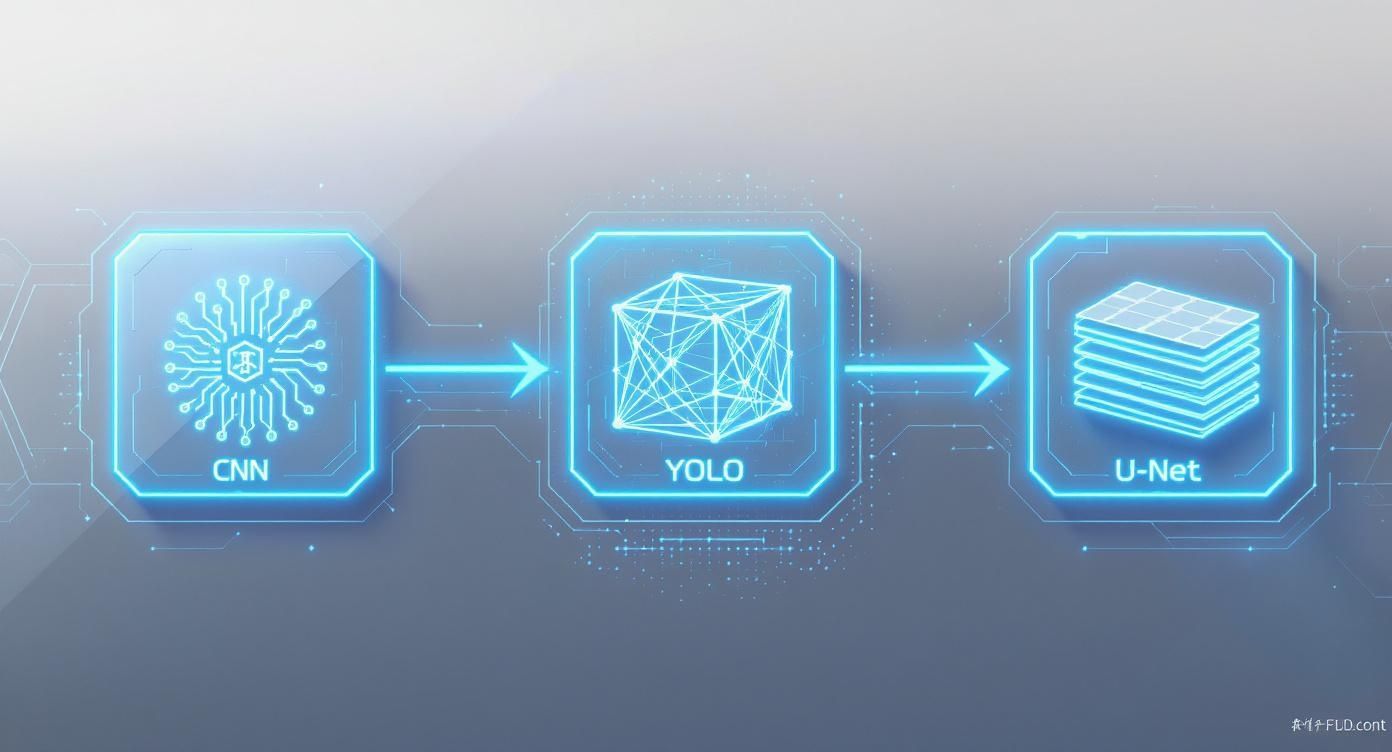
- Object Detection Models: The goal here is not just to know what is in an image, but also where it is. Algorithms like the YOLO (You Only Look Once) family are famous for their speed and efficiency. They can identify multiple objects in a single pass, drawing bounding boxes around each one and assigning a label. This is essential for practical applications like real-time inventory tracking in a warehouse or monitoring vehicles in traffic footage.
- Semantic Segmentation Models: These models offer the most granular analysis possible by classifying every single pixel in an image. An algorithm like U-Net, initially designed for biomedical imaging, assigns each pixel to a category (e.g., “road,” “building,” “sky”). This pixel-perfect understanding is vital for tasks demanding extreme precision, such as outlining tumors in medical scans or identifying exact road boundaries for autonomous vehicles. Our AI quality assurance processes are built to validate the outputs of these complex models.
Ultimately, choosing the right algorithm comes down to the business problem you are trying to solve. Simple classification may be sufficient for some tasks. But for more intricate challenges, you will need specialized models like YOLO or U-Net, powered by flawlessly annotated data, to achieve actionable results.
Building High-Performing Recognition Systems
Selecting a powerful image recognition algorithm is just one piece of the puzzle. A truly effective AI system is built on a solid foundation of high-quality data, disciplined training, and relentless evaluation. Without this groundwork, even the most sophisticated models will fail to deliver the reliable, scalable results your business needs.
It all begins with the data. Before you can even consider training, you need a large, diverse dataset that mirrors the real-world scenarios your model will encounter. This is where data annotation becomes the most critical step; it is the process of meticulously labeling that raw visual data to create the “answer key” the algorithm learns from.
This infographic illustrates how the complexity of common computer vision tasks increases, moving from simple classification to detailed segmentation. Each step up this ladder demands a higher degree of annotation precision.
As you can see, the required detail escalates quickly. This reinforces a critical point: your choice of algorithm and your annotation strategy must be perfectly aligned with your end goal.
The Critical Role of Precise Annotation
Data annotation is far more than just drawing boxes around objects. It demands a deep understanding of the project’s goals to ensure every single label is both accurate and consistent. The annotation technique you choose will directly influence your model’s performance.
- Bounding Boxes: Ideal for object detection tasks. These simple rectangles are used to locate and identify individual items, like products on a retail shelf or cars on a road.
- Polygons: When objects have irregular shapes, polygons provide far more precision by allowing annotators to trace the exact outline. This is non-negotiable for applications like medical imaging, where every boundary is critical.
- Semantic Segmentation: This is the most detailed approach. It involves labeling every pixel in an image and assigning each one to a class like “sky,” “road,” or “building.”
Inconsistency is the enemy of performance. If one annotator labels a feature as a “small crack” and another calls the same thing “minor damage,” the algorithm receives mixed signals. The result? Poor accuracy and unreliable predictions.
This is precisely why clear guidelines and a partnership with a skilled annotation team are so important. For more on what to look for, check out our guide on how to evaluate data annotation companies.
Training, Evaluating, and Scaling Your Model
Once you have a well-annotated dataset, the training can begin. A powerful shortcut called transfer learning is often used here. Instead of training a model from scratch, a process that consumes immense data and computing power, you start with a pre-trained model and simply fine-tune it on your specific dataset. This approach slashes development time and costs.
After the model is trained, its performance must be tested. Key metrics like precision (how many of its positive identifications were actually correct?) and recall (what percentage of the actual positives did it find?) provide a clear, honest picture of its effectiveness.
This entire lifecycle is enveloped in a robust AI Quality Assurance (QA) process. QA is not a one-time check; it is a continuous effort to monitor the model, identify areas for improvement, and retrain it with fresh data to prevent its performance from degrading over time. This constant loop of annotation, training, and evaluation is what keeps your image recognition system accurate and reliable as it scales, ensuring a measurable return on investment.
Choosing the Right Algorithm for Your Needs
Selecting the perfect image recognition algorithm is not about finding a single “best” model. It is about choosing the right tool for the job. The evolution from classic methods to modern Vision Transformers proves there is a specialized solution for nearly any visual task, and the key is matching its capabilities to your specific business problem.
Think about what you are trying to accomplish. Is it a straightforward classification task, like sorting products by category? A battle-tested CNN like ResNet delivers fantastic accuracy and efficiency. But what if you need to pinpoint multiple moving objects in a busy warehouse to track inventory? That is where an object detection model like YOLO shines with its blistering speed and precision.
Matching Models to Business Cases
The decision really boils down to a few practical questions. Before you commit to an architecture, run your project through this quick evaluation:
- What is the task? How much detail do you really need?
- Classification: A simple “yes/no” answer, like “Is this a defective part?” (Best for CNNs).
- Detection: Locating objects, like “Where are all the forklifts in this facility?” (A job for YOLO).
- Segmentation: Pinpointing exact areas, like “What is the precise square footage of this road damage?” (Perfect for U-Net).
- What data do you have? How much of it is there, and how varied is it? CNNs are great performers with moderately sized datasets, especially when you use transfer learning. Vision Transformers, on the other hand, typically need enormous amounts of data to pull ahead.
- What are your resource constraints? Be realistic about your budget and computing power. Training a massive, complex model from the ground up is expensive and time-consuming. For most businesses, fine-tuning a pre-trained model is a much smarter and more economical path.
- What does performance mean to you? Is it all about real-time speed, or is flawless accuracy the top priority? A security system needs to react instantly, while a medical diagnostic tool cannot afford to be wrong.
The most powerful algorithm in the world will fail if it is fed sloppy, ambiguous data. A model is only as good as the annotations it learns from.
This unbreakable link between your model and your data quality is the absolute cornerstone of any successful AI vision project. A semantic segmentation model, for instance, requires pixel-perfect annotations, a task that demands far more discipline than just drawing bounding boxes around objects.
This is exactly why a rock-solid data pipeline, supported by expert human-in-the-loop annotation and relentless quality assurance, is completely non-negotiable.
Ultimately, turning visual data into business results requires a complete strategy. It is about pairing the right algorithm with a data quality program that guarantees accuracy and consistency, no matter how much you scale. When you focus on getting that synergy right, you build reliable, high-performing systems that deliver real value.
A Few Final Questions
As you get deeper into the world of image recognition algorithms, a few practical questions always seem to pop up. Let’s tackle some of the most common ones to help you build a solid AI strategy from the ground up.
What’s the Single Most Important Thing in an Image Recognition Project?
While the algorithm gets all the attention, it is the quality of your training data that will make or break your project. It is the absolute foundation.
You could have the most powerful model in the world, but it will fail miserably if it’s trained on messy, inconsistent, or poorly labeled data. High-quality data annotation, where every image is labeled with precision and consistency, is what separates a reliable system from an unreliable one. This is why investing in professional data annotation and a strong AI quality assurance workflow is not just a good idea; it is essential for getting trustworthy results at scale.
Should I Use a CNN or a Vision Transformer?
The answer really comes down to your dataset size and how much computing power you have on hand. For most business applications, CNNs are the practical and proven choice. They perform exceptionally well on small to medium-sized datasets and are highly efficient. They are well-understood, robust, and a fantastic starting point for almost any project.
Vision Transformers (ViTs), on the other hand, are data-hungry. They need massive datasets to truly shine because they learn visual patterns completely from scratch. ViTs are best reserved for large-scale projects where you have a colossal amount of data and need to capture complex, long-range relationships within your images.
What Exactly Is Transfer Learning and Why Is It So Useful?
Think of transfer learning as giving your model a head start. Instead of training a model from zero, a process that takes huge amounts of data and time, you start with a model that has already been trained on a massive dataset like ImageNet. This pre-trained model already understands general visual features like edges, textures, and shapes.
From there, you just fine-tune this pre-trained model on your smaller, more specific dataset. This shortcut dramatically slashes training time and data requirements, making powerful AI accessible for countless business applications.
It is a game-changer because it allows companies to build high-performing models without the enormous cost and resources required to start from scratch. You get from concept to deployment much, much faster.
Ready to build a high-performing image recognition system powered by flawless data? The experts at Prudent Partners are here to help. We provide precision data annotation and robust AI quality assurance to ensure your models achieve their full potential and deliver measurable business impact.