
When you bring augmented reality and AI together, you create intelligent experiences that can see, understand, and interact with the world around you. This powerful fusion pushes AR far beyond simple visual overlays, turning it into a truly smart, context-aware technology that is already reshaping entire industries.
How AI Is Supercharging Augmented Reality
Think of Augmented Reality (AR) and Artificial Intelligence (AI) as a single, unified force. AR provides the "eyes," layering digital information onto your physical surroundings. But AI is the "brain" behind those eyes. It processes what you are seeing in real time and decides precisely what information to show you and why it matters in that exact moment.
This relationship fundamentally changes what AR can do. An AI powered AR system does not just display pre-loaded graphics. It can identify objects on the fly, understand spoken commands, and even generate new visuals instantly. This synergy unlocks sophisticated applications, from a technician seeing step by step repair instructions directly on a piece of machinery to a shopper virtually trying on clothes that perfectly conform to their body.
The Driving Force of Market Growth
The business world is taking this powerful combination seriously. The global AR market is seeing explosive growth, which is a clear sign of just how quickly it is being adopted across different sectors.
Valued at USD 31.97 billion in 2022, the market is projected to skyrocket to an incredible USD 599.59 billion by 2030. That is a compound annual growth rate (CAGR) of 37.9%.
This massive expansion is not just about cool new consumer gadgets. It represents a fundamental shift in how businesses handle everything from employee training and operations to customer engagement. As this technology becomes more common, understanding how augmented reality and AI work together is no longer just a good idea for business leaders; it is essential for staying competitive. You can dive deeper into how advanced AI systems process information with our guide to Retrieval Augmented Generation.
Why This Combination Is a Game Changer
Fusing AR and AI unlocks capabilities that neither technology could ever achieve on its own. For any organization, this translates into direct, measurable improvements in efficiency, accuracy, and the ability to scale.
Delivering the right data at the right time directly into an employee's line of sight or a customer's personal space creates entirely new ways to add value. This growth highlights just how important it is to have a solid strategy in place. You can learn more about the projected expansion of the AR market in the full research from MarketsandMarkets.
The Core Technologies Behind Intelligent AR

To really understand what makes augmented reality and AI click, you have to look under the hood. The magic is not just one thing; it is a tight-knit ecosystem of technologies. Each piece leans on the others to create those seamless, smart experiences that feel completely natural.
This tech stack is what elevates an AR app from a simple gimmick like placing a digital cartoon in your room to a powerful tool. It lets the system understand the room, recognize everything in it, and react intelligently as things change. The sophistication of these core components directly dictates how accurate, stable, and useful the final product will be.
Computer Vision: The Digital Eyes of AR
At the absolute heart of any smart AR system is computer vision. This is the branch of AI that trains machines to see and interpret the world just like we do. In short, computer vision gives an AR app the ability to make sense of whatever its camera is pointed at.
It works by finding patterns, objects, and even human gestures in a live video stream. For an AR app, this means it can spot a specific product on a store shelf, identify a piece of heavy machinery on a factory floor, or track a user’s hands to let them interact with virtual controls. This is the fundamental bridge between the physical world and the digital information you want to overlay on it.
Without solid computer vision, an AR system is basically blind. It cannot lock digital content onto real-world objects or serve up useful info based on what you are looking at. High-quality data is the fuel for this engine, a topic we dig into in our guide on the importance of quality AI training datasets.
SLAM: Mapping The World in Real Time
While computer vision identifies what’s in the world, Simultaneous Localization and Mapping (SLAM) gives an AR system its sense of where it is. SLAM algorithms are workhorses, doing two critical jobs at once: building a map of the physical environment and tracking the device's exact position within that map.
Think of SLAM as a tiny digital cartographer, constantly drawing a 3D map of your room while also pinning your location on it. This is what makes virtual objects stay “stuck” in place as you walk around them. It stops digital overlays from drifting or floating away, which is key for a stable and believable augmented experience.
This real-time spatial understanding is what separates professional-grade AR from simple camera filters. It allows for complex interactions where digital elements can realistically pop up behind real furniture or sit perfectly on a tabletop, behaving as if they’re truly part of the room.
Generative AI: The Creative Spark
If computer vision provides the eyes and SLAM provides the spatial awareness, Generative AI adds the creative brain. This technology lets AR systems generate brand-new content on the fly, moving way beyond static overlays to deliver dynamic, personalized experiences. Instead of just showing pre-made 3D models, generative AI can create them based on what a user asks for or what the environment needs.
For instance, a user in an interior design app could describe their preferred style, and a generative AI model could create unique furniture that fits the room’s exact dimensions and lighting. In a manufacturing setting, it could generate a custom, animated repair guide for a specific mechanical failure it just identified through computer vision.
Putting these technologies together creates a powerful feedback loop. Computer vision sees the world, SLAM maps it, and generative AI populates it with perfectly suited content. This synergy powers the next wave of truly intelligent augmented reality and AI applications, a dynamic explored in a recent AR and consumer experiences study by Snap Inc. and PMG.
Building the Data Foundation for AR and AI
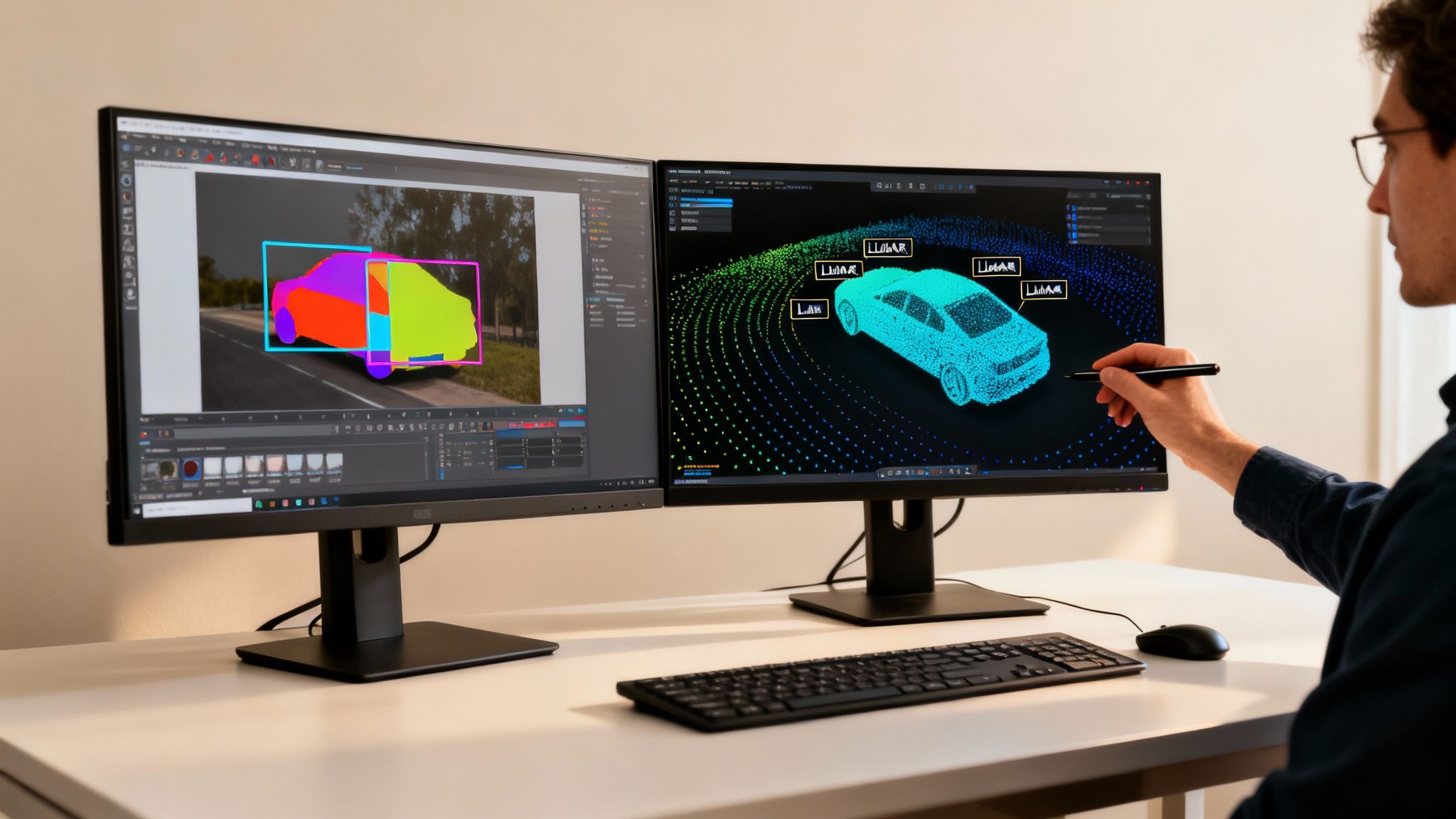
All the impressive technologies that bring augmented reality and AI to life depend on one thing: data. High-quality, meticulously labeled data is the bedrock on which every intelligent AR experience is built. Without it, even the most powerful algorithms for computer vision or SLAM simply cannot make sense of the real world.
Think of an AI model like an apprentice. To learn its craft, it needs clear, consistent, and accurate examples. Data annotation is the process of providing those examples by labeling raw data, essentially teaching the AI what to look for and how to understand it. This foundational work is non-negotiable for creating AR solutions that are accurate, reliable, and safe.
Image Annotation for Object Recognition
Image annotation is perhaps the most fundamental form of data labeling for AR. It is how we teach AI models to identify and classify objects in a visual field, a core skill for almost any AR application that interacts with a user's surroundings.
There are two primary techniques used here:
- Bounding Boxes: This method involves drawing rectangular boxes around objects. It’s an efficient way to show a model an object's location and general size, perfect for an AR retail application that needs to identify products on a shelf.
- Semantic Segmentation: This is a more detailed approach where every single pixel in an image is labeled according to the object class it belongs to. This creates a precise, pixel-perfect mask, which is critical for high-stakes applications like medical imaging.
For example, a surgical AR guide requires semantic segmentation to overlay a precise digital model of a patient’s organs during a procedure. The AI must know the exact boundary between a tumor and healthy tissue, a level of detail that only expert, pixel-level annotation can provide.
LiDAR Annotation for 3D Environmental Models
While cameras provide 2D images, Light Detection and Ranging (LiDAR) sensors capture rich 3D data by measuring distances with laser light. This creates a "point cloud." Annotating these dense 3D point clouds is essential for AR systems that need a deep understanding of physical spaces, such as those in autonomous vehicles or smart city planning.
LiDAR annotation involves classifying individual points or groups of points to identify objects like buildings, cars, pedestrians, and roads. This process lets the AI build a highly accurate, interactive 3D map of the environment.
A prime use case is in urban planning, where AR apps use annotated LiDAR data to visualize the impact of new construction. Planners can see exactly how a proposed building would cast shadows or affect traffic by interacting with a precise digital model of the city.
Text and Audio Annotation for Interactive Experiences
Modern AR experiences are increasingly interactive, responding to both typed text and spoken commands. This is made possible by Natural Language Processing (NLP) models trained on large volumes of annotated text and audio data.
Annotation for these data types often includes:
- Named Entity Recognition (NER): Identifying and tagging key pieces of information in text, like names, places, and organizations.
- Sentiment Analysis: Labeling text or speech with emotional tones, such as positive, negative, or neutral.
- Speech-to-Text Transcription: Converting spoken words into written text and then annotating specific keywords or phrases.
A practical example is an AR powered museum guide. When a visitor asks, "Tell me more about this painting," audio annotation ensures the system correctly transcribes the request. NER then helps the AI identify "this painting" by linking the command to the object the user is looking at, triggering the right informational overlay. The performance of these systems hinges entirely on the precision of the underlying AI training datasets.
Data Annotation Techniques For Augmented Reality Applications
To bring these AR applications to life, different types of data must be labeled with specific techniques. The table below breaks down the most common data types and the annotation methods required to train accurate AI models.
| Data Type | Annotation Technique | Primary Use Case in AR |
|---|---|---|
| 2D Images & Video | Bounding Boxes, Polygons, Semantic Segmentation, Keypoint Annotation | Object detection for retail, medical imaging overlays, gesture recognition |
| 3D LiDAR/Point Clouds | 3D Cuboids, Point Cloud Segmentation | Creating digital twins for smart cities, autonomous vehicle navigation |
| Text Data | Named Entity Recognition (NER), Sentiment Analysis, Text Classification | Contextual information overlays, interactive AR guides, brand monitoring |
| Audio Data | Transcription, Speaker Diarization, Emotion Recognition | Voice commands for hands-free control, real-time translation overlays |
Ultimately, the quality and accuracy of the annotation directly determine the intelligence and reliability of the final AR experience. Choosing the right technique for each data type is the first step toward building a system that users can trust.
A Look at AR and AI in the Real World
Theory is one thing, but the real impact of combining augmented reality and AI is seen in practical application. Across industries, this fusion is not just a concept; it is a practical tool delivering measurable gains in accuracy, safety, and efficiency. The success of these powerful applications comes down to the quality of the data used to train their AI models.
Whether in a surgeon's operating room or a customer's living room, the principle is the same. A well-trained AI can interpret the world with precision, which lets AR deliver the right information at exactly the right time. This direct line between meticulously annotated data and real-world performance is where the value truly lies.
Revolutionizing Healthcare with Surgical Precision
In the high-stakes world of healthcare, AI powered AR is becoming an indispensable tool in the operating room. Surgeons can now use AR overlays to project 3D models of a patient's organs, veins, or tumors directly onto their body during a procedure. This acts as a form of "X-ray vision," allowing them to see what lies beneath the skin without ever looking away from the patient.
This is the result of incredibly precise data annotation.
- Medical Image Segmentation: To build these 3D models, AI systems are trained on thousands of MRI and CT scans. In each scan, every single pixel of an organ or tumor has been painstakingly labeled. This semantic segmentation teaches the model the exact boundaries of complex anatomical structures.
- Enhanced Accuracy: Armed with this data, the AR system can overlay its digital twin with sub-millimeter accuracy. This helps surgeons navigate complex anatomies and avoid critical nerves or blood vessels. The outcome is a clear reduction in surgical errors and improved patient results.
The reliability of these life-saving tools is a direct reflection of the expert-level annotation behind them, illustrating how data quality translates directly into real-world safety and performance.
Transforming Retail with Immersive Customer Experiences
The retail industry is using the augmented reality and AI combination to close the gap between online browsing and in-store shopping. Virtual try-on technology is a powerful example, letting customers see how clothes, makeup, or furniture would look on them or in their homes before making a purchase.
An AI model analyzes the user's body shape or room dimensions through their smartphone camera. It then realistically drapes a digital version of the product into that live feed. For this experience to feel real, the product data must be flawless. Every item, from a handbag to a sofa, needs detailed annotation to teach the AI its shape, texture, and how it should behave in a 3D space. This commitment to data quality is proven to reduce return rates and significantly boost customer engagement.
This technology is quickly moving from novel to necessary, especially on mobile devices. The mobile augmented reality market is an incredibly dynamic space, with its market volume projected to grow from USD 49.59 billion in 2025 to an estimated USD 529.93 billion by 2034.
That kind of tenfold growth underscores the massive consumer appetite for these smart, interactive experiences. You can find more insights on this trend by reading about the future of AR for consumers from Emerline.
Building Smarter Cities with Geospatial Intelligence
For geospatial and smart city applications, augmented reality and AI offer a powerful new way to manage complex urban environments. By training AI models on annotated satellite, drone, and aerial imagery, city planners and utility managers can use AR to visualize infrastructure that is completely hidden from view.
A field technician can point their tablet at a street and see a perfect overlay of all the underground water pipes, electrical conduits, and fiber optic cables. This is only possible with precise annotation of geospatial data, where every asset is labeled with its exact location, type, and maintenance history. This capability prevents costly and dangerous mistakes during excavation and drastically speeds up repair work, making our cities safer and more efficient.
Your Roadmap to Successful AR Implementation
Embarking on an augmented reality and AI project is exciting, but a great idea is not enough. The difference between a proof-of-concept that stalls and a scalable solution that drives real business value is a clear, methodical roadmap. This journey does not start with code; it starts with data.
The entire process is a disciplined sequence, with each step building on the last. It is crucial to get everything right, from sourcing the right datasets to managing the practical realities of edge computing. Every stage has its own unique challenges that demand careful planning and expert execution.
This process flow shows how different industries move from an idea to a live application with AR and AI.
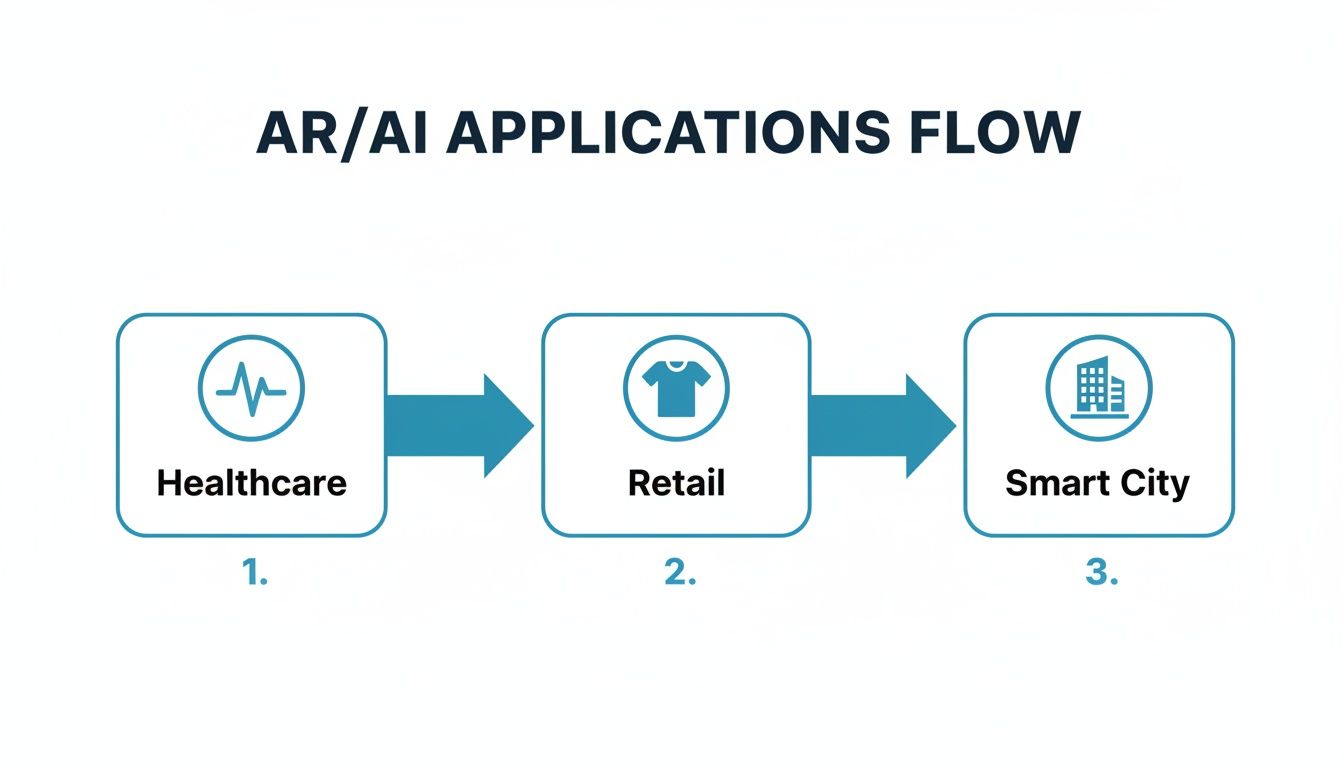
As the diagram shows, sectors as different as healthcare, retail, and urban planning all rely on a similar foundational process to bring their unique AR solutions to life.
Phase 1: Data Strategy and Collection
The first and most critical phase is defining your data strategy. This is where you determine exactly what your AI model needs to learn and identify the best sources for that information. Sourcing high-quality, relevant data is non-negotiable, as the model's performance will be a direct reflection of the data it is trained on.
Key actions in this phase include:
- Defining Data Requirements: Pinpoint the exact data types you need, whether 2D images, LiDAR point clouds, or audio clips.
- Sourcing and Collection: Gather data from ethical, reliable sources that accurately represent the real-world conditions the AR app will encounter.
- Establishing an Ontology: Create a clear, consistent set of definitions and rules for labeling to ensure every annotator applies tags uniformly. A solid ontology is the bedrock of model accuracy.
Phase 2: Annotation and Model Integration
Once you have a solid dataset, the focus shifts to meticulous annotation. This is where you transform raw data into structured information that an AI model can understand. The quality of this step directly shapes how reliable your AR application will be.
Next comes the technical integration of the trained AI model into the AR system. This connects the AI's "brain" to the AR's "eyes." Rigorous testing is required here to ensure the model performs exactly as expected within the app's framework.
Companies are moving fast on this. In fact, 75% of global brands are expected to adopt some form of AR or VR for marketing by 2026. Economists are forecasting that AR and VR could add USD 1.5 trillion to the global economy by 2030, creating around 23 million jobs worldwide. This growth is happening because of successful rollouts in verticals from healthcare to manufacturing. You can learn more about the global economic impact of AR on Statista.
Phase 3: Addressing Technical Hurdles
Even with a perfectly trained model, deploying it in the real world comes with technical challenges. The two biggest hurdles are usually latency and the limits of edge computing.
Latency, the delay between a user's action and the AR system's response, can completely ruin the experience. For an AR overlay to feel real, it must react instantly. That means optimizing the model to process data with almost zero delay.
This often means running models on edge devices like smartphones or smart glasses instead of relying on the cloud. Edge computing reduces latency but forces you to work with constraints on model size and power consumption. A successful roadmap must account for these trade-offs, balancing model complexity with on-device performance to deliver a smooth user experience. Underestimating data complexity or these technical limits is a common pitfall, but a strategic partner can help you navigate it and ensure your project launches successfully.
Bringing Your AR Projects to Life with Precision and Scale
Getting a pilot AR and AI project off the ground is one thing. Launching it successfully at scale is a completely different challenge. The true power of this technology is not just in the concept; it is in the execution, and that execution hinges entirely on the quality of the data feeding the system.
From model accuracy to the user’s final experience, every challenge can be traced back to the data. This is where having the right partner becomes a critical success factor. You need more than just smart algorithms; you need a battle-tested operational backbone built on precision data annotation and relentless Generative AI quality assurance.
The Foundation of Trust
In high-stakes environments like healthcare or public infrastructure, there is simply no margin for error. Reliability is not a feature; it is a prerequisite. This kind of dependability only comes from an obsessive commitment to accuracy and globally recognized standards.
With ISO certified processes and a 99%+ accuracy target, you build the trust necessary for users to rely on your AR application for critical tasks. This commitment ensures every annotated data point contributes to a safer, more predictable, and more effective experience.
From Ambitious Vision to High-Impact Reality
The gap between a brilliant AR vision and a reliable, high-impact product is bridged by managing immense data complexity. For an AR system to truly understand the world, it often requires pixel-perfect labeling. You can learn more about how we achieve this in our detailed guide on semantic image segmentation. It is this painstaking process that gives AI models the clarity they need for advanced, real-world applications.
Prudent Partners brings the specialized expertise and scalable workforce needed to handle high-volume annotation and QA. We deliver consistent quality, freeing up your internal teams to focus on what they do best: innovation. We take the operational headache of data management and turn it into your strategic advantage, helping you get to market faster and with less risk.
Ready to transform your AR concept into a dependable, scalable solution? Let's connect. Talk to our experts today for a custom consultation and see how our precision data services can deliver the accuracy your project demands.
Frequently Asked Questions About AR and AI
As more organizations explore the fusion of augmented reality and AI, a few critical questions consistently arise around implementation, quality, and overall strategy. Let's address the most common ones.
Getting these details right is the difference between an interesting concept and a high-impact application that people trust and use.
How Does Data Annotation Quality Impact the AR User Experience?
The link is direct and unforgiving. When you see digital objects jittering, floating in the wrong spot, or failing to recognize the real world, it is almost always a data quality problem. Think of the AI model as the engine in your AR system; your annotated data is its fuel.
High-quality annotation teaches the AI model to understand the physical world with pinpoint precision. This leads to stable, reliable, and genuinely helpful AR overlays that feel seamless. Conversely, even tiny inaccuracies in labeling can snowball, resulting in an app that feels broken and untrustworthy, which can kill user adoption before it even starts.
What Are the Biggest Hurdles When Integrating Generative AI into AR?
Bringing Generative AI into an AR system introduces a new set of challenges, primarily centered on content relevance and safety. The biggest hurdles are ensuring the AI-generated content is contextually appropriate, factually accurate, and free from harmful bias or AI "hallucinations."
For example, a generative AI in a retail AR app needs to produce helpful and accurate product descriptions, not fabricate information. One incorrect or inappropriate output can instantly erode user trust and tarnish your brand.
This demands a rigorous quality assurance framework with a human-in-the-loop process. Every output must be checked against strict guidelines to verify its safety and relevance before a user sees it. Robust QA is not a "nice-to-have"; it is an absolute necessity.
Why Is a Specialized Partner So Important for Scaling AR and AI Projects?
Moving an augmented reality and AI project from a small pilot to a full-scale deployment creates a mountain of data complexity and logistical challenges. The sheer volume of data needing annotation and quality checks can quickly overwhelm internal teams whose primary focus should be on core product innovation.
A specialized partner brings three essential elements to the table for success at scale:
- Proven Expertise: They already have certified processes and deep experience managing the complex data workflows specific to AR.
- A Scalable Workforce: They provide a trained, ready-to-go workforce that can handle massive volumes of data without compromising quality.
- Operational Efficiency: They manage the entire data pipeline, from annotation to QA, freeing up your team to focus on innovation.
By handling the intricate data operations, a partner de-risks the entire scaling process and helps you get to market faster. It turns the data management challenge into a strategic advantage, ensuring your ambitious AR vision becomes a dependable, high-impact reality.
Prudent Partners provides the expert annotation, rigorous quality assurance, and scalable support needed to turn your vision into a reliable, high-impact reality. Connect with our experts today to start a pilot and see how our tailored solutions can accelerate your project.