At its core, a video labeling service is about teaching computers how to see. It is the process of taking raw video and carefully marking up every object, movement, and interaction, frame by painstaking frame. This turns messy, unstructured footage into clean, organized data that an AI model can actually learn from.
Think of it as creating the ultimate study guide for your AI. Without it, the model is just guessing.
Why Your AI's Success Depends on High-Quality Video Labeling
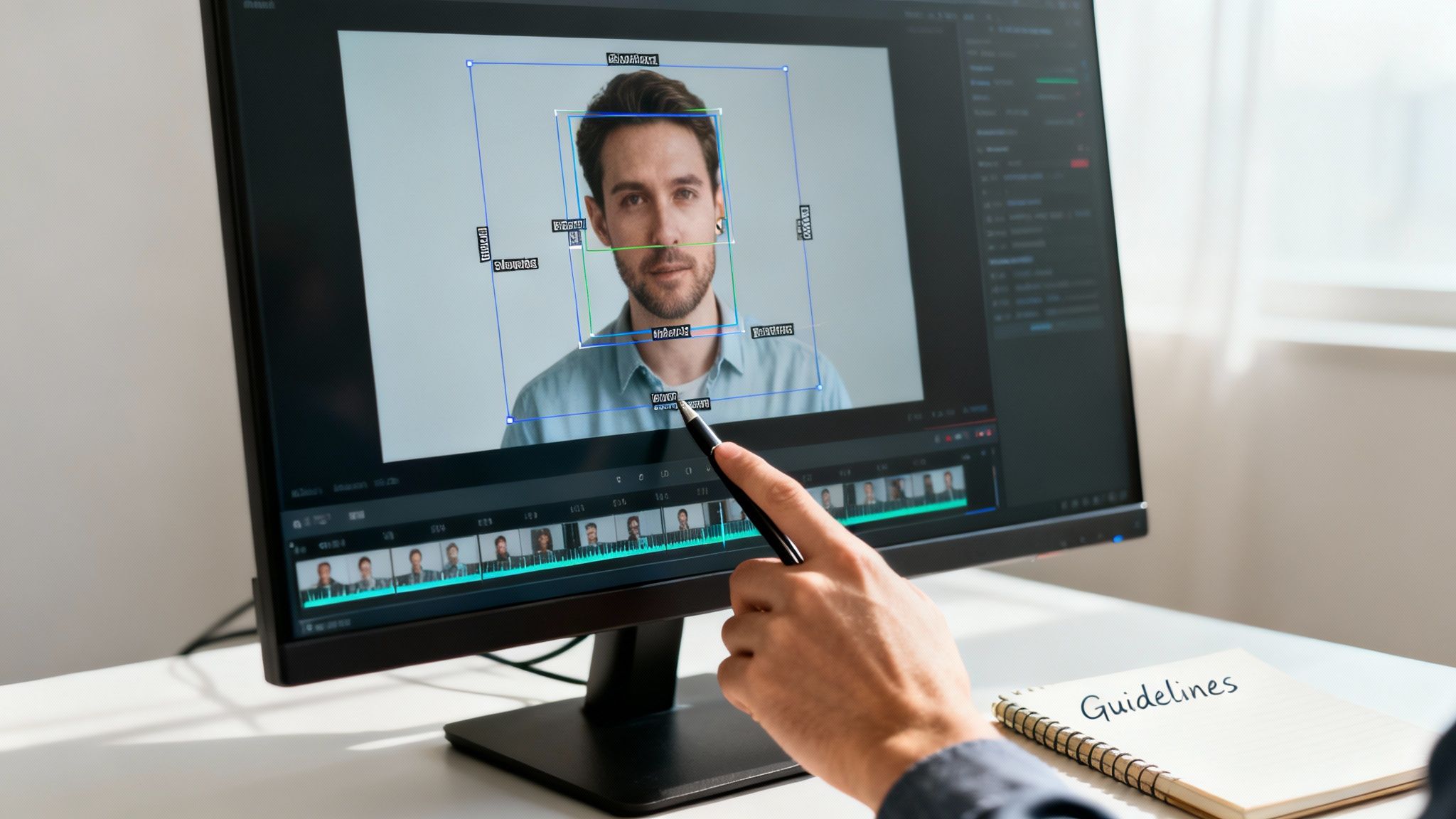
The old saying "garbage in, garbage out" has never been more true than in AI. The performance of any computer vision system is a direct reflection of the data it was trained on. Labeled video is like a detailed script for an actor; it provides the precise cues and context needed for a flawless performance. Poorly labeled data is like giving that actor a script full of typos and missing pages; the result will be confusing and unreliable.
A professional video labeling service does not just draw boxes on a screen. They act as a strategic partner, meticulously teaching your model to see the world with the same nuance a human does. This human touch is absolutely essential, as automated tools often miss the subtle details that separate one object from another in a chaotic, real-world scene.
The Foundation of Reliable AI Perception
High-quality video annotation is the bedrock of any AI you can actually trust. It transforms ambiguous visual chaos into the kind of structured data that powers game-changing applications.
- Autonomous Vehicles: Precisely labeled video helps a self-driving car tell the difference between a pedestrian, a cyclist, and a shadow, allowing it to navigate safely.
- Medical Diagnostics: In healthcare, annotations on an ultrasound video can train an AI to spot subtle anomalies that might be missed by the human eye.
- Retail Analytics: E-commerce and brick-and-mortar stores use labeled video to understand shopper behavior, keep tabs on inventory, and optimize layouts.
It is no surprise that this reliance on computer vision is fueling explosive growth. The image and video labeling market already makes up 37.5% of the entire data labeling industry, and the video annotation slice is growing at a massive 34% CAGR. This is not just a trend; it is a fundamental shift driven by the demand for accurate visual data.
Labeled video data is more than just information; it is the fundamental building block of perception in artificial intelligence. The quality of this foundation directly determines the safety, reliability, and effectiveness of the final AI system.
Ultimately, the goal is to build intelligent systems that can perceive and interact with the world reliably. That journey starts with giving them the best education possible, and that is exactly what a high-quality video labeling service delivers. By ensuring every frame is annotated with precision, you are setting the stage for AI you can depend on. This detailed annotation is a vital part of building powerful perception artificial intelligence models.
Core Video Annotation Techniques and When to Use Them
Picking the right video labeling service means knowing which annotation techniques they offer and, more importantly, which one your project actually needs. Think of it like a painter's toolkit; you would not use a broad brush for fine details. The method you choose directly shapes how well your AI model can spot objects, track their movement, and make sense of the world around it.
A true annotation partner does more than just draw boxes. They guide you to the most efficient and effective technique for your specific goals. It is a careful balance between getting the precision you need and keeping the project scalable and on budget.
Let’s break down the core methods that turn raw video into AI-ready intelligence.
Bounding Boxes: Simple and Scalable Object Detection
The most common starting point is the 2D bounding box. It is exactly what it sounds like: an annotator draws a simple rectangle around an object of interest in each frame. This method is fast, easy to execute, and perfect for projects where an object's general location and size are more important than its exact shape.
For instance, a retail AI might use bounding boxes to count items on a shelf or measure foot traffic in different aisles. The model does not need the perfect outline of every product, just a reliable way to know it is there.
- When to Use It: Object detection, general object tracking, and inventory management.
- Key Benefit: Extremely fast and cost-effective, making it ideal for massive datasets.
Cuboids: Adding Depth for 3D Perception
When your AI needs to understand an object’s volume and position in 3D space, you need 3D cuboids. Instead of a flat rectangle, annotators create a six-sided box that captures the object's full dimensions: length, width, and depth.
This is the bedrock of autonomous vehicle technology. A self-driving car must see other vehicles as solid, 3D objects to accurately predict their trajectory and avoid collisions. Cuboids provide that crucial spatial context.
Polygons: Precision for Irregular Shapes
Let us face it, most things in the real world do not fit into neat little boxes. For anything with a complex or irregular shape, polygon annotation is the answer. Annotators click a series of points to trace an object's exact outline, creating a highly precise mask.
This technique is a game-changer in medical AI, where a model might need to identify the precise border of a tumor in an ultrasound video. The accuracy of that polygon directly impacts the reliability of the entire diagnostic system. You can explore more about the different types of annotation and see how they apply across other data formats.
Semantic Segmentation: Pixel-Perfect Scene Understanding
For the absolute highest level of detail, there is semantic segmentation. This technique is meticulous, assigning every single pixel in a video frame to a specific class, like "road," "sky," "building," or "pedestrian."
Instead of just identifying objects, you get a complete, color-coded map of the entire scene. This is vital for environmental AI analyzing land use from satellite footage or for advanced driver-assistance systems that need to understand the entire driving environment, not just the cars in it.
Semantic segmentation moves beyond identifying individual objects to creating a comprehensive, contextual understanding of the entire visual scene. It is the difference between knowing a car is on the road and understanding the exact boundaries of the road itself.
Skeleton Annotation: Understanding Human Movement
To teach an AI about human motion and behavior, you need skeleton annotation, also known as pose estimation. This involves placing key points on major joints, elbows, knees, shoulders, hips, and connecting them to form a digital "stick figure."
This is the technology behind everything from professional sports analytics, where it refines an athlete's form, to ergonomic safety checks in a factory. The focus shifts from what an object is to what it is doing.
Choosing the Right Video Annotation Technique
Each of these methods unlocks a different AI capability. The key is matching the technique to your specific goal to avoid over-engineering your data or, worse, failing to capture the information your model needs.
| Annotation Technique | Primary Use Case | AI Capability Unlocked | Best For |
|---|---|---|---|
| Bounding Box | Object detection and counting | Basic object recognition and location | Large-scale projects where speed and cost are priorities. |
| 3D Cuboid | Autonomous driving, robotics | 3D perception, depth estimation | AI that needs to understand an object's volume and spatial orientation. |
| Polygon | Medical imaging, satellite imagery | Precise object segmentation | Datasets with irregular or complex object shapes requiring high accuracy. |
| Semantic Segmentation | Environmental analysis, ADAS | Full scene understanding | Applications needing a pixel-perfect map of an entire environment. |
| Skeleton Annotation | Sports analytics, ergonomics | Human pose estimation, activity recognition | AI focused on analyzing human movement, gestures, and actions. |
Ultimately, selecting the right technique is not just a technical choice; it is the first and most critical step in building a powerful, accurate, and reliable AI model.
Inside a Professional Video Labeling Workflow
What really separates a decent video labeling service from a great one? It is not just about speed; it is about having a structured, transparent, and repeatable workflow. A proven process gets rid of guesswork, slashes error rates, and guarantees the final dataset actually aligns with what your AI model needs to learn. It transforms a messy, complicated task into a smooth, reliable partnership.
This whole process kicks off long before anyone even thinks about annotating the first frame. It starts with a deep dive into your project goals to make sure everyone is on the same page. From there, it unfolds in stages, with quality checks baked into every single step.
This diagram shows how different annotation techniques, from simple bounding boxes to more complex polygons and skeleton tracking, fit into the bigger picture.
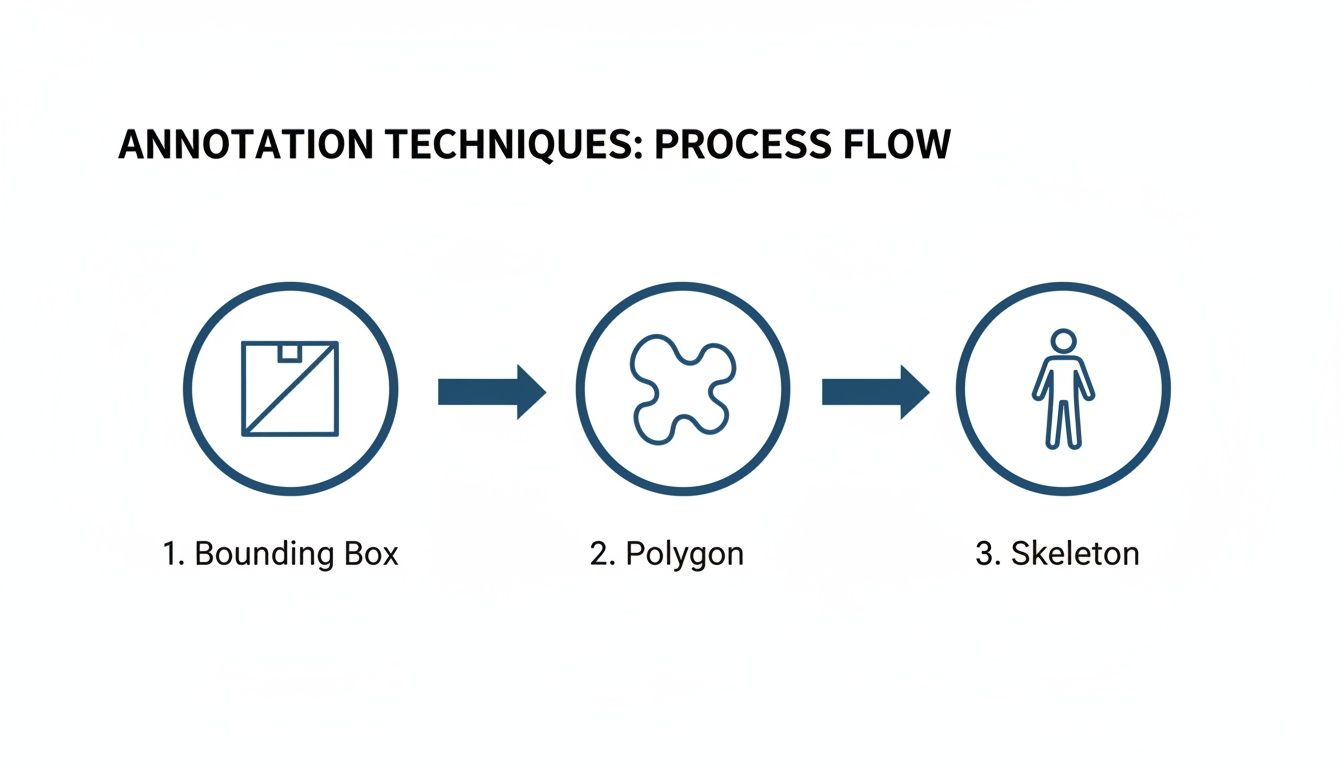
As you can see, the technique you choose depends entirely on the level of detail you need, which directly shapes what your finished AI model can do.
Kicking Off the Project and Defining Guidelines
Believe it or not, the most important part of any video labeling project happens right at the start. During the project kickoff, a dedicated project manager sits down with your team to nail down every last detail. This is not just a high-level chat about what to label; it is about building crystal-clear annotation guidelines that leave zero room for interpretation.
Think of these guidelines as the project's constitution. They cover critical details like:
- Object Classes: What exactly makes someone a "pedestrian" versus a "cyclist"? What about edge cases, like a person walking their bike?
- Occlusion Rules: How should an annotator label an object when it is partially hidden behind a tree or another car?
- Annotation Consistency: Making absolutely sure that a specific vehicle is labeled with the same unique ID across hundreds of video frames.
Getting this alignment right from the beginning prevents massive headaches and costly rework down the line. This is also why most projects start with a small pilot phase; a small batch of data is annotated and reviewed, allowing everyone to fine-tune the guidelines before scaling up.
The Core Annotation and Multi-Stage QA Process
Once the guidelines are locked in, the real work begins. Trained human annotators get to work, meticulously applying the rules frame-by-frame with specialized tools. But here is where a professional service truly shows its value: the rigorous, multi-stage Quality Assurance (QA) pipeline that follows.
This is not a quick, one-and-done check. A mature QA process has multiple layers of review designed to systematically catch and correct errors.
A robust QA pipeline is the immune system of a data annotation project. It proactively identifies and neutralizes errors, ensuring the health and integrity of the final dataset and preventing flawed data from 'infecting' the AI model.
A typical workflow includes several key checkpoints:
- Peer Review (Consensus): A second annotator reviews the work of the first. If they disagree on a label, a senior annotator steps in to make the final call. This keeps the entire team consistent.
- Expert Audit: A subject-matter expert or a lead annotator runs random spot checks on a percentage of the labeled data. They are looking for those subtle, nuanced errors that a standard review might miss.
- Systematic Checks: Automated scripts are often used to flag common logical mistakes, like a label ID that suddenly disappears and reappears, or a bounding box that changes size erratically between frames.
Ensuring Scalability and Clear Communication
Finally, a mature operation is built to scale. That means having the project management backbone, a trained workforce, and the right tech to handle huge volumes of data without ever letting quality slip. The glue holding it all together? Clear, constant communication.
You should expect regular reports on key metrics like accuracy rates, team throughput, and project timelines. This gives you complete transparency, so you always know exactly where your project stands and can be confident that the video labeling service is delivering on its promises. Evaluating these processes is a core part of any thorough data annotation assessment when you are choosing a partner.
How Top Services Handle Data Security and Compliance
When you are dealing with proprietary technology, personal information, or sensitive scenarios in your video data, security is not just a feature, it is everything. A top-tier video labeling service understands this completely. They build data protection into the very foundation of their operations, not just as a final checkbox. This commitment is far more than simple password protection; it is a complete framework of certifications, protocols, and physical safeguards built to defend your intellectual property from every angle.
Choosing a partner is an act of trust. You are handing over valuable assets, and you need absolute certainty they will be handled with the highest level of care. This is where internationally recognized standards become the clearest signals of a provider's maturity and reliability.

Understanding Key Security Certifications
Certifications are not just badges to display on a website. They are proof of a rigorous, audited commitment to operational excellence and security. They tell you that a company has invested serious time and resources into building systems that meet global benchmarks.
Two of the most important standards to look for are:
- ISO/IEC 27001 (Information Security): This is the gold standard. A provider with this certification has proven they have a systematic approach to managing sensitive information, ensuring its confidentiality, integrity, and availability. It covers everything from risk assessment and access control to business continuity planning.
- ISO 9001 (Quality Management): While not strictly a security standard, this one is just as important. It demonstrates a commitment to consistent, high-quality processes. This has a direct impact on security because well-defined workflows minimize the risk of human error that could lead to data breaches or mishandling.
These certifications provide a verifiable baseline of trust. They show that a partner’s security practices are not just self-proclaimed but have been validated by an outside party.
Adhering to Industry-Specific Regulations
Beyond general security standards, many industries have their own strict compliance rules. A professional video labeling service must be equipped to handle them. Take healthcare, for example, where any video data containing patient information is protected under the Health Insurance Portability and Accountability Act (HIPAA).
A HIPAA-compliant partner will have strict protocols for de-identifying data, controlling who can see it, and ensuring every annotator has gone through specialized training. This is how sensitive medical data can be used to train life-saving AI models without ever compromising patient privacy.
For any project involving sensitive data, an airtight Non-Disclosure Agreement (NDA) is the foundational legal document. It formally binds the service provider to strict confidentiality, providing legal recourse and peace of mind that your intellectual property is protected.
Operational Security in Practice
Certifications and legal agreements are essential, but they have to be backed up by real, day-to-day security measures. A secure provider implements a multi-layered defense to protect your data from the moment they receive it until the project is complete.
This typically includes:
- Secure Data Transfer: Using encrypted protocols like SFTP or dedicated VPNs to make sure data is protected while it is in transit between your systems and theirs.
- Strict Access Controls: Implementing role-based access so annotators can only view the specific data assigned to them, preventing any unauthorized exposure.
- Physically Secured Facilities: Operating from buildings with controlled entry points, surveillance systems, and clean desk policies to prevent any physical data theft.
- Network Security: Maintaining secure, isolated networks for annotation work that are completely separate from public internet access, which minimizes external threats.
By combining internationally recognized certifications with robust operational safeguards, a professional video labeling service creates a secure environment where you can innovate with confidence.
Decoding Pricing Models and Service Level Agreements
Figuring out the cost of a video labeling service is about more than just the sticker price. It is about making a smart investment. The right pricing model fits your project’s scope and budget, while a solid Service Level Agreement (SLA) guarantees you get the quality you are paying for. You have to look past the initial quote to understand the real value.
Lots of things play into the final cost. The complexity of the annotation is a big one; a simple bounding box costs far less than intricate semantic segmentation. The video's resolution and length matter too, as does the required accuracy. A project demanding 99% accuracy will naturally need a more rigorous QA process than one that is fine with 95%.
Common Pricing Structures Explained
When you get a quote from a video labeling service, it will likely use one of a few common models. Each has its pros and cons, and one might be a better fit for your project than another.
- Per Hour: You pay for every hour an annotator works on your project. This model is transparent and great for projects where the requirements might change. The downside? It can be tough to predict the total cost upfront.
- Per Frame or Per Video: You are billed for each frame or video file annotated. This gives you predictable costs, making it perfect for large-volume projects with a clearly defined scope.
- Per Project (Fixed Price): You agree on a total price for the entire project from the start. This is ideal for well-defined, one-off projects because it completely removes any budget surprises.
The Importance of a Robust Service Level Agreement
While the price tells you what you will pay, the Service Level Agreement (SLA) tells you what you will get. Think of it as a formal contract that defines the standard of service, sets clear expectations, and gives you a path forward if those standards are not met. Without a detailed SLA, you are flying blind.
A strong SLA transforms a vendor relationship into a true partnership. It is the written commitment to quality, security, and timeliness that gives you the confidence to build your AI models on the data provided.
A comprehensive SLA should always spell out the metrics for a few key areas.
- Accuracy Guarantees: The SLA must specify the minimum acceptable accuracy, like 99% or higher, and detail exactly how it will be measured and confirmed.
- Turnaround Times: It needs to set clear deadlines for deliverables, whether you are getting daily batches or waiting for the final project. This keeps your timeline on track.
- Data Security and Confidentiality: The agreement must outline all security protocols, such as following ISO/IEC 27001, and confirm that all work is protected by a strict Non-Disclosure Agreement (NDA).
By carefully reviewing both the pricing model and the SLA, you can choose a video labeling service that delivers not just data, but dependable value and a solid foundation for your AI goals. This is a core part of our business process management philosophy.
A Practical Checklist for Choosing Your Annotation Partner
Picking the right video labeling service is not just another vendor decision; it directly impacts how well your AI model performs and whether your entire project succeeds. A real partner does more than just draw boxes on a screen; they become an extension of your team, bringing the expertise, reliability, and security you need to turn raw video into a high-value asset.
To make a smart choice, you need a clear framework. This checklist boils down the key criteria into a practical guide. Use it to vet potential partners and find a service that meets your technical needs and aligns with your long-term goals. The right choice creates a foundation of trust and quality for your whole AI initiative.
Foundational Expertise and Proven Experience
First things first: confirm the provider has a real track record in your specific world. Generic annotation experience just does not cut it. You need a partner who gets the unique challenges of your industry, whether that is spotting tiny defects in manufacturing footage or tracking complex human movements in a clinical setting.
- Industry Specialization: Do they have case studies or testimonials from clients in your field? Ask for examples in autonomous vehicles, medical imaging, or retail analytics, whatever applies to you.
- Technical Proficiency: Can they have an intelligent conversation about the best annotation techniques for your use case? They should be able to advise you on when to use bounding boxes versus polygons or full segmentation.
- Problem-Solving Skills: Ask them to walk you through a complex annotation challenge they have solved for another client. This cuts through the sales pitch and reveals their practical, real-world expertise.
Rigorous Quality Assurance and Accuracy Guarantees
Quality is the one thing you cannot compromise on. A provider’s commitment to accuracy needs to be baked into their workflow from the start, not just bolted on as a final check. You need to dig into the details of their QA process to see how they systematically prevent and fix errors.
The quality of your labeled data is a direct predictor of your AI model's performance in the real world. A partner's QA process is not just an operational detail; it is the core mechanism that ensures your investment pays off.
Look for a process with multiple layers:
- Consensus Review: Does their workflow involve multiple annotators checking the same data? This is key to ensuring consistency and rooting out subjective bias.
- Expert Audits: Do they have senior or specialized annotators who perform regular, random checks to catch the kind of subtle errors that less experienced teams might miss?
- Measurable Metrics: How do they actually define and measure accuracy? This should be spelled out clearly in the Service Level Agreement (SLA) with a guaranteed accuracy rate, like 99% or higher.
Security, Compliance, and Scalability
Your data is an incredibly valuable asset, and protecting it has to be a top priority. A trustworthy partner must have rock-solid security protocols and the infrastructure to grow with you. This is where official certifications and security practices separate the pros from the amateurs.
- Certifications: Do they hold key industry certifications like ISO/IEC 27001 for information security and ISO 9001 for quality management? These are not just logos; they are proof of commitment.
- Compliance: Can they meet industry-specific regulations? If you are handling sensitive medical data, for example, HIPAA compliance is non-negotiable.
- Scalability: Do they have the workforce and project management muscle to handle more data as your project grows, without letting quality or deadlines slip? This is where having access to a dedicated virtual assistant services team can be a huge asset for keeping projects on track.
Transparent Communication and Flexible Engagement
Finally, a great partnership is built on clear communication and a willingness to be flexible. The provider should be happy to start with a pilot project, which lets you test their process, quality, and communication style before you sign a long-term contract.
With the global Data Collection and Labeling Market projected to hit USD 17.10 billion by 2030, finding a reliable, long-term partner is more critical than ever. You can dig into these market projections and read the full research from Grand View Research. A partner who is transparent and easy to work with from day one is the one you want for the long haul.
Common Questions About Video Labeling
Choosing a video labeling partner is a big decision, and it is smart to have questions. Here are a few of the most common ones we hear, with straightforward answers to help you feel confident about moving forward.
How Do You Guarantee Annotation Accuracy?
For us, accuracy is not just a goal; it is the entire foundation of our work. We guarantee it with a multi-layered Quality Assurance (QA) system that is much more than a final check.
Every annotation goes through multiple reviews, including consensus checks where a second annotator validates the first person’s work. On top of that, a senior annotator conducts random audits to catch subtle errors. We lock in a minimum accuracy target, often 99% or higher, right in our Service Level Agreement (SLA).
What’s a Realistic Turnaround Time for a Project?
Turnaround really comes down to three things: complexity, volume, and team size. Drawing simple bounding boxes on a 10-minute video is worlds away from performing pixel-perfect semantic segmentation on hours of high-resolution footage.
In our first conversation, we will dig into your exact needs to map out a realistic timeline. From there, we build a dedicated annotation team perfectly sized for your project, so we hit your deadlines without ever cutting corners on quality.
Think of project turnaround as a balance. By transparently discussing complexity and volume upfront, we can build a dedicated team that is perfectly sized to deliver high-quality data precisely when you need it.
How Do You Handle Sensitive or Confidential Video Data?
Protecting your data is our absolute highest priority. As an ISO/IEC 27001 certified provider, we operate under strict, internationally recognized security protocols. This is not just a piece of paper; it means your data lives within a secure infrastructure with encrypted transfers, role-based access controls, and physically secured facilities.
Every project is also backed by a comprehensive Non-Disclosure Agreement (NDA), giving you a legal guarantee of confidentiality. For specialized fields like healthcare, we are fully prepared to meet specific regulations like HIPAA, ensuring total compliance and peace of mind.
How Can I Start a Pilot Project?
Getting started is simple. We believe the best partnerships kick off with a pilot project. It is a low-commitment way for you to see our process, communication, and quality firsthand.
Here’s how it works:
- Initial Consultation: We meet to understand your goals and nail down clear annotation guidelines.
- Sample Data Annotation: You send over a small batch of video, and we get to work, annotating it based on the rules we established.
- Review and Feedback: We deliver the labeled data for your review. Your feedback helps us fine-tune everything before we scale up.
This approach makes sure we are perfectly aligned and builds a solid foundation for a successful long-term partnership.
Ready to see how a professional video labeling service can accelerate your AI development with unmatched accuracy and security? Prudent Partners can build a dedicated team to meet your exact needs, demonstrating our expertise in data annotation and AI quality assurance.
Contact us today to schedule your complimentary pilot project.