When you have a massive amount of raw data like images, text, or audio files, it's like having a library filled with millions of untitled, unsorted books. An AI model, like a new librarian, has no idea what to do with it all. Data annotation is the process of putting a clear label on every single one of those books, giving it a title, author, and genre so it becomes a useful, organized resource.
Simply put, data annotation outsourcing services are the expert teams you bring in to do that critical labeling work for you. This partnership takes the incredibly time consuming and often tedious task of labeling off your data scientists' plates, freeing them up to focus on what really matters: building and refining the algorithms that drive your business forward.
What Exactly Are Data Annotation Outsourcing Services?
Think of it this way: instead of your highly paid engineers spending their days drawing boxes around cars in thousands of images, they can focus on perfecting the self driving algorithm itself. The labeling is handled by a dedicated workforce skilled in delivering precision and consistency at a massive scale.

This strategic move transforms a major operational bottleneck into a competitive advantage, letting you scale your AI initiatives without the headache and overhead of building and managing a huge in house labeling team.
The Core Function of an Annotation Partner
At its heart, outsourcing this work is about injecting structure and meaning into your data. A professional partner like Prudent Partners doesn't just label stuff. They bring a disciplined, systematic approach to the entire process.
This is a comprehensive service that includes much more than just the labeling itself.
To give you a clearer picture, here’s a breakdown of what a full service data annotation partner actually does.
Key Components of Data Annotation Outsourcing
A quick look at the core elements that define a comprehensive data annotation outsourcing service, helping you understand the full scope of what's involved.
| Service Component | Description | Impact on AI Projects |
|---|---|---|
| Project Scoping & Guideline Creation | They work with you to define crystal clear labeling rules and project goals. | Well defined annotation guidelines are the bedrock of any successful AI project. |
| Workforce Management & Training | They deploy trained, vetted annotators with the specific skills needed for your data type, from medical imagery to legal text. | You get domain experts on day one without having to hire or train them yourself. |
| Quality Assurance (QA) Layers | Multiple review processes are put in place to ensure the labeled data meets or exceeds accuracy targets, often hitting 99%. | High quality data prevents costly model rework and ensures reliable AI performance. |
| Technology & Tooling | They use specialized software and platforms to streamline workflows, boost annotator efficiency, and lock down data security. | This speeds up timelines and protects your sensitive intellectual property. |
These components work together to ensure that the final dataset isn't just labeled, but is accurate, consistent, and ready to power a high performing AI model.
The real value of outsourcing data annotation is turning a slow, manual chore into a fast, scalable engine for your AI development. It’s about building momentum, not getting bogged down.
Ultimately, these services are the fuel that makes modern machine learning run. By taking your raw, unstructured data and turning it into meticulously labeled training sets, a dedicated partner directly accelerates your entire AI lifecycle. This ensures your models are built on a foundation of quality from the very beginning.
The Strategic Edge of Outsourcing Your Data Annotation
So, we know what data annotation is. But the real question is, how does it give you a strategic edge? When you bring in a specialized provider for data annotation outsourcing services, you’re doing more than just offloading a task. You’re gaining a powerful ally to accelerate your entire AI development cycle.
The decision to outsource really comes down to three strategic pillars: massive scalability, significant cost efficiency, and instant access to specialized expertise. This approach helps you sidestep the common operational bottlenecks that can derail even the most promising AI projects.

Unlocking Massive Scalability on Demand
Let’s say your autonomous vehicle project needs millions of images labeled with precise bounding boxes and semantic segmentation. Building an in house team to handle that volume is a monumental effort. It means recruiting, training, and managing hundreds, if not thousands, of people.
An outsourcing partner like Prudent Partners already has this infrastructure locked and loaded. We can deploy a large, trained workforce almost instantly, letting you ramp up or down based on what your project demands. This kind of elasticity is crucial for agile development and ensures your data pipeline never holds back your innovation.
Achieving Significant Cost Efficiency
Building an annotation team in house, especially in high cost regions, is expensive. It’s not just about salaries. You have to factor in overheads like benefits, office space, software licenses, and management. Outsourcing turns these high fixed costs into a predictable, variable expense.
The financial upside is huge. The global data annotation outsourcing market is growing at a blistering pace, projected to hit USD 3.6 billion by 2031 at a CAGR of 33.2%. A huge driver is cost effectiveness. Companies can save up to 60-70% on operational overhead compared to building teams in the US or Europe. That’s capital you can pump back into core research and development.
Outsourcing isn't just about cutting costs; it's about optimizing them. It lets you invest your money and your people where they create the most value: on your core algorithms and product development.
This strategic shift is what separates market leaders from everyone else. You stop managing a labor intensive process and start driving real technological breakthroughs.
Accessing Specialized Expertise Instantly
Some AI applications require deep domain knowledge that’s incredibly hard to find and cultivate internally. Think about it:
- Medical AI: Labeling medical images like prenatal ultrasounds or CT scans isn’t a job for just anyone. You need annotators who understand anatomy and pathology to ensure HIPAA compliance and diagnostic accuracy.
- Autonomous Systems: Making sense of complex LiDAR point cloud data for self driving cars requires expertise in 3D sensor data and a keen eye for spotting objects in cluttered scenes.
- Financial AI: Analyzing financial documents for sentiment or entity extraction demands familiarity with industry specific jargon and regulations.
A specialized partner brings a team that's already trained in these niche areas. This immediate access to expertise ensures your data is labeled not just correctly, but with the contextual understanding needed for a high performing model. They also come ready with proficiency across a wide range of specialized data labeling tools, guaranteeing efficiency and precision no matter the data type.
By bringing in an outsourcing partner, you gain a strategic edge that gets your product to market faster. You get the scale you need, the cost savings you want, and the expertise required to build a truly exceptional AI product.
How Data Annotation Drives Real-World Innovation
It’s one thing to talk about data annotation in theory, but its true power becomes clear when you see it in action. High quality, meticulously labeled data is the invisible engine behind some of the most advanced AI applications changing our world. This is where the abstract concept of "training a model" gets real and delivers tangible impact.
This isn't just about drawing boxes on images. It's about teaching an AI to understand context, nuance, and the complexities of human environments. From saving lives in hospitals to making your online shopping cart smarter, the fingerprints of expert annotation are everywhere.

Revolutionizing Healthcare with Precision Labeling
In the medical field, there’s zero room for error. AI diagnostic tools must perform with near perfect accuracy, and that high standard starts with the data they’re trained on. This is where specialized data annotation becomes absolutely critical.
Take prenatal diagnostics, for example. AI models are now being built to spot potential anomalies in ultrasound scans far earlier than the human eye can. For that to work, the model needs to learn from thousands of images where every single anatomical feature is labeled with pixel perfect precision.
This is much more than simple object detection. It requires annotators with deep domain expertise to perform semantic segmentation, outlining the exact shape of organs and tissues and classifying them correctly. A skilled outsourcing partner guarantees this process is handled with the right medical understanding and attention to detail, consistently achieving over 99% accuracy. The impact? Radiologists get a powerful assistant, diagnostic times shrink, and earlier interventions improve patient outcomes.
Powering E-commerce and Retail Experiences
In the hyper competitive world of e commerce, a seamless customer experience is everything. Data annotation is the unsung hero that creates intuitive search functions, personalized recommendations, and efficient inventory management.
Imagine an online fashion retailer with a catalog of millions of products. To power a smart recommendation engine, each item has to be tagged with dozens of attributes.
- Product Categorization: Is it a "women's V-neck cotton sweater"?
- Attribute Tagging: What’s the sleeve length, color, pattern, and style?
- Visual Search: Can a customer upload a photo to find similar items?
An expert annotation team can process massive product catalogs with incredible speed and consistency. This high quality data ensures that when a customer searches for a "blue floral summer dress," the results are spot on. The direct results are happier customers, higher conversion rates, and a healthier bottom line. This measurable business impact demonstrates how expert annotation services directly translate to revenue growth.
The precision of data labeling directly correlates with the reliability of your AI model. In sectors like healthcare or e-commerce, this precision is not a luxury; it is the foundation of a successful and trustworthy system.
Advancing Geospatial and Environmental Intelligence
From precision agriculture to modern urban planning, geospatial AI is changing how we monitor and manage our planet. The technology leans heavily on accurately annotated satellite and aerial imagery to identify objects, track changes over time, and assess environmental risks.
A classic use case is asset monitoring for an energy company. Annotators might be tasked with identifying and mapping thousands of miles of pipelines or pinpointing specific infrastructure in high resolution satellite photos. Another powerful application is environmental risk assessment, where AI models trained on labeled data can detect early signs of deforestation, monitor flood plains, or track the impact of climate change.
These tasks demand meticulous polygon annotation and semantic segmentation to create detailed, machine readable maps. This empowers organizations to make proactive decisions, protect valuable assets, and respond more effectively to environmental challenges.
Shaping the Future with Generative AI Quality Assurance
The explosion of Generative AI has created a new and critical need for human oversight. While models can generate impressive text, images, and code, their outputs often require validation to ensure they are accurate, safe, and aligned with a brand’s voice.
This is where Reinforcement Learning from Human Feedback (RLHF) comes into play. Skilled human annotators review and rank AI generated responses, providing the crucial feedback loop that refines a model’s performance. The demand for these services is a major driver of the market’s explosive growth, with industry analysts forecasting the data annotation outsourcing service market will surge from USD 1.19 billion in 2025 to USD 9.94 billion by 2034. You can read the full research on this global trend. This human in the loop process is absolutely essential for building public trust in generative technologies.
Building a Fortress Around Your Data
Handing over your proprietary data to an external partner can feel like a big leap of faith. And it should. In a world where data is one of your most valuable assets, security and compliance aren’t just checkboxes. They're the foundation of a trustworthy partnership.
When you engage with data annotation outsourcing services, you're not just buying labels. You're entrusting a vendor with sensitive information that could include intellectual property, customer data, or regulated medical records. A professional outsourcing provider gets this. They build a fortress around your data from day one.
Non-Negotiable Certifications and Standards
So, how can you be sure a vendor is serious about security? Look for internationally recognized certifications. These aren't just badges to put on a website; they represent rigorous, third party audits of a company's processes. They prove a robust information security management system is actually in place.
Two of the most critical certifications to look for are:
- ISO/IEC 27001: This is the gold standard for information security management. It ensures a provider has systematic controls for handling sensitive information so it stays secure, covering everything from risk assessment to incident management.
- ISO 9001: This one focuses on Quality Management Systems. While not purely a security standard, it demonstrates a commitment to process consistency and quality, both essential for maintaining secure and reliable workflows. A partner like Prudent Partners holds both, signaling a deep commitment to operational excellence.
Practical Safeguards in Action
Certifications provide the framework, but day to day security comes down to practical, enforceable measures. A top tier vendor will have a whole set of safeguards designed to protect your data from unauthorized access, period.
This starts with ironclad Non-Disclosure Agreements (NDAs) signed by every single employee who even comes close to your project. But legal papers are just the beginning. The operational environment itself has to be locked down.
A true partner treats your data with the same care you do. Their security measures should be transparent, verifiable, and baked into every part of their workflow, from data transfer to final delivery.
This means using secure data transfer protocols like SFTP or VPNs to ensure data is encrypted in transit. Physical security is just as important, with access controlled facilities where annotators work in monitored environments. Often, they won't have access to external devices or open internet connections, shutting down common pathways for data leaks.
Navigating Industry-Specific Compliance
For companies in highly regulated sectors like healthcare or finance, generic security just doesn't cut it. Compliance with industry specific regulations is a must have. This is especially true in healthcare, where protecting patient information is a legal and ethical obligation.
A partner serving the medical AI space must show strict adherence to the Health Insurance Portability and Accountability Act (HIPAA). This goes far beyond just signing a Business Associate Agreement. It means having processes specifically designed to de identify and protect Patient Health Information (PHI) from the moment it arrives.
Annotators receive specialized training on HIPAA regulations, and workflows are structured to minimize exposure to sensitive data. This ensures your project stays compliant while still producing the high quality training datasets you need. This level of specialized compliance is a key differentiator when choosing your data annotation outsourcing services partner.
Your Checklist for Choosing the Right Partner
Picking a vendor for your data annotation outsourcing services is one of the most important decisions you’ll make on your entire AI journey. The right partner is a genuine extension of your team, pushing your roadmap forward and making sure your models are built on a rock solid foundation of quality.
The wrong one? They can introduce costly delays, garbage data, and massive budget overruns.
To make the right call, you need a clear way to evaluate your options. This isn’t about chasing the lowest price; it's about finding a partner who delivers on quality, security, communication, and scalability. This checklist will give you the criteria and questions you need to cut through the marketing fluff and find a real strategic ally.
Evaluating Quality Assurance Processes
The real measure of any annotation service is the quality of the data it hands back to you. A vendor’s Quality Assurance (QA) process can’t just be a single checkpoint; it needs to be multi layered, transparent, and absolutely relentless about accuracy.
Look for a partner who can walk you through a robust QA workflow. A good one usually includes:
- Initial Annotation: The first pass, where trained annotators do the initial labeling based on your project guidelines.
- Peer or Senior Review: A second set of eyes, where a more experienced annotator or QA specialist reviews a sample of the work for mistakes and inconsistencies.
- Consensus Scoring: For tricky or ambiguous cases, several annotators label the same asset. The final label is decided by consensus, which also helps flag parts of your guidelines that might need clarifying.
- Gold Standard Datasets: Using a "perfect," pre labeled dataset to regularly test annotators and catch any quality drift before it becomes a problem.
Before you even think about a contract, ask direct questions about their commitment to quality. A great first step is to clarify your own needs with a complimentary data annotation assessment.
Essential Questions for Potential Vendors
Once you have a shortlist, it's time to start asking tough questions. Your goal is to get past the sales pitch and understand how they actually operate.
Here are some must ask questions:
- How do you measure and report data accuracy? You're looking for specifics here, like Intersection over Union (IoU) for bounding boxes or F1-scores for classification. Vague answers are a huge red flag.
- What's your process for handling ambiguous edge cases? A great partner has a clear, collaborative system for kicking unclear scenarios back to your team, ensuring the guidelines get smarter as the project evolves.
- Can you walk me through your team's training and onboarding? This tells you how they get their people up to speed on the specific nuances of your project and industry.
- How do you guarantee data security and confidentiality? Ask about their certifications, data transfer protocols, and physical security. Don’t settle for generic answers.
Prioritizing Security and Scalability
Security isn’t just a feature; it's a deal breaker. Your data is a priceless asset, and any potential partner has to prove they can protect it like a fortress. This decision tree lays out the core pillars of a secure data setup.
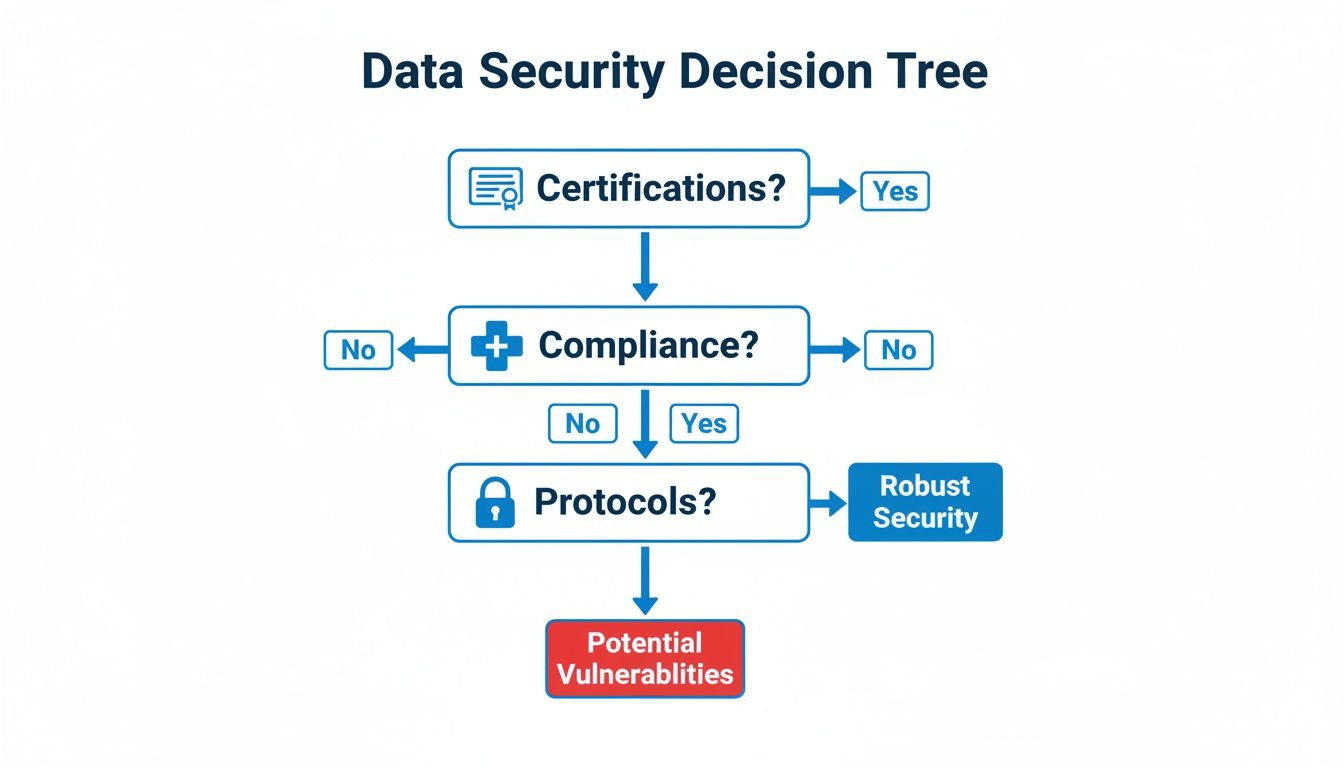
Starting with baseline certifications like ISO 27001, moving to industry specific compliance like HIPAA, and finishing with bulletproof protocols is the sign of a vendor who takes security seriously.
Beyond security, you need a partner who can keep pace with your growth. Ask them how they scale their teams up or down to match your project's demands. A partner with a deep bench of trained annotators can handle fluctuating volumes without letting quality slip, a massive advantage.
In fact, North America currently holds over 33.2% of the AI annotation market, with large companies often outsourcing high volume work to specialists. And with 70% of enterprises now using a hybrid model, a partner’s flexibility is more critical than ever.
The best partnerships are built on trust and transparency. A vendor shouldn't just answer your questions. They should proactively share insights and reports that give you a clear window into their entire process.
The Power of a Paid Pilot Project
At the end of the day, the best way to know if a vendor is the real deal is to see them in action. Before you lock into a long term, large scale contract, propose a paid pilot project. Think of it as a small scale, real world test drive that lets you evaluate their performance firsthand.
A pilot project gives you hard evidence of their:
- Communication Style: Are they responsive and easy to work with? Or do you have to chase them for updates?
- Quality Delivery: Does the labeled data from the pilot actually meet your accuracy standards?
- Adherence to Timelines: Can they deliver on schedule, or are they already making excuses?
This trial run minimizes your risk and gives you the confidence you need to commit to a full engagement. By following this checklist, you can systematically vet your options and find a partner that will genuinely accelerate your AI success.
Answering Your Questions About Data Annotation Outsourcing
Even the best AI strategy hits a few practical hurdles. When it comes to data annotation outsourcing services, decision makers rightfully want to know exactly how a partnership will work, what it will cost, and how their data will be protected.
Let's clear the air and answer some of the most common questions we hear from leaders just like you.
How Does Outsourcing Compare to an In-House Team?
Building an in house team gives you a sense of direct control, but that control comes with a hefty price tag. You’re on the hook for fixed costs like salaries, benefits, and office space, not to mention the enormous management overhead needed to hire, train, and supervise a team of annotators. When project volumes spike or dip, you’re stuck, either understaffed or over budgeted.
Outsourcing flips that script. You get immediate access to a large, pre trained workforce that scales on demand. This shifts your financial model from high fixed costs to a flexible, variable expense. A dedicated partner brings specialized expertise and proven QA processes, delivering faster turnarounds and higher data quality without distracting your core engineering team from building your next big thing.
What Should I Expect from a Quality Assurance Process?
A top tier outsourcing partner never relies on a single check for quality. That's the difference between professional services and a simple crowdsourcing platform. You should expect a multi layered Quality Assurance (QA) process designed to catch errors and enforce consistency at every step.
A rock solid QA system typically looks something like this:
- Initial Annotation: A trained annotator performs the first pass, labeling your data according to the project guidelines.
- Peer Review: A second, more senior specialist reviews that work, hunting for obvious errors or deviations from the rules.
- Consensus-Based Workflows: For tricky or ambiguous data, multiple annotators label the same asset independently. The final label is decided by consensus, which is a fantastic way to handle tough edge cases and identify where your guidelines might need a tune up.
- Benchmark Testing: The team is regularly tested against a "gold standard" dataset to measure ongoing accuracy and ensure quality never drifts.
Always demand transparent, regular reporting on key metrics like accuracy, precision, and recall. It's the only way to be sure your standards are being met week in and week out.
What Are the Common Pricing Models?
Flexibility is key. A good partner will work with you to find a model that fits your project's scope, budget, and long term goals. There's no one size fits all solution, but you'll usually see one of these three models.
The most common pricing structures include:
- Per-Annotation Model: You pay a fixed price for each labeled item like an image, a sentence, or a frame of video. This is perfect for projects with well defined, repetitive tasks and predictable volumes.
- Per-Hour Model: You pay for the annotator's time. This model is much better for complex or exploratory tasks where the effort required for each asset can vary wildly.
- Full-Time Equivalent (FTE) Model: You contract a dedicated team of annotators who work exclusively on your projects for a set period. This gives you the most control and is ideal for large, ongoing initiatives that require deep domain knowledge and tight integration with your in house team.
A transparent partner will help you figure out which model gives you the best bang for your buck and the most predictable costs.
How Do You Guarantee My Data Remains Secure?
Data security is non negotiable, period. A reputable vendor protects your intellectual property with a combination of legal, physical, and technical safeguards. It all starts with strict Non-Disclosure Agreements (NDAs) signed by every single person who touches your project.
Security isn't just a feature; it's the foundation of trust. A reliable partner will have verifiable protocols that protect your data at rest, in transit, and during processing, ensuring confidentiality and integrity at every step.
Operationally, your data should live within secure, access controlled environments, often on machines with disabled USB ports and restricted internet access to prevent any unauthorized transfers. All data movement should happen over encrypted protocols like SFTP or VPNs. The clearest sign of a vendor's commitment to security? Their certifications. Look for internationally recognized standards like ISO/IEC 27001, which proves they have a robust information security management system in place.
Ready to turn your raw data into a high performance asset? The experts at Prudent Partners are here to build a customized, secure, and scalable data annotation solution that accelerates your AI roadmap.