When you hear ISO 27001 certification, think of it as a globally recognized seal of approval. It’s the gold standard that proves an organization has a world class system for protecting its information. But this isn't just about firewalls and antivirus software; it’s a complete framework that weaves together people, processes, and technology to keep data safe, accurate, and accessible.
Decoding ISO 27001: A Framework for Trust

It’s helpful to think of ISO 27001 not as a single security tool, but as the master blueprint for an entire data fortress. This blueprint is what’s known as an Information Security Management System (ISMS). An ISMS is a living, breathing system that defines how a company consistently identifies, manages, and reduces information security risks.
Instead of just reacting to threats after they happen, an organization with a strong ISMS has a proactive security culture. Security practices are embedded into the very DNA of the business. From handling sensitive client files to developing a new piece of software, every action follows a secure, documented, and repeatable process.
The explosive growth of this standard with over 70,000 certificates now issued across 150 countries is a testament to its value. You can find more data on the global rise of ISO 27001 on Rhymetec's blog.
Core Principles of Certification
At its heart, the standard is built on a cycle of continuous improvement. It forces an organization to systematically examine its security risks by looking closely at threats, vulnerabilities, and potential impacts. This whole system stands on a few key pillars:
- Risk Assessment: Methodically identifying potential security threats and then evaluating how likely they are to happen and what the damage would be.
- Control Implementation: Designing and rolling out a customized set of security controls and other risk treatments to neutralize the threats you’ve identified.
- Continuous Monitoring: Putting in place a management process to ensure the security controls are always working and meeting the organization's evolving needs.
To help break it down, here is a quick look at the core components of the standard.
ISO 27001 at a Glance: Key Components
| Component | Description | Example in Practice |
|---|---|---|
| ISMS Framework | The overall system of policies, procedures, and controls to manage information security. | An employee onboarding process that includes mandatory security awareness training. |
| Risk Assessment | A formal process to identify, analyze, and evaluate information security risks. | Identifying the risk of a phishing attack and evaluating its potential business impact. |
| Annex A Controls | A list of 93 potential security controls covering areas like access, cryptography, and operations. | Implementing multi-factor authentication (MFA) for all critical systems (Control A.5.16). |
| Statement of Applicability (SoA) | A document listing which Annex A controls have been selected and why. | A document stating that encryption is used for all laptops, justifying the decision. |
| Continuous Improvement | The requirement to regularly review and improve the ISMS based on performance and audits. | Conducting quarterly internal audits to find and fix security weaknesses. |
These elements work together to create a resilient and adaptive security posture.
For organizations like Prudent Partners, which handle sensitive AI training data and business processes for regulated industries, ISO 27001 certification is far more than a compliance checkbox. It’s a tangible promise to clients that their most valuable assets are protected by a robust, audited, and internationally respected security framework.
Achieving this certification proves a serious commitment to information security management. It provides independent, expert verification that a company’s security practices are not just ad hoc but are comprehensive and follow established best practices. This verification builds immense trust with clients, partners, and stakeholders, especially when you're handling sensitive data in fields like healthcare, finance, and artificial intelligence.
Understanding the Heart of ISO 27001: The ISMS
To really get what ISO 27001 is all about, you have to look past the certificate on the wall and dive into its operational core. The engine driving this entire standard is the Information Security Management System (ISMS). An ISMS isn't just a piece of software you install or a checklist you tick off once. Think of it as the central nervous system for your company's entire security posture.
It’s a living framework that weaves together people, processes, and technology to systematically manage your organization's information security risks. It ensures that protecting data isn't an afterthought but is baked into every single business operation, from how an analyst handles client data to how your internal IT systems are managed.

The Continuous Improvement Cycle: Plan-Do-Check-Act
At the heart of any effective ISMS is a simple but powerful cycle known as Plan-Do-Check-Act (PDCA). This model is what keeps your security measures from becoming stale. It transforms security from a one time project into a dynamic process that constantly adapts to new threats.
Imagine you're in charge of securing a brand new office building. The PDCA model gives you a clear, logical path forward.
- Plan: First, you identify the risks like unauthorized entry, theft, and fire. Based on that assessment, you design a security plan including access card systems, security cameras, and mandatory staff training.
- Do: Now you put the plan into action. You install the cameras, issue the access cards, and run the first round of security training sessions for all employees. This is the implementation phase.
- Check: After a few weeks, you review how everything is working. You check the surveillance footage, audit the access logs for any strange activity, and maybe even run a drill to see how staff respond to a simulated security event.
- Act: Based on what you found, you make improvements. Maybe one camera has a blind spot, so you adjust its position. Perhaps employees are forgetting to challenge strangers, so you schedule a quick refresher on tailgating policies.
And then the cycle begins again. This constant loop ensures the building’s security gets stronger and more resilient over time.
Putting the ISMS into Practice
In a data heavy environment like ours at Prudent Partners, this isn’t some abstract concept; it's our daily operational reality. Our ISMS governs every single touchpoint where sensitive client data is handled.
Whether it’s an analyst annotating complex medical images for an AI model or a virtual assistant processing financial records, their work is guided by the rules and controls within our ISMS framework. This systematic approach creates a clear, auditable trail for every information handling activity. The benefits of this structure are huge, much like the advantages you see in well defined business process management. You can learn more about how structure drives results by reading about the benefits of business process management.
The ISMS ensures that security is a shared responsibility, not just the IT department's job. It fosters a culture where every team member understands their role in protecting information, creating a human firewall that complements technological safeguards.
The entire framework is built on three fundamental pillars of information security, often called the CIA triad.
The Three Pillars of Information Security
The ISMS and the whole ISO 27001 standard are designed to preserve three key attributes of information.
- Confidentiality: This is all about making sure information is only accessible to those who are authorized to see it. For example, our role based access controls prevent a data annotator working on a public retail dataset from ever viewing sensitive medical records from a different healthcare project.
- Integrity: This pillar is about protecting the accuracy and completeness of information. It means putting controls in place to prevent data from being modified without authorization, ensuring the AI training data we deliver is exactly what it's supposed to be, uncorrupted and reliable.
- Availability: This principle ensures that authorized users can get to the information and systems they need, when they need them. It involves building resilient infrastructure and protecting against downtime so our clients’ projects can continue without disruption.
By systematically addressing these three pillars through the PDCA cycle, an organization builds a security environment that is both tough and adaptable. The ISMS becomes the living blueprint that not only gets you ISO 27001 certified but also provides real, tangible protection for your most valuable asset: your data.
Why ISO 27001 Is a Competitive Edge in AI and Tech
In highly regulated fields like artificial intelligence, healthcare, and finance, information security isn't just an IT problem, it's a core business advantage. For companies in these sectors, ISO 27001 certification has quickly moved from a "nice to have" badge to a non negotiable requirement for winning business and building trust.
This certification is far more than a technical checklist. It’s about forging unbreakable client trust, gaining a huge leg up in competitive bids, and slashing the financial and reputational risks of a data breach. In short, it’s the bedrock upon which high value, long term partnerships are built.
The market is already signaling this shift. Adoption of ISO 27001 is surging among tech and AI firms, with 81% of surveyed organizations reporting they are either certified or planning to be. That’s a massive 14% year over year jump from 67%, proving just how vital this standard has become. You can dig into more stats like these in A-LIGN’s Compliance Benchmark Report.
Unlocking High-Stakes Partnerships
For companies at the cutting edge of AI, security is everything. When a generative AI company hands over its proprietary models to a partner for quality analysis, it’s entrusting them with the keys to the kingdom, its core intellectual property. That partner's ISO 27001 certification is the client's verifiable proof that its IP will be protected by an audited, internationally recognized security framework.
Think about a medical AI firm needing HIPAA compliant data annotation for sensitive patient scans. Our certified ISMS offers a documented, auditable system that directly reinforces their own strict regulatory obligations. It's not just about our security; it's about making their compliance stronger. This documented commitment is often the very thing that opens the door to enterprise clients who simply won't compromise on security.
Building a Foundation of Client Trust
Trust is the currency of any service relationship, especially when sensitive data is involved. An ISO 27001 certification takes the conversation from vague promises to concrete proof, offering a transparent and objective measure of a company’s dedication to security.
It immediately tells a potential client several critical things:
- Proactive Risk Management: We don’t just react to threats; we systematically find, assess, and fix them before they can cause harm.
- Leadership Commitment: Security isn’t just an IT department task. It’s a strategic priority with buy in and oversight from the very top.
- Operational Resilience: We have solid plans in place to keep our business running, meaning our services and your projects are protected from disruption.
This level of assurance is absolutely vital in the AI space, where the quality and integrity of data are directly tied to model performance. In fact, understanding why data quality is the real competitive edge in AI makes it clear just how critical this foundational security is for getting reliable results.
Gaining a Decisive Advantage in Competitive Bids
In a crowded market, any verifiable differentiator can be the deciding factor. When a potential client puts out a Request for Proposal (RFP) for a major data annotation or business process project, security is almost always a heavily weighted criterion.
Having an ISO 27001 certification instantly elevates a vendor’s proposal. It dramatically simplifies the client’s due diligence, since the certification acts as a third party seal of approval on our security posture.
For procurement teams and security officers evaluating partners, an ISO 27001 certificate is a powerful shortcut. It instantly answers dozens of security questions and shows a level of maturity that uncertified competitors can't easily claim, often moving a vendor right to the top of the shortlist.
This isn't just a theory; we see it happen all the time when responding to RFPs from financial institutions, healthcare providers, and tech giants. Our certification frequently satisfies entire sections of their security questionnaires, letting us focus the conversation on the value and expertise we bring, not just basic security checks. It turns a potential hurdle into a clear competitive strength.
Your Step-by-Step Roadmap to ISO 27001 Certification
Getting ISO 27001 certified can feel like a huge undertaking, but it’s really just a structured journey. Forget climbing a sheer cliff; think of it more like following a well marked trail with clear stages. Each step logically builds on the last, guiding your organization from initial planning to final certification and keeping you on track afterward.
The process is designed to be methodical. It ensures your Information Security Management System (ISMS) isn't just a binder of policies on a shelf but a living, breathing part of your daily operations. For a services company like Prudent Partners, this roadmap was indispensable for scoping our ISMS to cover hundreds of data analysts and a huge variety of complex data services. It turned an abstract standard into a concrete reality.
Stage 1: Gaining Leadership Support and Defining Scope
Before a single line of code is reviewed or a policy is written, the journey starts at the top. The most critical first step is securing genuine buy in from your leadership team. This isn’t just about getting a budget approved; it’s about making information security a recognized business priority that everyone, from the C suite down, understands and supports.
Once you have that backing, you can define the scope of your ISMS. This is where you draw the map. Will the ISMS cover the entire company? Just a specific department handling sensitive client data? Or a single service line? A crystal clear scope is vital for focusing your efforts and resources where they matter most.
Stage 2: Performing a Thorough Risk Assessment
With your scope set, it’s time to look under the hood. The next stage is a comprehensive risk assessment, which is basically a diagnostic phase. Here, you systematically identify potential threats to your information, analyze where you’re vulnerable, and figure out the real world impact if a security incident actually happened.
This process breaks down into a few key activities:
- Identifying Assets: You need to know what you're protecting. This means cataloging all valuable information assets within your scope, from client databases and intellectual property to employee records.
- Identifying Threats: Brainstorm everything that could go wrong. Think cyberattacks, simple human error, natural disasters, or critical system failures.
- Assessing Vulnerabilities: Pinpoint the weak spots in your current processes, people, or technology that a threat could exploit.
- Evaluating Impact: Determine the business consequences if a risk becomes a reality. This helps you prioritize what needs to be fixed first and what can wait.
Stage 3: Implementing Security Controls from Annex A
Once your risks are identified and prioritized, you can start building your defenses. ISO 27001 gives you a toolkit of 93 potential controls in a section known as Annex A. Your job is to select and implement the controls that directly address the risks you just uncovered.
For example, if your risk assessment flagged a high risk of unauthorized access to sensitive client data, you’d pull controls from Annex A related to access control. That means implementing things like strong password policies, role based access, and multi factor authentication. The goal isn't to implement every control, but to build a set of defenses tailored to your organization’s unique risk profile.
Stage 4: Conducting Internal Audits
After you've put your controls in place, you have to test the system. This happens during an internal audit, which is essentially a dress rehearsal for the main event. An objective internal party or an external consultant reviews your ISMS from top to bottom to verify that it meets all the requirements of the ISO 27001 standard.
This step is your chance to find and fix any gaps or nonconformities before the external auditors show up. It’s an opportunity to fine tune processes, improve documentation, and make sure everyone on the team knows their role in the ISMS.
Stage 5: Navigating the External Audit
This is the formal certification phase, and it’s always conducted by an accredited third party certification body. The audit typically happens in two parts:
- Stage 1 Audit: The auditor mainly reviews your ISMS documentation like policies, procedures, and risk assessment reports. This is a desktop review to confirm you have everything on paper and are ready for the real thing.
- Stage 2 Audit: Now the auditor returns for a much deeper dive. They’ll test how well your controls are actually implemented and how effective they are. Expect interviews with staff, observation of processes, and a review of records to ensure your ISMS is operating as designed.
This infographic shows exactly how getting certified gives you a powerful competitive edge by building trust, winning more bids, and reducing overall business risk.
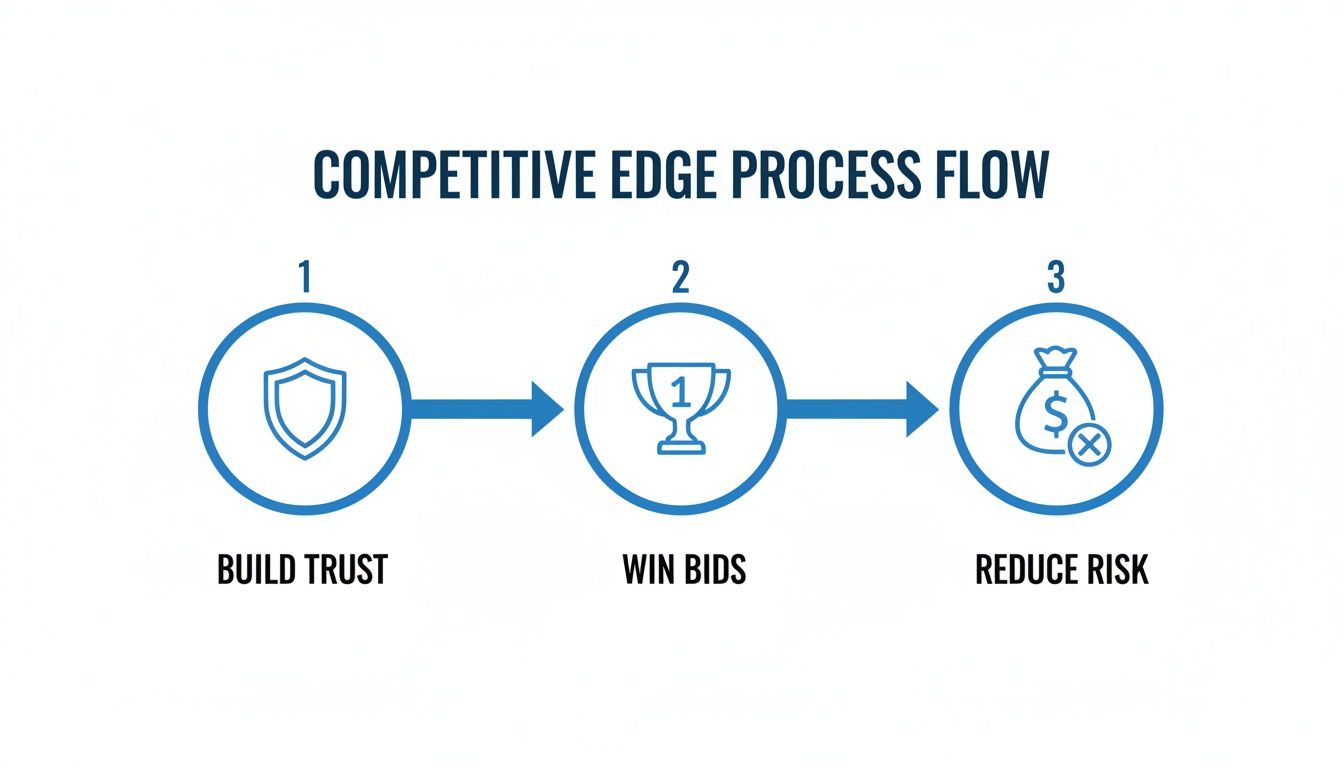
As you can see, the process leads to tangible business outcomes that strengthen both your market position and your operational resilience.
Stage 6: Achieving Certification and Continuous Improvement
If your Stage 2 audit is successful, you are officially awarded your ISO 27001 certificate. But the work doesn’t stop there. Certification is valid for three years, and you’ll have annual surveillance audits to ensure you’re maintaining and improving your ISMS.
This commitment to continuous improvement is a core part of the standard. It guarantees your security posture doesn’t become static but evolves to meet new threats and challenges head on.
Making Sense of Key Annex A Security Controls
If the ISO 27001 clauses are the strategic blueprint for your security program, then Annex A is the toolbox. It’s where the theory ends and the practical work begins.
Annex A provides a comprehensive catalog of 93 security controls, the individual nuts, bolts, and safeguards you’ll use to build your ISMS. Think of it as a menu of defenses. You don't have to order everything; you only select the controls that directly address the risks you've already identified. This keeps your security focused and efficient, preventing you from wasting resources on threats that don't apply to your business.
For a data centric company like ours, a few of these control families are absolutely non negotiable for protecting client information. Let's break down how they work in the real world.
Protecting Information with Access Control
At its heart, access control is about one simple but powerful idea: people should only be able to see and touch the information they absolutely need for their job. Nothing more. This is called the principle of least privilege, and it's a cornerstone of modern information security.
Imagine we’re working on two different client projects. One team is annotating sensitive financial records for a bank, while another is labeling product images for an e commerce giant. Without strong access controls, a data analyst on the e commerce project could accidentally stumble upon confidential financial data. That’s a risk we can’t afford.
This is where Annex A controls provide a direct solution. We implement role based access control (RBAC) to assign permissions based on a person’s exact role:
- E-commerce Data Analyst: Can only access the servers, tools, and datasets for the e commerce project. The financial project is completely invisible to them.
- Finance Project Manager: Can access the financial dataset and project tools but has zero visibility into the e commerce work.
- System Administrator: Has the keys to the kingdom for maintenance, but every single action is logged and audited.
This strict separation ensures that even if one account is compromised, the damage is contained within that project's silo. It’s a perfect example of how an Annex A control directly reduces risk for our clients' data.
Key Annex A Control Domains Explained
To build a truly resilient ISMS, multiple control domains have to work together. While there are 14 control families in total, some are more critical than others in a data services environment. Below is a snapshot of the controls we prioritize to safeguard client data from every angle.
| Annex A Domain | Objective | Prudent Partners' Implementation Example |
|---|---|---|
| A.5: Organizational Controls | To establish a high level security framework and define roles and responsibilities. | We create an Information Security Policy that everyone reads and signs. Roles like "Information Security Manager" are formally assigned to ensure clear ownership. |
| A.6: People Controls | To ensure staff are aware of their security duties before, during, and after employment. | Security awareness training is mandatory for all new hires. We also have strict offboarding procedures to revoke all access immediately upon an employee’s departure. |
| A.7: Physical Controls | To prevent unauthorized physical access, damage, and interference to our facilities and the information within them. | Our offices have secure entry points with access card readers, 24/7 CCTV surveillance, and a clean desk policy to protect sensitive documents. |
| A.8: Technological Controls | To protect the hardware, software, and networks that process and store information. | We enforce endpoint protection (antivirus) on all workstations, use firewalls to segment our network, and mandate strong, complex passwords for all systems. |
These domains aren't just checkboxes; they represent layers of defense that collectively create a secure environment where client data is protected by policy, people, and technology.
Securing the Foundation with Operations Security
Operations security is all about the daily grind, the repeatable processes that keep our IT infrastructure secure and reliable. This covers everything from data backups and malware scans to system monitoring. It’s about building a tough, resilient environment where data is safe at every stage.
A great example is how we handle data transfers. When a client sends us a dataset for an AI project, a series of operational controls clicks into place instantly:
- Secure Transit: Data arrives only through encrypted channels, like SFTP or a secure cloud bucket. This stops anyone from snooping on the data while it’s in transit.
- Malware Scans: Before the data even touches our production environment, it’s automatically scanned for malware. This protects our systems and the client's data integrity.
- Data Segregation: The data is immediately moved into a logically isolated environment, reinforcing the access controls we discussed earlier.
- Logging and Monitoring: Every single touchpoint, every time someone accesses, moves, or changes the data, is logged. We monitor these logs for anything unusual, so we can spot potential trouble fast.
These operational controls aren’t just one off actions. They form a secure, interconnected pipeline that protects client data from the moment it arrives until the moment we deliver our work. It shows that great security is a system, not a single event.
Calculating the Real ROI of ISO 27001
It's easy to look at ISO 27001 certification as just another line item on the budget. But viewing it as a pure expense completely misses the point. Think of it less as a cost and more as a strategic investment in business resilience, customer trust, and long term growth. The real value goes far beyond the framed certificate on the wall.
Of course, there's an initial financial outlay. You'll have costs for implementation support, maybe you bring in consultants to guide the process, along with fees for the external certification body and the internal cost of your team's time. Don't forget ongoing maintenance, like annual surveillance audits, which also factor into the total cost.
Beyond Direct Costs: The Intangible Gains
While the expenses are easy to calculate, the real value comes from two places: risk mitigation and strategic advantage. The most obvious financial return is avoiding the catastrophic costs of a data breach. Between the fines, legal fees, and reputational damage, a single incident can cripple a business. A robust ISMS is your best defense.
But the indirect benefits are often even more powerful. An ISO 27001 certification can:
- Unlock New Markets: It’s your ticket into enterprise deals and government contracts where certification isn't just a "nice to have," it's a mandatory requirement.
- Enhance Brand Reputation: It sends a clear signal to the market that your organization takes security seriously and operates with a high level of professional maturity.
- Deepen Customer Loyalty: It gives clients verifiable proof that their sensitive information is protected, building the deep trust needed for lasting partnerships.
A Strategic Investment in Growth
The global demand for ISO certification is climbing fast, driven by the non negotiable need for information security. This trend isn't just about compliance; it highlights a growing recognition of security as a strategic pillar. You can learn more about how market demands are shaping ISO certification on OpenPR.
For a company like Prudent Partners, which handles complex data for AI and regulated sectors, certification is fundamental to our entire business model. It's not optional.
When you frame the discussion around return on investment, you see that achieving what is ISO 27001 certification isn’t about absorbing a cost. It’s about making a calculated investment that pays dividends in customer confidence, operational stability, and new market opportunities.
Ultimately, the ROI isn't just about preventing losses. It’s about creating positive gains. The certification becomes a key differentiator that shortens your sales cycles, makes vendor due diligence a breeze for your clients, and solidifies your position as a trusted leader in your industry.
How to Vet Your Certified Data Partner
So, you've decided ISO 27001 is a must have for your data partners. That's a huge step. Seeing the certification logo on a vendor’s website is a great sign, but it’s really just the starting line.
The real test is digging deeper to understand the substance behind that certificate. You need to look past the badge and get a feel for the true strength of their security posture. It's about asking the right questions, ones that move beyond a simple "Are you certified?", to make sure their ISMS is comprehensive, relevant to your project, and actually being used day to day. A partner who’s genuinely committed to security will not only expect this level of scrutiny but welcome it.
Key Questions to Ask a Certified Vendor
To really understand how seriously a vendor takes security, you need to probe their transparency and the specific details of their certification. A partner's readiness to talk openly about these things is a massive indicator of their security maturity. For a wider view on choosing vendors, our guide on how to evaluate data annotation companies offers a solid framework.
Here are a few essential questions to get the conversation rolling:
- Can you define the exact scope of your certification? This is crucial. The scope tells you which parts of the business are actually covered. Is it the entire organization, or just one department in a specific office? A narrow scope might not cover the people or systems handling your data.
- Will you share your Statement of Applicability (SoA)? This document is the heart of their ISMS. It lists which of the 93 Annex A controls the company has implemented and, just as importantly, why. Looking at the SoA gives you a crystal clear view of their risk appetite and security priorities.
- How do your security controls extend to remote workers and subcontractors? In today’s world of distributed teams, you need to know that security policies are enforced everywhere, not just within the four walls of an office. This is a key part of what is ISO 27001 certification in a modern, flexible work environment.
- What is your process for managing security incidents? Every mature ISMS has a battle tested incident response plan. Ask them to walk you through their communication protocols, remediation steps, and how they learn from incidents to prevent them from happening again.
Verifying a Partner’s Commitment
The answers you get will tell you everything you need to know. They reveal just how deeply security is woven into the fabric of their daily operations. A confident, genuinely certified partner can explain their processes clearly and without fumbling for answers. Their responses should paint a picture of continuous improvement, not a one and done compliance exercise.
A partner’s willingness to discuss the specifics of their ISMS is as important as the certificate itself. Transparency is the ultimate proof of a robust security culture and demonstrates a genuine commitment to protecting your most valuable assets.
At Prudent Partners, this kind of transparency isn't just a policy; it's fundamental to how we build relationships. We believe our certified ISMS is the foundation of the trust our clients place in us.
Your data’s security and integrity are non negotiable. At Prudent Partners LLP, our ISO 27001 certified ISMS is designed to de-risk your most critical AI and data initiatives, providing the auditable assurance you need to scale with confidence. Connect with us today to discuss how our commitment to security can protect and empower your business.