

Computer vision is, at its heart, about teaching computers to see and interpret the world. In a retail setting, this technology transforms existing store cameras from simple security feeds into an intelligent, data-gathering network. The goal is not just to record what happens, but to analyze visual data to solve persistent business problems like empty shelves, long checkout lines, and inventory shrinkage.
Think of it as giving your physical stores a set of digital eyes that can automate tedious tasks, provide actionable insights, and elevate the entire operational workflow.
Seeing the Future of Retail with Computer Vision
Imagine your store could instantly detect a low stock level on a best-selling product and automatically alert a team member to restock it. What if you could identify a shopper who appears confused or lost and dispatch an associate to provide assistance before frustration sets in? This is not a futuristic concept; it is the practical, high-impact reality of computer vision in retail.
By analyzing the visual data your cameras are already capturing, retailers are gaining unprecedented control over in-store operations and creating a smoother, more efficient customer journey. This technology works silently in the background, a constantly vigilant partner focused on operational excellence. It is not about monitoring individuals; it is about understanding patterns to make the entire retail ecosystem smarter.

Why Retailers Are Adopting Visual Intelligence
The shift toward visual intelligence is gaining significant momentum. The global market for computer vision in retail was valued at USD 1,997.3 million and is projected to reach USD 6,746.0 million by 2030. This substantial growth demonstrates a clear commitment from retailers to invest in solutions that resolve stubborn operational challenges and provide a competitive advantage. You can read the full research about the expanding retail computer vision market for a detailed analysis.
This investment is fueled by tangible benefits that directly boost the bottom line and improve customer satisfaction. The secret to unlocking this potential lies in high-quality annotated data, which is the foundational element required to train these systems to perform accurately and reliably in real-world environments.
To provide a clear understanding of its value, here is how this technology addresses common retail frustrations.
How Computer Vision Solves Key Retail Challenges
| Retail Function | Common Problem | Computer Vision Solution |
|---|---|---|
| Inventory Management | Stockouts and overstocks leading to lost sales or wasted capital. | Automatically detects on-shelf availability, identifying empty shelves or misplaced items in real time. |
| Customer Experience | Long checkout lines and difficulty finding products. | Enables frictionless "grab-and-go" checkout and analyzes shopper behavior to optimize store layouts. |
| Loss Prevention | Shrinkage from theft and fraudulent activities. | Identifies suspicious behavior patterns associated with theft, alerting staff before losses occur. |
| Store Operations | Inefficient planogram compliance and poor merchandising. | Verifies that product displays match the planned layout and analyzes which promotions attract the most attention. |
| In-Store Analytics | Lack of visibility into how customers navigate the physical store. | Creates heat maps of foot traffic and tracks customer paths to reveal popular zones and bottlenecks. |
As demonstrated, computer vision delivers measurable improvements across core retail functions, turning visual data into a powerful operational asset.
Here are a few of the core benefits driving this wave of adoption:
- Operational Automation: Manual shelf checks become obsolete. The system automatically monitors inventory, detects spills for enhanced safety, and confirms products are correctly placed.
- Enhanced Customer Experience: It dramatically reduces wait times with automated checkouts, helps staff provide proactive assistance, and powers seamless shopping models like Amazon Go.
- Intelligent Loss Prevention: By flagging unusual behavior tied to theft as it happens, it helps reduce shrinkage more effectively than traditional security tags and cameras.
- Data-Driven Insights: It generates store heat maps to optimize layouts and provides hard data on how customers interact with products, removing guesswork from merchandising.
At its core, computer vision gives retailers the ability to manage their physical spaces with the same level of data-driven precision they use for their e-commerce platforms. It bridges the gap between the digital and physical shopping worlds.
Real-World Applications Transforming the Retail Floor
While the theory is compelling, seeing computer vision in retail in action demonstrates its true business value. This technology is actively solving some of the industry's most persistent challenges, turning abstract concepts into tangible results that impact the bottom line. These are not futuristic ideas; they are practical tools being deployed today to optimize store operations and enhance the customer experience.
The foundation of this technology is incredibly precise data. Before a machine learning model can identify a specific brand on a shelf or flag the subtle actions of a potential thief, it must learn from thousands of accurately labeled images. This foundational work of drawing bounding boxes around products or polygons around shelf sections is where expert data annotation becomes absolutely critical for building reliable AI.
Frictionless and Automated Checkout
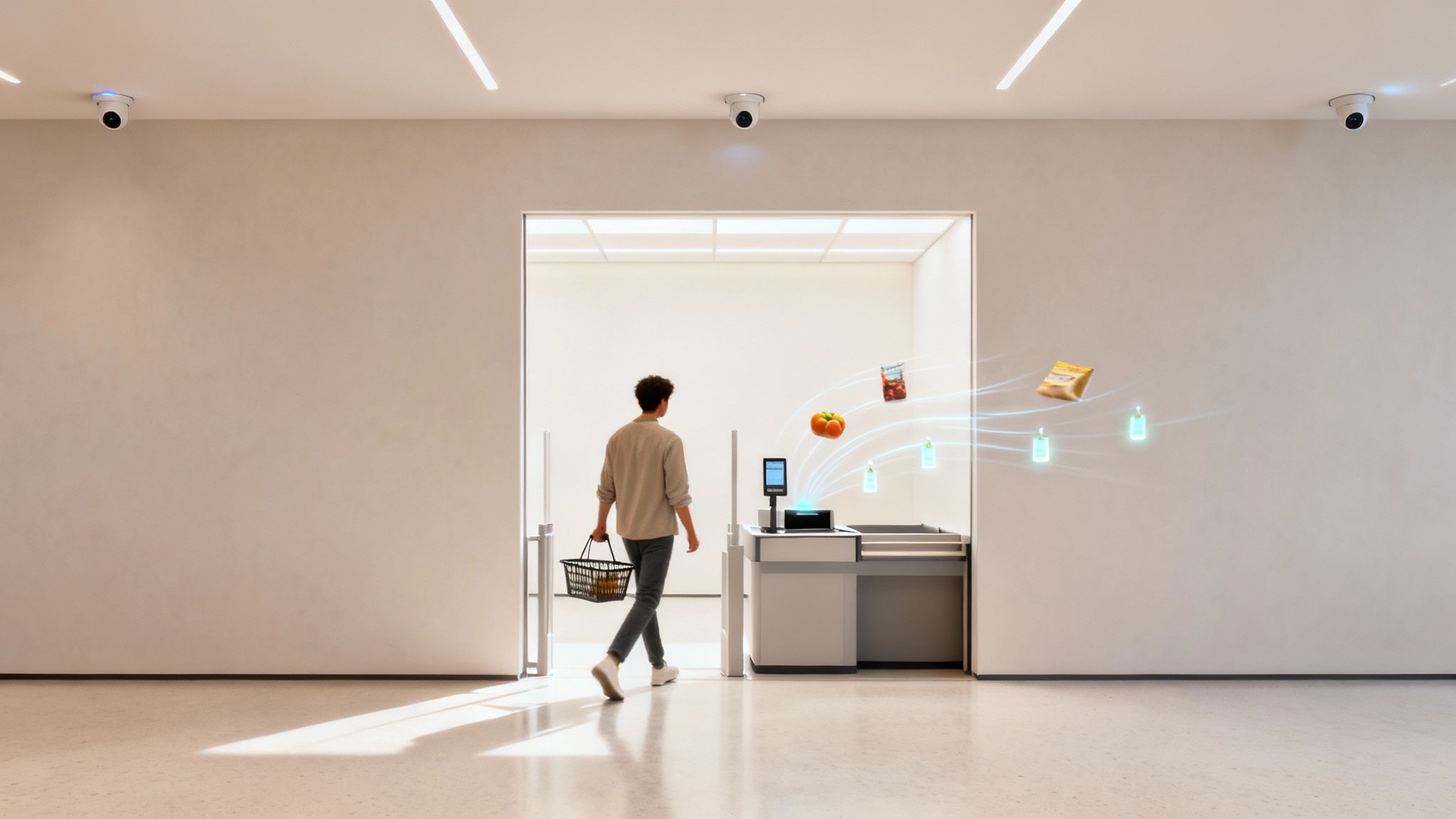
Long checkout lines are a significant source of customer frustration and abandoned sales. Studies show that 77% of shoppers are likely to abandon a store after a single negative experience with long waits. Frictionless checkout systems, pioneered by concepts like Amazon Go, address this problem directly.
Using an array of overhead cameras, these systems identify customers upon entry and track the items they select from shelves. The AI model recognizes each product, adds it to a virtual cart, and automatically processes payment when the customer exits. This "grab-and-go" experience eliminates queues, making shopping fast and convenient. The technology relies on meticulously annotated video data to accurately track hundreds of unique products and shopper movements simultaneously.
Real-Time Inventory Monitoring
An empty shelf is a lost sale. For decades, retailers have relied on periodic manual checks, meaning stockouts are often discovered hours too late. Computer vision provides a proactive solution to this challenge.
Cameras trained on store shelves constantly monitor product availability. The AI model is taught to recognize every product, count its quantity, and detect empty spaces or misplaced items. When stock for a specific product falls below a predefined threshold, the system sends an instant notification to a store associate's mobile device, enabling an immediate restock. This process keeps products available to customers, maximizing sales opportunities and preventing disappointment.
Automated Planogram Compliance
Retailers invest significant resources in designing planograms, the detailed diagrams that dictate product placement to maximize sales. However, ensuring consistent execution across hundreds of stores is a major operational challenge.
Computer vision automates the entire verification process. An AI system can analyze images of shelves and instantly compare the current layout to the official planogram.
- Flags misplaced items: The model can identify a product that is in the wrong location.
- Verifies promotional displays: It confirms that special promotions and endcaps are set up correctly.
- Ensures price accuracy: It can even check that the price tag on the shelf matches the product displayed above it.
This automated audit provides corporate teams with immediate insight into on-the-ground execution, ensuring a consistent brand experience and maximizing the return on promotional strategies.
By turning raw visual data into actionable intelligence, computer vision provides retailers with a new level of precision in managing their physical stores. It closes the gap between strategy and execution on the sales floor.
Sophisticated Loss Prevention
Shrinkage, or inventory lost to theft, costs the retail industry billions of dollars annually. Computer vision offers a more intelligent approach to loss prevention than traditional security monitoring. Instead of simply recording events, these systems are trained to recognize behaviors that often precede a theft.
These behaviors might include:
- Suspicious movements: Identifying individuals who linger in low-traffic areas or repeatedly handle high-value items without purchasing.
- Atypical checkout actions: Detecting when items are passed around a self-checkout scanner without being scanned.
- Organized retail crime signals: Recognizing patterns like coordinated entries by a group or large-scale shelf-sweeping.
When the AI identifies a high-risk event, it sends a discreet alert to security personnel, allowing for proactive intervention. This approach helps reduce shrinkage while creating a safer environment for shoppers and staff. The accuracy of this system is paramount, demanding precisely annotated data that can teach the AI to distinguish normal shopping behavior from genuine threats. This nuanced understanding is a core component of perception artificial intelligence, which enables models to interpret complex, real-world scenes.
The Hidden Engine Powering Accurate AI
An AI model is only as intelligent as the data it is trained on. While sophisticated algorithms and powerful hardware receive much of the attention, the true engine behind any successful computer vision project is the meticulously prepared training data. This process, known as data annotation, is how a machine learns to see and interpret the retail environment.
This is analogous to teaching a child to recognize different fruits. You point to an apple and say "apple," then to a banana and say "banana." Data annotation performs the same function for AI, but with far greater precision. It involves human experts carefully labeling objects in images and videos, creating a structured "answer key" from which the model can learn.
The quality of this training data directly dictates the model's real-world performance. Inaccurate or inconsistent labels lead to an AI that makes costly mistakes, such as misidentifying products, triggering false theft alarms, or generating flawed analytics. This is why achieving 99%+ accuracy during annotation is not just a goal; it is a business necessity for creating scalable and reliable AI solutions.
The Language of Vision: Annotation Techniques
To teach a machine about a complex retail environment, annotators use several specific techniques. Each method serves a different purpose, much like using different tools for different jobs. The right technique depends entirely on the business problem being solved.
- Bounding Boxes: This is one of the most common methods. Annotators draw a simple rectangle around an object of interest, like a single cereal box or a bottle of soda. This tells the AI, "This specific area contains this specific product." It is ideal for inventory counting and basic product detection.
- Polygons: For items with irregular shapes that do not fit neatly into a box, polygons offer much greater precision. Annotators trace the exact outline of an object, such as the entire shelf space for a specific brand or the unique shape of a promotional display. This is essential for accurate planogram compliance checks.
- Semantic Segmentation: This advanced technique assigns a category to every single pixel in an image. Instead of just drawing a box around a shopper, it colors all shopper pixels blue, all shelf pixels green, and all floor pixels gray. This creates a highly detailed map of the environment, enabling the AI to distinguish between customers, employees, and fixtures with exceptional clarity.
These precise annotations are the building blocks of reliable AI. A model trained with poorly drawn bounding boxes will struggle with object recognition from image data, leading to chronic inventory errors that undermine the system's value.
Why Precision Prevents Problems
Investing in high-quality data annotation from the outset is the most effective way to prevent costly operational failures. A small error during the labeling process can be magnified exponentially once the model is deployed across hundreds of stores.
An AI model trained on flawed data is like building a skyscraper on a weak foundation. No matter how advanced the architecture, the entire structure is at risk of collapse when put under real-world pressure.
Consider the consequences of imprecise data. An automated checkout system might consistently mischarge customers for similar-looking products, leading to frustration and lost trust. A loss prevention model trained on ambiguous data could generate so many false alarms that security staff begin to ignore them, defeating its purpose.
This is where Prudent Partners’ commitment to multi-layer quality assurance becomes a critical advantage. By implementing rigorous review processes, we ensure the datasets used to train your AI are clean, consistent, and exceptionally accurate. This meticulous approach enables the development of enterprise-grade retail solutions that deliver measurable impact, ensuring your investment in computer vision technology yields reliable, scalable results.
Your Roadmap to Implementing Computer Vision
Successfully implementing computer vision in retail is a strategic journey, not an overnight switch. A successful deployment requires a clear plan that connects technology directly to tangible business outcomes. By following a structured roadmap, you can progress from an initial concept to a scalable solution that delivers measurable value.
The process begins long before any cameras are installed. It starts with a laser focus on a specific, high-impact business problem. Vague goals like "improving efficiency" are insufficient. A winning project needs a defined target, such as "reducing out-of-stock incidents for our top 50 SKUs by 15% within six months."
This diagram illustrates the core data flow that fuels every computer vision model.
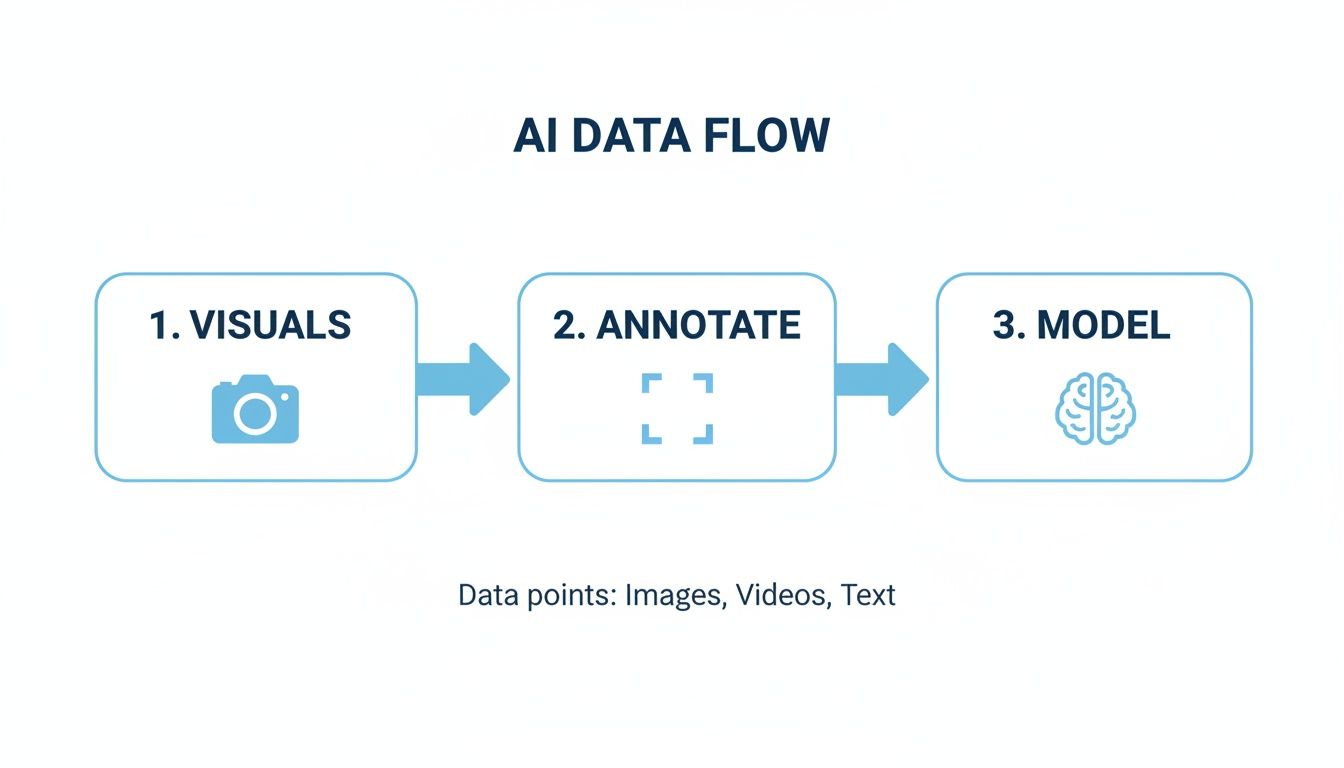
This three-stage process of capturing visuals, adding expert annotation, and building the model is the engine that transforms raw video feeds into actionable business intelligence.
Starting with Strategy and Data Collection
Before implementing any technology, the first step is to define the problem and establish how you will measure success. Are you trying to reduce shrinkage, decrease checkout wait times, or ensure planogram compliance? Each goal requires a different approach, dataset, and set of key performance indicators (KPIs).
Once your objective is clear, data collection becomes the next critical phase. This involves more than just pointing cameras at your store.
- Strategic Camera Placement: Cameras must be positioned to capture the specific views needed for your use case. Inventory monitoring requires a clear view of the shelves, while shopper analytics needs a wider perspective of the aisles.
- Optimal Lighting Conditions: Poor lighting can severely impact a model's accuracy. You must ensure consistent and adequate light, considering how it changes throughout the day and across seasons.
- Sufficient Data Volume: Your model needs a diverse range of examples to learn from. This means capturing footage across various scenarios, including busy weekends, quiet weekday mornings, and major promotional events.
The quality of this initial visual data is paramount. However, raw video is just the beginning. This data must be meticulously prepared through a professional image labeling service to make it understandable for an AI model.
Choosing Your Deployment: Edge vs. Cloud Computing
A critical decision is determining where your AI model will process data. Will it run on a device directly in the store (edge computing), or will it send data to a central server for analysis (cloud computing)? The correct choice depends entirely on your specific objectives.
The decision between edge and cloud is a trade-off between speed and scale. Edge computing provides real-time responsiveness for immediate action, while the cloud offers the raw power needed for deep, large-scale analysis.
This table breaks down the key differences to guide your decision.
| Consideration | Edge Computing | Cloud Computing |
|---|---|---|
| Latency | Low. Processing happens on-site, enabling instant alerts for loss prevention or safety monitoring. | Higher. Data must travel to the cloud and back, which is suitable for analytics but too slow for immediate alerts. |
| Bandwidth | Minimal. Only essential data or alerts are sent to the cloud, reducing network strain and costs. | High. Requires constant streaming of high-resolution video, which can be costly and demanding on store networks. |
| Scalability | Hardware-Dependent. Scaling requires installing more physical devices in each store. | Highly Scalable. You can easily ramp up computing resources in the cloud to analyze data from thousands of stores. |
| Best Use Cases | Real-time theft detection, automated checkout, immediate stockout alerts, and safety hazard identification. | Shopper foot traffic analysis, heat mapping, long-term inventory trend analysis, and planogram compliance reports. |
Ultimately, many retailers adopt a hybrid approach, using edge computing for time-sensitive tasks and the cloud for comprehensive data analysis.
Proving Value with a Pilot Project
Instead of attempting a chain-wide rollout from the start, the most prudent approach is to begin with a focused pilot project. Select one or two stores and a single, well-defined use case. A successful pilot achieves several crucial goals:
- Validates the Technology: It proves the solution works effectively in your unique store environment.
- Demonstrates ROI: It provides hard data on the project's financial impact, making it easier to secure buy-in for a broader rollout.
- Identifies Unforeseen Challenges: Every store is different. A pilot helps you identify and resolve practical issues before attempting to scale.
By starting small, measuring everything, and proving the business case, you build momentum and a solid foundation for expanding your computer vision initiatives across the entire organization.
Measuring the True Impact on Your Bottom Line
Adopting new technology is exciting, but a computer vision initiative is only valuable if it delivers a clear, positive impact on your business. The key to confirming this value is to define and track the right key performance indicators (KPIs) that connect directly to your bottom line.
It is time to move beyond abstract benefits to concrete numbers. Vague goals are insufficient. You need specific, measurable metrics for each application to quantify its success. This data-driven approach not only justifies the initial investment but also builds a solid business case for scaling your computer vision solutions across the organization.
Key Performance Indicators by Application
To get an accurate measure of performance, you must align your KPIs with the specific business problem you are solving. Each computer vision use case has distinct metrics that reveal its true operational and financial impact.
For inventory management, the primary goal is to maximize sales by ensuring product availability. The most critical KPIs here are:
- Reduction in Out-of-Stock (OOS) Rates: This is the most important metric. It measures the decrease in instances where a product is missing from the shelf, directly preventing lost sales. An AI system that detects low stock in real time can dramatically reduce these situations.
- Improved Inventory Turn: This metric indicates how quickly your inventory is sold and replaced. Faster turns signify efficient stock management and less capital tied up in slow-moving goods.
When it comes to loss prevention, the focus shifts to minimizing shrinkage and protecting assets. The main KPI is straightforward:
- Shrinkage Reduction Percentage: This tracks the direct decrease in inventory losses from theft or administrative errors after the AI system is implemented. Even a 2-5% reduction can translate into millions in savings for large retailers.
Finally, for enhancing the customer experience, success is measured by how seamless and efficient the shopping journey becomes. The key metrics to monitor are:
- Decreased Checkout Times: For automated or frictionless checkout systems, this measures the average time a customer spends from finishing their shopping to exiting the store. Reducing this time improves satisfaction and increases store throughput.
- Increased Dwell Time in Promotional Areas: This KPI indicates if customers are spending more time engaging with high-margin product displays, providing a clear sign that your merchandising and store layout optimizations are effective.
Calculating Your Return on Investment
Calculating the ROI for computer vision involves balancing upfront costs with long-term gains. Your initial investment will typically include hardware like cameras and servers, software licenses, and the critical cost of high-quality data annotation from a partner like Prudent Partners.
The core of a compelling ROI calculation is comparing the total cost of deployment against the measurable financial gains in sales, efficiency, and loss reduction. This transforms the project from a technology expense into a strategic investment.
A simple framework to start with is:
ROI (%) = (Net Profit from CV – Cost of Investment) / Cost of Investment x 100
Here, "Net Profit from CV" represents the sum of all your gains, including increased sales from fewer stockouts, reduced losses from theft, and labor savings from automated tasks. By meticulously tracking these KPIs, you can build a powerful, data-backed narrative that proves the undeniable value of implementing computer vision in retail.
A Global Look at Retail AI Trends
The adoption of computer vision is not happening in isolation; it is a global shift. Retailers worldwide are implementing the technology for reasons tied to their unique market pressures and economic realities. Understanding these global trends provides a richer perspective on how this technology is taking hold.
While the end goal is often the same—smarter, more efficient stores—the path to achieve it varies significantly across continents. Factors like labor costs, data privacy regulations, and existing store infrastructure are shaping how and why retailers invest in visual AI.
North America: The Early Adopter
North America, particularly the U.S., was an early and decisive adopter of retail AI. Driven by a mature retail sector seeking efficiency gains, the region made substantial initial investments in automation. This head start is why the market is projected to reach USD 2.95 billion by 2032.
Retailers here were quick to recognize AI as a practical solution for persistent problems like inventory blind spots and long checkout lines. Their proactive approach has established them as the current leader in this space.
Asia-Pacific: The Growth Engine
While North America currently leads, the Asia-Pacific region is experiencing the most explosive growth. Soaring labor costs and a booming middle class have created an urgent need for operational efficiency, creating a perfect environment for AI adoption.
As a result, the region is set to grow at a compound annual growth rate (CAGR) of 24.9% between 2025 and 2032, easily outpacing North America. This signals a major rebalancing of the global AI landscape. For a closer look, you can explore a deeper analysis of these regional dynamics to see how quickly markets like India are expanding.
Europe: The Privacy-First Innovator
Europe is also a key player, with a projected CAGR of 24.1%. What makes the European story compelling is its "privacy-by-design" approach to innovation.
Guided by strict regulations like GDPR, European retailers are pioneering privacy-first AI. They are using techniques like on-device (edge) processing and robust data anonymization to gain powerful insights without compromising consumer trust. This model demonstrates that it is possible to achieve both operational intelligence and customer privacy.
This global awareness is key. Understanding these different market dynamics helps us at Prudent Partners support our clients no matter where they operate, tailoring strategies that are effective for their specific landscape.
Frequently Asked Questions
Adopting computer vision in retail often raises practical questions. Retail leaders frequently ask about the best way to get started, how to handle privacy, and what it truly takes to build a reliable AI model. Let's address these common questions directly.
What Is the First Step to Implementing Computer Vision?
We always advise our partners to start small. Do not try to solve every problem at once. The best approach is to select one high-impact problem to address in your stores.
Perhaps it is chronic stockouts on a best-selling product line, or maybe it is the long checkout lines during peak hours. Focus on that single issue and launch a targeted pilot project. This allows you to prove the concept in a controlled environment, measure the ROI with clean data, and build the internal support needed for a broader rollout.
How Do You Ensure Customer Privacy?
Protecting customer privacy is non-negotiable. It is not just a compliance issue; it is the foundation of customer trust. Modern computer vision systems are built with privacy as a core principle, using intelligent techniques to deliver operational insights without identifying individuals.
Here’s how it works:
- Facial Blurring: Algorithms automatically obscure faces in video feeds the moment they are captured. Personal identities are never recorded or stored.
- Data Anonymization: The system treats shoppers as anonymous data points. It tracks patterns, such as foot traffic and dwell times, not individuals.
We operate under strict global privacy laws like GDPR and hold an ISO 27001 certification, which means our data security standards are rigorously audited and maintained.
How Much Data Is Needed to Train an Effective Retail AI Model?
It is a common misconception that you need massive amounts of data. In reality, it is not about quantity; it is about quality. The single most important factor for success is the accuracy of your data annotation.
A smaller, impeccably labeled dataset will always outperform a massive, poorly labeled one. This is where a high-quality data partner becomes your most critical asset.
Clean, consistent, and precisely labeled data teaches your AI model the right lessons from the start. It prevents costly errors down the line and ensures the system you deploy in your stores is reliable. Investing in quality annotation is not an expense; it is how you build a trustworthy AI system that delivers real value.
Ready to unlock the potential of computer vision for your retail operations? The expert team at Prudent Partners is here to help you build a scalable, accurate, and privacy-first solution. We provide the high-quality data annotation and AI quality assurance needed to turn your visual data into your greatest operational asset. Connect with us today to discuss your project and discover how we can drive measurable results.