
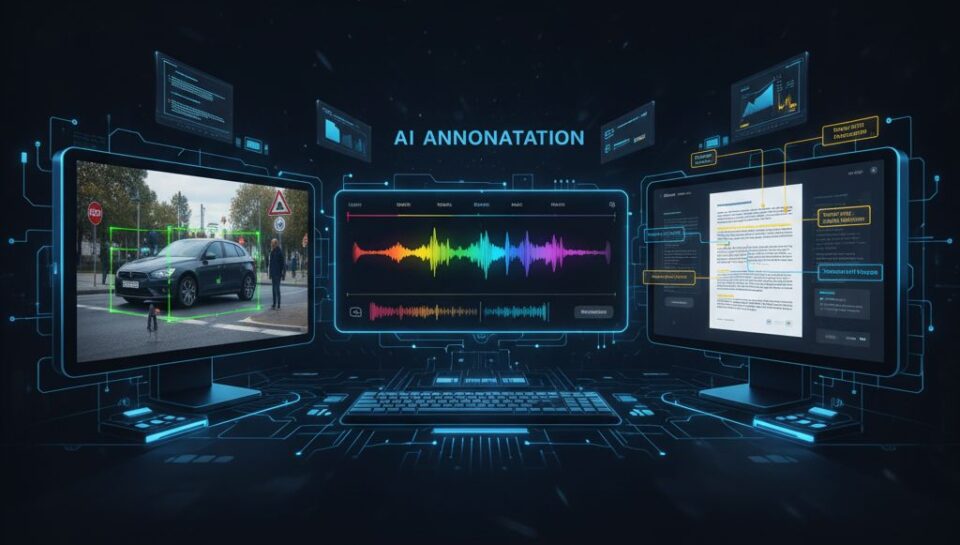
Introduction: The Hidden Backbone of AI
In the U.S., AI adoption is accelerating across industries—healthcare, e-commerce, autonomous vehicles, and finance. But the success of any AI system does not depend only on advanced algorithms. Instead, it rests on one critical factor: the AI annotation service that prepares training data.
Annotation transforms raw data into structured, machine-readable information. Without it, even the most sophisticated algorithms fail. For U.S. companies building AI models, choosing the right AI annotation service can mean the difference between success and costly failure.
This article explores what AI annotation services are, the types of data they cover, the benefits of outsourcing, and the key criteria U.S. enterprises should use when selecting a provider.
What Is an AI Annotation Service?
An AI annotation service is a specialized offering that labels raw data—images, video, audio, text, or sensor input—so that it can be used to train machine learning models. These services often include:
- Data Labeling: Adding structured tags to raw data.
- Quality Control: Multi-tiered reviews to ensure accuracy.
- Scalability: Handling millions of data points for enterprise AI projects.
- Compliance: Protecting sensitive data with ISO, HIPAA, and GDPR standards.
Instead of investing heavily in in-house teams, U.S. companies often outsource annotation tasks to service providers who have the expertise, workforce, and infrastructure needed to deliver at scale.
Types of AI Annotation Services
Image Annotation
Used in healthcare diagnostics, e-commerce catalogs, and autonomous vehicles. Techniques include:
- Bounding boxes
- Polygons and polylines
- Semantic segmentation
- Keypoints
Video Annotation
Essential for training AI models in self-driving cars, surveillance, and sports analytics. Methods include:
- Frame-by-frame labeling
- Object tracking
- Activity recognition
Text Annotation
Supports natural language processing (NLP) for chatbots, compliance monitoring, and sentiment analysis. Techniques include:
- Named Entity Recognition (NER)
- Part-of-speech tagging
- Sentiment and intent analysis
Audio Annotation
Critical for voice assistants, call center analytics, and accessibility tools. Examples include:
- Transcriptions aligned with audio
- Speaker identification
- Tone and emotion labeling
LiDAR Annotation
Used in autonomous vehicles, drones, and robotics. Examples include:
- 3D cuboids
- Point cloud segmentation
- Sensor fusion
Why U.S. Businesses Need AI Annotation Services
- Accuracy for Mission-Critical Models
In industries like healthcare and finance, an annotation error can result in misdiagnosis or compliance failures.
- Scalability
AI projects require enormous datasets. An outsourced AI annotation service allows U.S. companies to scale without expanding headcount.
- Faster Time-to-Market
By leveraging service providers, enterprises reduce development cycles and deploy AI faster.
- Cost Savings
Outsourcing avoids the overhead of recruiting, training, and managing annotation teams internally.
- Compliance and Security
Providers with ISO and HIPAA certifications ensure sensitive U.S. data is secure and compliant.

Challenges Without an AI Annotation Service
- Data Bias: Poor annotation increases bias, leading to unfair or unreliable AI outputs.
- Delays: Internal teams may lack the bandwidth to process large volumes of data.
- Inconsistent Quality: Lack of QA frameworks reduces trust in models.
- High Costs: Recruiting U.S.-based annotators for large datasets is expensive.
How to Evaluate AI Annotation Services in the U.S.
- Accuracy Benchmarks
Look for >99% accuracy rates and multi-layered QA checks.
- Security Standards
Ensure providers are ISO 9001 & ISO/IEC 27001 certified and compliant with HIPAA.
- Industry Experience
Different domains require unique expertise—annotating pathology slides is different from labeling satellite imagery.
- Technology Compatibility
Providers should be tool-agnostic, integrating seamlessly with Labelbox, CVAT, and custom tools.
- Scalability and Agility
Check whether they can handle both pilot projects and enterprise-scale rollouts.
- Transparent Reporting
Look for dashboards or performance management systems that give real-time visibility.
Why U.S. Enterprises Choose Prudent Partners
Prudent Partners provides a world-class AI annotation service with:
- 99%+ accuracy across all data types
- ISO-certified processes ensuring data security and compliance
- 300+ skilled annotators trained across healthcare, finance, retail, and defense datasets
- Prudent Prism, our proprietary performance management tool that tracks KPIs, QA reworks, and efficiency
- Global delivery model supporting U.S. enterprises in scaling quickly and securely
Our services are not just about labeling data—they are about enabling reliable AI outcomes.
Conclusion: Building AI the Right Way
For U.S. companies, AI models are only as strong as their training data. Choosing the right AI annotation service ensures models are accurate, compliant, and ready to drive innovation. By partnering with experts like Prudent Partners, enterprises gain scalability, security, and a trusted partner in their AI journey.
FAQs
- What is an AI annotation service used for?
It prepares data—images, videos, text, audio, and LiDAR—for AI model training.
- Why do U.S. companies outsource AI annotation?
Outsourcing provides scale, reduces costs, and ensures compliance in sensitive industries.
- How does Prudent Partners ensure accuracy?
Through multi-layer QA, domain-specific SOPs, and transparent performance dashboards.