
AI Data Annotation for Autonomous Vehicles in the USA
Introduction: Why Data Annotation Drives the Self-Driving Revolution
The U.S. is leading the global race toward autonomous vehicles. From Silicon Valley startups to automotive giants in Detroit, billions are being invested in self-driving technology. But behind the algorithms and sensors lies one critical enabler: AI data annotation for autonomous vehicles in the USA.
Without accurately labeled datasets, autonomous vehicles cannot distinguish between a pedestrian and a signpost, interpret traffic signals, or respond to unexpected obstacles. Data annotation is the invisible force powering the future of safe mobility in America.
What Is AI Data Annotation for Autonomous Vehicles?
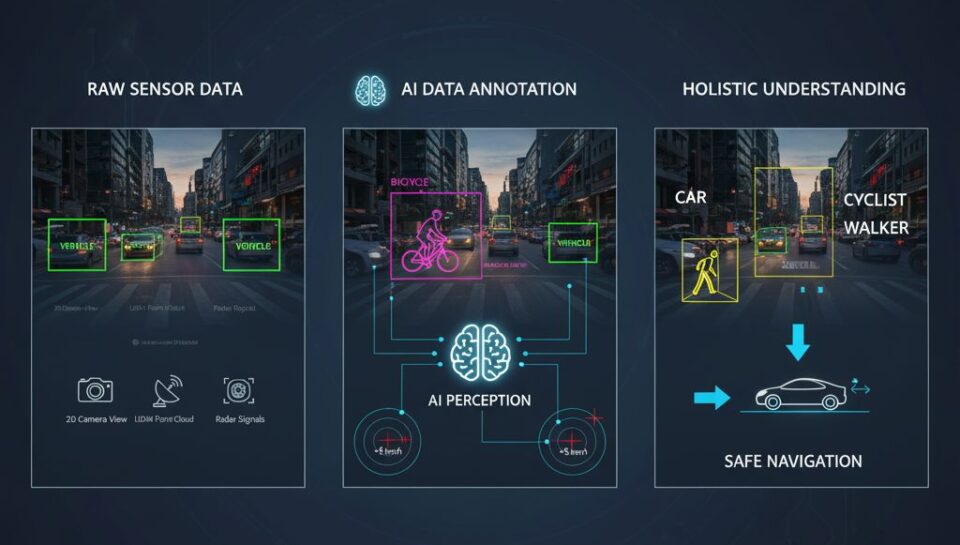
AI data annotation for autonomous vehicles involves labeling raw data—images, videos, LiDAR point clouds, and radar signals—so machine learning models can “see” and understand their surroundings.
Types of annotated data include:
- 2D Images: Bounding boxes and segmentation of vehicles, pedestrians, and road signs.
- Video Streams: Frame-by-frame tracking of dynamic objects.
- LiDAR Point Clouds: 3D cuboids and segmentation for distance and depth perception.
- Radar Data: Annotation for speed and object detection.
- Sensor Fusion: Aligning multiple sensors (cameras, LiDAR, radar) for a holistic view.
Why the U.S. Is a Hotspot for Autonomous Vehicle Development
- Massive Market Potential The U.S. is home to millions of vehicles and has a strong appetite for mobility innovation.
- Regulatory Push States like California and Arizona have created test-friendly environments for AVs.
- Tech Ecosystem With players like Tesla, Waymo, and Aurora, the U.S. has both startups and established OEMs pushing innovation.
- Safety Demands Given rising road accidents, accurate AI models trained with annotated data are essential for safer roads.
Why AI Data Annotation Matters for U.S. Autonomous Vehicles
- Safety and Accuracy Errors in annotation can cause misinterpretation of road scenarios, leading to accidents.
- Regulatory Compliance Autonomous vehicles in the U.S. must comply with strict safety standards. Annotated datasets provide auditable trails for compliance.
- Scalability Self-driving models require millions of annotated miles of data. Outsourcing makes this possible.
- Bias Reduction Diverse U.S. driving conditions—urban, rural, snow, rain—require broad datasets. Annotation ensures inclusivity.
- Faster Development High-quality annotated data accelerates testing and deployment.
Types of Annotation Techniques for Autonomous Vehicles
- Bounding Boxes Used to detect objects like cars, cyclists, and pedestrians.
- Semantic Segmentation Pixel-level labeling for detailed road scene understanding.
- 3D Cuboids for LiDAR Critical for depth and spatial analysis in self-driving systems.
- Polyline Annotation Used to annotate road lanes and curbs for navigation.
- Keypoint Annotation Tracking human posture and cyclist movement for predictive safety.
- Sensor Fusion Alignment Synchronizing camera, LiDAR, and radar data for comprehensive perception.
Challenges in AI Data Annotation for Autonomous Vehicles
- Scale of Data: Terabytes of data collected daily must be annotated.
- Complexity: Road environments vary drastically across the U.S.
- Real-Time Needs: Annotation must support models deployed in real-time scenarios.
- Bias Risks: Data must reflect diverse weather, geographies, and traffic patterns.
- Security: Sensitive driving data must remain secure and compliant with U.S. laws.
Benefits of Outsourcing AI Data Annotation for U.S. Autonomous Vehicles
- Access to Expertise: Trained teams understand AV-specific annotation requirements.
- Scalability: Providers can annotate millions of data points quickly.
- Cost Efficiency: Outsourcing reduces expenses compared to in-house annotation.
- Compliance Assurance: Certified vendors ensure regulatory alignment.
- Faster Deployment: Offshore and nearshore teams accelerate turnaround.
Case Examples
- Urban Driving: Annotated datasets of pedestrians and cyclists in New York City helped train urban navigation models.
- Adverse Weather: Labeled LiDAR data from snowy conditions in Michigan improved performance in extreme environments.
- Highway Driving: Annotated video of highway merges enabled safer lane changes.
How to Choose an AI Data Annotation Partner in the USA
- Proven AV Experience: Look for providers with autonomous vehicle case studies.
- Accuracy Benchmarks: Ensure >99% accuracy in LiDAR and image annotation.
- Security Standards: Verify ISO 9001 and ISO/IEC 27001 certifications.
- Scalability: Confirm capacity to handle terabytes of daily data.
- Technology Compatibility: Providers should integrate with AV development platforms.
- Transparent Reporting: Dashboards and QA systems ensure visibility.
Why U.S. Enterprises Choose Prudent Partners
Prudent Partners delivers trusted AI data annotation for autonomous vehicles in the USA with:
- 99%+ accuracy across image, video, LiDAR, and radar data
- ISO-certified processes ensuring security and compliance
- 300+ trained annotators specializing in AV datasets
- Prudent PlanWise, our performance management tool for real-time KPI tracking
- Experience supporting U.S. automotive, robotics, and AI startups
We enable U.S. enterprises to accelerate autonomous vehicle deployment with confidence.
Conclusion
The future of mobility in the U.S. depends on reliable AI. AI data annotation for autonomous vehicles ensures that models are accurate, safe, and compliant. By outsourcing to expert partners like Prudent Partners, American companies can scale their efforts, reduce risks, and bring self-driving cars closer to mainstream adoption.
FAQs
1. What is AI data annotation for autonomous vehicles?
It involves labeling images, video, LiDAR, and radar data to train AV models.
2. Why is annotation critical in the U.S.?
It ensures safety, compliance, and scalability across diverse driving conditions.
3. How does Prudent Partners support AV annotation?
Through ISO-certified processes, trained annotators, and transparent performance reporting via Prudent PlanWise.