
Ever wonder how a bustling hospital keeps running smoothly? While doctors and nurses are focused on patient care, a massive operational engine is working tirelessly behind the scenes. This engine handles everything from scheduling appointments and verifying insurance to managing medical coding and billing.
Business process outsourcing (BPO) in healthcare is the decision to bring in a specialized partner to run parts of that engine for you.
This is not just about handing off a to-do list; it’s about tapping into focused expertise and resources that can scale on demand. Many healthcare providers find their internal teams stretched thin, juggling complex administrative work that pulls them away from patients. By outsourcing these functions, you ensure that high-volume, repetitive tasks get handled with precision and consistency, delivering measurable impact on your bottom line and patient care.

The Core Idea Behind Healthcare BPO
At its heart, healthcare BPO is about letting specialists do what they do best. A cardiologist has deep expertise in heart health; a BPO provider has deep expertise in making administrative processes hum. The main goals are simple and powerful, providing actionable insights for your organization:
- Sharpen Operational Focus: Free up your clinical and administrative staff to concentrate on high-value activities and direct patient interaction.
- Boost Accuracy: Let dedicated teams with rigorous quality control minimize errors in critical areas like billing, coding, and data management.
- Scale with Ease: Quickly ramp your administrative capacity up or down to match fluctuating patient loads, all without the overhead of hiring permanent staff.
The scope of BPO in healthcare can be as narrow or as broad as you need, covering both back-office and front-office tasks. A clinic might start by outsourcing just one specific function, like prior authorizations, or an entire departmental workflow. The key is that effective business process management underpins this partnership, creating a seamless link between your core team and the outsourced experts.
Why Is This a Growing Trend?
Let's be honest: the healthcare industry is under immense pressure. We're all dealing with rising costs, labyrinthine regulations, and a constant scramble for skilled talent. BPO is a direct and practical response to these challenges.
The market growth tells the story. Projections show the global healthcare BPO market is set to explode, reaching between USD 554 billion and USD 694 billion by 2030. That growth is fueled by a compound annual growth rate (CAGR) of over 10%.
By outsourcing non-core functions, healthcare organizations can transform their back-office from a cost center into a strategic asset. It's about turning administrative processes into a source of efficiency and competitive advantage, ultimately supporting better health outcomes.
This is not a fluke; it's a fundamental shift in thinking. Healthcare leaders now recognize that operational excellence is not just a "nice-to-have." It is absolutely essential for financial stability and delivering quality care. Partnering with a BPO expert like Prudent Partners gives you the tools and talent to make that excellence a reality, ensuring accuracy and scalability for your operations.
Core BPO Services That Transform Healthcare Operations
The real value of business process outsourcing in healthcare is not just theory. It's about tackling the specific, high-friction tasks that drain resources and slow down operations. When you partner with a BPO expert, you're targeting the most time-consuming, complex, and critical administrative functions holding your organization back.
Let's break down the core services that solve these persistent challenges and create real, measurable value.

Revenue Cycle Management And Medical Billing
Revenue Cycle Management (RCM) is the financial lifeblood of any healthcare provider. It’s the entire journey from a patient's first appointment to the final payment, including insurance verification, coding, claim submission, and denial management. When any part of this cycle breaks down, cash flow grinds to a halt and administrative costs balloon.
Outsourcing RCM puts these critical tasks into the hands of certified specialists who live and breathe payer rules and coding updates.
- Medical Coding: Expert coders translate diagnoses and procedures into the right standardized codes (like ICD-10 and CPT). This precision is the foundation of a "clean" claim, minimizing rejections and getting you paid faster. For example, a hospital outsourcing its cardiology coding could see a 12% reduction in claim denials related to complex procedures, directly improving revenue capture.
- Claims Processing: A dedicated BPO team manages the entire claims lifecycle. They handle the submission, track its status, and aggressively follow up on any denials. Their only job is to get claims paid correctly and on time, freeing your team from hours of frustrating phone calls.
There's a reason RCM is one of the fastest-growing segments in healthcare BPO. Providers who bring in external specialists often see back-office cost reductions of 15% to 20%. For a large health system, that’s millions in annual savings.
Prior Authorization Services
We’ve all been there. Getting prior authorization from an insurer is a notorious bottleneck, delaying patient care and causing immense frustration. The process is painfully manual, demanding endless paperwork and persistent follow-up just to get a "yes."
Outsourcing this function to a healthcare-savvy BPO partner clears the logjam. Specialized teams take over the entire workflow, from submitting the initial request with all the correct documentation to chasing down insurers until approval is secured. This gets patients the treatments they need faster and lifts a huge administrative weight off your clinical staff. A real-world example is a multi-specialty clinic that reduced its average prior authorization turnaround time from 7 days to 2 days after outsourcing, leading to a significant increase in patient satisfaction.
Data Annotation For Medical AI
The next wave of healthcare innovation is being driven by artificial intelligence, from AI that helps radiologists spot diseases earlier to algorithms that predict which patients are at high risk. But here’s the catch: these powerful tools are only as smart as the data they learn from. This is where data annotation becomes a game-changing outsourced service.
High-quality, accurately labeled data is the fuel for reliable medical AI. Without precise human-in-the-loop annotation, even the most advanced algorithms will fail to deliver safe and effective results.
BPO partners like Prudent Partners provide teams of trained annotators who meticulously label medical images (X-rays, MRIs, ultrasounds) and clinical notes. They identify tumors, highlight anomalies, and structure unstructured text, creating the "ground truth" datasets needed to build and validate AI models. This highly specialized work is the foundation for any organization building healthcare AI tools. Reliable and scalable data entry outsourcing services are the backbone of this process.
Virtual Assistant Services
Beyond the highly specialized functions, healthcare organizations are also turning to virtual assistants (VAs) to handle a wide range of administrative and patient-facing tasks. These skilled professionals work remotely, offering flexible, on-demand support right where you need it most.
Common VA tasks include:
- Appointment Scheduling: Managing calendars, booking patient appointments, and sending out automated reminders.
- Patient Communication: Fielding routine patient questions by phone or email, which keeps your front-desk staff free for in-person needs.
- Telehealth Support: Helping patients get set up for their virtual visits and troubleshoot basic technical issues.
- Administrative Support: Taking on tasks like data entry, transcription, and keeping electronic health records (EHR) up to date.
To give a clearer picture, here’s how these services directly address common pain points and deliver tangible results.
Key Healthcare BPO Services At A Glance
| Service Area | Challenge Addressed | Typical Impact / ROI |
|---|---|---|
| Revenue Cycle Management | Delayed payments, high denial rates, administrative overhead | 15-20% reduction in back-office costs; 10-15% increase in clean claim rates |
| Prior Authorization | Care delays, staff burnout, patient dissatisfaction | 30-40% faster authorization turnarounds; frees up 10-15 hours of clinical staff time per week |
| Medical Data Annotation | Lack of high-quality data for AI model training | Enables development of accurate diagnostic AI; reduces time-to-market for new tools by 50% or more |
| Virtual Assistants | Overloaded front-desk staff, appointment no-shows | 20% reduction in patient no-show rates; improved patient satisfaction scores |
By targeting these specific areas, healthcare BPO moves from a simple cost-cutting measure to a strategic tool for improving efficiency, financial health, and even patient care.
Unlocking the Strategic Value of Healthcare Outsourcing
When people first talk about business process outsourcing in healthcare, the conversation usually starts and stops with cutting costs. But that’s only scratching the surface. The real return on investment is not just about the budget. It's about turning your administrative work from a necessary cost center into a strategic asset that fuels growth, accuracy, and agility.
The game changes when you stop asking, "How much can we save?" and start asking, "What can we gain?" The answer is simple: you gain access to specialized talent you can't find locally, achieve operational flexibility you never thought possible, and elevate the quality of your entire administrative workflow. These are the advantages that deliver compounding returns, strengthening your financial health and letting you focus on patient care.
Gaining Immediate Access to a Global Talent Pool
Finding, hiring, and keeping specialized talent is one of the biggest headaches in healthcare. The demand for certified medical coders, seasoned billing specialists, and sharp data annotators is way higher than the local supply in most places. This talent crunch drives up salaries and creates long hiring cycles, leaving you with constant operational bottlenecks.
Healthcare BPO cuts right through this problem by connecting you to a global pool of vetted experts.
- Specialized Skills on Demand: Partners like Prudent Partners have entire teams with deep expertise in areas like revenue cycle management and AI data quality assurance. You get their skills without the overhead of recruiting, training, and benefits.
- Focus on What Matters: When experts are handling your administrative tasks, your in-house teams are free to do what they do best, whether that's patient care, clinical research, or strategic growth.
This approach takes the risk out of your staffing strategy. Instead of fighting for a handful of local candidates, you tap into a dedicated, scalable workforce ready to go from day one.
Achieving Unmatched Operational Scalability
Healthcare workloads are never steady. A bad flu season or the launch of a new service line can completely overwhelm an internal team built for "average" capacity. You're left with a tough choice: burn out your staff with overtime or scramble through a costly and slow hiring process.
Outsourcing gives you a flexible, scalable alternative that matches your administrative muscle with your actual demand. Think of your back office less like a fixed switch and more like an adjustable dial. A BPO partner lets you turn that dial up or down as needed, so you only pay for what you actually use.
This operational elasticity is a huge strategic advantage. It lets healthcare organizations grow with confidence, adapt to market shifts, and handle seasonal peaks without the financial drain or logistical nightmare of a large, permanent administrative staff.
This model is a game-changer for growing practices or organizations expanding into new markets. It provides the support you need to scale without demanding a massive upfront investment in people.
Driving Accuracy and Quality Assurance
In healthcare administration, tiny errors create big problems. A single coding mistake can trigger a denied claim, stall reimbursement, and create hours of rework. In the AI world, inaccurate data annotation can completely undermine a promising new medical model. Better accuracy is not just about efficiency; it's about financial stability and clinical integrity.
Reputable BPO providers build their entire business on rigorous quality assurance (QA). Their teams operate within structured workflows with multiple layers of review and validation, a process that’s often too resource-intensive for a busy internal department to maintain. This obsession with precision leads to real, measurable improvements:
- Fewer Billing Errors: This means a higher clean claim rate and faster cash flow.
- Faster Reimbursements: You reduce the days in accounts receivable and strengthen your entire revenue cycle.
- Higher Quality Data: Your AI and analytics projects are built on a foundation of trustworthy information.
By partnering with an expert, you are not just offloading tasks; you're plugging into a proven system for getting things right. This commitment to quality transforms your back office from a potential source of errors into a source of reliability.
How to Ensure Security and HIPAA Compliance
In healthcare, data security is not just a technical detail; it's the bedrock of patient trust. When you partner with a business process outsourcing healthcare firm, you're not just offloading tasks; you're entrusting them with protected health information (PHI). That makes security and compliance completely non-negotiable. A breach is not just a system failure; it's a profound violation of that trust.
For any organization touching U.S. patient data, the conversation starts and ends with the Health Insurance Portability and Accountability Act (HIPAA). This federal law is the definitive standard for safeguarding sensitive health information. But simply claiming compliance is not enough. A truly reliable BPO partner builds their entire operation around HIPAA's principles, turning security from a checkbox item into a core business function.

Beyond HIPAA: The Global Standard of Security
While HIPAA is the law of the land in the U.S., a vendor’s deep commitment to security often shines through its adherence to global standards. Certifications like ISO/IEC 27001 are a clear signal of a mature and comprehensive approach to managing information security.
This is not just a certificate you hang on the wall. The international standard requires an organization to build, implement, and continuously improve a full-scale information security management system (ISMS). It’s a rigorous, third-party audited process that proves the BPO partner has robust controls for risk management, access control, and incident response. For any organization that needs the highest level of assurance, an ISO-certified partner is a massive advantage.
Core Security Measures to Demand From Your BPO Partner
When you’re vetting a potential partner, you have to look past the promises on their website. You need to see concrete security measures, the real-world defenses protecting your data day in and day out.
Your due diligence checklist should confirm a multi-layered security strategy:
- End-to-End Data Encryption: All data, whether it's moving between systems (in transit) or sitting on a server (at rest), must be encrypted with strong, industry-standard protocols. This ensures that even if data is intercepted, it remains completely unreadable.
- Strict Access Controls: The principle of least privilege should be law. This means an employee can only access the specific data and systems absolutely required for their job. Look for things like role-based access controls (RBAC) and mandatory multi-factor authentication (MFA).
- Continuous Security Monitoring: Proactive security is about watching the gates 24/7. A skilled security team should be using advanced tools to monitor networks and systems for any suspicious activity, ready to respond to potential threats in real time.
- Mandatory and Ongoing Training: Every single employee handling PHI must go through regular, documented training on HIPAA rules and internal security policies. This "human firewall" is one of your most critical defenses against social engineering and accidental data leaks.
Partnering with a BPO firm that holds both HIPAA attestation and ISO 27001 certification doesn't just transfer risk; it actively strengthens your organization's security posture. You gain access to a dedicated security infrastructure that may be more advanced than what you can maintain in house.
For functions like medical data annotation for AI, where huge volumes of sensitive images and text are handled, these security layers are especially vital. You can learn more about how we integrate these practices in our detailed guide on ensuring accuracy and compliance for U.S. healthcare AI. This commitment transforms a potential vulnerability into a solid advantage, safeguarding your data and your reputation.
Where Healthcare BPO is Headed: Tech, Talent, and the Future
So, what’s next for business process outsourcing in healthcare? The future is not about replacing people with technology; it's about fusing skilled human expertise with intelligent automation. As administrative work gets more tangled and complex, the best BPO partners are evolving past simple task execution. They’re building hybrid models where technology handles the grunt work, freeing up human experts to focus on the high-value critical thinking that actually matters.
This shift hinges on two key technologies: Artificial Intelligence (AI) and Robotic Process Automation (RPA). Together, they’re completely rewriting the rules for healthcare administration, turning back-office functions into lean, data-smart operations.
The Role of AI and Robotic Process Automation
Imagine an insurance claim comes in. In the old days, a human agent would have to eyeball every single line, check for mistakes, and confirm patient details. It’s slow and tedious. With modern tech, the workflow is night and day.
An RPA bot can instantly grab the claim, pull out the key data points, and check them against a list of rules. If it’s all good, the claim moves on. But if the bot spots a problem, say, a mismatched procedure code, it immediately sends the claim to a skilled human agent for review.
That’s the hybrid model in a nutshell.
- RPA for Repetitive Tasks: Bots are perfect for the high-volume, rules-based stuff like data entry, initial claims checks, and firing off automated appointment reminders. They run 24/7 with flawless consistency, wiping out human error on routine tasks.
- AI for Intelligent Analysis: AI takes things a step further by spotting complex patterns. For instance, an AI tool could sift through thousands of denied claims to predict which new ones are likely to get rejected, letting agents step in before it happens.
By automating the time-sucking initial steps, your skilled people can pour their energy into resolving tricky denials, navigating complex prior authorizations, and handling sensitive patient calls that require a real human touch.
A modern BPO partner doesn't just give you a workforce; they give you a technology-powered solution. This blend of smart automation and human judgment creates a system that’s faster, more accurate, and far more scalable than either could ever be alone.
Tapping into the Global Delivery Model
But technology is only half the story. The other crucial piece is getting access to specialized talent, no matter where in the world it is. This is where the global delivery model becomes a massive strategic advantage. It is not just about cutting labor costs; it’s about finding the absolute best people for the job.
For decades, countries like India and the Philippines have built deep benches of expertise in business process services. They offer huge, highly educated, and multilingual workforces that live and breathe the complexities of U.S. healthcare administration. This is about more than just labor arbitrage; it's about building dedicated teams that bring specialized skills and an incredible work ethic to your operations.
The global model gives you a few clear wins:
- Access to Specialized Talent: You can tap into a massive pool of certified medical coders, billing specialists, and data annotators without getting stuck in a competitive local hiring market.
- Around-the-Clock Productivity: By using teams in different time zones, the work never stops. Claims filed at the end of the U.S. business day can be processed overnight and waiting for you the next morning.
- Cost Effectiveness: Lower operational costs in global talent hubs mean you can scale your administrative muscle without breaking the bank.
Market analysis shows this powerful mix of tech and global talent is what’s pushing the industry forward. The entire structure of healthcare BPO today is built on technology-driven automation combined with global talent pools. Asia, especially India and the Philippines, continues to be a major delivery hub thanks to its large, skilled workforce and cost advantages, while North America and Europe remain the biggest buyers. Projections of 8–12% compound annual growth are tied directly to vendors investing in automation and analytics that supercharge productivity. To learn more, you can read the full market outlook on healthcare BPO's future growth.
This modern approach creates a solution where smart technology and a skilled global workforce come together to deliver efficiency and quality that was once unimaginable.
Choosing the Right BPO Partner for Your Needs
Picking a business process outsourcing healthcare partner is a major decision, one that will define your operations for years to come. The right partner becomes a true extension of your team, boosting efficiency and quality. Get it wrong, and you could introduce new bottlenecks, compliance risks, and endless headaches.
The whole process boils down to careful evaluation, a clear implementation plan, and a shared definition of success right from the start.
Making the right choice begins with asking the right questions. A thorough due diligence process helps you cut through the marketing noise and see a vendor’s real capabilities. It’s all about matching their expertise, security posture, and tech stack with your specific needs.
The best BPO partners today do not just throw more people at a problem; they blend smart automation with skilled human oversight. This creates a hyper-efficient workflow.
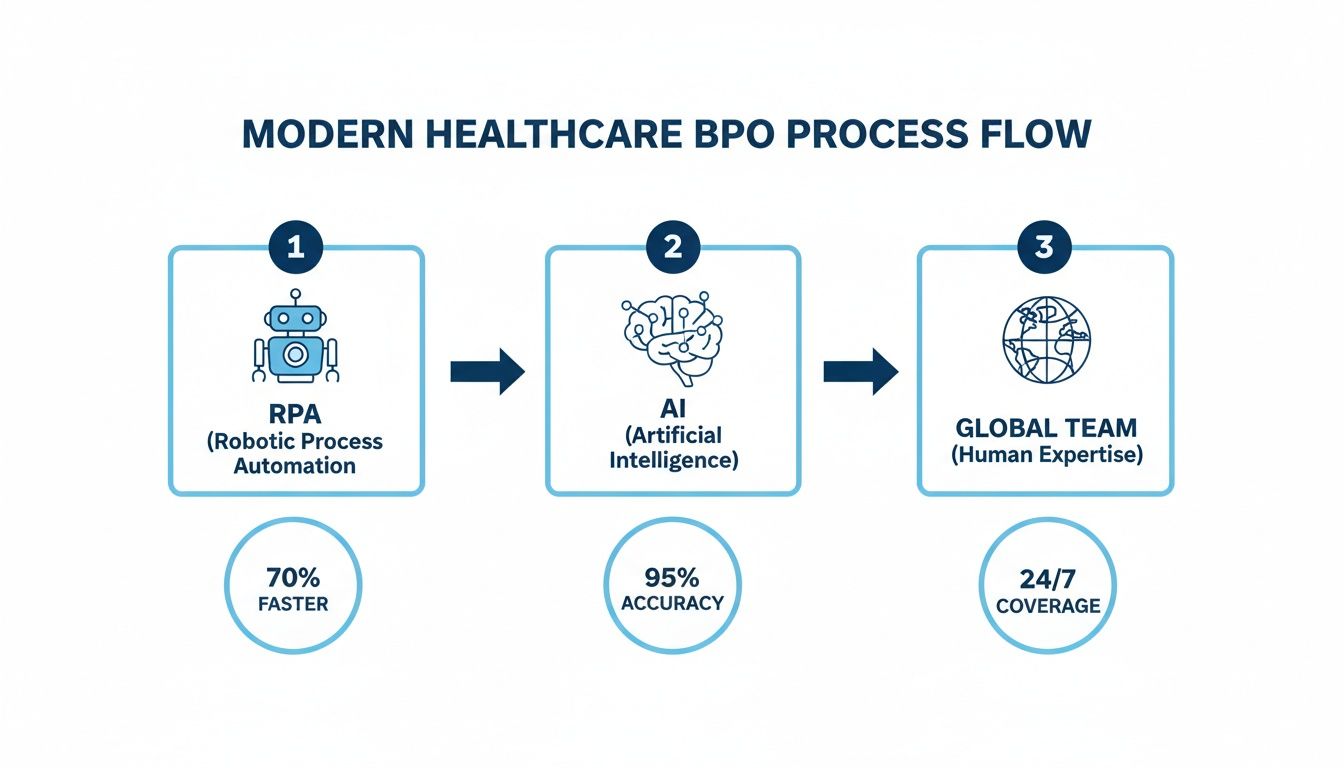
As you can see, Robotic Process Automation (RPA) can handle the repetitive, high-volume tasks. AI steps in for intelligent analysis, and a skilled global team manages the complex exceptions that always pop up. This is the new standard for efficiency.
Mapping Out the Implementation Plan
Once you've zeroed in on a partner, the next step is implementation. A well-defined roadmap is non-negotiable; it prevents confusion and ensures a smooth handoff from your internal team to the outsourced model.
- Discovery and Goal Setting: The relationship kicks off with a deep dive into your current processes, challenges, and goals. Together, you’ll define what a "win" looks like and set the Key Performance Indicators (KPIs) to measure it.
- Process Mapping and Training: The BPO partner documents your existing workflows and pinpoints opportunities for improvement. Their team then goes through rigorous, specific training to match your operational standards and culture.
- Pilot Program Launch: You do not go from zero to one hundred overnight. Start with a small, controlled pilot project. This is the perfect low-risk environment to work out any kinks before you scale.
- Performance Review and Scaling: After the pilot, you review the initial KPIs. Did you hit your targets? Based on those results, you can fine-tune the process and confidently expand the partnership's scope.
Choosing a partner is fundamentally about trust. Look for transparency in their processes, a willingness to conduct a pilot program, and a clear communication structure. This lays the groundwork for a successful long term relationship.
Setting clear metrics and milestones from day one is the key to a transparent, effective partnership. It makes sure everyone is on the same page and can measure the real impact of the work. To see how Prudent Partners puts these principles into action for complex AI projects, check out our approach to Generative AI Quality Assurance.
Your Due Diligence Checklist for Selecting a Healthcare BPO Partner
Before signing on the dotted line, you need a structured way to evaluate potential partners. This checklist ensures you cover all the critical bases, from their compliance paperwork to the tech they use every day.
| Evaluation Area | Key Questions to Ask | What to Look For |
|---|---|---|
| Industry & Service Expertise | How many years have you specialized in healthcare? Can you provide case studies for the exact service I need (e.g., medical coding, AI data annotation)? | A proven track record, not just generalist experience. Look for deep expertise in your specific niche and client references you can actually talk to. |
| Compliance & Security | Can you provide proof of your HIPAA compliance program? Are you ISO/IEC 27001 certified? How do you train your team on data privacy? | Don't accept verbal assurances. Ask for documentation, audit reports, and clear security protocols. A vendor's commitment to security reflects their professionalism. |
| Technology & Infrastructure | What platforms and tools do you use? How do you ensure data integrity and system uptime? Do you use automation like RPA to improve efficiency? | Modern, secure, and scalable technology. They should be able to explain how their tech stack reduces errors, improves speed, and protects your data. |
| Quality Assurance & KPIs | What is your QA process? How do you measure success and report on KPIs? What happens if performance targets are missed? | A multi-layered QA process with clear, transparent reporting dashboards. Look for a partner who is proactive about performance, not reactive. |
| Scalability & Flexibility | How quickly can you scale the team up or down? What is your process for handling sudden increases in volume? | A partner who can grow with you. They should have a clear plan for resource management and the ability to adapt to your changing business needs. |
This checklist is not just a formality; it's your defense against a bad partnership. Taking the time to be thorough here will save you immense trouble down the road.
Got Questions About Healthcare BPO? We've Got Answers.
Jumping into the world of business process outsourcing in healthcare can bring up a lot of questions. To help clear things up, we’ve put together straightforward answers to some of the most common things healthcare leaders ask us.
What Healthcare Services Are Outsourced Most Often?
The functions that get outsourced the most are usually the ones that are repetitive, time-consuming, and have a direct impact on your revenue cycle or patient satisfaction. This almost always includes medical billing and coding, claims processing, and the endless back-and-forth of prior authorization management.
Beyond that, we’re seeing a huge uptick in outsourcing for more specialized, tech-focused work. Think clinical data annotation to train medical AI models or deploying virtual assistants to handle scheduling and other administrative tasks that bog down your core staff.
How Does a BPO Partner Actually Stay HIPAA Compliant?
Any BPO partner worth their salt does not just "follow" HIPAA; they build their entire operation around it. Compliance is not a checkbox; it's a multi-layered security and privacy strategy woven into everything they do.
Here’s what that looks like in practice:
- Constant Employee Training: Every team member gets rigorous, ongoing education on how to protect sensitive patient health information (PHI). It is not a one-and-done deal.
- Serious Tech Safeguards: This means robust data encryption, secure networks, and strict role-based access controls so that only the right people see the right data, and nothing more.
- Ironclad Legal Agreements: The relationship is always governed by a formal Business Associate Agreement (BAA). This is a legal contract that binds the BPO provider to protect your data just as you would.
- Proactive Audits: They do not wait for a problem. Reputable partners conduct regular risk assessments to find and fix potential security weak spots before they can be exploited.
What’s the Difference Between Onshore and Offshore Outsourcing?
It really just comes down to location.
Onshore outsourcing means you’re working with a company located right here in your own country. The big win here is usually seamless communication, since you’re in the same time zone and share the same cultural context.
Offshore outsourcing, on the other hand, means partnering with a firm in another country, for example, a U.S. hospital working with a team in the Philippines or India. This can offer major cost advantages and the ability to have round-the-clock coverage. The right choice depends entirely on your specific goals for budget, coverage, and language needs.
Ready to see how a dedicated BPO partnership can fortify your operations and deliver results you can actually measure? The team at Prudent Partners is here to design a solution that fits your organization perfectly.
Contact us today to schedule your complimentary consultation.