
Data labeling outsourcing is the practice of engaging a specialized external partner to annotate raw data, such as images, text, or audio, preparing it for machine learning models. This approach allows your AI team to access expert-level quality and scale rapidly, freeing them to concentrate on core algorithm development rather than the repetitive, resource-intensive work of in-house labeling.
Why Data Labeling Outsourcing Is a Strategic Move
If you lead an AI team, you have likely encountered the in-house data labeling bottleneck. It is a common challenge. The reality is that creating high-quality training data is far more complex and demanding than it initially appears. It requires a significant investment to hire, train, and manage a workforce, not to mention building the robust quality control processes needed to ensure accuracy.
This is precisely why data labeling outsourcing has evolved from a simple cost-cutting tactic into a core strategic decision for forward-thinking AI teams.

Attempting to manage annotation internally often creates hidden operational drags that can stall innovation. Your highly skilled and compensated data scientists and ML engineers end up spending valuable hours on tedious labeling tasks, which is not their primary function. This misallocation of resources not only wastes talent but also delays project timelines and gives competitors an advantage.
Overcoming In-House Limitations
Building and maintaining an internal labeling team comes with a long list of significant hurdles that a specialized partner is purpose-built to overcome. The operational overhead alone can be staggering once you factor in salaries, benefits, office space, and the necessary software stack.
Furthermore, internal teams are often not structured for the elasticity that modern AI projects demand. One month you might need a small team for a pilot project, but the next month you could be facing millions of data points under a tight deadline. Scaling a full-time, in-house workforce up and down to meet such fluctuating demand is both impractical and incredibly expensive.
A strategic outsourcing partnership solves these core challenges head-on by delivering:
- Immediate Scalability: You gain instant access to a large, trained workforce ready to tackle projects of any size, from small-batch prototypes to massive production-level datasets.
- Cost Efficiency: Fixed overhead costs are converted into a variable operational expense. You only pay for the annotation services you need, when you need them.
- Enhanced Focus: Your internal experts are freed to concentrate on high-value activities that drive your business forward, like model architecture, research, and deployment.
Elevating Data Quality and Reliability
Beyond efficiency, the most critical reason to consider outsourcing is the relentless pursuit of uncompromising data quality. Reputable partners like Prudent Partners bring certified processes and a human-in-the-loop approach that transforms your raw data into a reliable, production-ready asset.
A successful AI model is built on a foundation of meticulously labeled data. Outsourcing to a partner with a dedicated multi-layer QA process ensures that every annotation meets the exacting standards required for building world-class AI.
This deep commitment to quality means your models are trained on data that is not just labeled, but accurately and consistently annotated according to your specific guidelines. That level of precision is absolutely essential for developing AI systems that perform reliably in the real world. It’s how you turn your data from a simple resource into a powerful competitive advantage.
Knowing When to Outsource Your Data Labeling
Making the leap to data labeling outsourcing is not just about choosing between building a team or buying a service. It is a strategic move, often prompted by specific growing pains. Most AI teams begin by labeling data themselves, and for early-stage prototypes, that approach works well. However, there is a clear tipping point where the DIY approach ceases to be an asset and starts to hinder progress.
Identifying these triggers early is crucial. The shift from a manageable in-house task to a full-blown operational bottleneck can happen quickly and catch even well-prepared teams by surprise. By recognizing the signs, you can pivot to a partnership model before your entire AI pipeline grinds to a halt.

When Your Project's Ambition Outgrows Your Team's Capacity
The most common signal is an explosion in the sheer volume of data. Your project might start with a few thousand images, something a small, dedicated team can manage. But what happens when that number jumps to millions of data points with a deadline that is weeks, not months, away?
This is where the in-house model crumbles. Suddenly, your core mission gets sidelined by the massive overhead of recruiting, training, and managing a large team of annotators. When you add aggressive project deadlines to the mix, it becomes nearly impossible for an internal team to deliver quality data on time without neglecting other critical work.
If your roadmap includes scaling up for new markets or launching new features, you are facing a scalability problem that outsourcing was designed to solve. A dedicated partner provides instant access to a trained, managed workforce, turning a major roadblock into a simple operational task.
The Need for Niche Domain Expertise
Let’s be honest: not all data is created equal. Labeling cats and dogs in photos is one thing. Annotating complex medical scans or dense legal contracts is entirely different. As soon as your projects move into specialized territory, the need for true subject matter experts becomes non-negotiable.
Consider these real-world scenarios:
- Medical AI: Accurately identifying tumors in MRI scans requires annotators who understand radiology. A single incorrect annotation is not just a data point; it is a potential patient safety issue.
- Geospatial Analysis: You cannot ask just anyone to label satellite imagery to spot specific agricultural diseases. It demands expertise in remote sensing and environmental science to achieve accuracy.
- Financial Document Processing: Extracting key information from complex financial reports for risk modeling requires individuals familiar with accounting rules and regulatory jargon.
In situations like these, data labeling outsourcing to a partner with proven domain knowledge is not just a good idea; it is the only way to achieve the required accuracy levels. It ensures your data is handled by professionals who understand the context and nuance of your field, which leads directly to more reliable AI models. You can see more about how we handle this with our high-accuracy AI data annotation services.
The decision to outsource often becomes clearest when the cost of an error is unacceptably high. For complex, high-stakes data, partnering with domain experts is a risk mitigation strategy.
Navigating Strict Security and Compliance Mandates
In today's regulatory landscape, you cannot afford to be casual about data security and compliance. As soon as you handle sensitive information like personal health information (PHI) or financial records, the risks multiply. For many companies, the strict requirements of certifications like ISO/IEC 27001 make building a compliant in-house operation impossibly expensive and complex.
This is a classic "buy, don't build" scenario. Outsourcing to a certified partner like Prudent Partners shifts that entire burden to an organization built from the ground up to meet these standards. It guarantees your data is handled in a secure, controlled environment, shielding you from devastating breaches and regulatory fines. When compliance is a deal-breaker, a certified partner is not just an option, it is a necessity.
This is part of a much larger trend. The data analytics outsourcing market is projected to grow by a massive USD 52.86 billion between 2024 and 2029, with specialized AI annotation being a huge driver of that growth. You can explore more of the market analysis on Technavio.
In-House vs. Outsourced Data Labeling: A Strategic Comparison
Deciding whether to build your own data labeling team or partner with an expert provider is a pivotal choice for any AI team. Each path comes with its own set of trade-offs in terms of cost, speed, quality, and focus. To make the decision clearer, we have broken down the key factors to consider.
| Factor | In-House Labeling | Outsourced Labeling (e.g., Prudent Partners) |
|---|---|---|
| Cost | High initial and ongoing costs (salaries, benefits, tools, management overhead). | Lower, predictable costs. Pay-per-task or FTE models avoid fixed overhead. |
| Scalability | Difficult and slow. Scaling up or down requires a lengthy hiring or layoff process. | Highly flexible. Instantly scale workforce up or down to meet project demand. |
| Speed & Time-to-Market | Slower due to recruitment, training, and management. Can become a bottleneck. | Faster project completion. Access to a large, pre-trained workforce accelerates timelines. |
| Quality & Accuracy | Quality can be inconsistent without dedicated QA processes and experienced managers. | High accuracy (>99%) is standard, backed by multi-layer QA and performance metrics. |
| Expertise | Limited to the knowledge of your internal team. Hard to find specialized domain experts. | Access to a deep pool of subject matter experts (e.g., medical, legal, finance). |
| Focus | Diverts focus from core AI R&D to managing a manual labeling operation. | Allows your core team to stay focused on model development and innovation. |
| Security & Compliance | The entire burden of achieving and maintaining certifications (ISO, HIPAA) is on you. | Certified providers handle compliance, reducing your risk and operational burden. |
Ultimately, the right choice depends on your organization's stage, resources, and strategic priorities. While in-house labeling can work for small, initial projects, outsourcing becomes a powerful strategic advantage when you need to scale quickly, ensure high accuracy in specialized domains, and maintain strict compliance, all without losing focus on your core mission.
How to Select the Right Data Labeling Partner
Picking the right data labeling partner is perhaps the most important decision you will make in your entire AI development journey. Get it right, and you will accelerate your roadmap. Get it wrong, and you will be dealing with inaccurate data, security headaches, and blown deadlines. The key is to look past the marketing fluff and find a team that truly operates as an extension of your own.
The market has exploded. What was once a niche task is now the standard way companies build AI training datasets. The scale of this shift is massive. Market.us projects the data labeling market will hit USD 19.7 billion in 2024, with outsourced providers capturing a staggering 85.6% of that revenue. The message is clear: very few organizations can successfully scale complex annotation projects on their own anymore. You can dig deeper into the growth of the data annotation market to see the trend.
Look for Verifiable Accuracy and Robust QA
Accuracy is the foundation of any good AI model, so your potential partner’s obsession with it should be your top priority. Vague promises of “high quality” are not sufficient. You need to get into the details of their Quality Assurance (QA) processes and see a concrete, repeatable system.
A top-tier partner will have a multi-layer QA framework designed to catch mistakes at every stage. This is not just a final check; it is a process integrated into their workflow from the start.
- Initial Annotation: A trained analyst performs the first pass according to your project guidelines.
- Peer or Senior Review: A second, more experienced analyst reviews 100% of that initial work to check for consistency and adherence to your rules.
- Project Lead Audit: A project manager or QA lead conducts final spot checks, often focusing on tricky edge cases or areas where the team previously made mistakes.
- Consensus-Based Labeling: For highly subjective tasks, multiple annotators label the same asset. The final "gold standard" label is decided by consensus or an expert adjudicator.
Your goal is to find a partner who aims for 99%+ accuracy and can show you exactly how they measure and achieve that target. Ask to see their performance dashboards or get access to their platform. This kind of transparency is a significant positive signal, indicating a confident, quality-driven organization.
Prioritize Security and Compliance Certifications
Data breaches are expensive and all too common, so you cannot afford to be lax on security. When you hand over your data, you are trusting a partner with one of your most valuable assets. Their security posture is non-negotiable.
The most important credential to look for is ISO/IEC 27001 certification. This is the global gold standard for information security management. It proves a vendor has implemented strict, audited controls to protect data. It is not just a certificate; it is a commitment to a culture of security.
Entrusting your data to a vendor is a significant leap of faith. Choosing a partner with globally recognized certifications like ISO 27001 transforms that leap into a calculated, secure business decision, ensuring your intellectual property is protected by proven, audited processes.
Beyond certifications, ensure the vendor has tight internal rules. Every single annotator should be under a comprehensive Non-Disclosure Agreement (NDA). If your data is sensitive, ask if they can work within your secure cloud environment or offer isolated, access-controlled workspaces. A partner who takes security seriously will welcome these questions and have clear, reassuring answers. Our own approach to high-accuracy AI data annotation services is built on this very foundation of security and trust.
Assess True Scalability and Domain Expertise
Scalability is not just about having a large headcount. True scalability means having a stable, well-trained workforce that can expand to meet your project's needs without a decline in quality. Ask potential partners about their workforce stability, how they train their teams, and how they handle sudden spikes in volume. A provider that relies on an unstable, untrained crowd will inevitably fail you when you need to scale up.
Just as important is domain-specific expertise. If your project involves medical imaging, legal documents, or autonomous vehicle data, generic annotators will not suffice. You need a partner with a proven track record in your specific field.
For example, annotating a prenatal ultrasound requires a real understanding of fetal anatomy. Labeling financial contracts for risk analysis demands familiarity with legal and financial jargon. A partner with genuine domain expertise will produce more accurate labels and understand the nuances and edge cases unique to your industry. This kind of insight is invaluable and can improve your entire project. Always ask for case studies and references from clients in your vertical to back up their claims.
Structuring Your Project for Success
Picking a partner is a huge step, but now the real work begins. A successful outsourcing relationship does not just happen. It is built on a foundation of crystal-clear communication, solid expectations, and a setup that gets your team and your vendor aligned.
This whole process kicks off long before a single data point gets labeled. It starts with crafting a smart Request for Proposal (RFP) and designing a pilot project that actually puts a vendor's promises to the test.
Designing an Effective Pilot Project
Think of a pilot project as your single best tool for vetting a potential partner. It is where the conversation shifts from sales pitches to real-world results using your data. A well-designed pilot should be a miniature version of your full-scale project, complex enough to show you what a vendor is really made of.
Here is a pro tip: do not give them your easy, "clean" sample data. Throw them a curveball. Hand over a dataset that includes the tricky edge cases and ambiguous examples your full project will inevitably have. This is how you test their problem-solving skills and the strength of their QA process, not just their ability to follow a simple script.
Your pilot should be designed to answer a few critical questions:
- Quality and Accuracy: Can they consistently hit your accuracy targets, even on the tough stuff?
- Communication and Responsiveness: How fast and effectively do they handle questions and feedback? Are they proactive?
- Process Adaptability: Can they tweak their workflow to fit your needs and integrate feedback without a fuss?
The goal of a pilot isn't just to see if a vendor can label data. It's to see if they can think like a partner, spot potential issues before they become problems, and work with you to nail down the process for the long haul.
This whole evaluation process boils down to a few key pillars.
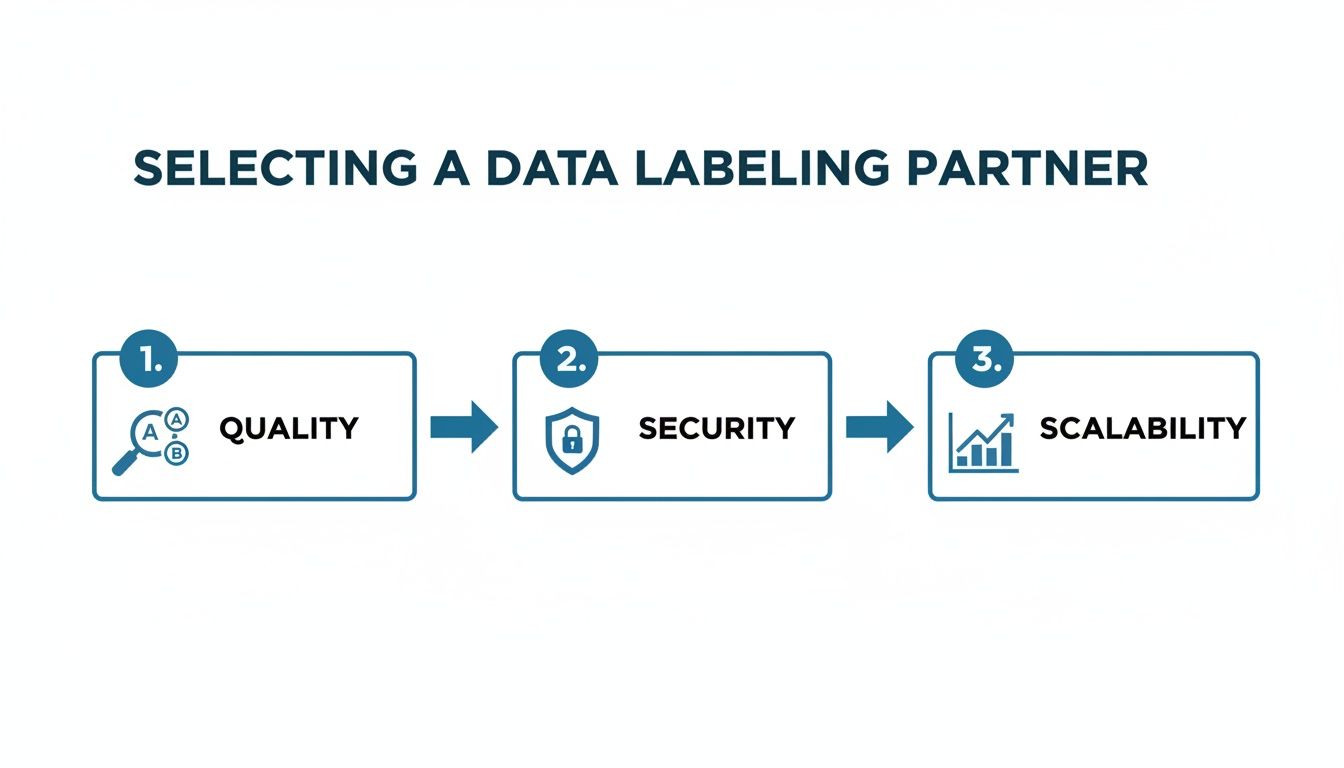
As you can see, a great partnership is all about balancing proven quality, ironclad security, and the ability to scale up without things falling apart.
Establishing Clear Service Level Agreements
Once you have found your partner, it is time to make it official with clear Service Level Agreements (SLAs). SLAs are not just legal boilerplate; they are the operational rulebook for your project. They define everyone's expectations and create a framework for accountability.
A strong SLA needs specific, measurable metrics. Vague goals just lead to headaches down the road. Instead, get granular with quantifiable targets for:
- Accuracy: Define the minimum acceptable accuracy rate, often aiming for 99% or higher. Be specific about how you will measure it, whether through gold-standard datasets or consensus scoring.
- Throughput: State exactly how much data needs to be annotated per day, week, or month. This keeps your project aligned with your development timeline.
- Turnaround Time: Set clear expectations for how quickly data batches will be completed. This is crucial for keeping your model training cycles moving.
These agreements give you a clear baseline for judging performance and make sure everyone agrees on what "success" actually looks like.
Navigating Pricing Models
Data labeling services come with a few different price tags. The right one for you will depend on your project's scale, complexity, and how long it will run. The most common models you will encounter are:
- Per Task or Per Annotation: This is your best bet for simple, high-volume jobs like drawing bounding boxes or basic image classification. You pay a fixed price for each labeled item, which makes your costs predictable and easy to manage as you scale.
- Per Hour: If you have a more complex or subjective task like detailed semantic segmentation or analyzing nuanced text, an hourly rate makes more sense. It compensates the annotators for the brainpower and expertise required.
- Full-Time Equivalent (FTE): For long-term, ongoing projects with needs that might fluctuate, dedicating a team via an FTE model offers the most flexibility. You get a consistent, trained crew for a fixed monthly cost.
A good partner will sit down with you and figure out the most cost-effective and transparent model for your specific situation.
Building a Collaborative Partnership
The best outsourcing engagements are true partnerships. This means doing more than just tossing data over the fence and waiting for labels to come back. It requires a structured onboarding process, open lines of communication, and a constant feedback loop.
A formal onboarding ensures the vendor’s team understands your project's goals, nuances, and overall context. This is where you work together to build out a detailed instruction manual. To see what a great one looks like, check out our guide on creating effective annotation guidelines.
On top of that, set up dedicated communication channels, like a shared Slack channel or regular video check-ins. This helps build a "one team" mentality. This continuous feedback is vital for improving quality on the fly, letting you quickly fix issues, refine instructions, and adapt to new challenges as your project grows.
Common Outsourcing Pitfalls and How to Avoid Them
Even with a great vendor, outsourcing data labeling is not always a straight line to success. There are a few common bumps in the road that can derail a project if you are not prepared for them. The key is knowing what these challenges are ahead of time so you can build a strategy to sidestep them entirely.
Fortunately, nearly all of these problems are preventable with the right planning and communication. Let’s walk through the most common pitfalls and cover some practical ways to keep your project on track.
Pitfall One: Underestimating Guideline Ambiguity
This is, without a doubt, the number one mistake teams make. You provide annotation guidelines that seem perfectly clear to you, but to an outside team, they are full of holes. What feels obvious to your internal team, who lives and breathes this project every day, is often a mystery to your partner.
Ambiguous instructions are the single biggest cause of inconsistent labels and expensive, time-consuming rework.
For instance, simply telling an annotator to "label all cars" is a recipe for failure. What constitutes a car? Does it include pickup trucks? What about vans? How do you handle a vehicle that is 80% hidden behind a building? Without crystal-clear rules, every annotator will invent their own, and you will end up with a dataset riddled with inconsistencies.
How to Avoid This:
- Co-create an Instruction Manual: Do not just hand over a document. Work with your vendor to build a living guide packed with visual examples of correct and incorrect labels, especially for tricky edge cases.
- Add a "Do Not Label" Section: It is just as important to define what not to label as it is to define what to label. This single step eliminates a huge source of confusion.
- Run a Calibration Phase: Before kicking off the full project, have your team and the vendor's team label the exact same small batch of data. Get on a call, compare the results, and resolve any disagreements. This surfaces misunderstandings before they impact thousands of images.
Pitfall Two: The False Economy of the Lowest Bid
It is tempting to just pick the vendor with the lowest price tag, but this is a dangerous trap. Rock-bottom pricing often comes with hidden costs you will pay for later in poor accuracy, blown deadlines, or even serious security breaches. The cheapest option is almost never the best value.
A vendor who is cutting corners on price is probably also cutting corners on annotator training, multi-layer QA, and security protocols. This leads to a low-quality dataset that your own engineers have to waste time cleaning up, which completely defeats the purpose of outsourcing. You can learn how to evaluate a vendor’s full capabilities by conducting a thorough data annotation assessment.
Selecting a vendor on price alone is a short-term saving that often leads to long-term pain. The true cost of a partnership is measured by the quality of the final data and the reliability of the process, not the initial quote.
Pitfall Three: Failing to Plan for Edge Cases
Sooner or later, your AI model is going to encounter something unexpected in the real world. If your training data only contains clean, straightforward examples, your model will be brittle and fail when it faces the unexpected. Too many teams focus on the "happy path" and forget to plan for the messy reality of edge cases.
Think about an autonomous vehicle model trained only on images from sunny, clear days. The first time it sees heavy fog, a snow-covered road, or the confusing glare of wet asphalt at night, its performance could drop off a cliff.
How to Avoid This:
- Actively Hunt for Edge Cases: Dedicate a specific part of your data collection and labeling budget to finding and annotating these rare but vital scenarios.
- Create an Escalation Channel: Give annotators a clear, simple way to flag confusing examples they cannot solve. This turns your labeling team into a powerful data discovery engine.
- Iterate on Your Guidelines: Use the edge cases your annotators find to constantly update and improve your instruction manual. This feedback loop makes your entire process smarter over time.
Let’s Turn Your Data Into an Asset
When you get data labeling right, it is not just a task you check off a list; it becomes a strategic partnership. The journey from messy, raw data to a high-performing AI model is built on a foundation of accuracy, security, and the ability to scale. At Prudent Partners, our entire process is designed to be that foundation for your most important projects.

With our ISO-certified workflows, a dedicated team of over 300 expert analysts, and an obsessive focus on achieving 99%+ accuracy, we deliver the high-quality data engine your AI initiatives need to succeed. We manage everything through our Prudent Prism platform, giving you transparent reporting and complete visibility into your project's performance at all times.
Choosing a partner is about more than just getting data labeled; it's about building a reliable process that accelerates innovation. A true partnership delivers the quality, security, and scale needed to turn ambitious AI goals into reality.
Let's have a real conversation about how our solutions can help you solve your specific data challenges. We are here to help you transform your data from a simple cost center into a true competitive advantage.
Ready to get started? Schedule a consultation with our experts today.
Frequently Asked Questions About Data Labeling
When you are looking into outsourcing data labeling, a lot of questions pop up, mostly around the process, how your data is handled, and what it is all going to cost. Getting straight answers is the only way to feel confident about bringing a partner on board.
Here are a few of the most common questions we hear from AI teams and business leaders, along with some no-nonsense answers.
How Do You Ensure Labeling Quality and Accuracy?
You cannot build great AI on shaky data. That is why top-tier vendors do not just do a quick final check; they build quality assurance (QA) into every step of the process. For us at Prudent Partners, it all starts with intensive, project-specific training for every single analyst.
Our workflow is designed to catch errors before they ever become a problem:
- First, a trained specialist completes the initial round of annotation.
- Next, a senior analyst or QA expert independently reviews that work. It is never the same person doing both.
- Finally, a project manager audits the batch to settle any disagreements and ensure everything aligns with the guidelines.
We often use a consensus model, where multiple annotators label the same asset. If their labels do not match, the data is automatically flagged for a subject matter expert to review. This multi-layered approach, combined with real-time reporting you can see in platforms like Prudent Prism, is how we consistently hit 99%+ accuracy.
What Are the Typical Pricing Models?
Pricing for data labeling outsourcing is not one-size-fits-all. It really depends on your project's complexity and scale. Generally, you will see three main models: per-task, per-hour, or a dedicated team (FTE).
- Per-task pricing is straightforward and predictable. It is perfect for high-volume, repetitive jobs like drawing bounding boxes or simple image classification.
- Per-hour pricing makes more sense for complex tasks that require deep focus, like intricate semantic segmentation or analyzing nuanced text where an annotator needs time to think.
- An FTE model gives you a dedicated, managed team for a flat monthly rate. This is the best fit for long-term projects where the requirements might shift over time.
We always work with our clients to figure out which structure gives them the most value and transparency for their specific goals.
How Is Sensitive or Confidential Data Handled?
This is non-negotiable. Any partner you consider must have rock-solid, verifiable security protocols. At Prudent Partners, we are ISO/IEC 27001 certified, which is the global gold standard for information security. It is not just a piece of paper; it dictates everything we do.
Every analyst we employ is bound by a comprehensive Non-Disclosure Agreement (NDA). All data is handled in secure, access-controlled environments, and we are flexible enough to work within your own setup, like a client-specific virtual private cloud (VPC).
This layered approach guarantees that your data is encrypted and handled in line with global privacy laws, giving you complete peace of mind.
At Prudent Partners, we turn messy data challenges into the reliable, high-quality fuel your AI models need. Let's talk about how our certified teams and battle-tested processes can get your AI initiatives moving faster.