
The success of any artificial intelligence model, from computer vision to large language models, hinges directly on the quality of its training data. Without accurately annotated datasets, even the most sophisticated algorithms will fail to perform. This process of labeling raw data, known as data annotation or data labeling, is a critical, yet often complex, step in the machine learning lifecycle. Choosing the right data labeling tools is paramount to achieving the necessary accuracy, efficiency, and scalability for your AI initiatives.
This guide is designed to help you navigate the crowded market of annotation platforms and services. We provide a comprehensive, comparative analysis of the top solutions available, moving beyond surface-level feature lists to offer practical insights. You will find detailed breakdowns of leading platforms like Labelbox, Scale AI, and V7, as well as open-source options such as CVAT and Label Studio. Each review is structured for clarity, including direct links and screenshots, to help you quickly assess if a tool aligns with your specific needs.
Whether you're an AI team leader at a large enterprise, a data scientist at a fast-growing startup, or a project manager in a specialized field like medical imaging or geospatial analysis, this resource will equip you to make an informed decision. We will explore key differentiators across deployment models, annotation types, quality assurance workflows, and pricing structures. We also compare the benefits of using a DIY software platform versus partnering with a managed service provider like Prudent Partners for end-to-end data operations. Our goal is to simplify your evaluation process and connect you with the ideal solution to power your next AI breakthrough.
1. Prudent Partners LLP
Prudent Partners LLP is not a self-service software platform but a specialized, fully managed data annotation and business process support service. It stands out for organizations that prioritize guaranteed accuracy, stringent security, and operational transparency without dedicating internal engineering resources to managing labeling tools or workforces. As a managed service provider, Prudent delivers high-precision data labeling services across a comprehensive range of data types, including images, video, LiDAR, text, and audio.
This provider is particularly well-suited for high-stakes industries like healthcare, cybersecurity, and insurance, where data quality and compliance are non-negotiable. Their ISO 9001 and ISO/IEC 27001 certifications provide verifiable assurance of their commitment to quality management and information security protocols, a critical differentiator for enterprises handling sensitive data.
Key Strengths & Use Cases
A significant advantage of working with Prudent is their human-in-the-loop, multi-layered quality assurance process. With a team of over 300 trained analysts, they consistently target an accuracy rate of 99% or higher. This process is made transparent to clients through proprietary performance tracking dashboards like Prudent Prism and Prudent PlanWise, which provide real-time visibility into productivity, quality metrics, and turnaround times.
This makes them an ideal choice for complex, large-scale projects. For example, in healthcare, they have successfully executed prenatal ultrasound annotation. In the insurance sector, their teams have annotated aerial imagery to identify roof damage for risk assessment. Their work in e-commerce includes detailed product matching and packaging annotation to streamline catalog management.
One of their most modern offerings is Generative AI quality analysis. Prudent’s teams can validate model outputs for tasks like NER, sentiment analysis, and summarization, providing crucial human feedback on AI performance without requiring any engineering changes from the client.
Engagement & Pricing
Prudent Partners' engagement model is designed to minimize risk. It begins with a detailed consultation to scope project requirements, followed by a free pilot to validate workflows and quality benchmarks before a full-scale rollout. Pricing is customized based on project complexity, volume, and required SLAs; there are no public rate cards. This bespoke approach, while requiring an initial consultation, ensures the final pricing structure is aligned with specific client needs.
Website: https://prudentpartners.in
2. Labelbox
Labelbox positions itself as a comprehensive "data engine," extending beyond simple annotation to cover the full AI data lifecycle. It's an excellent choice for teams that require an integrated platform for data curation, labeling, and model evaluation, all under a single roof. The platform supports a wide range of data types, including text, image, video, and audio, making it one of the more versatile data labeling tools available.
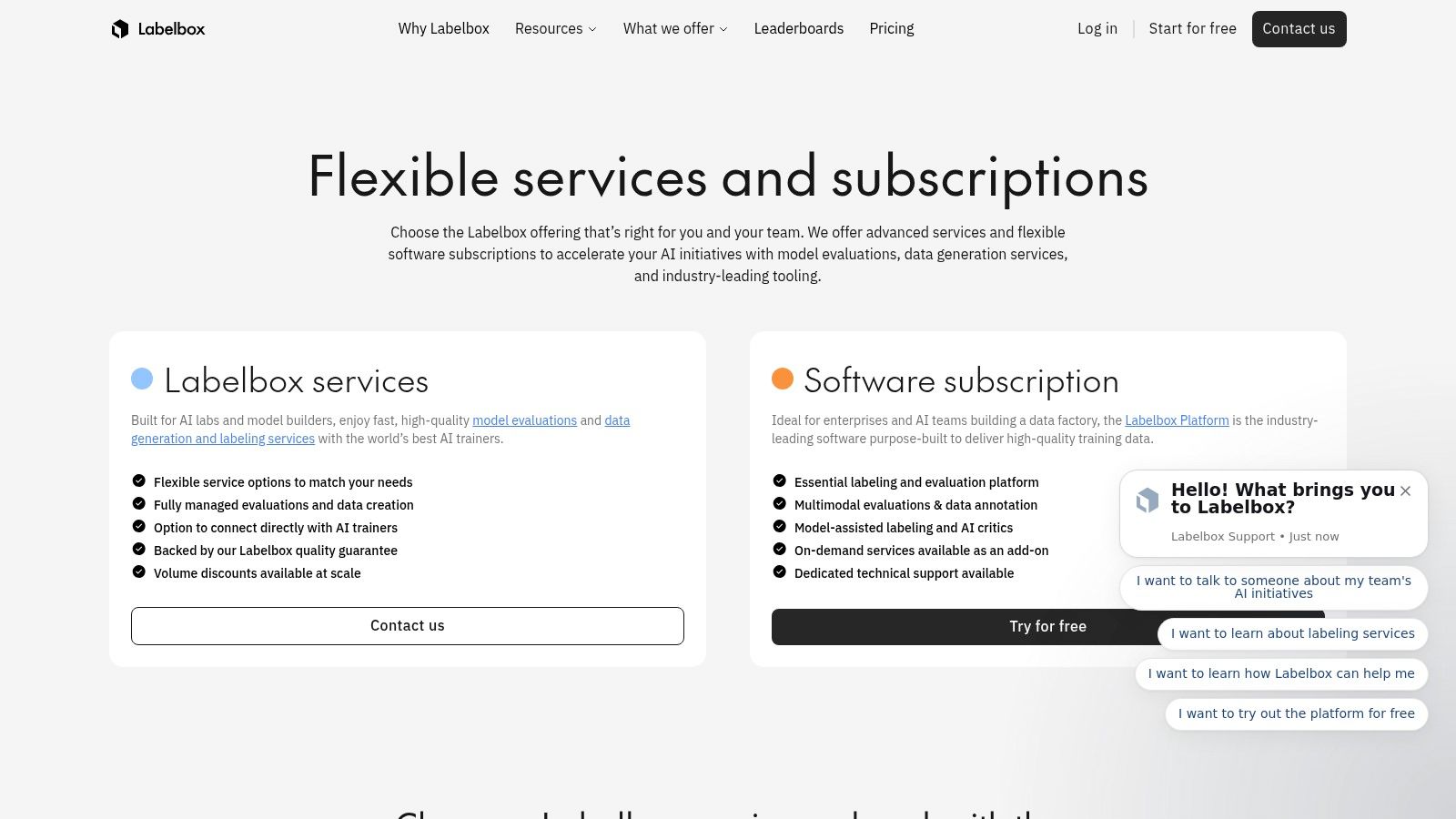
What sets Labelbox apart is its unified workflow across its Catalog, Annotate, and Model modules. This allows teams to find unstructured data, label it efficiently with model-assisted tools, and then analyze model errors to prioritize the next batch of data for labeling. For organizations scaling their AI initiatives, this iterative loop is crucial for improving model performance systematically.
Pricing and Access
Labelbox offers a clear tiered pricing structure designed for different team sizes and needs. A generous free tier supports up to 30 users and 50 projects, making it highly accessible for startups and academic research. Paid plans operate on a usage-based model calculated in Labelbox Units (LBUs), which can require some initial estimation but offers flexibility. Enterprise-grade features like SSO, advanced security, and HIPAA compliance are available on higher-tier plans, catering to regulated industries like healthcare. Get started with Labelbox.
Key Features and Considerations
- Model-Assisted Labeling: Integrates your own models to pre-label data, significantly accelerating annotation workflows.
- Integrated Data Curation: The "Catalog" feature helps teams explore, visualize, and curate datasets before labeling begins.
- On-Demand Services: For teams needing to offload annotation work, Labelbox provides managed labeling services with quality guarantees. For a deeper understanding of how managed services can enhance AI model reliability, you can learn more about the benefits of professional AI annotation services.
- Pricing Model: The LBU-based pricing is flexible but may present a learning curve for teams accustomed to per-seat or per-hour models.
3. Amazon SageMaker Ground Truth (and Ground Truth Plus)
For teams deeply embedded in the AWS ecosystem, Amazon SageMaker Ground Truth offers a native, highly integrated solution for building high-quality training datasets. It simplifies the process of labeling data by providing built-in workflows and interfaces for common tasks across images, video, text, and 3D point clouds. The platform is designed for scalability and leverages the broader AWS infrastructure for security and data management.
What truly sets Ground Truth apart is its flexible workforce options and tight integration with the SageMaker machine learning pipeline. Users can choose between their own private labelers, a curated vendor workforce, or the public Amazon Mechanical Turk workforce. The more recent addition of Ground Truth Plus provides a fully managed service, where AWS experts handle the entire labeling workflow, which is ideal for teams needing to offload operational burdens while maintaining high accuracy for their AI models.
Pricing and Access
SageMaker Ground Truth operates on a pay-as-you-go pricing model, typical of AWS services. Costs are calculated per labeled object, and the price varies significantly based on the data type and the workforce selected (private, vendor, or Mechanical Turk). Ground Truth Plus has its own project-based pricing. This model offers great flexibility but requires careful cost management, as expenses are directly tied to usage. The primary benefit is that you only pay for what you use, without upfront commitments. Explore SageMaker Ground Truth pricing.
Key Features and Considerations
- Flexible Workforce Management: Choose from private teams, third-party vendors, or Amazon Mechanical Turk to find the right balance of cost, quality, and expertise.
- Active Learning Capabilities: The platform includes automated data labeling features that use a machine learning model to label a portion of the dataset, reducing the manual annotation workload and associated costs.
- Deep AWS Integration: Seamlessly connects with Amazon S3 for data storage, AWS IAM for security, and the broader SageMaker suite for model training and deployment.
- Pricing Complexity: The per-task, pay-as-you-go model is powerful but can be difficult to forecast accurately, especially for large or complex projects. It delivers the most value for teams already heavily invested in AWS infrastructure.
4. Scale AI (Rapid, Studio, Managed Services)
Scale AI offers a mature, end-to-end data platform designed for enterprise AI teams that need to manage large-scale labeling operations with high accuracy. It provides a flexible suite of tools and services covering a broad spectrum of data types, including images, video, LiDAR, documents, text, and audio. This makes Scale a powerful choice for organizations with diverse data needs, from autonomous vehicle development to natural language processing.
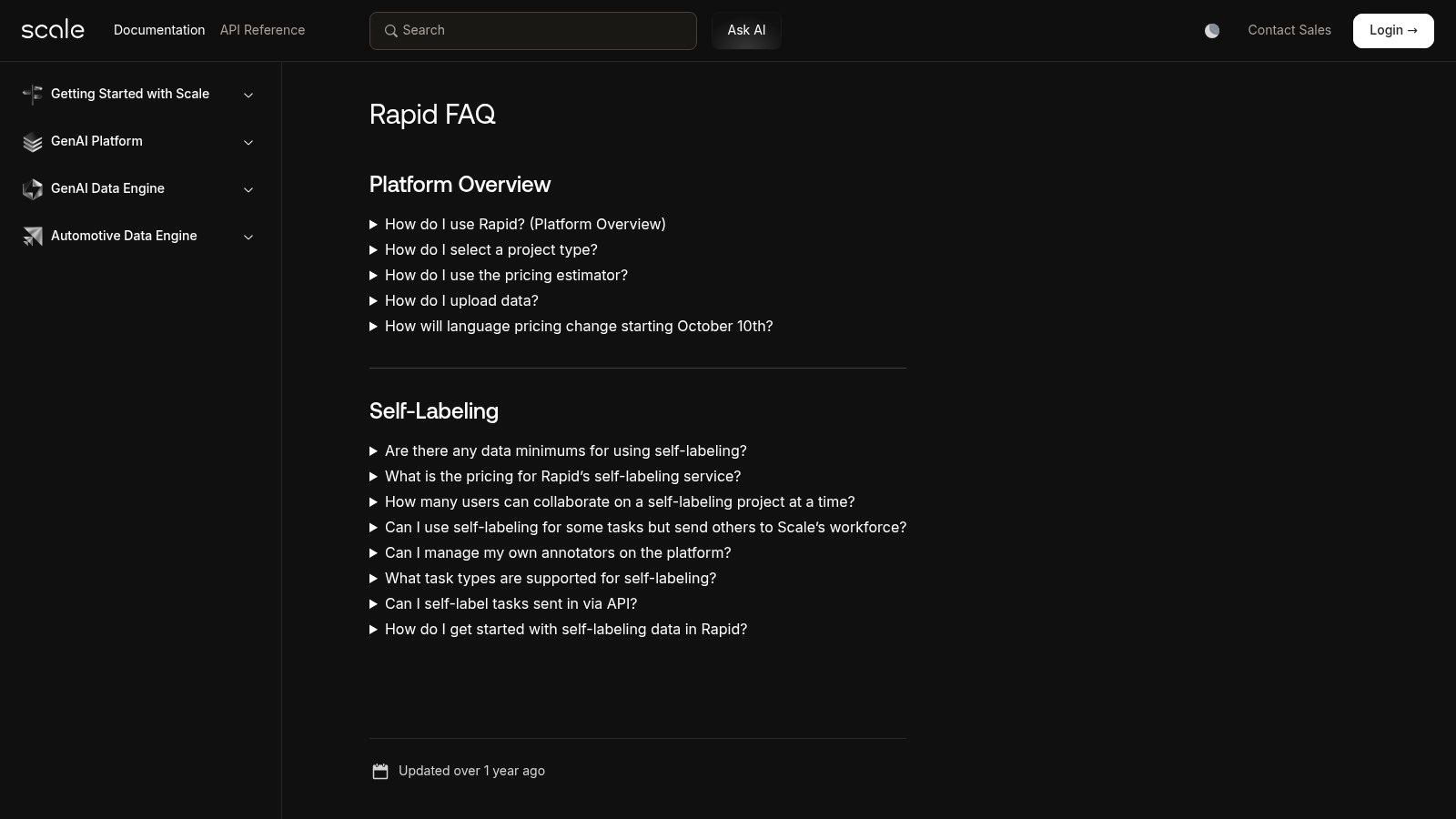
What distinguishes Scale is its multifaceted approach to data annotation. Teams can use Scale Rapid for quick, self-service labeling, Scale Studio to manage their own workforce with enterprise-grade tools, or leverage Scale's fully managed labeling services for complex projects requiring expert oversight. This operational flexibility allows organizations to mix and match solutions based on project requirements, budget, and in-house capacity.
Pricing and Access
Scale's pricing is tailored to its different offerings. Scale Rapid includes 200 free labeling units per month, allowing teams to experiment and handle small projects without initial investment. For larger, ongoing needs, pricing for Studio and their managed services is typically sales-led and customized for enterprise clients, which can make initial cost estimation less transparent. You can find basic information and get started through the Scale Rapid FAQ.
Key Features and Considerations
- Flexible Workforce Models: Choose between self-service (Rapid), bringing your own labelers (Studio), or using Scale's expert workforce, providing a solution for nearly any operational setup.
- Broad Modality Support: Comprehensive coverage for advanced data types like 3D sensor fusion and large language model (LLM) instruction tuning sets it apart from many other data labeling tools.
- Managed Services at Scale: For teams looking to offload the entire annotation pipeline, Scale provides robust, expert-managed services. To better understand the strategic advantages of this model, consider exploring insights on why U.S. companies partner with global experts for data labeling.
- Opaque Enterprise Pricing: While powerful, the cost for enterprise and managed services is not publicly listed and requires direct consultation, which may not suit teams needing immediate budget clarity.
5. SuperAnnotate
SuperAnnotate positions itself as a comprehensive platform for building higher-quality training data, combining powerful tooling with integrated workflow orchestration. It is particularly well suited for teams that need robust collaboration features and AI-assisted labeling across multiple data types, including images, video, text, and audio. The platform is designed to manage the entire data pipeline from annotation to data curation and quality assurance.
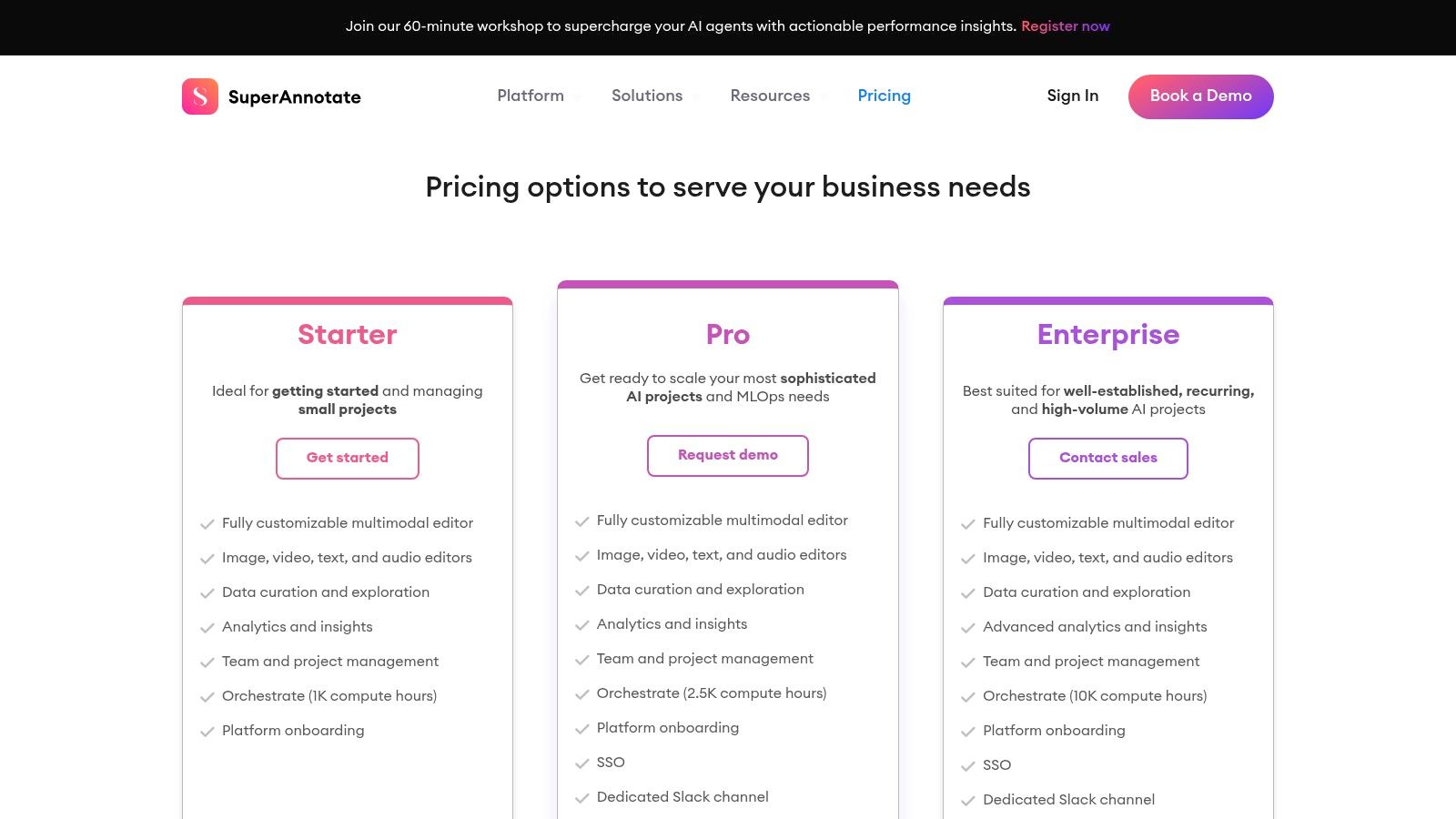
What distinguishes SuperAnnotate is its focus on mature team management and project orchestration. Advanced analytics and quality assurance workflows are built directly into the platform, allowing managers to monitor annotator performance, track project progress, and enforce high standards efficiently. This emphasis on process control makes it a strong contender among data labeling tools for organizations scaling their annotation operations and requiring granular oversight.
Pricing and Access
SuperAnnotate offers several pricing tiers to accommodate different needs, starting with a free plan that supports up to three users and provides a solid entry point for small teams or pilot projects. Paid plans include Starter, Growth, and Enterprise options, with increasing feature access, support levels, and usage limits. While specific per-feature limits can be gated behind plan selection, the structure is designed to scale with your team's complexity and data volume. Learn more at SuperAnnotate.
Key Features and Considerations
- Multimodal Annotation Editors: Provides highly customizable editors for a wide range of data types, enabling complex annotation tasks across various AI use cases.
- Team and Project Orchestration: Includes powerful features for managing workflows, assigning tasks, and analyzing team performance with detailed analytics.
- AI-Assisted Labeling: Incorporates auto-labeling and other AI-powered tools to accelerate the annotation process and improve consistency.
- Gated Enterprise Features: The most advanced capabilities and detailed pricing information are reserved for higher-tier plans and often require a demo, which may be a consideration for teams needing immediate clarity on cost.
6. V7 (Darwin)
V7 presents itself as an intelligent data platform built for complex computer vision tasks. Its core offering, Darwin, is designed for organizations that need highly automated and accurate labeling for image, video, medical, and 3D data types. The platform is particularly strong in its model-in-the-loop capabilities, where AI models actively assist human annotators to create a highly efficient workflow. This makes it a powerful option for enterprise-level teams focused on scaling their AI initiatives with precision.
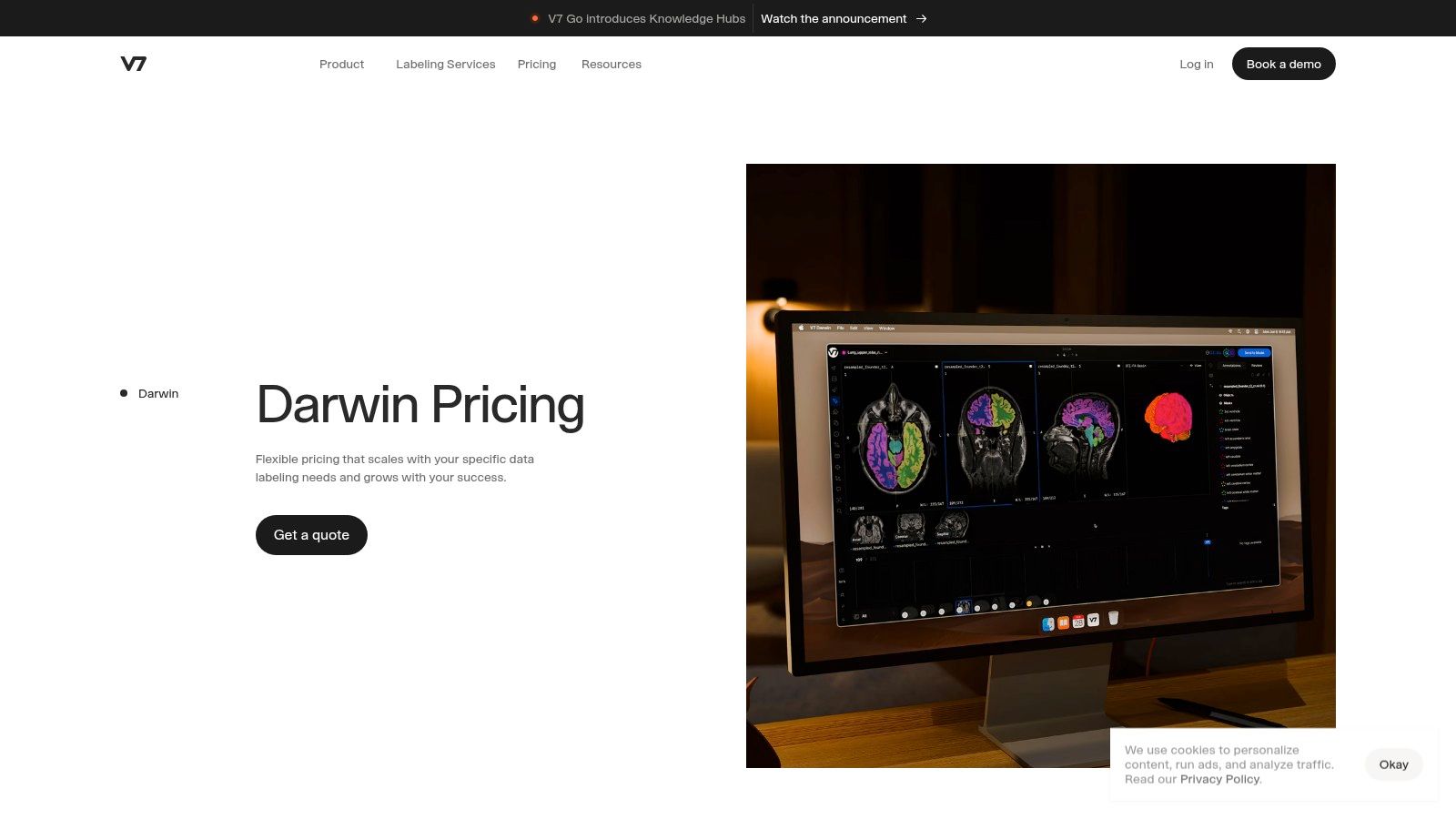
What truly distinguishes V7 is its emphasis on automation and enterprise-grade controls. The platform's AI-assisted labeling can significantly reduce manual effort, while its role-based permissions and workspace model provide the governance needed for large, distributed teams. This combination is ideal for specialized fields like medical imaging and geospatial analysis, where both accuracy and security are paramount.
Pricing and Access
V7’s pricing is quote-based and tailored to enterprise needs, so there is no public fixed price list. The model is typically built around licenses and platform usage, providing clarity and predictability for budget planning once a quote is obtained. The company is transparent about its billing components, though prospective customers should note that legacy accounts may operate on a different credit-based system. To get a specific quote, you need to contact their sales team directly. Get started with V7.
Key Features and Considerations
- Advanced AI Automation: V7's standout feature is its powerful model-assisted labeling, which automates a significant portion of the annotation process for complex data.
- Enterprise-Grade Controls: Strong support for role-based permissions, detailed audit trails, and workspace management makes it suitable for large, regulated organizations.
- Broad Modality Support: Excels in handling diverse and complex data, including DICOM for medical imaging, video streams, and 3D point clouds.
- Quote-Based Pricing: The lack of a public price list means smaller teams or those needing immediate access cannot self-serve; a sales consultation is required.
7. Label Studio (HumanSignal)
Label Studio, powered by HumanSignal, is a highly popular open-source data labeling tool that offers unparalleled flexibility for teams wanting full control over their annotation environment. It supports a diverse array of data types, including images, text, audio, video, and time-series data. This versatility makes it an excellent choice for organizations that need a single, adaptable platform for various machine learning projects, from NLP to computer vision.

The core strength of Label Studio lies in its configurable labeling interface. Users can create custom UIs using simple XML-like tags, tailoring the annotation experience precisely to their project's needs. This is particularly valuable for complex labeling tasks or when combining different annotation types in a single interface. As a true open-source tool, it empowers teams to own their entire data labeling stack, integrating it deeply into their existing MLOps pipelines.
Pricing and Access
Label Studio offers a straightforward three-tier model. The Community Edition is completely free and self-hosted, ideal for individual developers or small teams comfortable with managing their own infrastructure. The cloud-based Starter plan provides managed hosting with features like role-based access control (RBAC) and task distribution for a clear monthly price. For larger organizations needing advanced security, the Enterprise plan adds SSO, SOC 2, and HIPAA compliance, along with dedicated support. Explore Label Studio plans.
Key Features and Considerations
- Open-Source Flexibility: The free Community Edition allows for complete customization and self-hosting, giving teams total control and ownership of their data labeling tools.
- Configurable Interfaces: Its powerful template system enables the creation of highly specific UIs for complex or multi-modal annotation tasks.
- Managed Cloud Option: The Starter plan removes the burden of self-hosting, offering a quick on-ramp for teams needing managed features like RBAC.
- Gated Enterprise Features: Critical security and compliance features such as SSO and HIPAA are reserved for the Enterprise plan, which may be a consideration for regulated industries evaluating lower tiers.
8. CVAT (Computer Vision Annotation Tool)
CVAT, or the Computer Vision Annotation Tool, is a powerful open-source platform that has expanded to include a user-friendly hosted cloud version. It strikes an excellent balance between the flexibility of open-source software and the convenience of a managed service, making it a practical choice for teams needing robust annotation capabilities for images, videos, and 3D data without a hefty price tag.

What makes CVAT stand out is its strong community backing and its focus on automation. The tool supports webhooks and AI-powered features, including integrations with popular platforms like Hugging Face and Roboflow, allowing teams to incorporate semi-automated labeling workflows. This blend of open-source roots and modern cloud features positions CVAT as one of the most adaptable data labeling tools for computer vision projects that are rapidly scaling.
Pricing and Access
CVAT.ai offers a flexible pricing structure that caters to everyone from individual developers to large enterprises. A free "Solo" plan is available for individual use, while paid "Team" and "Business" tiers provide collaborative features, increased storage, and automation quotas. Role-based access control and SSO are available on higher-tier annual plans. For organizations with strict data residency or security requirements, CVAT also offers an enterprise on-premise deployment option. Get started with CVAT.ai.
Key Features and Considerations
- Open-Source Core: Built on a popular and actively maintained open-source project, ensuring continuous improvement and community support.
- Automation and AI Tools: Integrates with models for semi-automatic annotation and includes AI-powered tools to accelerate labeling tasks.
- Multiple Deployment Options: Offers the flexibility of a fully managed cloud service or a self-hosted on-premise solution for greater control.
- Feature Gating: Key enterprise features like advanced SSO and detailed audit logs are reserved for the higher-tier annual subscription plans.
9. Supervisely
Supervisely positions itself as an all-encompassing computer vision platform, moving beyond just data annotation to include data management, model training, and deployment. It is an ideal choice for teams that need a unified environment for the entire CV lifecycle, especially those working with diverse and specialized data types like medical imaging (DICOM), 3D LiDAR point clouds, and video. The platform's app ecosystem allows for extensive customization, making it a powerful solution for complex, end-to-end AI projects.
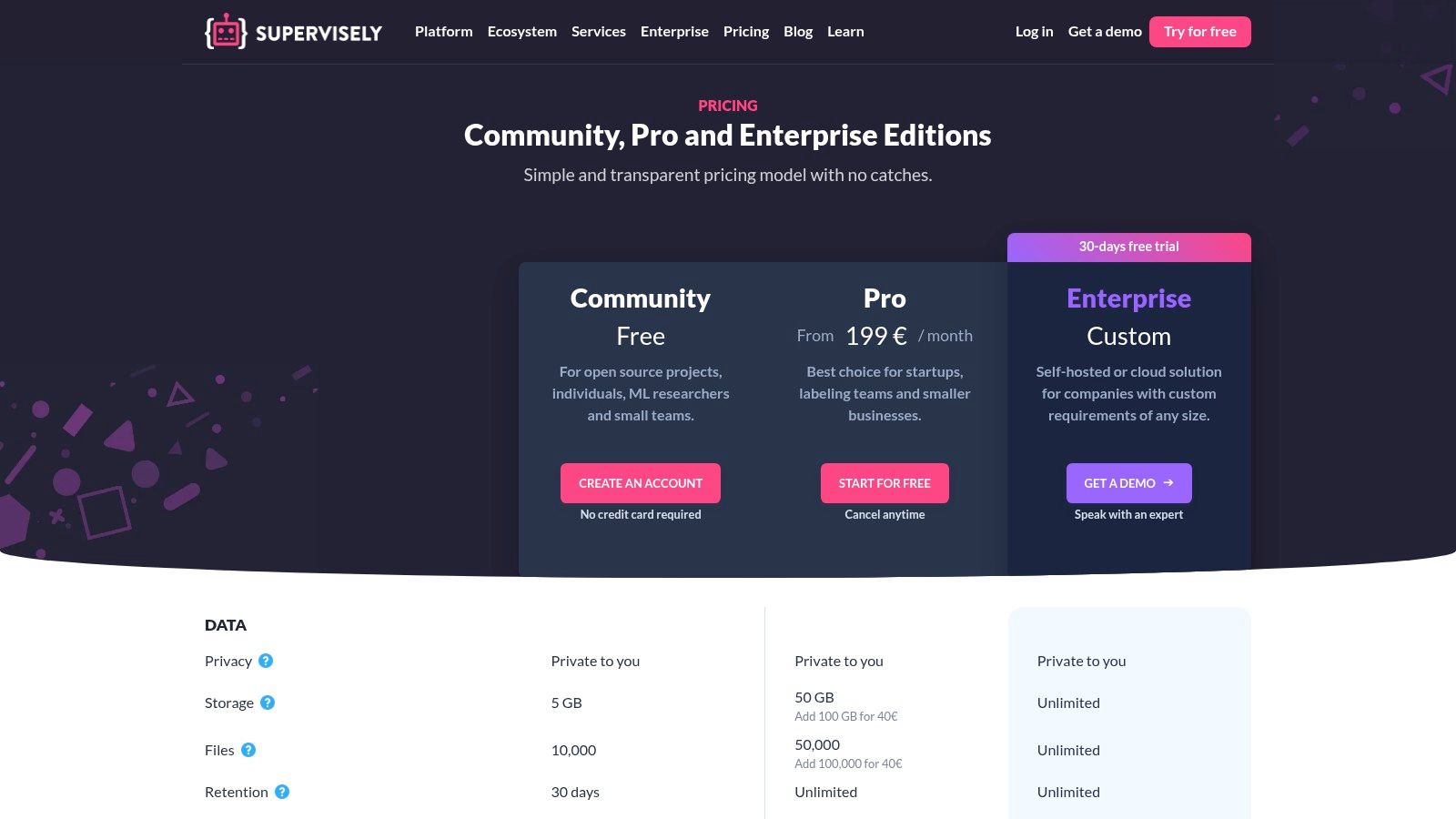
What makes Supervisely unique is its combination of a comprehensive feature set with flexible deployment options, including on-premises and private cloud SaaS. This caters directly to enterprises with strict data security and compliance requirements. Its robust toolsets for niche areas, such as an advanced video player and specialized medical annotation tools, provide the deep functionality that generic data labeling tools often lack, ensuring high-quality output for demanding use cases.
Pricing and Access
Supervisely offers a transparent pricing structure with several tiers. The free Community Edition is excellent for individual developers, academics, and small-scale projects. The Pro plan provides more features for professional teams with fixed per-user pricing, though add-ons can increase the total cost. Enterprise plans offer custom solutions with features like SSO, advanced security, and dedicated on-premises deployment for organizations with specific operational needs. Get started with Supervisely.
Key Features and Considerations
- Broad Modality Support: Excels in handling a wide array of data types, including images, videos, 3D point clouds, and specialized medical formats like DICOM.
- Flexible Deployment: Offers both cloud-based and on-premises deployment, providing a solution for companies with strict data residency and security policies.
- Integrated App Ecosystem: A built-in "Ecosystem" of apps allows users to extend platform functionality with custom tools, models, and data transformations.
- Cost Structure: While the Pro plan is transparent, be mindful that "Max packs" and other add-ons can escalate costs beyond the base per-user price.
10. Prodigy (by Explosion)
Prodigy is a highly scriptable, developer-first annotation tool from the creators of the popular NLP library spaCy. It is engineered for rapid, iterative data labeling, particularly for NLP, computer vision, and audio tasks. The platform stands out by running entirely on your local machine, ensuring that sensitive data never leaves your infrastructure, making it a top choice for teams with strict privacy and security requirements.
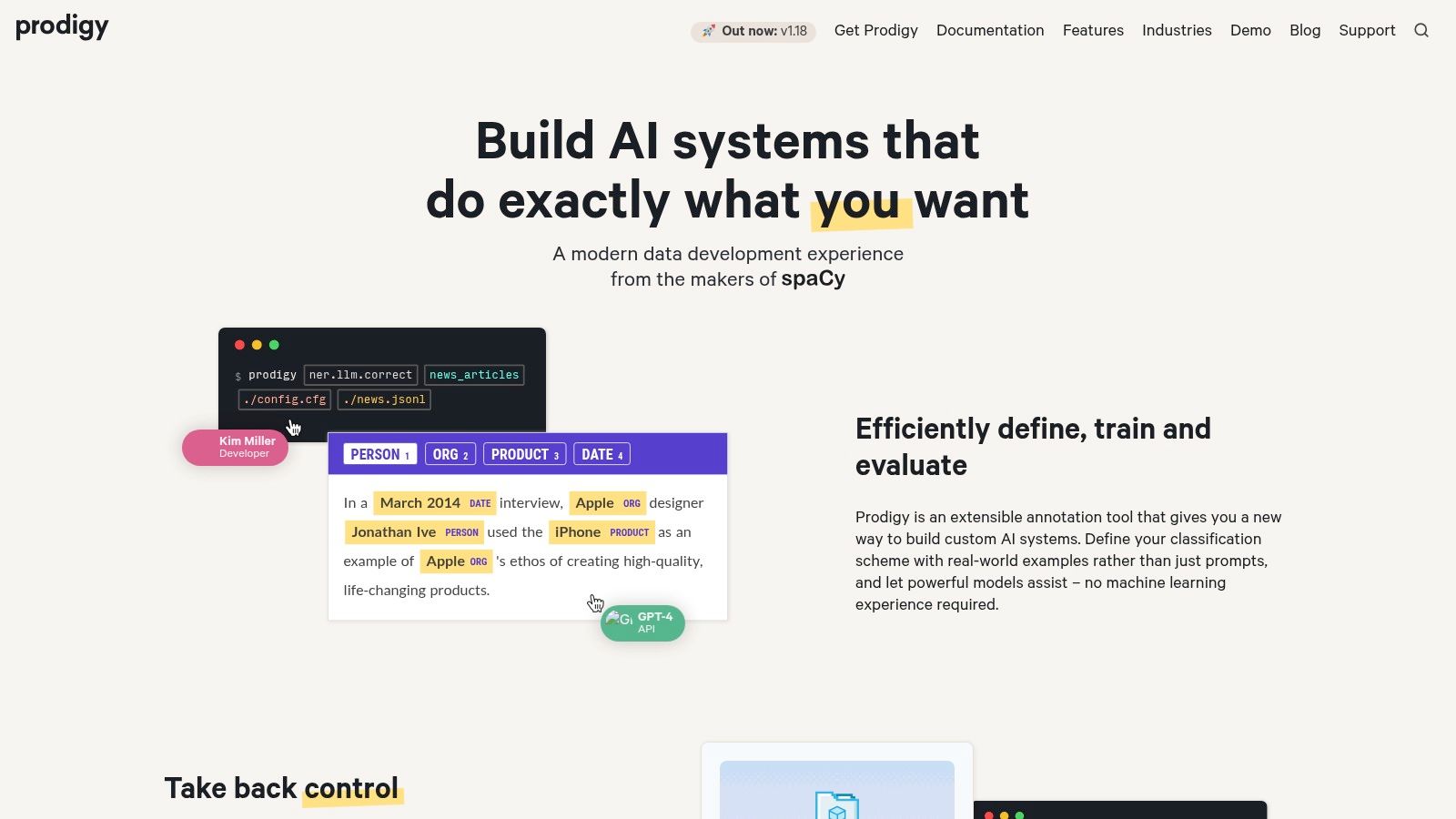
What truly differentiates Prodigy is its model-in-the-loop, or active learning, workflow. Instead of annotating random examples, the tool presents data points that the model is most uncertain about, allowing you to create high-quality training data more efficiently. This code-first approach, using Python-based "recipes," gives technical teams granular control over the entire annotation process, from data loading to UI customization. It is one of the most powerful data labeling tools for teams that prefer scripting over a GUI-driven setup.
Pricing and Access
Prodigy uses a one-time purchase model, granting a lifetime license for a specific version, which is a significant departure from the subscription-based SaaS norm. This can be highly cost-effective for long-term projects. Pricing is not publicly listed and requires contacting their sales team for a quote, which typically depends on the number of users. Since it is self-hosted, there are no ongoing cloud costs, but you are responsible for your own infrastructure management. Learn more about Prodigy.
Key Features and Considerations
- Scriptable Workflows: Offers deep customization through Python scripts, allowing developers to define complex labeling logic and integrate custom models.
- Privacy-First: As a self-hosted tool, all data processing and annotation happen on-premise, which is critical for healthcare, finance, and other regulated industries.
- Active Learning Focus: The model-in-the-loop approach helps prioritize ambiguous examples, leading to more efficient annotation and better model performance with less data.
- Self-Managed Infrastructure: The lack of a hosted cloud edition means your team is responsible for setup, maintenance, and scalability, which may be a barrier for non-technical teams.
11. Dataloop.ai
Dataloop.ai presents itself as a comprehensive, data-centric platform designed for the entire AI lifecycle. It goes beyond basic annotation to offer a full suite of tools for data management, model training, and automated data pipelines. The platform is built to handle unstructured and multimodal data, making it a powerful choice for enterprises aiming to operationalize large-scale, ongoing data labeling and ML development programs.
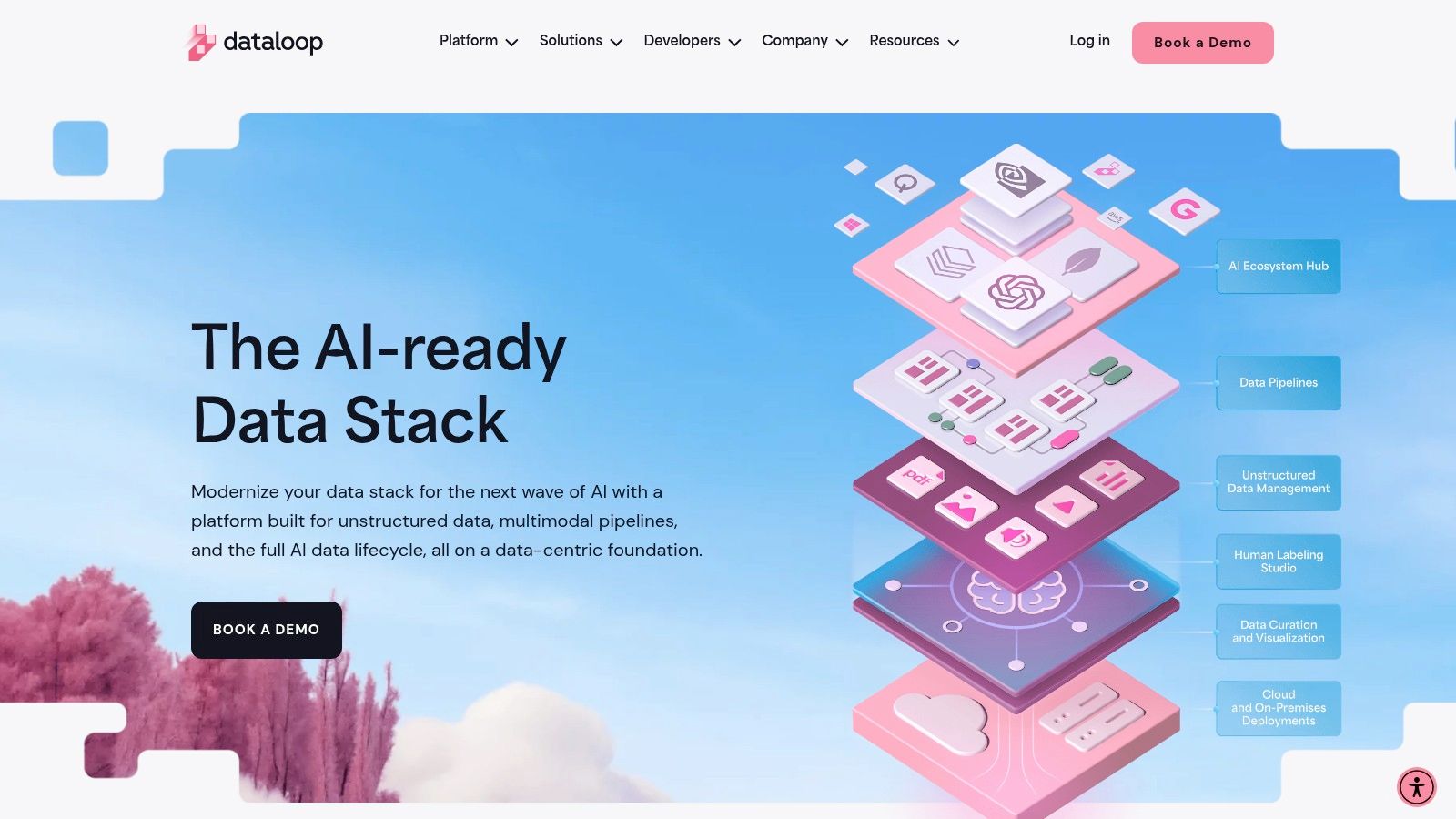
What makes Dataloop stand out is its end-to-end data stack, integrating data, models, pipelines, applications, and human annotators into a unified workflow. This approach is tailored for organizations that need robust governance, orchestration, and visibility over their AI projects. With features like a workforce marketplace and detailed billing dashboards, Dataloop helps teams manage resources and track usage transparently, which is crucial for scaling complex AI initiatives efficiently.
Pricing and Access
Dataloop's pricing is primarily contract-based and tailored for enterprise clients, so specific tiers are not publicly listed. This model is ideal for large organizations that require customized solutions, dedicated support, and specific compliance features. Prospective users need to contact their sales team for a custom quote based on their project scope, data volume, and required services. Explore Dataloop's platform.
Key Features and Considerations
- End-to-End Data Stack: Offers an integrated environment for managing data, from labeling and quality assurance to model training and deployment.
- Workforce Marketplace: Provides access to a managed workforce, allowing teams to scale their annotation capacity on demand without hiring in-house.
- Enterprise Focus: Built with features like advanced security, compliance, and detailed usage tracking dashboards to meet the needs of large-scale operations.
- Contract-Based Pricing: The lack of public pricing tiers means it is less accessible for smaller teams or those looking for immediate, off-the-shelf solutions. It is best suited for established, well-funded AI programs.
12. Appen
Appen has established itself as a global leader in data for the AI lifecycle, specializing in large-scale data collection and annotation powered by a vast, managed crowd. It is an ideal solution for enterprises that require high-volume data, stringent quality control, and the reliability of managed services with service-level agreements (SLAs). The platform excels in sourcing and preparing diverse datasets across multiple modalities, including text, image, video, and audio.
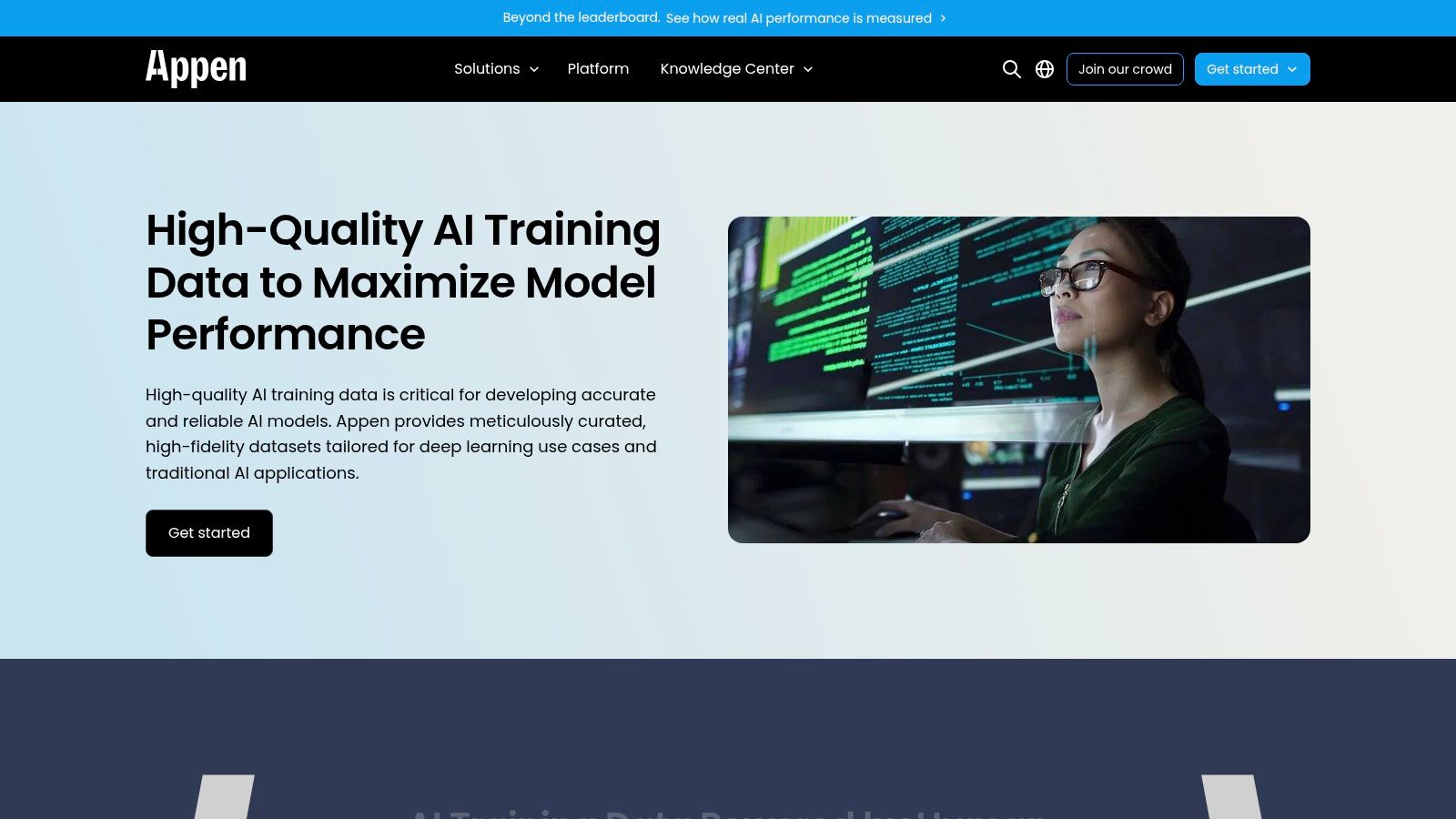
What differentiates Appen is its focus on providing a fully managed, human-in-the-loop service rather than just a self-serve tool. This approach is particularly valuable for complex projects that demand nuanced human judgment or massive-scale data collection that is impractical for in-house teams. Appen's combination of its annotation platform, project management expertise, and global workforce allows it to deliver customized, high-quality training data for sophisticated AI models.
Pricing and Access
Appen’s pricing is primarily quote-based, tailored to the specific needs of each project, including data complexity, volume, and required quality levels. The company provides guidance and cost calculators to help organizations estimate project expenses. While it does not offer a free self-service tier like some tool-centric platforms, its model is designed for enterprises looking for a predictable, outcomes-based partnership. Access to its services begins with a consultation to define project scope and requirements. Get started with Appen.
Key Features and Considerations
- Managed Labeling Services: Offers end-to-end project management with a global workforce, robust quality control, and delivery SLAs, making it a strong choice among data labeling tools for enterprise needs.
- Off-the-Shelf Datasets: Provides a catalog of pre-labeled, ready-to-use datasets, which can significantly accelerate the initial stages of model development.
- Hybrid Human+LLM Workflows: Leverages a combination of human annotators and large language models (LLMs) to enhance efficiency, reducing annotation time and costs.
- Service-Focused Model: The platform's primary strength is its managed service offering; teams looking for a pure self-serve software tool may find other options more suitable. Making the right choice is critical, and you can learn how to evaluate data annotation companies to ensure they meet your needs.
Top 12 Data Labeling Tools: Features & Services Comparison
| Provider | Core modalities & services | Quality & Security (★) | Target audience (👥) | Pricing & Value (💰) | Unique selling points (✨) |
|---|---|---|---|---|---|
| Prudent Partners LLP 🏆 | Image, Video, LiDAR, Text, Audio; GenAI QA; virtual assistants & BPM | ★ 99%+ accuracy target; ISO 9001 & ISO/IEC 27001; multi-layer QA, NDAs | 👥 AI teams in healthcare, e‑commerce, finance, geospatial, architecture | 💰 Competitive, custom quotes; free pilot | ✨ Prudent Prism/PlanWise tracking; 300+ analysts; tailored pilot |
| Labelbox | Image, Video, Text, Audio, Chat; model-assisted labeling & data curation | ★ Strong enterprise controls; HIPAA options | 👥 ML/product teams wanting platform + managed services | 💰 Free tier; usage-based LBU; paid add‑ons | ✨ Catalog + Model components; on‑demand managed labeling |
| Amazon SageMaker Ground Truth | Managed/self-managed labeling; active learning; tight AWS integration | ★ AWS enterprise security & compliance | 👥 Teams already on AWS needing scale & compliance | 💰 Pay-as-you-go; per-task pricing varies | ✨ Native S3/IAM/SageMaker workflows; Ground Truth Plus |
| Scale AI | CV, NLP, Audio, Docs, LiDAR; Rapid/Studio/Managed options | ★ Mature ops and enterprise workflows | 👥 Teams needing broad modality coverage & managed experts | 💰 200 free Rapid units; enterprise/quote pricing | ✨ Mix self-serve + expert labelers; evaluation tools |
| SuperAnnotate | Image, Video, Text, Audio; DataOps, analytics & orchestration | ★ Robust tooling and collaboration features | 👥 Teams seeking collaborative annotation + analytics | 💰 Plan-gated pricing; demo for details | ✨ Custom multimodal editors; consulting support |
| V7 (Darwin) | Image, Video, Medical, 3D; automation & model-in-loop | ★ Enterprise controls; built for scale | 👥 Orgs needing automation and enterprise controls | 💰 Quote-based; license vs credits nuances | ✨ AI-assisted automation; clear billing docs |
| Label Studio (HumanSignal) | Text, Image, Audio, Time-series; OSS + managed cloud | ★ Open-source maturity; enterprise security add‑ons | 👥 Teams wanting OSS control or managed starter cloud | 💰 Free OSS; starter cloud caps; enterprise quotes | ✨ Flexible templates & review workflows |
| CVAT | Image, Video, 3D annotation; OSS with hosted plans | ★ Active OSS community; affordable hosted tiers | 👥 Teams wanting OSS flexibility or low-cost hosted | 💰 Affordable hosted; some features on annual tiers | ✨ Integrations (Hugging Face, Roboflow), automation APIs |
| Supervisely | CV labeling, data management, training; medical & 3D support | ★ Broad modality support; Pro & Enterprise options | 👥 Teams needing medical/3D support and on‑prem choices | 💰 Pro & Enterprise; Pro priced in EUR | ✨ App ecosystem; migration/import tools |
| Prodigy (Explosion) | NLP, CV, Audio; scriptable, local-first annotation | ★ Privacy-first; developer-focused | 👥 Developer/ML teams wanting code-first & on‑prem | 💰 One-time license (sales-gated) | ✨ Scriptable recipes; model-in-loop; local execution |
| Dataloop.ai | Labeling, pipelines, orchestration, workforce marketplace | ★ Built for large-scale, ongoing programs | 👥 Enterprises operationalizing large labeling programs | 💰 Contract-based; not public | ✨ Workforce marketplace; billing dashboards |
| Appen | Large-scale data collection, annotation, off-the-shelf datasets | ★ Global workforce with enterprise SLAs | 👥 Enterprises needing high-volume managed labeling & datasets | 💰 Quote-based; dataset catalog options | ✨ Ready-to-deliver datasets; hybrid human+LLM workflows |
Turning Data into Decisions with a Trusted Partner
Navigating the expansive landscape of data labeling tools can be a formidable task. From open-source powerhouses like CVAT and Label Studio to comprehensive commercial platforms such as Labelbox, V7, and Scale AI, the options are as diverse as the AI models they help create. This guide has dissected twelve of the market's leading solutions, evaluating them across critical dimensions like data modality support, automation features, quality assurance workflows, deployment flexibility, and pricing structures.
The core takeaway is clear: there is no single "best" data labeling tool. The optimal choice is intrinsically linked to your project's unique requirements, team composition, data complexity, and long-term strategic goals. A startup developing a niche computer vision model might find the flexibility and cost-effectiveness of an open-source tool like Label Studio ideal, while a large enterprise in the healthcare sector will prioritize the robust security, compliance (like HIPAA), and end-to-end MLOps integrations offered by platforms like SuperAnnotate or Amazon SageMaker Ground Truth.
Key Considerations Before You Commit
As you move from evaluation to implementation, several pivotal factors will determine your success. The decision between a self-service tool and a managed service provider represents a fundamental fork in the road.
- Total Cost of Ownership (TCO): Look beyond the sticker price of a software license. Factor in the hidden costs associated with a DIY approach: engineering time for setup and maintenance, project management overhead, workforce training, and the cost of rectifying quality control failures. Often, the efficiency gains from a managed service can lead to a lower TCO.
- Scalability and Elasticity: Your data labeling needs will fluctuate. Consider how your chosen solution handles scaling. Can it support a sudden surge in data volume without a significant drop in quality or turnaround time? Platforms with integrated workforces or partnerships with managed service providers offer superior elasticity.
- The Human-in-the-Loop: Even the most advanced AI-assisted labeling features require human oversight and expertise. The quality of your annotations is directly proportional to the skill of your annotators and the rigor of your QA processes. Never underestimate the value of a well-trained, well-managed labeling team.
Your Actionable Path Forward
Selecting the right partner or platform is a strategic decision that directly impacts your model's performance and your project's timeline. Your journey to high-quality labeled data starts with a clear understanding of your specific needs. Use the detailed comparisons and use-case analyses in this article as a checklist to narrow down your options.
For many organizations, especially those in highly regulated industries or those facing aggressive deadlines, the most effective path forward is not just choosing a tool, but choosing a partner. A specialized data annotation provider leverages sophisticated data labeling tools as part of a holistic, managed service. This approach offloads the operational burden of workforce management, quality control, and process optimization, allowing your core AI and data science teams to focus on what they do best: building transformative models. Ultimately, the goal is not just to label data, but to create a reliable, scalable data engine that fuels innovation and drives confident, data-backed decisions.
Are you ready to transform your raw data into a strategic asset without the operational overhead? The expert team at Prudent Partners LLP combines industry-leading data labeling tools with a highly skilled, managed workforce to deliver unparalleled accuracy and scalability for your most critical AI projects. Contact us today to discuss your unique data annotation needs and discover how our tailored solutions can accelerate your path to production.