
Image annotation is the process of labeling visual data, like images and videos, to make it understandable to artificial intelligence. It is how machines learn to see and interpret the world around them, turning raw, meaningless pixels into structured information that computer vision models can use.
What Are Image Annotation Services and Why Are They Crucial?
Teaching an AI what a “car” is can be compared to teaching a toddler. You would point to the car, perhaps trace its outline, and say the word. Image annotation services perform the same function for AI, but with exceptional precision and on a massive scale.
This process is the essential bridge between raw visual data and an AI model's ability to spot patterns, identify objects, and make intelligent decisions. Without it, an AI perceives only a jumble of pixels. With high-quality annotations, it learns to distinguish a pedestrian from a lamppost, a healthy crop from a diseased one, or a malignant tumor from healthy tissue. It is the bedrock of computer vision.
The Human Element in a Digital World
At its core, image annotation is a human-driven task. Skilled annotators use specialized software to meticulously label objects within an image, following a project's specific rules. This “human-in-the-loop” approach provides the nuance, context, and accuracy that automated systems cannot replicate on their own.
The quality of this human effort directly dictates how well the final AI model performs. Inaccurate or inconsistent labels will confuse the model, leading to unreliable predictions. On the other hand, precise and consistent annotations build a robust, dependable AI. This is why partnering with an expert in data annotation services is a strategic decision, not just a tactical one.
Before we explore this further, it is helpful to understand the core components that make up a professional annotation service. These elements work together to ensure the final labeled dataset is accurate, consistent, and ready to train a high-performing AI model.
Key Components of an Image Annotation Service
| Component | What It Means for Your Project | Direct Impact on AI Model |
|---|---|---|
| Skilled Human Annotators | A team of trained professionals who understand the project's specific context and guidelines. | Reduces labeling errors and inconsistencies, leading to a more accurate and reliable model. |
| Specialized Annotation Tools | Software platforms (like Labelbox or CVAT) designed for specific annotation types, such as polygons or LiDAR. | Enables higher precision and efficiency, ensuring data is labeled correctly and quickly. |
| Multi-Layer Quality Assurance (QA) | A robust review process where annotations are checked by peers, team leads, and automated systems. | Catches and corrects errors before they contaminate the training data, preventing model bias and poor performance. |
| Project Management & Governance | Clear workflows, communication channels, and performance tracking to manage the annotation pipeline. | Ensures projects stay on schedule and on budget while maintaining high-quality standards. |
| Data Security & Compliance | Secure infrastructure and processes (like ISO 27001 or HIPAA) to protect sensitive visual data. | Protects your intellectual property and ensures regulatory compliance, especially in healthcare or defense. |
Ultimately, a great annotation service is not just about drawing boxes on images. It is a comprehensive system designed to produce the highest-quality fuel for your AI engine.
Fueling a Rapidly Growing Market
The demand for high-quality labeled data is immense and continues to grow. The global AI annotation market, in which image annotation is a significant segment, was valued at USD 2.3 billion in 2024. It is projected to skyrocket to around USD 28.5 billion by 2034.
This explosive growth, with a compound annual growth rate (CAGR) of 28.60%, makes one thing clear: annotation is the critical engine driving innovation across every industry. You can learn more about the trends shaping the AI annotation market on Market.us.
High-quality annotated data is not an expense; it is the single most important investment you can make in the long-term performance and reliability of your computer vision system.
This investment is what separates an AI model that works in a controlled lab environment from one that performs reliably in the messy, unpredictable real world. From guiding autonomous vehicles on busy streets to helping medical AI assist in life-saving diagnoses, the impact of expert image annotation services is undeniable.
Exploring Core Image Annotation Techniques
Just as a cartographer needs different tools to map a coastline versus a mountain range, image annotation relies on a variety of techniques to label visual data. There is no one-size-fits-all method; the right approach depends entirely on what you need your AI model to do. Selecting the correct technique is the first and most critical step toward building a computer vision system that truly understands its environment.
The entire process is about turning a simple picture into a structured dataset that an AI can learn from. This flowchart breaks down that fundamental workflow, showing how an unlabeled image becomes a powerful training asset through precise annotation.

This visual makes one thing crystal clear: the quality of your AI model is directly tied to the precision of the annotation. Let's delve into the core techniques that make this transformation happen.
Bounding Boxes: The Foundation of Object Detection
The most common and straightforward technique is the bounding box. It involves drawing a simple rectangle around an object of interest. Think of it as the digital equivalent of putting a frame around the most important part of a photo.
Bounding boxes are ideal when your AI only needs to know that an object exists and its general location. For example, an e-commerce company might use them to train a model to find and count products in a warehouse photo. While they are not pixel-perfect, they are fast, efficient, and incredibly effective for many object detection tasks.
Polygonal Segmentation: For When Shapes Get Complicated
But what happens when objects are not neat rectangles? For items with irregular or complex outlines, polygonal segmentation provides a much more precise solution. Here, annotators click a series of connected points (vertices) to trace the exact boundary of an object.
Imagine you're looking at a satellite image of a farm or a medical scan of a tumor. A simple box would be clumsy, capturing parts of the background while missing parts of the object. Polygonal segmentation allows the model to learn the object's true shape, which is essential for accuracy in agriculture, medical diagnostics, and geospatial analysis.
Semantic Segmentation: Painting the Whole Scene with Labels
Taking precision to the next level, semantic segmentation is where every single pixel in an image gets assigned a class label. Instead of just identifying individual objects, it classifies entire regions. An autonomous vehicle, for instance, cannot just see a "car" or "person"; it has to understand the entire scene.
Semantic segmentation is like giving an AI a coloring book where every category—road, sky, building, pedestrian—has its own specific color. This gives the model a complete, contextual understanding of its surroundings, letting it distinguish drivable areas from sidewalks and obstacles.
This pixel-level detail is non-negotiable for building robust AI systems that can safely navigate complex, real-world environments. For a closer look at this powerful method, you can learn more about how we approach semantic image segmentation at Prudent Partners.
Keypoint Annotation: Tracking Motion and Form
When your project focuses on analyzing posture, movement, or shape, keypoint annotation is the ideal technique. This method involves placing specific points, or landmarks, on an object to map out its form. A fitness app, for example, uses keypoints on joints like elbows, knees, and hips to track a user's form during an exercise.
These connected dots create a sort of "skeleton" that allows the AI to understand and analyze human posture or facial expressions. This is the magic behind everything from augmented reality filters and gesture recognition to advanced ergonomics and sports analytics.
3D Cuboids: Adding the Third Dimension
While 2D annotations are powerful, some AI systems need to understand an object's volume and orientation in three-dimensional space. That is where 3D cuboids come in. These are drawn around objects to provide crucial depth information, which is especially important for robotics and autonomous systems that have to physically interact with their environment.
By defining an object's length, width, and height, 3D cuboids give a robot the spatial awareness it needs to grab an item off a shelf or help a self-driving car accurately judge its distance from other vehicles. Each of these techniques provides a different level of detail, empowering AI to solve an ever-growing list of challenges.
The Blueprint for Annotation Excellence
High-quality data does not happen by accident. It is the direct result of a systematic, meticulous process designed to eliminate errors and enforce consistency. Once you have chosen your annotation techniques, the real work begins. This is about how professional image annotation services actually deliver data you can trust.
This all comes down to a solid framework of quality assurance (QA), governance, and compliance that turns raw labels into a reliable training dataset.

This operational backbone is what separates a weekend project from a production-grade data pipeline that can fuel high-stakes AI systems. Without it, even the most advanced models are set up to fail.
The Foundation: Crystal-Clear Annotation Guidelines
Every great annotation project starts with a single source of truth: the annotation guidelines. This document is not just a simple instruction manual; it is the project's constitution. It must define every single object class, spell out how to handle tricky edge cases, and provide clear visual examples to leave zero room for interpretation.
Think of it as the first line of defense against inconsistent work. A well-written guide ensures that every annotator is playing by the same rules. To see what makes these documents so effective, check out our deep dive into creating comprehensive annotation guidelines. This foundation is absolutely essential for achieving accuracy at scale.
Measuring What Matters: Objective Quality Metrics
You cannot manage what you do not measure. In the world of image annotation, one of the most critical metrics is Intersection over Union (IoU). It is a simple but powerful calculation that measures the percentage of overlap between a ground truth label and a new annotation.
Intersection over Union (IoU) gives you a hard number for annotation accuracy, taking all the guesswork and subjectivity out of quality reviews. A higher IoU score means a more precise label, which is exactly what you need to train a high-performance computer vision model.
We set a clear IoU threshold, for example 95%, as the minimum bar for quality. Any annotation that scores below this number gets flagged for immediate review and correction. This creates a data-driven feedback loop that pushes the quality of the entire dataset higher over time.
Multi-Layer Reviews for Flawless Data
One person checking the work is never enough. The best image annotation services rely on a multi-tiered QA system to catch mistakes at every step. This structure guarantees that by the time the data gets to your AI team, it has been thoroughly scrubbed for accuracy.
This process usually includes several layers of checks:
- Peer Review: Annotators review a sample of each other's work. This is effective for catching obvious errors right away and ensuring everyone is sticking to the guidelines. It also builds a team culture focused on quality.
- Expert Review: A senior annotator or QA specialist with deep domain knowledge steps in to review flagged items or complex cases. Their experience is vital for making the right call on ambiguous annotations that require true contextual judgment.
- Automated Checks: We can also use algorithms to spot common mistakes automatically, such as mislabeled classes or annotations that are too big or small. This adds another layer of efficiency to the QA process.
The Non-Negotiables: Data Security and Compliance
In a world where data is one of your most valuable assets, security and privacy are non-negotiable. A trustworthy annotation partner must demonstrate a rock-solid commitment to protecting your information. This goes beyond signing an NDA; it means having bulletproof technical and procedural safeguards in place.
Here is what to look for in a secure annotation framework:
- Certifications: Always look for internationally recognized standards like ISO/IEC 27001. This proves the provider has a formal, audited system for managing information security.
- Compliance: If your project involves personal or sensitive data, strict adherence to regulations like GDPR or HIPAA is an absolute must.
- Secure Infrastructure: All data must be handled in a secure environment. That means end-to-end data encryption, strict access controls, and secure transfer protocols to lock down any potential vulnerabilities.
This combination of clear guidelines, objective metrics, multi-layer QA, and uncompromising governance is the blueprint for annotation excellence. It is how raw pixels are reliably transformed into the high-octane fuel that powers the world’s most advanced AI.
How Industries Depend on Specialized Annotation
Image annotation is never a one-size-fits-all solution. The right technique, the required precision, and the compliance standards are all dictated by the specific problem you are trying to solve. From saving lives in operating rooms to guiding autonomous vehicles through city streets, specialized image annotation services are the critical link between raw data and real-world impact.
This is where abstract concepts like semantic segmentation and 3D cuboids become tangible tools for innovation. The goals of a project directly shape the annotation strategy, ensuring the final AI model is perfectly tuned for its environment.
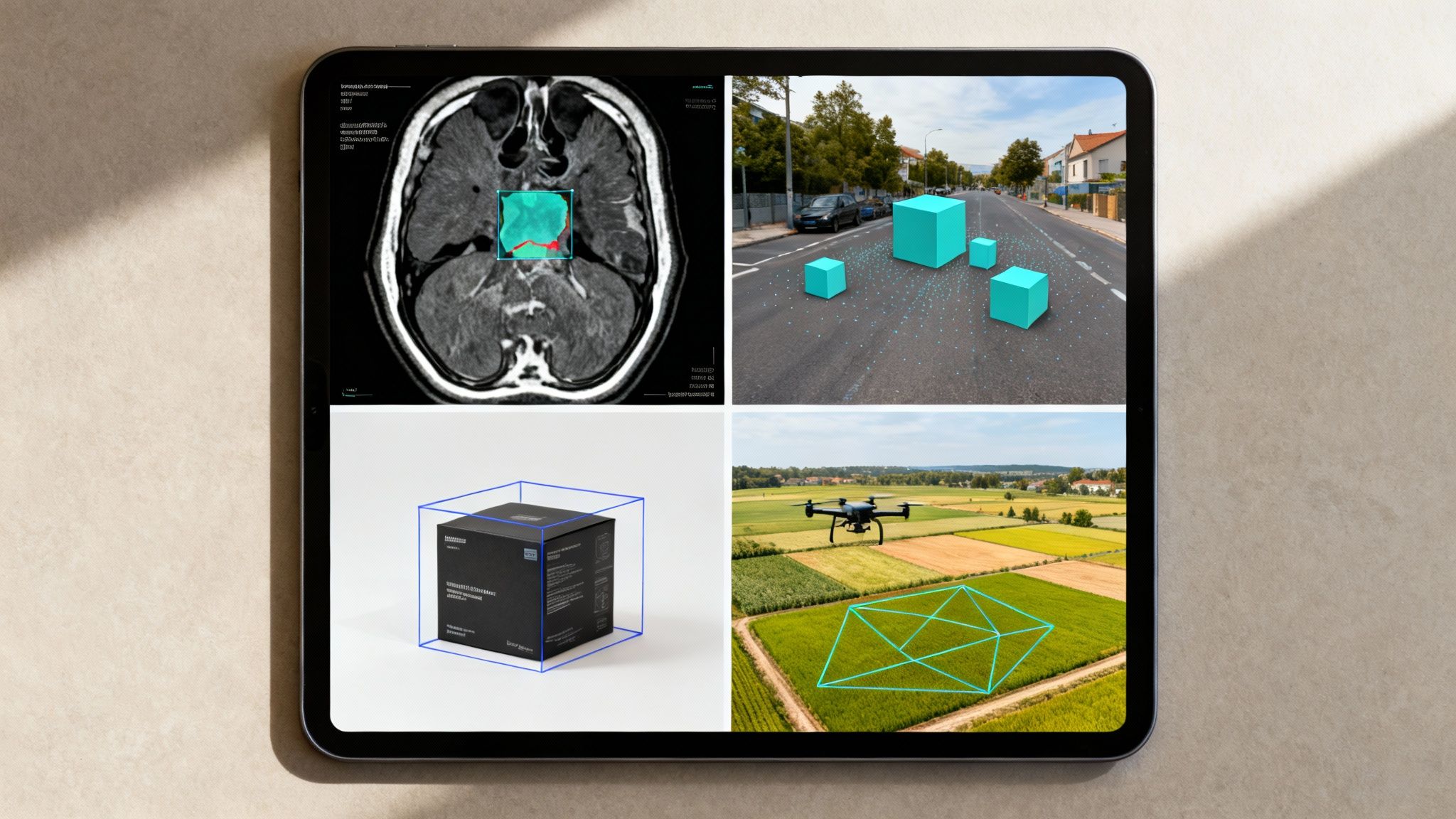
Let's look at how four completely different industries use tailored annotation to overcome their unique challenges. You will see how priorities shift from pixel-perfect accuracy and regulatory adherence to speed and operational scale.
Healthcare And Medical Diagnostics
In healthcare, there is simply no room for error. AI models used for medical diagnostics must be trained on datasets annotated with the highest possible degree of precision. For instance, when training an algorithm to detect tumors in MRI or CT scans, pixel-perfect semantic segmentation is essential, not a luxury.
Annotators, often with biomedical expertise, must meticulously outline the exact boundaries of anomalies. This task is far more than simple object identification; it demands a deep understanding of anatomy to distinguish cancerous tissue from healthy structures. All of this must be done under strict HIPAA compliance, protecting patient privacy at every single step.
Autonomous Vehicles And Transportation
For autonomous vehicles, safety is the absolute priority. AI models must perceive and predict the movement of objects in a complex, three-dimensional world with split-second accuracy. This requires a symphony of advanced annotation techniques working together.
LiDAR and 3D cuboid annotation are fundamental, allowing the system to understand the volume, position, and trajectory of other vehicles, pedestrians, and cyclists. These annotations must adhere to stringent automotive safety standards like ISO 26262. Ultimately, the ability to track objects consistently across video frames is what enables a self-driving car to make safe, reliable decisions in real time. For more on this, check out our guide on LiDAR annotation services.
Retail And E-commerce Operations
The retail and e-commerce worlds run on speed, scale, and customer experience. Here, annotation priorities shift toward efficiency and sheer volume. Simple but powerful techniques like bounding boxes and polygons are used to power a huge range of applications.
These methods are perfect for:
- Automated Inventory Management: AI models can quickly scan warehouse shelves to count products.
- Visual Search: A customer uploads a photo, and an AI finds similar products in the catalog.
- Automated Checkout Systems: Cameras identify products in a cart without any manual scanning.
In these scenarios, processing millions of images quickly and cost-effectively is far more important than achieving pixel-perfect detail. Scalability is the name of the game.
Agriculture And Environmental Monitoring
Modern agriculture is being transformed by data from drones and satellites. Annotating this aerial imagery helps AI models monitor crop health, spot areas affected by pests or drought, and optimize irrigation. It is precision farming at its best.
Using techniques like semantic and polygonal segmentation, annotators can label different crop types, identify invasive weeds, or map out soil variations. This provides farmers with actionable insights to increase yields and reduce waste. The accuracy of these annotations translates directly into better resource management and more sustainable farming.
Matching Annotation Techniques to Industry Needs
As these examples show, the "best" annotation method is entirely dependent on the use case. This table breaks down how specific techniques align with the core needs of different sectors.
| Industry | Primary Annotation Technique | Core Application | Required Level of Precision |
|---|---|---|---|
| Healthcare | Semantic Segmentation, Polygons | Tumor detection in MRIs, organ outlining | Extremely High (Pixel-Perfect) |
| Autonomous Vehicles | 3D Cuboids, LiDAR Point Cloud | Object detection, tracking, and prediction | Very High (Safety-Critical) |
| Retail & E-commerce | Bounding Boxes, Classification | Inventory management, visual search | Moderate to High (Speed-Focused) |
| Agriculture | Polygonal Segmentation | Crop health monitoring, weed detection | High (Resource Optimization) |
Each industry leverages a unique combination of tools and precision levels to turn raw visual data into a powerful business asset, reinforcing that there is no one-size-fits-all approach.
The growing demand across these varied industries underscores the importance of specialized partners. Within the data annotation tools market, professional data annotation services held a dominant share of over 57.20% in 2024. The healthcare sector, in particular, is a major driver of this growth, expanding at a notable CAGR of 29.70%. You can find more details in the data annotation market trends at Mordor Intelligence. These numbers confirm that organizations continue to rely on expert partners to handle the complex and critical task of data labeling.
How to Choose the Right Image Annotation Partner
Selecting a vendor for your image annotation services is one of the most important decisions you will make in your AI journey. The right partner becomes an extension of your team, delivering the rock-solid data that fuels reliable models. The wrong one can introduce costly delays, data errors, and serious security risks.
This is not a decision you can make by simply comparing price tags. You need a strategic partner who brings a mix of technical skill, operational discipline, and deep industry knowledge. The goal is to find a partner whose entire process aligns perfectly with your project's needs for accuracy, scalability, and security.
Evaluating Core Capabilities and Quality
First, you need to put their quality assurance (QA) framework under a microscope. High-quality data does not just happen; it is the result of a tough, multi-layered review system, not a quick check at the very end. A vendor should be completely transparent about how they achieve this.
Ask them some direct, probing questions:
- What does your standard QA workflow look like? You want to hear about multi-level reviews, such as peer checks, senior validation, and automated error detection.
- What quality metrics are you tracking? They should be able to show you hard data on metrics like Intersection over Union (IoU) and prove they consistently hit high accuracy targets, often 99% or higher.
- How do you train and manage your annotators? Consistent training and crystal-clear annotation guidelines are absolutely essential for maintaining high quality across large teams and long projects.
A partner’s commitment to quality should be obvious in their processes. If they cannot clearly explain their QA and governance strategy, that is a massive red flag.
Assessing Technology and Security Posture
A vendor’s technology stack is just as critical as its people. The right image annotation tools can massively boost both efficiency and accuracy. Ask about the platforms they use, whether proprietary or off-the-shelf, and how they handle different annotation types. Modern tools have become a huge competitive differentiator. For example, some platforms have shown 30% to 45% faster annotation speeds than others, which directly impacts your project timeline and budget.
Data security is completely non-negotiable. This provider will be handling your valuable and often sensitive visual data. You must verify that they hold internationally recognized certifications like ISO/IEC 27001, which confirms they have a formal, audited system for managing information security. If your project involves personal data, following regulations like GDPR or HIPAA is mandatory. A security failure can put your entire project in jeopardy.
Structuring a Pilot Project for Success
Before you sign any long-term contract, always start with a paid pilot project. It is the single best way to test-drive a partner's capabilities in a real-world scenario. A pilot lets you gauge their communication style, responsiveness, and their ability to follow your specific guidelines to the letter.
During this trial run, keep a close eye on:
- Communication: Are they transparent and proactive, or do you have to chase them for updates?
- Quality: Does the data they deliver actually meet the accuracy standards you agreed on?
- Turnaround Time: Can they meet deadlines without cutting corners on quality?
This pilot period gives you concrete proof of their performance, letting you make a confident, data-driven decision. It also ensures the partner truly understands the nuances of your project before you scale up. It is a crucial step in building a successful, long-term relationship with your image annotation services provider.
Frequently Asked Questions About Image Annotation Services
Diving into image annotation often brings up practical questions about cost, quality, and workflow. To help you make the right call for your project, here are straightforward answers to the questions we hear most from companies getting ready to launch their computer vision initiatives.
How Much Do Image Annotation Services Typically Cost?
There is no single price tag for image annotation because the cost can vary widely with each project. Think of it less like buying off-the-shelf software and more like commissioning a custom build.
Several factors drive the final price:
- Annotation Complexity: A simple bounding box around a car is far less work than pixel-perfect semantic segmentation of a complex medical image. The more detail and skill required, the higher the cost.
- Required Accuracy: If you are building a safety-critical system for an autonomous vehicle, you will need 99%+ accuracy. That level of quality assurance costs more than a project that can tolerate a few minor errors.
- Image Volume: While large volumes can sometimes unlock per-image discounts, the total number of images is a primary driver of the overall project budget.
- Delivery Timeline: Urgent projects that require a dedicated team may come with a premium for the expedited turnaround.
Pricing models usually fall into per-image, per-annotation, or per-hour categories. The best way to get a real number is to run a small pilot project, which gives you a precise, data-backed quote for your full-scale needs.
What Is the Difference Between Manual and Automated Annotation?
The key difference is who or what makes the first mark on the image.
Manual annotation is exactly what it sounds like: a skilled human annotator draws every box, traces every polygon, and classifies every pixel from scratch. For nuanced, ambiguous, or high-stakes data, this is the gold standard. It delivers the highest possible accuracy because it relies on human judgment from start to finish.
Automated annotation uses an AI model to make the first pass at labeling. A human expert then comes in to review, correct, and approve the AI's work. This "human-in-the-loop" approach can definitely speed things up, but the final quality is still 100% dependent on the skill of the human reviewer. For training foundational models from scratch or tackling tricky edge cases, nothing beats pure manual annotation.
How Is the Quality and Consistency of Annotated Data Ensured?
Top-tier annotation is not about a quick check at the end; it is a rigorous, multi-layered process baked into the entire workflow. You cannot just "inspect" quality into a dataset; you have to build it in from the ground up.
Here is what a robust quality framework looks like:
- Comprehensive Annotation Guidelines: We start with a crystal-clear instruction manual that becomes the single source of truth for every annotator on the project.
- Rigorous Annotator Training: Teams receive continuous, project-specific training to master the rules, especially for tricky edge cases.
- Multi-Layer QA Process: Labels are checked and double-checked. This includes peer reviews, validation by senior QA experts, and automated checks to flag any inconsistencies.
- Objective Metrics: Quality is not a feeling; it is a number. We use metrics like Intersection over Union (IoU) to provide a data-driven score for accuracy and hold ourselves accountable.
This structured system ensures every single label meets the project’s exact standards, giving you a reliable, high-performance dataset you can trust.
Ready to turn your visual data into a powerful AI asset? Prudent Partners provides high-accuracy, secure, and scalable image annotation services tailored to your specific industry needs. Our ISO-certified processes and multi-layered QA ensure your AI models are built on a foundation of trust. Contact us today for a consultation and a complimentary pilot project.