

An image labeling service transforms raw visual data into structured information that a machine learning model can understand. It’s the essential, human-powered step of annotating or tagging images with specific, meaningful labels, effectively teaching AI systems how to “see” and interpret the world around them.
Why Image Labeling Is The Backbone Of Modern AI
Before an AI can spot a pedestrian, diagnose a tumor on a medical scan, or recommend a product, it has to learn from thousands, if not millions, of labeled examples. This is the core function of an image labeling service.
Think of it like showing a child a picture book. You point to a photo of a dog and say, "dog." After seeing hundreds of different dogs, big, small, fluffy, short-haired, the child learns to recognize them in real life. Image labeling does the same thing for machines, just on a much larger and more complex scale.
This fundamental concept drives some of today's most incredible technologies. For a self-driving car to navigate a city street, its AI needs a dataset where every car, traffic light, pedestrian, and lane line has been meticulously identified. Without this foundational labeling, the AI model is effectively blind.
How Image Labeling Services Benefit Your Team
When you partner with a professional service, the value extends across your entire organization. It is not just an operational task; it is a strategic enabler that empowers different leaders to achieve their goals faster and more reliably.
| Stakeholder | Primary Benefit |
|---|---|
| Head of AI/ML | Gets access to high-accuracy, model-ready datasets, accelerating development cycles and improving model performance from day one. |
| CTO / CIO | Reduces the immense operational overhead of building and managing an in-house annotation team, freeing up internal resources for core R&D. |
| Product Manager | Ensures the AI features in their product are reliable and safe, leading to a better user experience and faster time-to-market. |
| CEO / Founder | Gains a competitive edge by deploying trustworthy AI solutions faster than competitors, driving innovation and market leadership. |
Ultimately, a professional labeling service de-risks AI initiatives, ensuring that the foundational data, the most critical part of the entire system, is built on a bedrock of quality and precision.
The Growing Demand for Precision
The need for high-quality data is fueling massive industry growth. The market for image data labeling was valued at around USD 1.5 billion in 2023 and is on track to hit USD 6.1 billion by 2032. This is not a random spike; it shows a critical shift where businesses are realizing that handling this complex task in-house is no longer practical.
This is why a professional image labeling service is no longer a luxury; it is a necessity for any serious AI project. It’s about more than just drawing boxes around objects. It’s about creating the high-octane fuel that powers safe, reliable, and effective AI systems.
High-quality, accurately labeled data is the single most important ingredient for a successful AI model. The performance, reliability, and safety of your system are directly tied to the precision of the training data it learns from.
From Raw Pixels to Actionable Intelligence
A good partner transforms your raw, ambiguous images into a structured, valuable asset ready for model training. This requires a deep understanding of your project goals to make sure every single label is consistent, accurate, and relevant.
Whether the task is simple object detection or complex pixel-level segmentation, the quality of the final dataset is non-negotiable. Our expertise in all forms of data tagging and annotation ensures your AI model is built on a foundation you can trust.
At the end of the day, the goal is to bridge the gap between what a machine sees (a collection of pixels) and what it needs to understand (context and meaning). This careful, human-driven process is what allows AI models to make dependable decisions, whether they are powering an e-commerce recommendation engine or a life-saving medical diagnostic tool.
Understanding The Different Types Of Image Annotation
Picking the right annotation method is like choosing the right tool for a job on a construction site. You would not use a sledgehammer to hang a picture frame. In the same way, different AI goals require different kinds of labels. A great image labeling service does not just apply tags to images; it strategically selects the best technique to achieve your business goals, ensuring your AI model learns exactly what it needs to.
This entire process is about turning raw, messy visual data into a structured format that AI models can learn from. This visual here shows you exactly where this critical step fits into the larger AI development pipeline.
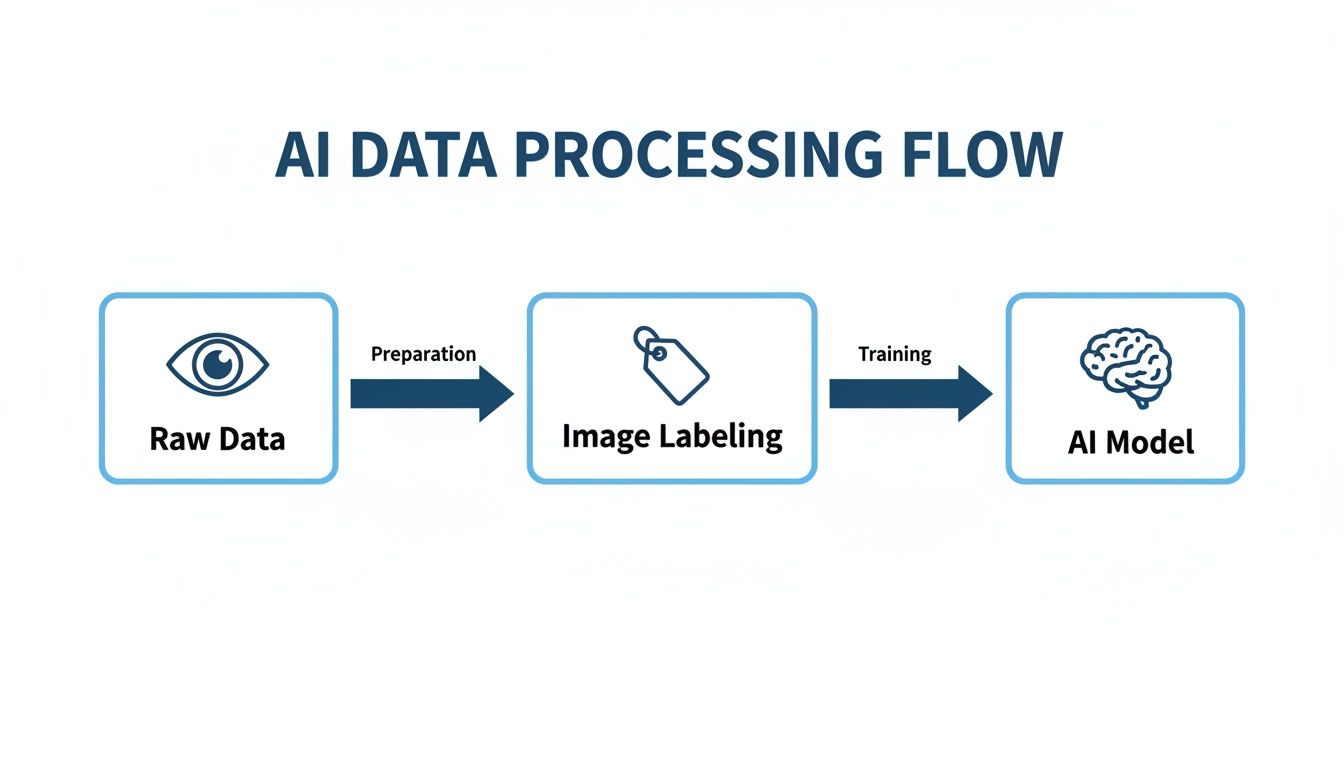
As you can see, image labeling is the bridge between your raw data and a smart, trainable AI model. Let's break down the main annotation types that make this happen.
Bounding Boxes: The Workhorse Of Object Detection
Bounding boxes are easily the most common and straightforward way to do image annotation. Annotators simply draw the tightest possible rectangle around an object to mark its location. This method is fast, cost-effective, and scales incredibly well.
For instance, an e-commerce platform can use bounding boxes to train a model to spot thousands of different products in photos customers upload. It's also the go-to for inventory management systems that use cameras to count boxes in a warehouse. It is simple, but its efficiency makes it perfect for projects that need to identify many objects quickly without getting bogged down in tiny details.
Polygons: For Capturing Precise Shapes
Sometimes, a simple rectangle just will not cut it. That is where polygon annotation comes in, offering the next level of detail. Instead of a four-sided box, annotators trace the exact outline of an object using a series of connected lines.
This technique is essential for anything with an irregular shape. Consider training an AI to identify specific car models in traffic; a tight polygon can capture the unique curves of a sports car far better than a box ever could. It’s also vital for AI in agriculture, where a model needs to distinguish between the shape of a crop and the weeds growing around it.
The market data backs up the importance of these techniques. Within the larger data labeling world, the image and video segment holds a massive 37.5% market share, showing just how central it is to modern AI. The entire global market is expected to hit USD 134.7 billion by 2034, driven by the explosion of visual data. You can dig into more data on the global data labeling market to see these trends for yourself.
Semantic Segmentation: For Pixel-Perfect Understanding
For applications that need the absolute highest level of detail and context, semantic segmentation is the only way to go. This advanced technique involves classifying every single pixel in an image into a category like "road," "sky," "building," or "pedestrian."
Unlike other methods that just identify objects, semantic segmentation creates a detailed, color-coded map of the entire scene. It does not distinguish between individual cars, for example, but groups all "car" pixels together.
This is non-negotiable for autonomous vehicles, which have to understand the exact boundary between the road and the sidewalk. In medical imaging, it lets an AI map out the precise size and shape of a tumor, pixel by pixel, giving doctors a level of detail that other methods cannot touch.
Keypoint Annotation: For Tracking Movement And Poses
Keypoint annotation, which you might also hear called landmark annotation, is all about placing specific points on an object to track its shape, pose, or movement. Instead of drawing an outline, annotators mark critical spots, like joints or distinct features.
Consider its use in sports analytics. By placing keypoints on an athlete's joints, a model can analyze their form and technique down to the smallest movement. In retail, it can power virtual try-on apps by tracking key facial features to overlay glasses or makeup perfectly. This method is the clear choice for any task that cares more about the posture or configuration of an object than just its location.
Choosing the right annotation type is fundamental. When we work with clients to sort out their data needs, we often find that a hybrid approach, mixing a few of these techniques, delivers the strongest results for really complex computer vision problems.
The Blueprint For Quality And Security In Data Annotation
When you are building high-stakes AI, especially for applications in healthcare or autonomous systems, "good enough" data is a recipe for disaster. The truth is, your model's performance is a direct reflection of its training data. This is why any world-class image labeling service is built on two non-negotiable pillars: uncompromising quality assurance and ironclad data security.
For mission-critical AI, hitting accuracy rates of 99% or higher is not just a goal; it is the baseline. You simply cannot reach that level of precision with a single layer of review. It demands a multi-layered quality assurance (QA) process that systematically finds and eliminates errors before they ever poison your model. This means combining automated checks, peer reviews, and expert validation.

This rigorous approach ensures every single annotation is consistent, accurate, and perfectly aligned with your project’s goals.
The Multi-Layered QA Framework
A truly robust quality framework does more than just catch mistakes; it is designed to prevent them from happening in the first place. At Prudent Partners, our process is not a simple checklist; it is a dynamic system with several validation steps built in to guarantee the highest data integrity.
Here’s what that looks like in practice:
- Initial Annotation: A trained annotator performs the first round of labeling based on incredibly detailed project guidelines.
- Peer Review (Consensus Model): A second annotator reviews the work, or two annotators label the same asset independently. Any disagreements get flagged automatically, forcing a consensus that drives up accuracy.
- Expert Review: A senior quality analyst or a subject matter expert provides the final sign-off. They focus on the tricky, nuanced edge cases that require deep domain knowledge.
- Feedback Loop: All the insights from the review stages are fed back to the entire annotation team. This creates a culture of continuous improvement and keeps everyone aligned with quality standards.
This systematic process creates a powerful cycle of refinement. To see how these standards are documented and implemented, you can explore our detailed guide on creating effective annotation guidelines.
Securing Your Most Valuable Asset
While accuracy is crucial, it’s worthless if your data is not secure. Your datasets are a major piece of intellectual property, and in industries like finance or healthcare, they often contain highly sensitive information. Protecting this data is a fundamental responsibility for any credible image labeling service.
When you entrust your data to a partner, you are also entrusting them with your competitive advantage and your customers' privacy. Ironclad security protocols are not optional; they are the foundation of a trustworthy partnership.
This is why internationally recognized security certifications are a critical benchmark when you are sizing up a potential provider.
Essential Security Protocols To Look For
A secure partner will have a comprehensive security posture covering physical, digital, and procedural safeguards. The objective is to create a locked-down environment where your data is protected at every single stage of the annotation lifecycle.
Key security measures include:
- ISO/IEC 27001 Certification: This is the global gold standard for information security management. It proves a provider has a systematic approach to managing sensitive information, ensuring it remains confidential, integral, and available. You can find more details on this standard at the official International Organization for Standardization (ISO) website.
- Strict Non-Disclosure Agreements (NDAs): Every single member of the annotation team must be bound by a comprehensive NDA. This provides legal protection for your intellectual property.
- Secure Infrastructure: This includes controlled access to facilities, encrypted data transmission and storage, and secure network configurations to shut down any unauthorized access.
- Regular Audits: Ongoing internal and external security audits ensure protocols are actually working and being adapted to handle new threats.
By demanding both a multi-layered QA process and a robust security framework, you ensure your AI projects are built on a foundation of trust, accuracy, and confidentiality.
How Image Labeling Drives Real-World Innovation
Theory is one thing, but the real power of an image labeling service comes to light when it is solving actual problems and creating a measurable impact. High-quality, precise annotations are the fuel for genuine breakthroughs across major industries. From improving patient outcomes in hospitals to streamlining global supply chains, labeled data is where innovation gets its start.

The numbers back this up. Image labeling holds a dominant 44% market share among all data formats, and its widespread adoption is pushing growth in critical sectors from automotive to retail. If you are curious about the scale of its influence, you can dig into more of these data labeling statistics.
Let's look at a few places where this innovation is happening right now.
Advancing Healthcare With Precision Diagnostics
In the medical field, accuracy is not just a metric; it can be a matter of life and death. AI models are being trained to help clinicians spot subtle anomalies in medical scans, but their reliability is completely dependent on the quality of the annotated data they learn from.
Take prenatal ultrasounds, for example. A skilled image labeling service can meticulously annotate these scans, using semantic segmentation to outline the exact boundaries of fetal organs or flagging potential developmental issues with keypoint annotation. When an AI model is trained on thousands of these precisely labeled images, it learns to spot patterns that might be missed by the human eye under routine conditions.
The impact is huge:
- Faster Diagnosis: AI tools can flag potential concerns for immediate review, shrinking diagnostic turnaround times.
- Improved Accuracy: The model acts as a consistent, data-driven second opinion, helping to reduce human error.
- Enhanced Clinician Support: It empowers healthcare professionals by augmenting their expertise, not replacing it, leading to better patient care.
This is a perfect example of how an image labeling service is not just a technical task but a critical piece in building the next generation of medical technology.
Transforming E-commerce Through Better Search And Personalization
In the cutthroat world of online retail, helping customers find exactly what they want, right away, is everything. Detailed product attribute tagging is a powerful way to do this, and it all starts with accurate image labeling.
Imagine a customer searching for a "red floral summer dress with short sleeves." An AI model trained on poorly labeled images might return a mess of irrelevant results. But when an image labeling service applies multi-label classification and polygon annotation to product photos, the AI learns to recognize specific attributes with incredible accuracy.
- Multi-Label Classification: Tags like "red," "floral," "summer," "dress," and "short sleeves" are all applied to a single image.
- Polygon Annotation: The exact shape of the dress is outlined, so the model can distinguish it from the background.
This granular data allows e-commerce platforms to build highly effective search filters and recommendation engines. The result? A better customer experience, higher conversion rates, and a measurable lift in sales.
Optimizing Geospatial Analysis For Risk And Asset Management
The geospatial sector relies on analyzing enormous volumes of satellite and aerial imagery to make big decisions about everything from agriculture to infrastructure. Manually reviewing this data just is not possible at scale. This is where image labeling turns raw pixels into actionable intelligence.
For an energy company monitoring its pipeline network, an image labeling service can use semantic segmentation to classify land use, identifying areas of encroachment or potential geological instability. For an insurance firm assessing wildfire risk, annotators can use bounding boxes to identify every single building in a high-risk zone.
This annotated data powers AI models that can:
- Automate Asset Monitoring: Continuously track the condition of thousands of miles of infrastructure.
- Predict Environmental Risks: Analyze changes in vegetation or water levels to forecast floods or droughts.
- Streamline Damage Assessment: Quickly evaluate the impact of a natural disaster by comparing pre- and post-event imagery.
Let's break down how these techniques are applied across different fields.
Image Annotation Use Cases By Industry
| Industry | Application Example | Primary Annotation Type | Business Impact |
|---|---|---|---|
| Healthcare | Detecting tumors in MRI scans | Semantic Segmentation, Bounding Boxes | Faster, more accurate diagnoses; improved patient outcomes. |
| E-commerce | Cataloging products by style, color, and material | Multi-Label Classification, Polygons | Enhanced search functionality; higher conversion rates. |
| Geospatial | Monitoring crop health from satellite imagery | Semantic Segmentation, Polylines | Optimized yields; early detection of disease or distress. |
| Automotive | Training self-driving cars to identify pedestrians | Bounding Boxes, 3D Cuboids | Improved vehicle safety; accelerated autonomous system development. |
| Insurance | Assessing property damage from drone footage after a storm | Polygons, Segmentation | Faster claims processing; reduced fraud and manual effort. |
Across all these industries, the story is the same. A professional image labeling service provides the foundational data that allows organizations to solve complex challenges, improve efficiency, and gain a decisive competitive advantage.
Choosing The Right Image Labeling Partner
Picking a partner for your data annotation is a critical decision, one that will define the success of your AI project. The right image labeling service feels like an extension of your own team, delivering the clean, high-quality data you need to build a trustworthy model. The wrong one can lead to costly delays, data breaches, and a model that simply does not perform.
This is not a choice to make lightly. A true partner does more than just draw boxes on images; they offer strategic guidance, enforce strict quality control, and operate within a secure framework. Your job is to find a provider who consistently delivers on the quality, security, and scale your project demands.
To do that, you need a practical way to look past the sales pitch and truly vet what potential providers can do.
Evaluating Accuracy Guarantees And Quality Assurance
Accuracy is everything. It’s the single most important metric in any annotation project, and a provider’s commitment to quality should be baked into their process, not just their promises. Look for a partner with a multi-layered Quality Assurance (QA) system.
A solid QA framework should include:
- Consensus Models: Having multiple annotators label the same image is a great way to catch individual bias and mistakes. Any disagreements get flagged and sent to a reviewer.
- Expert Review: A senior analyst or a subject matter expert should do a final check, especially on tricky edge cases that require real domain knowledge.
- Continuous Feedback Loops: What is learned during review should not stay with the reviewer. It needs to be shared with the entire annotation team to help everyone improve and stay consistent.
Ask potential partners to walk you through their exact QA workflow. A provider who is confident in their process will have no problem showing you how they achieve and maintain accuracy rates of 99% or higher.
Verifying Security And Confidentiality Protocols
Your data is an incredibly valuable asset. Handing it over to a third party means you need absolute confidence in their security. When you are dealing with sensitive IP or personal information, ironclad security is non-negotiable.
Choosing a partner is a matter of trust. Their security certifications and protocols are tangible proof of their commitment to protecting your data, your competitive advantage, and your customers' privacy.
Look for providers who can show you a comprehensive security plan. This should include:
- ISO/IEC 27001 Certification: This is the global gold standard for information security. It proves the provider has a serious, systematic approach to keeping sensitive data safe.
- Strict NDAs: Make sure every single employee, from the newest annotator to the project manager, is bound by a strong non-disclosure agreement.
- Secure Infrastructure: This covers it all, from who can physically enter their buildings to how they encrypt your data, both when it is stored and when it is being transferred.
A provider’s investment in security is a clear signal of their professionalism and reliability.
Assessing Scalability And Communication
As your project grows, your data needs will, too. Your partner has to be able to scale their team and output without letting quality or speed slip. Ask them about their team size, how they manage projects, and what happens when you suddenly need to double the volume.
A provider with a workforce of 300+ trained analysts, like Prudent Partners, is built to handle those kinds of changes. This ensures your development timeline stays on track as you move from a small pilot to full-scale production.
Clear communication is just as crucial. The best partner will give you regular updates, transparent performance metrics, and a single point of contact. They should feel like they are part of your team, working right alongside you to solve problems and hit milestones. When you start exploring different data annotation services, pay close attention to how they communicate from day one. That first interaction is often a very good predictor of what the long-term relationship will be like.
Launching a Successful Pilot Project
How do you kick off a partnership with an image labeling service and feel completely confident about it? The answer is a well-designed pilot project.
Think of it as a low-risk, high-reward first step to see what a provider can really do before you commit to a long-term engagement. A pilot is the best way to test everything, from their communication style to the efficiency of their workflow. It is more than just labeling a few images; it is a dress rehearsal for the main event.
This trial run lets both teams get on the same page, iron out any kinks in the process, and build a solid working relationship. When done right, it guarantees your full-scale project kicks off smoothly, stays on schedule, and meets your quality standards from day one.
Defining The Scope And Success Metrics
First, you need to decide what you want to achieve. A successful pilot starts with a crystal-clear scope, a good sample of your data, and measurable Key Performance Indicators (KPIs). This is not the time to be vague; precision is everything if you want to get real, actionable insights.
Your pilot scope should nail down three key areas:
- A Representative Dataset: Do not just send over the easy stuff. Provide a small but diverse batch of images that covers both your typical scenarios and the tricky edge cases. This is how you truly test an annotator’s skill.
- Clear Annotation Guidelines: Document exactly what you need. Detailed, unambiguous guidelines are the bedrock of consistent, high-quality labeling.
- Defined Success Metrics: Know what "good" looks like before you start. Your key metrics should include annotation accuracy (always aim for 99%+), turnaround time, and how responsive their team is to your questions.
Executing And Analyzing The Pilot
Once the scope is locked in, it’s time to begin. During the pilot, your main job is to watch how the provider operates. Pay close attention to how they handle your questions, how often they provide updates, and what their quality assurance process looks like in action.
A trustworthy partner will be an open book, often giving you a window into their process through a dedicated project management tool.
After they deliver the annotated data, the final step is to put it under the microscope. Compare the results against the success metrics you defined earlier. Did they hit the accuracy target? Did the team follow your guidelines, especially on those difficult edge cases you included? How was the back-and-forth communication?
The answers will tell you everything you need to know about whether this provider is the right long-term fit. A successful pilot builds the foundation for a scalable partnership, much like the virtual assistant services that help growing teams expand their capabilities.
Common Questions About Image Labeling Services
As you dive into the world of data annotation, a few practical questions always come up, usually about cost, methods, and how to handle unique projects. Getting clear, straightforward answers is the key to making a smart decision and setting your AI project up for a win.
Here are a few of the most common questions we get about working with an image labeling service.
How Is Pricing For An Image Labeling Service Determined?
Image labeling pricing is not a one-size-fits-all deal. The final cost really boils down to a few key factors, starting with the complexity of the annotation itself. Simple bounding boxes, for instance, are far less labor-intensive than drawing detailed, multi-point polygons or performing pixel-perfect semantic segmentation.
Other critical factors that shape the price include:
- Required Accuracy: Hitting accuracy rates of 99% or higher is not magic. It requires a rigorous, multi-layer quality assurance process, which naturally influences the cost.
- Image Volume: Like most services, volume matters. Most providers offer discounts as the number of images goes up, meaning the cost per image drops on larger projects.
- Turnaround Time: Need it fast? Expedited timelines often mean dedicating more resources to your project, which can affect the overall price.
A good partner will never just give you a number. They will provide a custom quote after a thorough consultation to understand your project’s specific needs. This ensures you get a transparent cost structure that actually aligns with your goals.
What Is The Difference Between Manual And Automated Image Labeling?
The main difference comes down to a classic trade-off: precision versus speed.
Manual labeling relies entirely on trained human annotators. This approach delivers the highest possible accuracy, which is absolutely essential for complex or nuanced tasks where context is everything. Think medical imaging or identifying subtle defects.
Automated labeling, on the other hand, uses AI models to process annotations at a much faster pace. The catch is that it can sacrifice precision and often misses the subtle details that a human expert would catch.
That is why the most effective approach is often a hybrid or semi-supervised model. In this workflow, an AI does the initial "pre-labeling," and then human experts review, correct, and validate the annotations. It’s a powerful combination that balances raw efficiency with the high-quality results needed for building a truly robust model.
How Do You Handle Complex Or Niche Annotation Projects?
Specialized projects, like those in medical imaging or geospatial analysis, demand a much more tailored approach. You cannot just jump in.
It always starts with a deep-dive consultation to fully understand the domain, your specific objectives, and any potential edge cases that could trip up the annotators.
From there, we build incredibly detailed annotation guidelines that become the single source of truth for the entire project. A dedicated team then gets specialized training on both these guidelines and the subject matter itself.
Most importantly, we run a pilot project. This is where we refine the workflow, pressure-test the guidelines, and make sure the team can consistently hit the required quality benchmarks. This methodical process allows us to adapt to unique challenges and deliver exceptional accuracy, even on the most demanding projects.
Ready to build a reliable, high-performance AI model? The journey starts with exceptionally accurate data. At Prudent Partners LLP, we combine deep expertise with rigorous quality assurance to turn your raw images into structured, model-ready datasets. Connect with our experts today to design a custom pilot project and see the difference precision makes.