
Photography annotation is the process of adding descriptive labels to images to enable artificial intelligence systems to understand them. In simple terms, you’re teaching a computer how to see. Each label, or piece of metadata, tells the AI what an object is and where it is located in a photo. This process transforms raw pixels into structured data that an AI model can effectively learn from.
What Is Photography Annotation and Why It Matters
Imagine teaching a toddler to identify a “dog.” You would point to the animal in various pictures and say, "That's a dog." Photography annotation performs the same function for machines, creating an essential bridge between our visual world and machine intelligence.
The process involves a skilled human annotator meticulously identifying and labeling objects of interest within an image. In doing so, they create a "ground truth" dataset, which serves as the gold standard for training machine learning models. Without high-quality, accurate annotation, an AI system has no reliable foundation for learning.
The Foundation of Computer Vision
Annotation is not merely a technical step; it is the bedrock upon which every successful computer vision system is built. The quality and accuracy of your annotations directly dictate your AI model's performance. Inaccurate or incomplete labels will teach the AI incorrect lessons, leading to poor results and costly failures.
For example, an e-commerce platform building a visual search feature requires product images annotated with absolute precision. If an annotator incorrectly labels a "leather handbag" as a "canvas tote," the AI becomes confused, resulting in irrelevant search results and frustrated customers. The measurable impact of high-quality annotation is a direct improvement in user satisfaction and conversion rates.
The primary goal of photography annotation is to create a clear, unambiguous language that both humans and machines can understand. It systematically breaks down a visual scene into its core components, allowing an AI to recognize patterns and objects with near-human perception.
Powering Growth in AI and Digital Imaging
The importance of this work is reflected in current market trends. While "photography annotation" may seem like a niche field, it is a significant driver in the broader digital photography industry. The global digital photography market is currently valued at USD 55.74 billion and is projected to reach USD 70.95 billion by 2029. Much of this growth is fueled by AI advancements in imaging, which are entirely dependent on meticulously annotated datasets. You can find more details on these trends in a comprehensive industry report.
Ultimately, any organization committed to building a reliable AI vision system must begin with high-quality photography annotation. It is the first and most critical investment in achieving scalable and accurate AI performance. From self-driving cars identifying pedestrians to medical AI spotting anomalies in X-rays, the journey always begins with a perfectly labeled image.
Exploring Core Annotation Techniques
In the world of photography annotation, different techniques serve different purposes. Similar to a sculptor selecting the right tool for a specific task, data annotators choose from a toolkit of techniques to teach an AI model how to see. The chosen method directly impacts the model's capabilities, balancing considerations of speed, cost, and the required level of precision.
Understanding these core methods is the first practical step toward building a dataset that aligns with your specific project goals. Let's explore the most common annotation types, from simple object identification to pixel-perfect scene analysis.
The visual below illustrates the fundamental workflow: a raw image is labeled, and that annotated data becomes the fuel that trains an AI model.
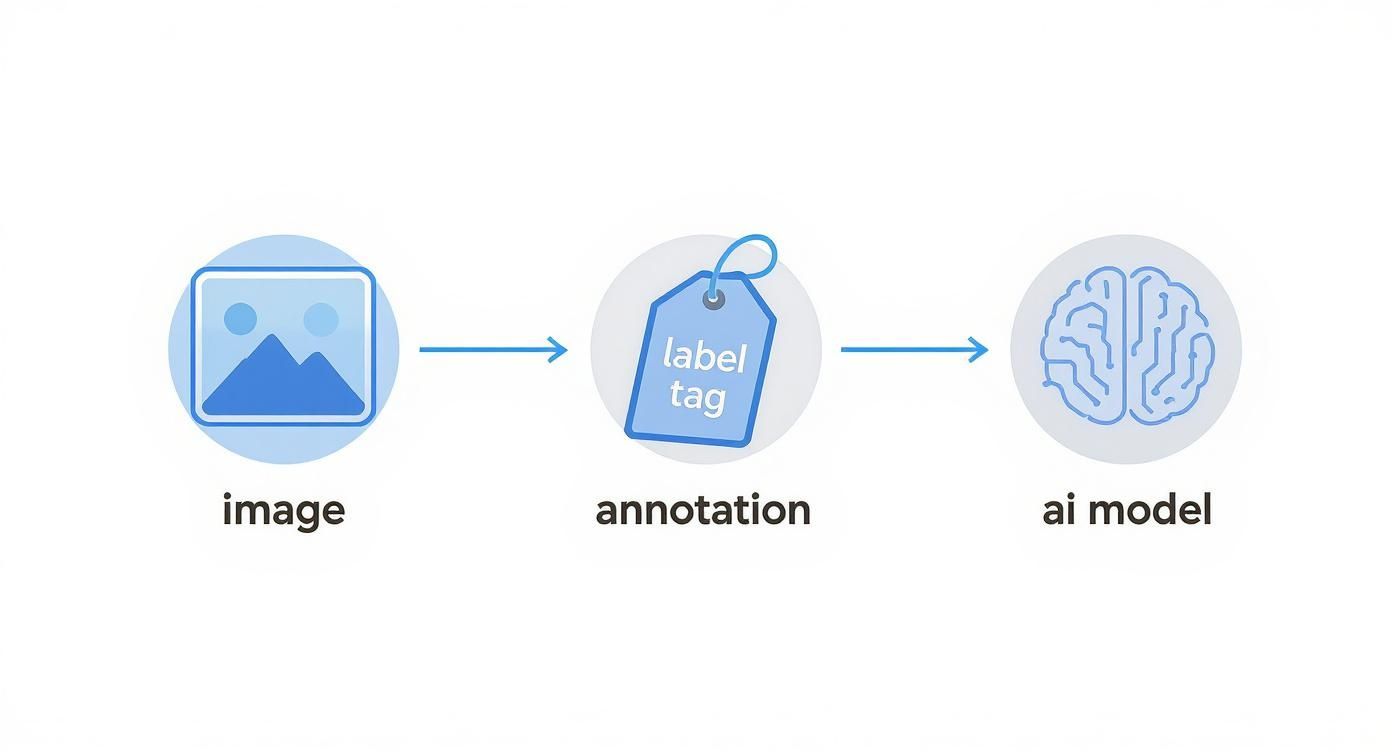
This workflow highlights a critical point: the annotation itself is the essential bridge between a visual asset and machine intelligence. The quality of that step determines the success of the entire project.
Bounding Boxes: The Workhorse of Object Detection
The most common and straightforward technique is the bounding box. It involves drawing a simple rectangle around an object. This method is fast, cost-effective, and ideal for applications where the primary goal is to confirm an object's presence and its approximate location.
For example, an e-commerce company can use bounding boxes to train an AI to count products on a warehouse shelf. A quick rectangular label around each item provides all the information the AI needs to learn how to recognize and count them efficiently, delivering measurable improvements in inventory management.
However, the simplicity of bounding boxes is also their main limitation. They struggle with irregularly shaped or overlapping objects, as the box inevitably includes background pixels that can confuse the model.
Polygons for Precision and Irregular Shapes
When an object’s exact shape is critical, polygon annotation is the preferred technique. Instead of a simple rectangle, annotators place a series of points around the object's perimeter, creating a precise, custom-fit outline. This method delivers a much higher level of precision.
This technique is essential for projects such as:
- Medical Imaging: Accurately outlining a tumor or organ in a scan where every pixel matters for diagnosis.
- Satellite Imagery: Tracing the precise border of a farm field, building, or river for geospatial analysis.
- Autonomous Vehicles: Identifying the exact shape of a pedestrian or another car to ensure safe navigation.
Polygons are more time-consuming and costly than bounding boxes, but the investment yields significant returns. The rich detail provides AI models with a much deeper understanding of an object's true form, leading to more accurate and reliable performance.
Keypoint Annotation for Movement and Pose Estimation
When a model needs to understand an object's position or movement, keypoint annotation (also known as landmark annotation) is used. In this technique, annotators place specific points on key joints or features of an object.
For example, to train an AI to analyze an athlete's form, keypoints would be placed on their elbows, knees, shoulders, and hips. By tracking these points frame by frame, the model learns to distinguish between correct and incorrect technique. This is the same core technology used in facial recognition, which maps keypoints on a person’s eyes, nose, and mouth.
The real power of keypoint annotation lies in its ability to capture structure and the relationships between different parts of an object. It elevates the AI beyond simple identification to a deeper understanding of pose and articulation.
Semantic Segmentation for Comprehensive Scene Understanding
For the highest level of detail, semantic segmentation is the solution. This is the most granular form of annotation, where every single pixel in an image is assigned a class label. Instead of just drawing a box around a car, semantic segmentation classifies every pixel belonging to the "car," every pixel that is "road," and every pixel that is "sky."
The result is a pixel-perfect map of the entire scene, giving the AI an incredibly detailed understanding of its environment. This method is absolutely critical for training autonomous vehicles, which need to make sense of everything around them. It is also used in medical AI to differentiate between various tissue types on a biopsy slide. To see how this advanced technique works, check out our detailed guide on semantic image segmentation.
Choosing the right annotation technique is a strategic decision, not just a technical one. It depends entirely on what your AI model needs to accomplish. By aligning the method with the mission, you build a powerful data foundation for a successful computer vision project.
Building a High-Quality Annotation Workflow
Consistently accurate photography annotation is not a matter of luck; it is the direct outcome of a structured, rigorous, and repeatable process. Simply hiring annotators and providing them with a tool is a recipe for inconsistent data that will degrade your AI model's performance. A professional annotation pipeline transforms a potentially chaotic task into a predictable, scalable, and quality-driven operation that delivers reliable results.
This workflow is built on a series of well-defined stages, each designed to identify errors, enforce consistency, and drive continuous improvement. It begins long before the first label is applied and continues through multiple layers of verification.

The entire system is founded on clear communication, thorough training, and a multi-layered quality assurance (QA) strategy. Without this structure, even the most skilled annotators will produce inconsistent work, leading to expensive rework and project delays.
Establishing the Ground Truth with Clear Guidelines
The first and most critical step is creating a comprehensive set of project guidelines. This document serves as the single source of truth for the entire team, defining exactly how every object should be labeled. Ambiguity is the enemy of quality annotation; clear instructions eliminate guesswork and ensure every team member operates from the same playbook.
These guidelines must include:
- Detailed Class Definitions: Explicitly describe the criteria for assigning an object to a specific class. For example, in a retail project, the guidelines must clearly differentiate between a "sneaker," a "running shoe," and a "casual shoe."
- Edge Case Examples: Provide visual examples of challenging or unusual scenarios, such as how to handle partially obscured objects, reflections, or items that blur categorical lines.
- Visual Instructions: Use annotated screenshots and clear "do vs. don't" images to make instructions unambiguous and easy to follow.
Well-documented annotation guidelines are non-negotiable for scaling any project. They accelerate the onboarding of new team members and serve as the definitive reference for resolving disagreements during QA.
Implementing a Multi-Layered QA Process
A single pass of annotation is never sufficient to guarantee high quality. A truly robust QA process involves multiple checkpoints designed to catch different types of errors. This systematic approach ensures that by the time the data reaches your engineers, it has been thoroughly vetted.
A battle-tested, multi-layer QA workflow typically includes:
- Initial Annotation: A trained annotator performs the first pass, labeling all objects according to the project guidelines.
- Peer Review: A second annotator reviews the first annotator's work, searching for missed objects, incorrect labels, or imprecise boundaries. This step is crucial for catching human error and fostering a culture of shared learning.
- Consensus Scoring or Adjudication: For particularly challenging images, a third, more senior annotator or a consensus algorithm resolves any disagreements between the first two. This ensures the final label is as accurate as possible.
This iterative process is essential for achieving accuracy rates exceeding 99%. It creates a continuous feedback loop where annotators learn from corrected mistakes, leading to a steady improvement in quality and efficiency across the entire team.
Measuring Quality with Key Metrics
To manage quality, you must measure it objectively. In photography annotation, several key metrics are used to evaluate the precision of labels, particularly for bounding boxes and polygons.
The most important metric is Intersection over Union (IoU). IoU measures the degree of overlap between an annotator's bounding box and the "ground truth" box (the ideal, perfect label). It is calculated as the area of overlap divided by the area of union.
An IoU score of 1.0 represents a perfect match, while a project might set an acceptance threshold of 0.9 or higher to enforce extreme precision. This metric provides a clear, quantitative way to assess and enforce quality standards across thousands of images.
Choosing Your Tools and Managing Data Formats
A high-quality workflow is only as effective as the tools and data formats that support it. Selecting the right technical foundation for your photography annotation project is a strategic decision that can prevent costly delays and integration challenges. The right platform should not only accelerate labeling but also provide the project management oversight needed to maintain high accuracy at scale.
This involves more than just selecting software. It is about building a seamless pipeline that transforms a raw image into a model-ready dataset. The best toolset functions as an extension of your team, complete with collaboration features, intuitive interfaces, and clear dashboards that provide real-time insights into project progress and quality.
Selecting the Right Annotation Platform
The market for annotation tools offers a wide range of options, from powerful open-source platforms to feature-rich commercial software. The best choice depends on your project's scale, complexity, and available technical resources. However, a few core features are non-negotiable for any serious AI project.
Look for a platform that delivers on these essentials:
- Collaborative Features: The tool must support multiple annotators working simultaneously. It should include clear roles for reviewers and project managers to streamline the QA process.
- Project Management Dashboards: You need a real-time view of key metrics, such as annotation speed, individual annotator accuracy, and overall project completion rates. Effective management requires visibility.
- Integrated Quality Control: The best platforms have QA functionalities built-in. Features like consensus scoring or direct feedback loops help resolve disagreements and enforce guidelines efficiently.
While open-source tools offer flexibility, commercial platforms often provide better support, security, and scalability. Taking the time to explore the full landscape of available image annotation tools is a critical first step in building an efficient operation.
Demystifying Common Data Formats
Once your images are annotated, the data must be exported in a format that your machine learning framework can read. Incompatibility at this stage can bring a project to a halt. Think of data formats as different languages; if your tool speaks one and your model speaks another, communication fails.
Three of the most common formats you will encounter are:
- COCO (Common Objects in Context): This widely used format stores all annotations in a single JSON file. Its versatility in supporting bounding boxes, segmentation, and keypoints makes it a standard for complex object detection tasks.
- Pascal VOC (Visual Object Classes): An older but still relevant format, Pascal VOC uses individual XML files for each image's annotations. Its straightforward, human-readable structure keeps it popular for many object detection projects.
- YOLO (You Only Look Once): This format is designed for speed. YOLO uses simple .txt files for each image, listing the class and coordinates for every object. It is the format of choice for real-time object detection models where every millisecond is critical.
It is absolutely non-negotiable that your annotation partner can deliver data in the specific format your ML engineers require. Finalizing this from the start saves you from the painful and error-prone process of data conversion later.
The value of well-structured image data is increasing across all industries. The global stock photography market, for instance, is projected to reach USD 11,252.4 million by 2032. This growth is fueled by the demand for high-quality, searchable image libraries, all of which depend on detailed annotation. To learn more, you can discover insights about the growing stock photography market on coherentmarketinsights.com. This trend underscores why mastering data formats is so crucial for unlocking the real value hidden in your visual datasets.
Real-World Applications of Photography Annotation
While the theory is important, the true power of photography annotation becomes clear when you see its real-world applications. Meticulously labeled images are the fuel for AI systems that drive efficiency, open new revenue streams, and, in some cases, even save lives. These applications demonstrate how a simple label on a photo translates directly into tangible business results.
From enhancing online shopping to guiding autonomous vehicles, the use cases for high-quality photography annotation are rapidly expanding. Let's examine how a few key industries are leveraging this foundational data work to gain a significant competitive advantage.

E-commerce and Retail Automation
In the competitive world of e-commerce, visual data is paramount. Photography annotation is the key ingredient that helps online retailers organize massive product catalogs, improve search functionality, and automate inventory management.
Consider a customer who uploads a photo of a jacket they want to buy. To enable a "visual search" feature, an AI model must first be trained on thousands of images where jackets, shirts, and pants have been precisely outlined using bounding boxes and polygons. This allows the system to instantly recognize the product and suggest similar items, providing a direct boost to user experience and conversion rates.
Behind the scenes, the same principles power warehouse automation. Robots equipped with computer vision can identify and sort products on shelves, a capability made possible only by training on datasets where every item was labeled for recognition.
Automotive and Autonomous Driving
The path to fully autonomous vehicles is paved with expertly annotated data. Self-driving cars rely on a continuous stream of images to perceive the world, and they must understand their surroundings with near-perfect accuracy to ensure safety.
This is where techniques like semantic segmentation and bounding boxes are mission-critical. Every element in a driving scene is labeled:
- Vehicles: Every car, truck, and motorcycle is identified.
- Pedestrians and Cyclists: Vulnerable road users are meticulously outlined.
- Infrastructure: Traffic lights, stop signs, lane markings, and crosswalks are all classified.
Without this incredibly detailed level of photography annotation, a self-driving car is effectively blind. The model's ability to make split-second, life-or-death decisions depends entirely on the quality and precision of its training data.
Healthcare and Medical Imaging
In medicine, photography annotation is helping doctors detect diseases earlier and more accurately. AI models are now being trained to analyze complex medical scans like X-rays, MRIs, and CT scans to identify subtle anomalies that a trained human eye might miss.
Using precise polygon annotation, medical experts carefully outline tumors, lesions, or other irregularities in an image. This annotated data then teaches an AI to recognize similar patterns in future scans, serving as a powerful decision support tool for radiologists. This technology helps reduce their workload, flag high-priority cases, and ultimately leads to better patient outcomes.
Agriculture and Environmental Monitoring
Even agriculture is being transformed by AI vision. Drones capture high-resolution images of vast fields, which are then used in photography annotation to train models to:
- Identify different crop types and monitor their health.
- Detect early signs of disease or pest infestation.
- Estimate crop yields with remarkable accuracy.
This data provides farmers with the insights needed to apply water, fertilizer, and pesticides with surgical precision, reducing waste and boosting efficiency. It is a perfect example of how photography annotation is helping to build more sustainable and productive systems.
Here’s a closer look at how different sectors are putting this technology to work.
Industry Applications of Photography Annotation
This table summarizes how various industries leverage photography annotation to solve specific business problems and drive innovation.
| Industry | Primary Use Case | Annotation Types Used | Business Impact |
|---|---|---|---|
| Retail & E-commerce | Visual Search & Automated Inventory | Bounding Boxes, Polygons | Improved user experience, increased conversion rates, streamlined logistics. |
| Automotive | Autonomous Driving & ADAS | Semantic Segmentation, 3D Cuboids | Enhanced vehicle safety, accelerated development of self-driving features. |
| Healthcare | Medical Image Analysis (e.g., tumor detection) | Polygons, Semantic Segmentation | Faster and more accurate diagnostics, reduced radiologist workload. |
| Agriculture | Crop Monitoring & Yield Prediction | Bounding Boxes, Segmentation | Increased crop yields, reduced resource waste, early disease detection. |
| Security | Surveillance & Anomaly Detection | Bounding Boxes, Object Tracking | Improved public safety, faster incident response, automated monitoring. |
| Insurance | Automated Damage Assessment | Polygons, Segmentation | Accelerated claims processing, reduced fraud, improved assessment accuracy. |
As these use cases illustrate, the applications are as diverse as the industries themselves, but the core principle remains consistent: high-quality annotation unlocks the value hidden in visual data.
The demand for high-quality, professionally shot images is a major force in many of these fields. The global photography services market, valued at USD 37.51 billion in 2025, is projected to hit USD 47.46 billion by 2030. This growth is largely fueled by the need for commercial images in e-commerce and digital media, all of which require annotation to become useful for AI. You can discover more insights on the growth of the photographic services market on mordorintelligence.com.
How to Evaluate an Annotation Partner
Choosing the right partner for your photography annotation is one of the most critical decisions for your AI project. The quality of your training data, the consistency of your labels, and the security of your assets all depend on this choice. While it is tempting to focus on price, the real value lies in finding a partner who delivers accuracy, scales with your needs, and acts as a true extension of your team.
A strong partnership is built on trust and transparency, not just transactions. To find such a partner, you need a solid framework for vetting potential providers, one that involves asking detailed questions about their processes, security measures, and quality guarantees.
Key Criteria for Vetting Providers
When you begin discussions with potential annotation partners, concentrate on the factors that drive successful AI outcomes. While cost is always a consideration, accuracy and reliability are far more critical to your project’s long-term success.
Your evaluation should be based on four core pillars:
- Quality Assurance: How do they guarantee accuracy? Do not settle for vague promises. Ask for specific details about their multi-layer QA process, including peer reviews and adjudication steps. A top-tier partner should confidently commit to accuracy rates of 99% or higher.
- Security and Compliance: How is your data protected? Investigate their data handling protocols, confidentiality agreements (NDAs), and certifications like ISO/IEC 27001. This is non-negotiable, particularly when working with sensitive or proprietary information.
- Scalability and Expertise: Can they handle your future volume as well as your current needs? A reliable partner has a deep bench of well-trained annotators ready to tackle projects of any size and complexity. Their expertise across different annotation types is a strong indicator of their overall capability.
- Communication and Project Management: How will you collaborate on a day-to-day basis? Look for clear communication channels, a dedicated project manager, and transparent reporting. You should expect regular updates on progress, quality metrics, and turnaround times without needing to ask.
A partnership approach is about much more than just delivering labeled images. It’s about collaborative problem-solving, proactive communication, and a shared commitment to achieving your project goals. This ensures your AI is built on a foundation of unquestionable data quality.
Making a Confident Decision
Ultimately, the right partner is invested in your success. They should be eager to run a pilot project to demonstrate their capabilities and align on expectations before you commit to a long-term contract. This trial period is your best opportunity to evaluate their workflow, communication style, and output quality firsthand.
At Prudent Partners, we believe in building these trusted relationships from day one. Our entire process, from the initial conversation to the final delivery, is designed for absolute transparency and precision.
Ready to build your AI project on a foundation of exceptional data? Connect with our team today to discuss your photography annotation needs and see how our customized solutions can drive your success.
Answering Your Top Questions
Let's address some of the most common questions that arise when teams are planning their first photography annotation project. Clarifying these practical concerns early on is key to a smooth and successful partnership.
How Is the Cost of Annotation Determined?
There is no flat rate for annotation; the price depends on several key factors. The most significant factor is complexity. A project requiring simple bounding boxes will cost far less per image than one that demands intricate semantic segmentation, which requires pixel-perfect accuracy and more time from a skilled annotator.
Volume also plays a major role. While more images naturally increase the overall project cost, most providers offer volume discounts, which can significantly reduce your per-image price as you scale. Finally, timelines are a factor. If you have an urgent deadline, your partner may need to allocate additional resources to meet it, which can affect the final cost.
How Is Data Privacy and Security Handled?
Your data is your most valuable asset, and its protection is non-negotiable. Any reputable annotation partner will operate under strict security protocols to keep your intellectual property safe and confidential. The process always begins with a robust Non-Disclosure Agreement (NDA) before any files are exchanged.
Beyond that, look for providers with internationally recognized certifications like ISO/IEC 27001. This is not just a certificate; it is a commitment to a rigorous security management system. This includes everything from encrypted data transfers and restricted file access to formal protocols for data handling and storage, ensuring your assets are protected at every step.
What Is a Typical Turnaround Time?
Turnaround time depends on the project's scope, the complexity of the labels, and the size of the team assigned to it. A small test batch of a few hundred images requiring basic bounding boxes could be completed in just a couple of days.
Conversely, a massive project with hundreds of thousands of images requiring detailed polygon annotation could take several weeks or even months. A reliable partner will work with you to establish a realistic timeline based on your specific needs and provide clear, consistent progress updates.
Ready to build your AI model on a foundation of accuracy and quality? Prudent Partners provides high-accuracy photography annotation services backed by a proven workflow, strict security, and a commitment to delivering exceptional results.
Get in touch with our experts today to start your custom pilot project.