
Sentiment analysis techniques are AI-driven methods that decipher and categorize the emotions tucked away in text, social media posts, and customer reviews. These tools automatically determine if the opinion is positive, negative, or neutral, turning a flood of unstructured language into clear, measurable business insights.
Unlocking Customer Opinions with Sentiment Analysis
In a world buzzing with digital chatter, understanding what your customers truly think has never been more important. Every day, people share their unfiltered opinions on social media, in product reviews, and through support chats. This mountain of unstructured data holds the keys to a better customer experience, but manually reading through it all is impossible.
That is the exact problem sentiment analysis was built to solve.
Think of it as a translator for human emotion. It takes raw, subjective feedback and turns it into structured, actionable data that reveals the why behind customer behavior. By analyzing word choice, context, and even subtle tone, sentiment analysis gets you past surface-level metrics like star ratings and shows you the nuanced feelings driving those scores.
The Strategic Value for Your Business
Using sentiment analysis is not just about tracking brand mentions; it is a strategic play to get ahead of the competition. According to industry analysis, the majority of customer service leaders are expected to integrate sentiment analysis solutions, which demonstrates just how critical this technology has become. It empowers organizations to:
- Monitor Brand Health in Real Time: Instantly gauge the public’s mood during a new product launch or a major marketing campaign.
- Refine Product Development: Pinpoint specific features customers love (or hate) by digging into their direct feedback. A software company, for example, can spot user frustration with a new interface long before it starts hurting retention.
- Enhance Customer Experience: Proactively address negative feedback from support tickets or reviews, turning unhappy customers into loyal advocates.
Ultimately, sentiment analysis gives you a direct line to the authentic voice of your customer. It closes the gap between what you think customers want and what they actually say, paving the way for data-driven decisions that build real brand loyalty and fuel growth.
Breaking Down the Core Sentiment Analysis Techniques
So, how do you actually turn a jumble of raw opinions into structured, usable insights? It all starts with the core sentiment analysis techniques. Each method comes with its own trade-offs in complexity, accuracy, and required resources, making them suitable for different jobs and data types. The approaches range from simple dictionary lookups to incredibly sophisticated models that try to mimic how a human understands language.
This diagram shows the basic concept: scattered opinions are collected, run through an analysis engine, and transformed into clear intelligence that can drive business decisions.
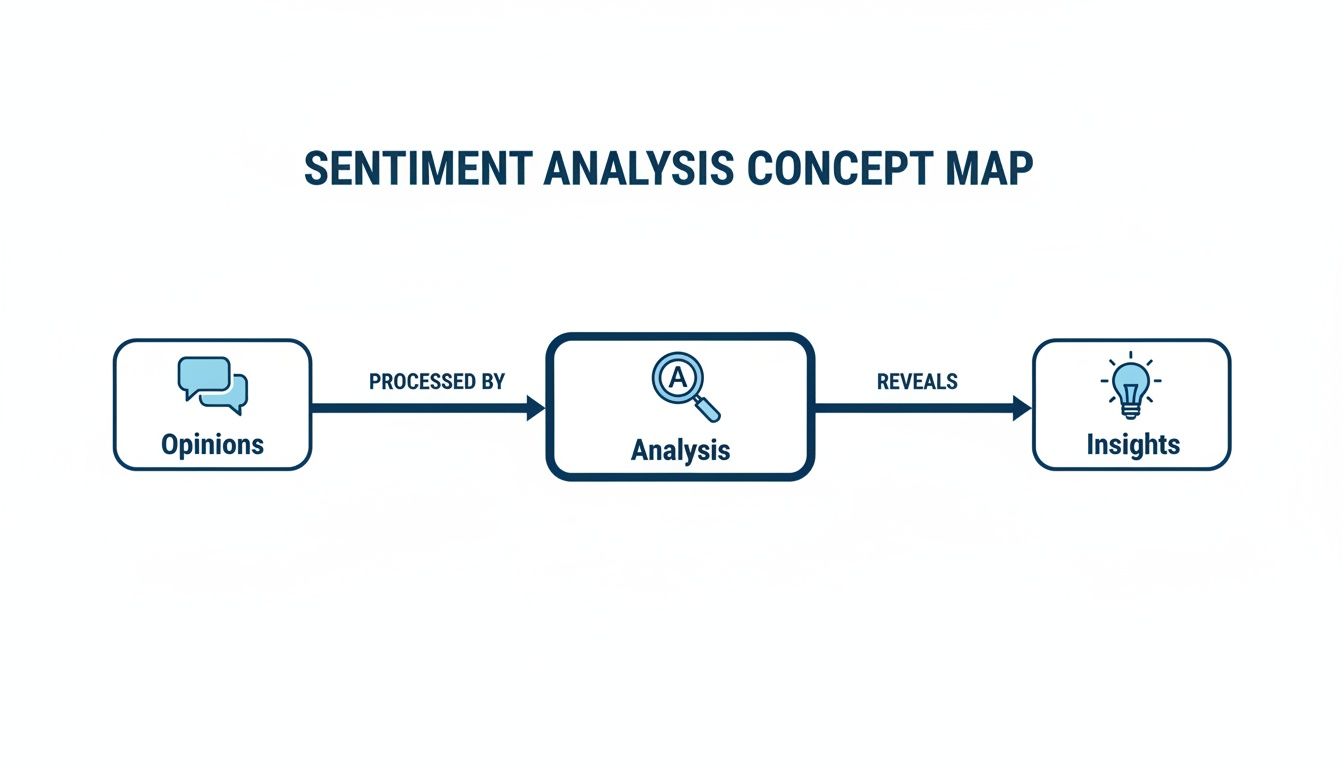
As you can see, it is a journey from gathering raw feedback to generating valuable insights that guide your strategy.
To give you a better feel for how these methods stack up, here is a quick side-by-side comparison.
A Quick Comparison of Sentiment Analysis Methods
This table breaks down the main sentiment analysis techniques, looking at how they work, their key advantages and disadvantages, and where they perform best.
| Technique | How It Works | Pros | Cons | Best For |
|---|---|---|---|---|
| Lexicon-Based | Matches words against a pre-defined dictionary of positive/negative words (a "lexicon"). | Simple, fast, transparent, and requires no training data. | Struggles with context, sarcasm, and negation. Very rigid. | Quick, simple sentiment checks where nuance is not critical. |
| Classical ML | Learns patterns from labeled text data (e.g., positive/negative reviews) to make predictions. | More accurate than lexicons, understands some context. | Requires large amounts of labeled data; can be computationally intensive. | General-purpose sentiment analysis for reviews, surveys, and social media. |
| Deep Learning | Uses neural networks (like Transformers) to understand complex relationships between words and sentences. | Highest accuracy, grasps sarcasm, negation, and deep context. | Needs massive datasets and significant computing power. Can be a "black box." | High-stakes applications requiring maximum accuracy, like financial analysis or brand safety. |
Each technique has its place. The one you choose really depends on your specific goals, the data you have, and the resources you can commit. Now, let’s dig a bit deeper into each one.
Rule-Based and Lexicon-Based Approaches
The most straightforward and transparent method is the rule-based or lexicon-based approach. Think of it as a meticulously organized dictionary where every word gets a sentiment score. "Excellent" or "love" might get a +1, while "terrible" or "fail" gets a -1.
When you feed it a sentence, the system simply adds up the scores of all the sentiment-heavy words it finds. A positive final score means a positive sentence, a negative score means negative, and a score near zero is labeled neutral.
This approach is easy to understand and does not involve any complex machine learning. But its biggest weakness is a complete inability to grasp context, sarcasm, or negation. For example, it would get tripped up by a phrase like "The battery life is not bad," likely flagging "bad" as a negative signal and missing the point entirely.
Classical Machine Learning Models
Moving up the ladder, we get to classical machine learning (ML) models. These are the workhorses behind many modern sentiment analysis systems and are a huge step up from rigid, rule-based methods. Instead of using a fixed dictionary, these models learn from data.
Imagine them as students who are taught to spot sentiment by studying thousands of examples. You feed them a huge dataset of text that humans have already labeled as positive, negative, or neutral. The model then churns through these examples, identifying patterns and connections between words and the overall sentiment.
Common classical ML algorithms include:
- Naive Bayes: A fast, probabilistic classifier that calculates the odds of a piece of text belonging to a category based on the words inside. It is surprisingly effective for basic text classification tasks.
- Support Vector Machines (SVM): This model works by finding the best possible "line" to separate data points into different classes (like positive vs. negative). SVMs are powerful and often deliver high accuracy, especially for clear-cut classification problems.
- Logistic Regression: Despite the name, this algorithm is used for classification. It calculates the probability of an outcome, making it a solid choice for deciding if a review is positive or negative.
These models perform much better than lexicon systems because they can learn from context. The global sentiment analytics market was valued at USD 5.42 billion and is projected to hit USD 10.82 billion by 2033, driven largely by this shift to ML. Models like Naive Bayes and SVM can achieve accuracies of 85-90% on standard datasets.
The key takeaway here is that machine learning brings adaptability. A lexicon is static, but an ML model can be retrained on new data. This allows it to keep up with new slang, evolving language, and industry-specific terms.
Advanced Deep Learning and Transformers
At the top of the pyramid are deep learning models, especially those built on transformer architectures like BERT (Bidirectional Encoder Representations from Transformers). These models are the current state-of-the-art in Natural Language Processing (NLP) and can interpret language with a nuance that was once pure science fiction.
If classical ML models are students, then deep learning models are like seasoned linguists. They do not just look at words in isolation; they analyze the intricate relationships between all words in a sentence to capture the full context.
This lets them tackle the toughest challenges in sentiment analysis:
- Understanding Sarcasm: They can recognize that "Great, another delay" is actually frustration, not praise.
- Handling Negation: They correctly interpret "not good" as negative, a common failure point for simpler systems.
- Grasping Ambiguity: They can tell the difference between "The movie was unbelievably good" and "The plot was unbelievably bad."
Models like BERT come pre-trained on gigantic volumes of text from across the internet, giving them a profound, built-in understanding of how language works. For sentiment analysis, you can then fine-tune them on a smaller, specific dataset to achieve accuracy often exceeding 92% on complex tasks. This makes them perfect for situations where precision is everything, like analyzing financial market sentiment or managing a high-stakes brand crisis.
Getting Granular: Specialized Sentiment Analysis Methods
While the core techniques give you a great high-level view, sometimes you need to pull out the magnifying glass. To really get to the bottom of customer feedback, you need specialized methods that can dissect opinions with surgical precision. These approaches go way beyond a simple "positive" or "negative" tag on an entire review, helping you answer much more specific and valuable business questions.
This is how you pinpoint exactly what customers love (or hate) about a specific product feature, understand feedback from a global audience, or even read between the lines by analyzing someone's tone of voice.

Aspect-Based Sentiment Analysis (ABSA)
Imagine a customer review that says, "The camera quality is incredible, but the battery life is a huge disappointment." A standard sentiment model might just call this "mixed" and move on, completely missing the crucial details. This is where Aspect-Based Sentiment Analysis (ABSA) comes in.
ABSA solves this problem by breaking down feedback into specific topics, or "aspects," and assigning a sentiment to each one. It creates a detailed map of what people think about the individual parts of your product or service.
Using ABSA, that review would be broken down like this:
- Aspect: "camera quality" → Sentiment: Positive
- Aspect: "battery life" → Sentiment: Negative
This level of detail is a game-changer for product and customer experience teams. It turns vague feedback into a clear, actionable to-do list, showing you which strengths to double down on and which weaknesses need immediate attention. At Prudent Partners, we often help e-commerce clients use ABSA to optimize product descriptions and make smarter inventory decisions based on this kind of feature-level feedback.
The Challenge of Multilingual Sentiment Analysis
In today's global market, your customers could be speaking dozens of different languages. Multilingual Sentiment Analysis is the key to understanding opinions across this linguistic divide. But it is not as simple as just translating text and plugging it into an English-based model.
Language and culture are deeply intertwined, and a direct translation often strips away the emotional context.
A phrase that is mildly negative in one language could be deeply offensive when translated literally into another. Sarcasm, idioms, and cultural shorthand are huge hurdles, demanding models that are not just translated but are actually trained on native data for each specific language.
For example, the English idiom "It's not my cup of tea" is a gentle way of expressing dislike. A literal translation would be nonsense in most other languages. A truly effective multilingual model needs to understand the intent behind the phrase, not just the words. This requires high-quality, culturally-aware data annotation services to build datasets that capture these nuances, ensuring you hear what your global customers are really saying.
Unlocking Deeper Insights with Multimodal Sentiment Analysis
The most advanced frontier is Multimodal Sentiment Analysis, which looks beyond text to analyze sentiment from multiple data types at once. This sophisticated approach combines text with audio and visual cues to build a complete picture of human emotion.
Think about a customer support video call. A multimodal system would analyze:
- Text: The words the customer is saying (from the transcript).
- Audio: Their tone of voice, pitch, and how loudly they are speaking.
- Video: Their facial expressions and body language.
By layering these inputs, the model can catch sarcasm where the words are positive but the tone is dripping with irony. It can also spot deep frustration even if the customer is trying to be polite. This gives you a far richer and more accurate read on their true emotional state.
In fact, advanced multimodal techniques that fuse text, voice, and facial cues are already outperforming text-only methods by 25-35% in accuracy. We have seen this firsthand at Prudent Partners, where projects for security and smart cities using annotated LiDAR and text data for behavior recognition have boosted detection rates by 30%. The power of combining data types is undeniable. For a deeper dive, it is worth exploring the latest market research on emotion recognition technologies.
These specialized techniques empower businesses to graduate from a general understanding to a deeply nuanced one. Whether you are refining a product, engaging a global audience, or transforming customer support, these granular methods deliver the insights needed to make truly customer-centric decisions.
Why High-Quality Data Annotation Is Non-Negotiable
Every sentiment analysis model, whether it is a classic machine learning algorithm or a state-of-the-art transformer, hinges on one simple truth: an AI model is only as good as the data it is trained on. This makes high-quality data annotation the absolute cornerstone of any successful sentiment analysis system.
Imagine trying to teach a student a new language with a dictionary full of typos and wrong definitions. No matter how smart the student is, they will never become fluent. It is the same with AI. Feeding a model ambiguous, inconsistent, or poorly labeled data just trains it to make unreliable predictions.
The Foundation of Model Accuracy
You cannot build a strong house on a shaky foundation. In the world of AI, high-quality data is that foundation. It is not just a box to check; it is a careful, continuous process that directly shapes how well your model performs. Even a dataset with a 5% error rate can cause a model's predictive accuracy to plummet, leading to flawed business insights and poor decisions.
Building this foundation means going far beyond just slapping "positive" or "negative" labels on text. It is about creating a structured, dependable process.
Here is what that looks like in practice:
- Creating Clear Guidelines: You need a detailed rulebook that defines every sentiment category with concrete examples, especially for tricky edge cases.
- Ensuring Annotator Consistency: Human annotators must be trained to apply the guidelines in the exact same way, removing subjective guesswork that can poison a dataset.
- Correctly Labeling Ambiguity: Your system needs a strategy for handling the tough stuff, such as sarcasm, idioms, and industry-specific jargon that machines almost always get wrong on their own.
These steps are not optional. They create the "ground truth" your model needs to learn, test itself, and actually understand human emotion.
Navigating the Nuances of Human Language
The real challenge with sentiment analysis is how messy and complex human language is. "Wow, the customer support was unbelievably helpful" is a breeze to label. But what about, "Great, my package is delayed again"?
Without a human-in-the-loop to catch the sarcastic tone, a model would almost certainly tag that as "positive."
This is exactly where expert data tagging makes all the difference. Professional annotators are trained to dissect these nuances, providing the clean, context-rich labels that machine learning models desperately need to understand what people really mean.
At Prudent Partners, our meticulous approach to data annotation is built to solve these exact challenges. We deliver datasets with 99%+ accuracy, giving AI teams the confidence to build models for mission-critical tasks like brand monitoring and customer experience management.
The Compounding Cost of Poor Data
Trying to save money with cheap, low-quality data annotation might seem tempting upfront, but it always creates bigger, more expensive problems down the line. A model built on bad data produces bad results. Period.
This leads to a cascade of issues:
- Wasted Engineering Time: Your data science team will burn countless hours trying to figure out why a model is underperforming, only to realize the problem was bad data from the start.
- Flawed Business Strategy: Making decisions based on faulty sentiment insights can lead to misguided product launches, ineffective marketing, and a damaged reputation.
- Loss of Trust: When stakeholders cannot rely on the AI's outputs, the entire project loses credibility, killing adoption and any hope of a positive ROI.
Ultimately, any initial savings are wiped out by the high cost of rework, missed opportunities, and strategic mistakes. A powerful sentiment analysis model starts with a non-negotiable commitment to data quality. When you partner with experts who guarantee precision from day one, you ensure your AI investment delivers accurate, measurable, and scalable results.
Putting Your Sentiment Analysis Model into Practice
So, you understand the theory. But turning that knowledge into a live, working sentiment analysis model is where the magic really happens. This is the practical side of the coin, a structured journey that takes you from messy, raw data all the way to a deployed system that feeds you continuous business intelligence. Getting this process right is what separates a cool tech experiment from a genuine strategic asset.
The whole thing kicks off with data gathering and prep. It is the foundational, and frankly, the most critical step. You will be pulling in text from all sorts of places: social media feeds, customer reviews, support tickets, you name it. This raw data is noisy, so the first order of business is cleaning it up. That means stripping out things like special characters, URLs, and other junk to get it ready for analysis.

From Data Gathering to Deployment
Once your data is clean, you face your next big decision: choosing the right model. This choice hinges entirely on your goals, the complexity of your data, and the resources you have. A simple lexicon-based model might be perfect for quick temperature checks, but for teasing out nuanced opinions where accuracy is everything, you will want to reach for a deep learning model.
After you have selected a model and trained it on high-quality annotated data, you are ready for deployment. This is the moment your model goes live, plugging into your business workflows to analyze new data as it streams in. It could be an API feeding insights into a customer service dashboard or a BI platform that helps your marketing team understand campaign reception in real-time.
This operational value is why the market is exploding. In social media analytics alone, the sentiment analysis segment pulled in USD 3,944.9 million and is on track to hit USD 17,048.5 million by 2030. We have seen accuracy leap from a shaky 75% in early tools to over 95% with fine-tuned models today. This allows businesses to spot crisis signals up to 48 hours earlier in 65% of brand reputation incidents. You can find more insights on the rapid expansion of the social media analytics market.
Measuring Success with Key Metrics
How do you know if your model is any good? Gut feelings do not cut it. You need hard numbers. Several key metrics give you a clear, quantitative picture of your model's performance, showing you exactly where it shines and where it stumbles.
These are the core metrics every sentiment analysis project should track:
- Accuracy: The most straightforward one. It is simply the percentage of correct predictions. If your model nails the sentiment in 900 out of 1,000 reviews, your accuracy is 90%.
- Precision: This asks, "Of all the times the model predicted 'positive,' how often was it right?" High precision is crucial when a false positive (like misidentifying a complaint as a compliment) is costly.
- Recall: This measures how well the model finds all the relevant examples. It answers, "Of all the actual 'positive' reviews, how many did the model catch?"
- F1 Score: This metric creates a healthy balance between Precision and Recall. It is especially useful when your data is skewed, for instance, if you have way more positive reviews than negative ones.
By keeping a close eye on these metrics, you can objectively judge your model's performance and make data-driven tweaks. This empirical approach is what builds a system your organization can actually rely on.
The Importance of Continuous Monitoring
Here is a secret: deployment is not the finish line. It is the start of a continuous improvement loop. Language never sits still. New slang, memes, and topics pop up constantly. A model that is a rockstar today could become tone-deaf in a few months if you just let it be. This decay in performance is a real phenomenon known as model drift.
The only way to fight model drift is with continuous monitoring. This means you have to regularly check your model’s performance on new, incoming data and retrain it periodically with fresh, accurately labeled examples. This iterative cycle keeps your sentiment analysis system relevant, sharp, and valuable over the long haul, ensuring it evolves right alongside your customers' voices. Prudent Partners’ expertise in ongoing AI Quality Assurance provides the framework for this essential upkeep.
Finding the Right Partner to Turn Insights into Action
As we have seen, the true power of sentiment analysis is not just about fancy algorithms, it is about the clean, high-quality data that brings them to life. Whether you are using simple rule-based systems or sophisticated transformers, the end goal is always the same: turning raw customer opinions into clear, actionable intelligence.
But getting there requires more than just code. It takes a partner who deeply understands both the technology and the meticulous data work it depends on. This is where a strategic ally can make or break your entire initiative.
From Data to Decisions with Prudent Partners
At Prudent Partners, we close the gap between AI theory and real-world business results. Our work is designed to support you at every stage of your sentiment analysis project, making sure your models are built on a rock-solid foundation of accurate, reliable data.
We help you connect the dots with:
- High-Accuracy Data Annotation: Our teams deliver meticulously labeled datasets with 99%+ accuracy, which is the essential first step for training any machine learning model you can trust. See how we establish the ground truth for your AI with our expert data annotation services.
- AI Quality Assurance: We do not just stop at training. We rigorously test and validate your model’s outputs, making sure its predictions are dependable and free from bias before they start shaping your business decisions.
- Scalable BPM Solutions: We help you weave validated sentiment insights directly into your day-to-day operations, turning analytics into a natural part of your customer experience and product development cycles.
Choosing a partner is not just about outsourcing a task. It is about securing a commitment to quality that grows with your goals. Our ISO-certified processes and focused solutions ensure every project delivers tangible, dependable results.
Ready to see what precision-labeled data can do for your sentiment analysis? Let’s talk. Connect with our experts to design a pilot project that tackles your unique challenges and finally unlocks the true voice of your customer.
Your Top Questions About Sentiment Analysis, Answered
Even after getting the hang of the different techniques, you are bound to have some practical questions. Let's tackle the most common ones that come up when teams start putting sentiment analysis into practice.
What is the Difference Between Sentiment and Emotion Analysis?
It is a great question, and people often use these terms interchangeably, but they measure two very different things.
Think of sentiment analysis as the big-picture summary. It sorts text into broad categories like positive, negative, or neutral. It is like getting a weather forecast that just says “sunny” or “rainy.”
Emotion analysis, on the other hand, zooms in on the specifics. It aims to identify distinct feelings like joy, anger, sadness, or surprise. To continue the analogy, it is the detailed report giving you the exact temperature, humidity, and wind speed.
How Accurate Can Sentiment Analysis Really Be?
This is the million-dollar question, and the honest answer is: it depends entirely on your method and your data.
- Rule-based systems are the most basic and tend to be less accurate. They get tripped up easily by nuance, context, and sarcasm.
- Classic machine learning models are a big step up. With a solid, well-labeled dataset, you can realistically expect 85-90% accuracy.
- Advanced deep learning models, especially transformers, are the current state-of-the-art. When fine-tuned on high-quality, domain-specific data, they can push past 92% accuracy.
The key takeaway? Accuracy is a direct reflection of how good your training data is.
No algorithm, no matter how sophisticated, can overcome the limitations of poorly labeled data. The quality of your annotation is the single biggest factor determining whether your model delivers real-world value or just noise.
Can Sentiment Analysis Understand Sarcasm?
Sarcasm is famously one of the toughest nuts to crack in natural language processing. Simpler methods, like lexicon-based tools, are almost guaranteed to fail here. They see positive words and take them at face value, completely missing the sarcastic jab.
This is where modern deep learning models really shine. Transformers, in particular, are much better equipped for this challenge. By analyzing the entire sentence, not just isolated keywords, they learn the subtle contextual clues and word relationships that signal sarcasm. It is not perfect, but it is a massive leap forward in capturing true human meaning.
At Prudent Partners, we specialize in turning messy, complex data into the reliable foundation you need for business intelligence. Our high-accuracy data annotation and AI quality assurance services build sentiment analysis models you can actually trust.
Connect with our experts to start a pilot project and see the difference quality data makes.