
Data labeling is the process of adding descriptive tags, or labels, to raw data so an AI model can learn from it. Think of it like teaching a child what a "cat" is. You do not just give them a biology textbook; you show them pictures and say "cat" repeatedly.
In the same way, we "show" an AI thousands of cat photos with a "cat" label. Without those simple tags, the data is just meaningless pixels to an algorithm. With them, it becomes the training manual for building smart, accurate AI.

The Foundation of Modern AI
At its core, data labeling is a human-centered effort to add context to information so a machine can understand it. An AI algorithm cannot tell the difference between a car and a pedestrian on its own, nor can it spot positive sentiment in a customer review. It needs a "ground truth," a perfectly labeled dataset that acts as its textbook for learning.
This process is what turns messy, unstructured data into a clean, structured format that algorithms can use. It's a non-negotiable step for supervised machine learning, which is the engine behind most of today's business AI applications. The quality of the labels directly dictates how well the final AI model performs, making it a critical component of any successful AI strategy.
Why Labeled Data Is Critical
High-quality labeled data is the fuel for any intelligent system. Even the most powerful algorithm is useless without it. Here’s why this step is so important from a business and technical perspective:
-
Model Accuracy: The more precise and consistent the labels, the better the AI will be at making correct predictions on new, real-world data. This directly translates to measurable business impact, such as more reliable product recommendations or more accurate medical diagnoses.
-
Reduced Bias: A carefully labeled dataset helps catch and correct biases that could otherwise lead to unfair or dangerously inaccurate automated decisions. This human-centered approach ensures AI systems are more equitable and trustworthy.
-
Scalable Intelligence: Once trained on quality data, an AI model can perform its task millions of times over at a speed and scale no human team could match. This scalability drives efficiency and opens new opportunities for growth.
To help you get started, we've put together a quick reference table outlining the essential concepts in data labeling.
Core Data Labeling Concepts at a Glance
| Concept | Description | Role in AI |
|---|---|---|
| Data Labeling | The process of adding descriptive tags (labels) to raw data like images, text, or audio. | Turns raw data into a structured format that AI models can learn from. |
| Ground Truth | The perfectly labeled, highly accurate dataset used as the "answer key" to train and validate an AI model. | It’s the gold standard that the AI model strives to replicate in its predictions. |
| Supervised Learning | A type of machine learning where an algorithm learns from data that has already been labeled with the correct outcomes. | The most common approach for business AI; it relies entirely on labeled data. |
| Unstructured Data | Data without a predefined format, such as images, audio files, videos, and raw text. | Labeling gives structure to this data, making it usable for machine learning. |
Understanding these terms is the first step toward building a successful AI strategy. The quality of each element directly impacts the final model's performance and business value.
The Growing Demand for Quality Data
The market's explosive growth tells the whole story. The data labeling services market was valued at USD 19.7 billion in 2024 and is on track to hit USD 134.7 billion by 2034. This is not just a trend; it's a fundamental shift in how businesses approach AI development.
As more companies adopt AI, they're realizing that the model itself is only half the equation. The other, more critical half is the data that feeds it. You can learn more about how data annotation is fueling smarter AI to see how this is playing out across the U.S. This rapid expansion proves a simple truth: the demand for expert data annotation that delivers accuracy at scale is only going to get bigger.
A Look at the Different Types of Data Labeling
Data labeling is not a one-size-fits-all job. The technique an AI team chooses depends entirely on the kind of data they’re working with and what they want their machine learning model to accomplish. Different data formats need different annotation methods to build the context an algorithm needs to learn.
Picking the right labeling technique is how you unlock your data's real potential, turning raw information into a powerful asset for building smarter AI. Let's walk through the most common types and see where they show up in the real world.
Image and Video Annotation
This is probably the type of data labeling you have heard of most. It is the engine behind everything from e-commerce product searches to breakthrough medical diagnostics. For an AI model to make sense of visual information, human annotators first have to identify and tag objects within images and video frames.
Here are a few of the go-to methods:
-
Bounding Boxes: These are the simplest approach, just a rectangular box drawn around an object. A practical example is an e-commerce site using them to train a model to spot different clothing items in photos customers upload.
-
Semantic Segmentation: This is far more granular. It involves classifying every single pixel in an image. Think of a self-driving car; this technique labels pixels as ‘road,’ ‘pedestrian,’ ‘vehicle,’ or ‘sky,’ painting a complete digital picture of its surroundings for safe navigation.
-
Polygonal Segmentation: When objects have funky, irregular shapes, annotators use polygons to trace their exact outlines. This precision is critical for identifying tumors in medical scans or pinpointing specific parts on a manufacturing line.
For a deeper dive into how these work, check out our guide on professional image annotation services. It breaks down the methods and quality control steps needed to get high-accuracy results.
The image below shows how different techniques like bounding boxes and polygons can be layered onto a single image to teach a computer vision model what it's looking at.
This example makes it clear how multiple layers of information can be pulled from one scene. It creates a rich, structured dataset that helps an AI model tell the difference between cars, people, and traffic signs with incredible precision.
Text and Audio Annotation
Of course, AI needs to understand more than just visuals; it has to grasp language and sound, too. Text and audio annotation give models the context they need to interact with human speech and writing.
The goal of text annotation is to teach a machine to read and comprehend language with the nuance of a human. This includes understanding intent, emotion, and context, which are critical for building effective customer service bots and content moderation systems.
Common applications here include:
-
Sentiment Analysis: Labeling customer reviews as ‘positive,’ ‘negative,’ or ‘neutral’ to get a pulse on public opinion and inform product strategy.
-
Named Entity Recognition (NER): Identifying and categorizing key information like names, dates, and locations within documents to automate data extraction from contracts or invoices.
-
Audio Transcription: Converting spoken language into written text. This is the first and most important step for training voice assistants and speech-to-text software.
Sensor Fusion Data Labeling
Modern autonomous systems, like self-driving cars and drones, see the world through more than just cameras. They combine data from multiple sensors, especially LiDAR (Light Detection and Ranging) and radar, to build a detailed 3D map of their environment.
Labeling this complex, multi-layered data is one of the toughest annotation jobs out there. Annotators have to accurately tag objects across different data streams, like camera footage and LiDAR point clouds, to create a single, unified "ground truth." This 3D understanding is what guides a vehicle’s decisions in real time.
From Raw Data to Quality Labels: The Data Labeling Workflow
Turning raw, unstructured data into a high-quality asset for AI training is a structured, meticulous journey. This process is far more than just adding tags; it's a managed cycle designed to produce reliable, consistent, and accurate labels that form the bedrock of any successful AI model. Each step builds on the last, with rigorous quality checks embedded throughout.
The reliance on this process is exploding. The global data labeling market, valued at around USD 4.87 billion in 2025, is projected to hit USD 29.11 billion by 2032. This incredible growth highlights the critical demand for quality labeled data across every industry. You can dig deeper into these trends in the full industry report.
From Data Collection to Annotation Guidelines
The workflow always kicks off with data collection and preparation. This means gathering a dataset that is not only large but also diverse and representative of the real-world scenarios your AI will face. Once collected, the data gets cleaned up and organized, making sure it's ready for the human annotators.
Right after that comes the most important step: creating the annotation guidelines. Think of this document as the definitive rulebook for the labeling team. It must be exceptionally clear, packed with detailed instructions, examples of edge cases, and precise definitions to kill any ambiguity. Strong guidelines are the single biggest factor in achieving label consistency and accuracy, especially across a large team.
The Annotation and Quality Assurance Cycle
With clear instructions in hand, the labeling process begins. Human annotators use specialized tools to apply the defined labels, whether that means drawing bounding boxes on images, transcribing audio files, or classifying the sentiment of a piece of text. This is where a human-centric approach, focusing on annotator training and support, really pays off.
This visual shows the high-level flow for handling different data types like images, text, and audio.
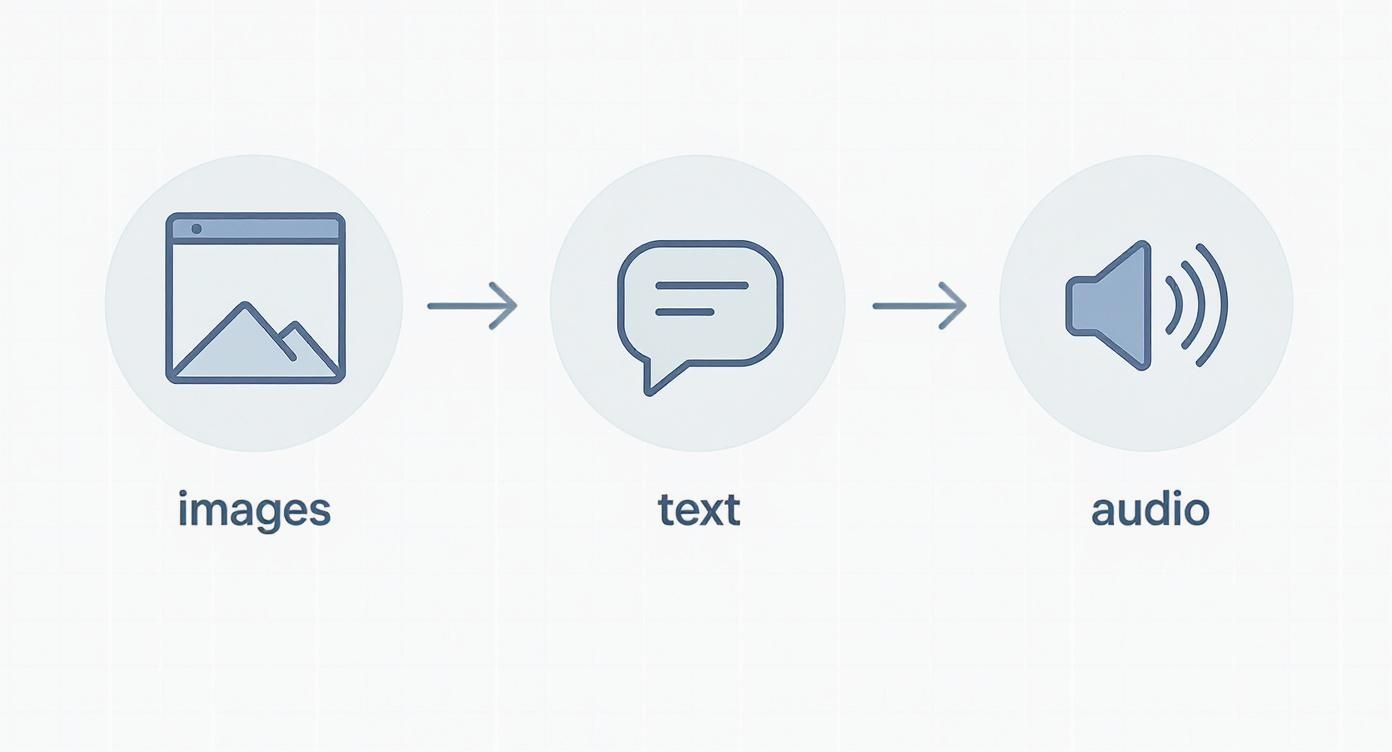
This flow shows how different data formats are channeled into a structured pipeline to ensure every label is applied consistently.
But the work does not stop once a label is applied. A multi-layered quality assurance (QA) process is absolutely essential for validating the output. This cycle is what separates mediocre data from exceptional, model-ready data.
Quality assurance is not a final step, it is an ongoing loop. It involves a systematic review process designed to catch errors, refine guidelines, and ensure every label meets the project's ground truth standards.
An effective QA process usually has several layers:
-
Peer Review: Annotators check each other’s work to catch obvious mistakes and make sure everyone is following the guidelines.
-
Expert Audit: Subject matter experts spot-check a percentage of the labeled data, homing in on the most difficult or ambiguous cases.
-
Consensus Scoring: Several annotators label the same asset independently. Their level of agreement is then measured to flag inconsistencies in either the work or the guidelines themselves.
This constant feedback loop drives continuous improvement, producing a final dataset that is accurate, reliable, and ready to train a high-performing AI model.
How to Measure Data Labeling Quality and Performance
So, you have labeled your data. But is it any good?
Moving past vague feelings of ‘quality’ means getting real about metrics. Without Key Performance Indicators (KPIs), you are flying blind. You have no way to verify the accuracy of the very data that's supposed to be training your AI model.
The goal is to set a clear, quantifiable baseline for what "good" actually looks like. This lets you properly evaluate your labeling operations, hold partners accountable, and make sure your AI investment is actually paying off. It turns data labeling from a subjective art into a measurable business process.

Core Metrics for Quality and Efficiency
To really gauge performance, most organizations lean on a few essential KPIs. These metrics give you a direct window into the health of your data labeling pipeline, from how a single annotator is doing to the overall quality of your final dataset.
Here are the most critical ones to track:
-
Label Accuracy: This is the big one. It measures how many labels correctly match the pre-established "ground truth." For mission-critical AI, high accuracy is non-negotiable. Think of a medical diagnostic model where a 99% accuracy score could be the difference between a correct and incorrect diagnosis.
-
Consensus Score (Inter-Annotator Agreement): This KPI measures how well multiple annotators agree when labeling the same piece of data. A high consensus score is a great sign that your annotation guidelines are crystal clear and your team is applying them consistently.
-
Throughput: This metric simply tracks how much data gets labeled over a set period (like labels per hour per annotator). While speed is great for scaling up, it must always be balanced with accuracy. Pumping out low-quality data quickly helps no one.
These numbers are not just for show; they translate directly into business results. Understanding the "why" behind each metric is key to making smart decisions about your AI projects.
Below is a quick breakdown connecting these technical metrics to real-world business impact.
Key Data Labeling Metrics and Their Business Impact
| Metric | What It Measures | Why It Matters for Your Business |
|---|---|---|
| Label Accuracy | The percentage of labels that correctly match the ground truth. | Directly impacts your AI model's reliability and performance. Higher accuracy reduces costly rework later on. |
| Consensus Score | The level of agreement between multiple annotators labeling the same data. | High scores mean clear guidelines and consistent quality, reducing ambiguity and the need for extra QA. |
| Throughput | The volume of data labeled per person or team over a specific time (e.g., labels per hour). | Helps you forecast project timelines and costs. It's a key indicator of your team's operational efficiency. |
| Edge Case Resolution Rate | How quickly and accurately ambiguous or difficult cases are handled and resolved. | Shows your team's ability to handle complexity, which is crucial for building robust, real-world AI models. |
| Rework Rate | The percentage of labels that are sent back for correction after a QA review. | A high rework rate signals problems in your process or guidelines, leading to delays and increased costs. |
| Labeler Performance | Individual accuracy, speed, and consistency of each annotator. | Identifies top performers and those needing more training, helping you optimize your workforce. |
By keeping a close eye on these metrics, you shift from simply doing data labeling to strategically managing it for the best possible business outcomes.
The Critical Balance of Speed, Cost, and Quality
Every data labeling project is a constant balancing act between three competing priorities: speed, cost, and quality. Push too hard on one, and the others almost always suffer. For example, demanding maximum speed might lower your cost-per-label, but it can crush your accuracy if your quality control is not rock-solid.
The key is not to find a perfect balance, but the right balance for your specific use case. An e-commerce product categorization model can probably live with a slightly lower accuracy rate in exchange for a faster turnaround. An autonomous vehicle's perception system? It cannot afford any compromise on quality. Period.
Getting this balance right is what allows you to scale effectively. And the need for scale is exploding. In 2024, the global market for data collection and labeling was valued at USD 1.48 billion and is projected to hit USD 10.07 billion by 2033. This growth is fueled by industries like healthcare and automotive that demand massive volumes of top-tier data. You can find more insights in this market analysis from Straits Research.
When you understand these metrics, you can make informed decisions. You can evaluate partners based not on promises, but on the measurable business value they deliver. A true partner helps you find the right calibration of these factors, ensuring your AI initiatives are built on a foundation you can trust.
Common Data Labeling Challenges and How to Overcome Them
Every data labeling project hits bumps in the road. No matter the scale, you are going to face hurdles that can tank data quality, blow up your timeline, and drain your budget. Knowing what these problems are ahead of time is the first step toward building a strategy that can actually withstand them.
The most successful AI projects are not the ones that avoid issues entirely; they are the ones with solid systems in place to handle them when they pop up. Getting this right is what separates a mediocre dataset from one that powers a truly reliable, high-performing AI.
Managing Ambiguity and Subjectivity
One of the toughest, most persistent challenges is dealing with subjectivity. If your annotation guidelines are vague or leave room for interpretation, different labelers will inevitably make different calls. It is only human.
This inconsistency injects "noise" into your dataset, which is a huge problem. It confuses your AI model during training and leads to unpredictable, unreliable performance out in the real world. A model trained on fuzzy data cannot make confident decisions.
The fix? You have to establish an ironclad "ground truth" with crystal-clear guidelines and a constant feedback loop.
-
Develop Granular Guidelines: Your instruction manual needs to be exhaustive. Fill it with tons of examples showing both correct and incorrect labels, paying special attention to those tricky edge cases that always come up.
-
Implement an Iterative Feedback Loop: Start small. Have a small batch of data labeled and then immediately reviewed by an expert. Use what you learn to tighten up the guidelines before you scale the project. This is how you stop small errors from becoming massive, project-wide problems.
The goal is to remove as much guesswork as possible from the annotator’s job. Clear, detailed instructions are the single most effective tool for ensuring consistency across a large, distributed workforce.
Ensuring Quality at Scale
Here’s another big one: how do you maintain high quality when the amount of data explodes? A process that works just fine for a few hundred images will completely fall apart when you are dealing with hundreds of thousands.
Manual quality checks become a massive bottleneck, and it gets exponentially harder to make sure every single annotator is sticking to the standards. If you rush to scale without a bulletproof QA framework, you will end up with a mountain of rework. In fact, one major tech company found that in-tool quality checks can slash that rework rate by a staggering 80%.
The key is a hybrid approach that blends smart technology with expert human oversight. This means using AI-powered tools to pre-label data or flag potential errors, which are then checked and confirmed by human experts. It's a method that boosts efficiency without sacrificing the nuanced understanding only a person can provide, making it a cornerstone of effective AI Quality Assurance services.
How to Choose the Right Data Labeling Partner
Knowing what data labeling is gets you to the starting line, but the success of your entire AI initiative often comes down to the team you choose to do the work. Selecting the right partner is not just a vendor choice; it is a critical decision that directly impacts your data quality, project timeline, and budget.
The goal is to find a group that acts as a true extension of your team, not just a service you hire. A top-tier partner does not just apply labels; they bring strategic value by digging deep into your goals to build a process designed specifically for you.
Evaluating Core Competencies
When you start vetting potential partners, zoom in on a few key areas that signal a real commitment to quality and reliability. A truly capable team will be transparent about how they work and can show you clear proof of their expertise.
Look for a partner that excels in these areas:
-
Proven Domain Expertise: Do they have experience in your world, whether it's healthcare, finance, or e-commerce? A partner who already knows the nuances of your data will deliver higher accuracy right out of the gate.
-
Robust Quality Assurance: Ask them to walk you through their QA process. A multi-layered approach involving peer reviews, expert audits, and constant performance tracking is a must-have for consistent, high-quality results.
-
A Scalable and Skilled Workforce: The partner should have a well-trained team ready to handle your project's volume without letting quality slip. Ask how they train their annotators and manage growth.
Security, Compliance, and Communication
Beyond the technical skills, the operational side of things is just as important. Your data is an incredibly valuable asset, and it needs to be handled with extreme care. Make sure any partner you consider has a strong commitment to data security and compliance.
Look for certifications like ISO 27001 and ask about their protocols for handling sensitive information under NDAs.
Clear communication is also non-negotiable. The right partner will provide continuous reporting and keep an open line of communication to tackle challenges and refine guidelines as they come up. For more detailed advice, our guide on how to evaluate data annotation companies offers an actionable checklist.
Choosing a partner is really about finding a team you can trust to build the foundation of your AI model. By focusing on expertise, quality, and security, you can find a partner who will help you push your AI initiatives forward with confidence.
Frequently Asked Questions About Data Labeling
As we wrap up our guide, let's tackle a few common questions that pop up when teams are just getting started. Think of this as the quick-reference section for those lingering thoughts.
How Much Labeled Data Do I Need?
This is the classic "it depends" scenario, and for good reason. The answer hinges entirely on what you're trying to build.
A relatively simple model, say, one that sorts products into ten different categories, might hit impressive accuracy with just a few thousand labeled examples. But if you are building something far more complex, like the computer vision system for an autonomous vehicle, you could be looking at millions of meticulously annotated images and LiDAR frames. That is what it takes to perform safely and reliably in the real world.
The most practical approach? Start with a reasonably sized dataset, train an initial model, and see how it performs. From there, you can add more labeled data in cycles until your performance metrics stop improving.
What Is The Difference Between Data Labeling and Data Annotation?
In the AI world, you'll hear the terms data labeling and data annotation used almost interchangeably. And honestly? That's perfectly fine.
Both terms describe the exact same process: adding tags or metadata to raw data so a machine learning model can understand it. While a few people might argue over tiny semantic differences, they mean the same thing in any practical conversation. Do not get hung up on the terminology.
How Much Does Data Labeling Cost?
The cost of data labeling is not a single number, it is a spectrum. The final price tag is shaped by a few key variables:
-
Complexity: Simple classification tasks are much cheaper than something intricate like pixel-perfect semantic segmentation.
-
Data Volume: This one is straightforward. The more items you need labeled, the more it will cost.
-
Required Expertise: Labeling everyday objects is one thing. Labeling specialized data, like medical images that require a radiologist's eye, costs significantly more because it demands true domain experts.
At the end of the day, the price is a direct function of the time and skill needed to hit your quality goals.
Ready to build a reliable foundation for your AI? Prudent Partners offers high-accuracy data labeling and annotation services designed to deliver the quality you need to scale with confidence. Contact us today for a customized project consultation.