
The quality assurance process is a proactive framework designed to prevent defects and ensure consistency from the very beginning. It is not about finding mistakes after the fact; it is about building quality into every single step to guarantee the final product or service meets, and exceeds, all requirements.
What Exactly Is A Quality Assurance Process?
Think of it like building a skyscraper. A solid quality assurance process is the master blueprint, the material specifications, and the scheduled engineering checks at every stage. You do not wait until the 50th floor is built to check the foundation’s integrity. Instead, you make absolutely sure the foundation is perfect before you even think about building on top of it.
This proactive approach is what prevents catastrophic failures and costly rework down the line.

In business and technology, the exact same principle applies. QA is the whole system of defined activities, from standard operating procedures (SOPs) to staff training, that makes a project's output predictable, reliable, and top-tier. It is the organization's commitment to getting it right the first time, every time.
To put it simply, a good QA process answers key questions upfront, like "Are we doing the right things, the right way?" This ensures everyone is aligned before significant resources are invested.
Here’s a quick overview of the core concepts that define a quality assurance process and why they matter for your business.
Quality Assurance At A Glance: Key Concepts
| Core Principle | Description | Business Impact |
|---|---|---|
| Proactive Mindset | Focuses on preventing defects rather than detecting them after they occur. | Reduces rework, lowers costs, and shortens project timelines. |
| Process-Oriented | Establishes clear, repeatable standards, processes, and guidelines for all tasks. | Ensures consistent, high-quality output regardless of who performs the work. |
| Systematic Approach | Involves planned and structured activities, from project kickoff to final delivery. | Builds trust with clients and stakeholders by demonstrating reliability. |
| Continuous Improvement | Uses feedback and metrics to refine and improve processes over time. | Drives operational efficiency and fosters a culture of excellence. |
Ultimately, a quality assurance process is not just a checklist; it is a strategic framework that turns quality from an accident into a deliberate, measurable outcome.
The Strategic Value of Proactive Quality
A well-defined quality assurance process shifts an organization from a reactive state of fixing errors to a strategic state of preventing them entirely. This fundamental shift has a massive impact on the bottom line by building a foundation of trust and reliability.
Just a few of the key benefits include:
- Enhanced Customer Trust: When you consistently deliver high-quality products and services, you build a rock-solid reputation and earn fierce customer loyalty.
- Increased Operational Efficiency: By catching potential issues early, organizations slash the time and resources wasted on rework, corrections, and customer support tickets.
- Reduced Costs and Risks: Preventing defects is always cheaper than fixing them. A solid QA framework minimizes financial losses, compliance penalties, and damage to your brand.
A robust QA process is a hallmark of operational maturity. It demonstrates a commitment to transparency and accountability, assuring clients and stakeholders that every deliverable is the result of a deliberate, controlled, and repeatable system designed for excellence.
At the end of the day, understanding what a quality assurance process is comes down to recognizing its role as a strategic enabler. It is the engine that drives continuous improvement, allowing teams at Prudent Partners to deliver services like our data annotation solutions with 99%+ accuracy and unwavering consistency.
Understanding The QA vs QC Difference
People often use the terms Quality Assurance (QA) and Quality Control (QC) interchangeably, but they are two different sides of the same quality coin. Getting this distinction wrong is not just a matter of semantics; it can leave huge gaps in your quality system.
The secret to an effective quality process is knowing when you need to prevent errors versus when you need to detect them.
Let’s use a simple analogy: cooking a gourmet meal.
QA is the recipe itself. It is choosing the freshest ingredients, carefully measuring everything, and following the proper cooking techniques. It is the entire proactive strategy you build to make sure the final dish will be incredible before you even turn on the stove.
QC, on the other hand, is the final taste test right before the plate goes out to the dining room. It is a reactive check to catch any last-minute mistakes, like forgetting to add salt. Both are critical, but they serve different purposes at different stages.
To help clarify how these concepts work in practice, let’s look at the key differences.
QA vs QC: A Practical Comparison
This table breaks down the roles, goals, and methods of both Quality Assurance (QA) and Quality Control (QC). Understanding these distinctions is the first step toward building a system that does not just catch errors but prevents them from happening in the first place.
| Aspect | Quality Assurance (QA) | Quality Control (QC) |
|---|---|---|
| Focus | Process-Oriented: "Are we doing things the right way?" | Product-Oriented: "Did we get the right result?" |
| Goal | Prevention: Proactively design systems to prevent defects. | Detection: Identify and correct defects in the final product. |
| Timing | Proactive: Implemented before and during the project lifecycle. | Reactive: Performed after the product is created but before delivery. |
| Responsibility | Everyone on the team: A shared, system-wide responsibility. | Specific team or individual: Often a dedicated QC inspector or team. |
| Examples | Defining guidelines, training staff, creating checklists, process audits. | Product testing, code reviews, final inspections, sampling outputs. |
| Analogy | Creating a reliable recipe and training the chef. | Tasting the final dish before it's served. |
In short, QA builds confidence that quality requirements will be fulfilled, while QC verifies that they have been fulfilled. You cannot have one without the other if you are serious about high-accuracy outcomes.
QA: Proactive Prevention
Quality Assurance is all about building quality into your process from the ground up. It is a strategic function focused on designing systems so robust that defects have nowhere to hide. QA answers the question, "Are we setting ourselves up for success?"
Take a large-scale data annotation project, for instance. A strong QA framework would include:
- Creating crystal-clear annotation guidelines that leave zero room for interpretation.
- Running comprehensive training and certification programs for every data analyst.
- Establishing a multi-tier review workflow where work is cross-checked at multiple stages.
These steps are not about inspecting the final data; they are about making the process itself nearly foolproof. This focus on prevention is exactly how teams achieve scalable, high-accuracy results, like the 99%+ accuracy Prudent Partners is known for. The American Society for Quality puts it best, defining QA as the activities that ensure quality in the processes by which products are developed.
QC: Reactive Detection
Quality Control, in contrast, is the tactical function of inspecting the final product before it lands in the client’s hands. It is all about measurement and verification. QC is your last line of defense.
Sticking with our data annotation example, QC activities are much more hands-on with the final output. They would involve:
- Inspecting a random sample of a completed batch of labeled images to spot errors.
- Validating an entire dataset against a final quality checklist to ensure it meets every specification.
- Running automated scripts to flag any inconsistencies or formatting errors in the final deliverables.
QC answers the question, "Did we achieve the result we wanted?" While it is absolutely essential, relying only on QC is like trying to win a race by only looking in the rearview mirror. It is inefficient and expensive because it catches mistakes after you have already spent the time and resources creating the work.
A truly world-class quality system harmonizes both. You use proactive QA to minimize defects from the start and reactive QC to catch the few that inevitably slip through. This dual approach is fundamental to building the kind of reliable AI and BPM solutions that businesses depend on.
The Key Stages Of A Powerful QA Process
A truly powerful quality assurance process is not just a single checklist. It is a living system, a series of connected stages that turn "quality" from an abstract idea into something you can repeat, scale, and rely on. When you break the workflow down this way, you are not just hoping for excellence; you are building an engine for it.
This structured approach is not new. The roots of modern QA go all the way back to the 1920s with Walter Shewhart at Bell Laboratories. He replaced subjective inspections with data-driven statistical control, a revolutionary idea at the time. His work gave us the Plan-Do-Check-Act (PDCA) cycle, a framework that still underpins the best quality systems today. You can learn more about the history of quality management and see how these foundational ideas evolved.
Stage 1: Planning and Definition
This is your blueprinting stage. Before a single task gets done, you have to nail down what "quality" actually means for the project. This is not the time for vague goals. It is about setting crystal-clear, measurable standards that leave zero room for interpretation.
For a data annotation project, that might mean defining a target accuracy rate of 99% or higher. It also means creating a detailed guide for every single label, complete with good and bad examples. This phase gets everyone from project managers to the annotators on the front lines on the exact same page.
Stage 2: Process Design and Documentation
Once you know what you are building, you need to figure out how. This stage is all about designing the workflows, procedures, and documentation that will guide the team. This is the heart of a proactive QA strategy.
Key activities here usually include:
- Developing Standard Operating Procedures (SOPs): These are the step-by-step playbooks for every single task. No guesswork allowed.
- Designing Review Workflows: You might set up a multi-layer review system, where a peer review is followed by a final audit from a senior analyst.
- Creating Training Materials: This means building solid guides, tests, and certification programs to get every team member up to speed.
This is where the difference between proactive QA (designing the system right) and reactive QC (inspecting the output) becomes obvious.
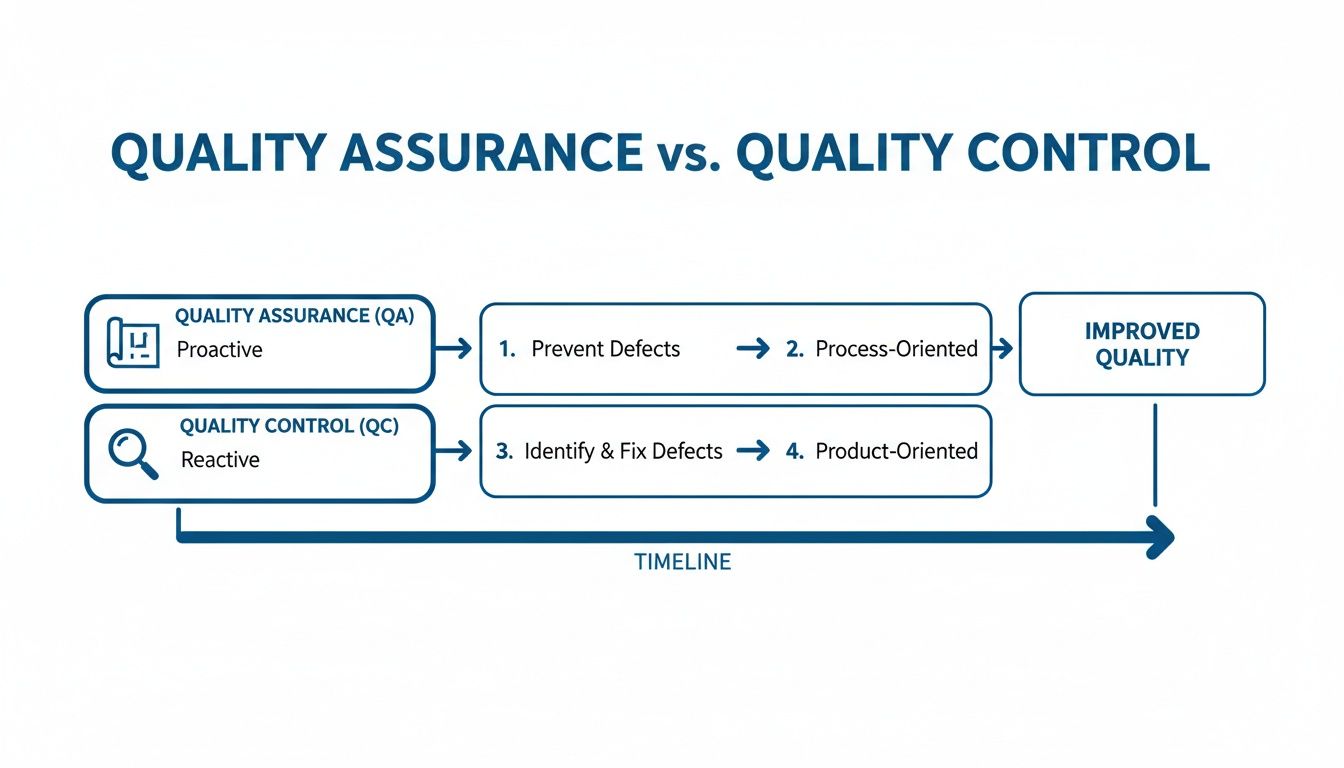
As the visual shows, QA is about building a solid foundation from the start. QC is the inspection that happens later. They are different, but you need both to succeed.
Stage 3: Implementation and Execution
With a solid plan and documented processes, it is time to hit "go." This is where the designed workflows come to life. Trained analysts are deployed, tools are switched on, and the real work begins.
Success at this stage comes down to one thing: consistency. It is the moment where all that meticulous planning and design pays off in the form of tangible, high-quality output, whether that is perfectly annotated medical images or flawlessly executed back-office tasks.
Stage 4: Monitoring and Continuous Improvement
The final stage never really ends. It is a continuous loop of monitoring, measuring, and refining. A good QA process is not set in stone; it has to learn and adapt. This means tracking Key Performance Indicators (KPIs), digging into QA reports, and using that data to spot recurring problems or opportunities to get better.
For instance, if QA reports keep flagging the same type of error, it is a signal. Maybe the process needs an update, or perhaps a specific team needs more training. This feedback loop is what makes a QA process stronger over time, ensuring you can deliver consistent, scalable results no matter how complex the work gets.
Putting Quality Assurance Into Practice For AI
Theory is great, but a quality assurance process only proves its worth when it is applied to high-stakes, real-world projects. In the world of Artificial Intelligence, data quality is not just a metric; it directly fuels model performance. A generic, one-size-fits-all QA plan simply will not cut it. The process has to be shaped around the unique demands of each use case, whether you are validating Generative AI outputs or annotating complex datasets.

When it comes to Generative AI, the QA workflow is about much more than just spotting errors. It is a detailed, human-led review that holds generated content to a strict set of standards.
Think of it as a multi-point inspection:
- Factual Accuracy: Does the AI-generated summary actually match the source material? Are the facts correct?
- Logical Coherence: Does the output flow naturally? Is it structured in a way that is clear and easy to follow?
- Tone and Style: Does the content sound like it came from your brand? Is it formal, conversational, or technical, as required?
- Completeness: Did the AI include all the necessary information, or did it leave out key details?
This kind of multi-faceted check ensures the AI’s output is not just technically correct, but genuinely useful and appropriate for its audience.
A Multi-Layer QA System For Data Annotation
For data annotation, where a single mistake can throw off an entire model, a multi-layer QA process is the industry standard for hitting near-perfect accuracy. It works like a series of filters, with each layer designed to catch different types of errors before the dataset is ever delivered.
This systematic approach is how a 99%+ accuracy rate becomes a repeatable, scalable reality. If you are looking to benchmark your own team, our guide on conducting a data annotation assessment is a great place to start.
A typical workflow usually breaks down like this:
- Peer Review: The first line of defense. One analyst reviews another's work, catching obvious errors and making sure basic project guidelines were followed.
- Senior Analyst Review: A more seasoned analyst takes a look, zeroing in on tricky edge cases and nuanced situations that a junior reviewer might miss.
- Final Audit: A project lead or quality manager performs a final check, often through random sampling, to give the batch the ultimate sign-off.
Real-World Use Cases And Their QA Demands
How you design a QA process depends entirely on the industry and the application. There is no such thing as a universal template.
For example, in prenatal ultrasound annotation, a misplaced polygon or an incorrect label is not just a data error; it could have serious medical consequences. Precision here is completely non-negotiable.
On the other hand, in cybersecurity threat labeling, the QA process relies on deep domain expertise. An analyst has to know the subtle differences between various types of malware or network intrusions to label the data correctly. Without that knowledge, the labels are useless.
This drive toward specialization is not new. The modern quality revolution of the 1970s and 1980s gave us measurable frameworks like Total Quality Management (TQM) and Six Sigma to systematically hunt down and eliminate defects. By 1987, the ISO 9000 series created global standards for quality. Those standards have since evolved to integrate risk management and customer focus, showing just how central QA has become.
Each of these examples makes one thing crystal clear: an effective quality assurance process is never one-size-fits-all. It must be meticulously designed to meet the unique accuracy, compliance, and expertise requirements of the task at hand.
How Certified QA Processes Guarantee Compliance
In high-stakes industries like healthcare, finance, and AI development, quality and compliance are not just related; they are two sides of the same coin. A well-designed QA process is a great start, but a certified one is an undeniable guarantee of trust.
Standardized frameworks like ISO 9001 (Quality Management) and ISO/IEC 27001 (Information Security) elevate a QA process from an internal company policy into an auditable, globally recognized commitment to excellence.
These certifications are not just badges to display on a website. They signal a deep-seated commitment to systematic, repeatable, and secure operations. They prove that an organization has built its quality assurance process to meet tough international standards, ensuring every step is documented, every risk is managed, and every outcome is measurable.
From Frameworks To Client Confidence
For a client, partnering with a certified organization simply removes uncertainty. When an AI company annotates sensitive medical images, ISO certifications provide tangible proof that quality and security are baked into the workflow from day one.
- ISO 9001 confirms that the data annotation process follows a documented, consistent, and continuously improving quality management system. This is what ensures the 99%+ accuracy needed for reliable model training.
- ISO/IEC 27001 guarantees that all data, especially sensitive patient information, is handled under a strict information security management system. It is all about confidentiality, integrity, and availability. You can learn more about what ISO 27001 certification means in our detailed guide.
This dual-certification framework creates a powerful value proposition. It translates directly into measurable client benefits: significantly reduced risk, assured data security, and unwavering confidence that the final output is both accurate and compliant.
A certified QA process provides an external validation of an organization's internal discipline. It demonstrates that quality is not an occasional achievement but the result of a systematic, audited, and reliable operational structure.
The Evolution of Standardized Quality
The global adoption of these frameworks really took off after the publication of ISO 9001 back in 1987. While early adoption was slow, these standards eventually became the bedrock for modern quality management systems worldwide.
Over the years, revisions have brought in new ideas, with the 2015 update emphasizing "risk-based thinking," a crucial element for today’s data-intensive AI organizations. For a data services partner, holding these certifications shows a mature understanding of what a quality assurance process truly is: a promise of reliability.
Achieving Scalable Quality With The Right Partner
Building a world-class quality assurance process from scratch is a massive undertaking. It is not just about hiring people; it is about designing validated workflows, acquiring specialized expertise, and managing the entire system, all while trying to hit consistently high accuracy at scale. For most companies, this is not just a challenge; it is a distraction from their core business.
A truly robust QA framework is not an operational cost; it is a strategic asset. It is what transforms raw, messy data into a reliable competitive advantage by guaranteeing every output meets exacting standards. And for smart, forward-thinking companies, this is precisely where partnering with a specialist makes the most sense.
The Partnership Advantage
When you work with an expert partner like Prudent Partners, you are not just hiring a team; you are plugging into a mature, ready-made quality ecosystem. Forget spending months trying to build from the ground up. You get immediate access to trained analysts, proven multi-layer review processes, and certified workflows that deliver 99%+ accuracy from day one.
This approach brings some clear, immediate wins:
- Scalability on Demand: You can seamlessly scale your quality operations up or down to match project needs, without the headaches of hiring and training.
- Guaranteed Security: Partnering with an ISO/IEC 27001 certified provider means your sensitive data is handled with airtight security protocols. No compromises.
- Operational Excellence: You get the benefit of an ISO 9001 certified system, which is built from the ground up for continuous improvement and measurable results.
Ultimately, a partnership turns your QA process from a potential bottleneck into a powerful engine for growth. By handing off these critical functions, you free up your internal teams to focus on what they do best and gain the confidence that your data operations are built on a foundation of proven excellence. To see how this works in practice, learn about the benefits of business process management in our detailed guide.
Common Questions About Quality Assurance Processes
Even with a solid strategy, a few practical questions always seem to pop up when teams are building or refining their QA process. Here are some of the most common challenges we see, along with quick, actionable answers.
What Are The Most Important KPIs To Track?
You cannot improve what you do not measure. While you could track dozens of metrics, a few are non-negotiable for understanding the true health of your quality process.
Key performance indicators (KPIs) give you a data-driven view, turning abstract goals like "high quality" into tangible numbers. They show you what is working and, more importantly, what is not.
Here are the most critical KPIs we recommend tracking:
- Defect Density: This is the number of defects found per unit of work, think errors per 100 annotated images. A low number here is a great sign of a stable, reliable process.
- First Pass Yield: What percentage of work gets through QA on the very first try, no rework needed? A high First Pass Yield (FPY), ideally above 95%, is a powerful indicator of efficiency.
- Accuracy Rate: This is the ultimate measure of quality. It calculates the percentage of data that was processed correctly. For high-stakes AI projects, the target is often 99% or higher for a reason.
Tracking these three metrics is often all you need to demonstrate the real-world impact of your QA process to stakeholders.
How Can A Small Team Implement QA Without Expensive Tools?
Great news: you do not need a huge budget or fancy software to build an effective QA framework. At its core, quality assurance is about process and culture, not technology.
Start simple. Create clear, documented guidelines and checklists using shared documents that everyone can access. From there, you can implement a straightforward peer-review system where one team member methodically checks another’s work against those standards.
The most important first step is building a culture where everyone feels responsible for the final output. A repeatable, documented process is far more valuable than any tool; the technology can always come later as you scale.
How Does QA Differ For Agile vs. Waterfall Projects?
The role of QA changes dramatically depending on your project management style. In a traditional waterfall model, QA is treated as a distinct, separate phase. It happens after all the development or production work is finished, acting as a final gatekeeper before release.
In an agile environment, quality assurance is woven into the entire process. It happens continuously throughout each development sprint. This "shift-left" approach means testing and validation happen alongside the work, not after it. This helps teams catch issues much earlier when they are far cheaper and faster to fix.
Ultimately, agile QA is about constant feedback and collaboration, while waterfall QA is all about final validation right before the finish line.
Ready to turn your quality assurance from a challenge into a competitive advantage? The expert teams at Prudent Partners build and manage certified QA processes that deliver 99%+ accuracy at scale. Contact us today to discuss your project.