

Introduction: Why Image Annotation Matters More Than Ever
The U.S. AI market is booming. From self-driving cars and medical imaging to e-commerce and agriculture, businesses are investing billions in artificial intelligence. But there’s one critical element that often determines success: the quality of training data.
Image annotation companies provide the backbone for computer vision applications by labeling images with precise metadata so that AI systems can learn to “see” and interpret the world. For U.S. businesses, choosing the right image annotation company is no longer optional—it’s a strategic decision that impacts compliance, scalability, and long-term competitiveness.
This blog explores what image annotation companies do, the techniques they use, the industries they serve, and the criteria U.S. enterprises should use when evaluating potential partners.
What Are Image Annotation Companies?
Image annotation companies specialize in labeling images with tags, shapes, or metadata that make them machine-readable. This allows AI models to:
- Detect and classify objects
- Recognize patterns and anomalies
- Navigate environments (autonomous vehicles, drones)
- Assist in diagnostic healthcare imaging
- Enhance search and personalization in e-commerce
Instead of building annotation teams in-house, many U.S. companies outsource to providers with established expertise, infrastructure, and security certifications.
Common Image Annotation Techniques
- Bounding Boxes: Simple rectangles used to identify objects in an image. Ideal for object detection tasks like labeling vehicles or pedestrians.
- Polygons and Polylines: More precise outlines for irregular objects such as rooftops, vegetation, or anatomical structures in medical scans.
- Semantic Segmentation: Pixel-level labeling that provides fine-grained detail, useful in medical imaging, satellite mapping, or autonomous navigation.
- Keypoint Annotation: Marking specific points such as joints in human figures (used for sports analytics) or landmarks in faces (used for facial recognition).
- 3D Cuboids: Adding depth to object labeling for applications in robotics and autonomous driving.
The choice of technique depends on the industry, dataset, and intended AI model.

Why U.S. Businesses Rely on Image Annotation Companies
- Scalability: Millions of labeled images are needed to train production-grade AI. Outsourcing ensures rapid scale without overloading internal teams.
- Accuracy: Annotation errors can derail model performance. Companies with QA frameworks deliver >99% accuracy.
- Cost Efficiency: Outsourcing avoids high labor costs of U.S.-based annotation while maintaining quality.
- Compliance: U.S. healthcare, defense, and finance projects require vendors with ISO, HIPAA, and SOC2 certifications.
- Domain Expertise: Different industries require specialized knowledge—annotating X-rays is vastly different from tagging retail product photos.
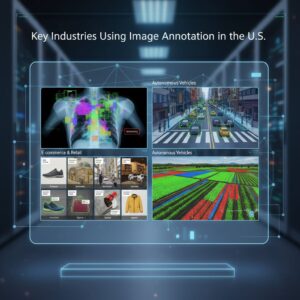
Key Industries Using Image Annotation in the U.S.
- Healthcare: Annotating X-rays, MRIs, ultrasounds for diagnostic AI.
- Autonomous Vehicles: Annotating pedestrians, vehicles, and road signals.
- E-commerce: Tagging images for catalog management and search optimization.
- Agriculture: Annotating satellite and drone images for crop monitoring.
- Defense and Security: Labeling surveillance images and satellite data for intelligence.
How to Evaluate Image Annotation Companies in the U.S.
- Accuracy Benchmarks: Look for firms that can prove consistent >99% accuracy across projects, with documented QA processes.
- Security Standards: Confirm compliance with ISO 9001, ISO/IEC 27001, HIPAA, and GDPR where relevant. Security is critical when working with medical or defense data.
- Tool Compatibility: The best image annotation companies are tool-agnostic, working seamlessly with platforms like Labelbox, CVAT, and custom-built tools.
- Scalability and Ramp-Up Speed: Ask about onboarding timelines, trained bench strength, and ability to handle both pilot projects and enterprise-scale rollouts.
- Industry Experience: Check if they have prior experience in your domain, whether healthcare, e-commerce, or automotive.
- Client References and Case Studies: A credible provider should showcase case studies from U.S. clients that demonstrate measurable business impact.
Risks of Choosing the Wrong Partner
- Low Accuracy: Leads to unreliable AI outcomes.
- Security Gaps: Exposes sensitive data to breaches or non-compliance penalties.
- Scalability Issues: Inability to handle large datasets or urgent spikes.
- Hidden Costs: Cheap providers may underdeliver, leading to expensive rework.
Why Prudent Partners Stands Out Among Image Annotation Companies
Prudent Partners has become a trusted partner for U.S. enterprises by combining scale, accuracy, and compliance. Our differentiators include:
- 99%+ accuracy through multi-layered QA
- ISO 9001 & ISO/IEC 27001 certifications for quality and security
- 300+ trained annotators with industry-specific expertise
- Prudent PlanWise, our in-house performance management tool offering visibility into KPIs and rework rates
- Experience delivering projects for U.S. clients in healthcare, finance, retail, defense, and autonomous vehicles
We don’t just annotate images—we provide peace of mind.
Conclusion: Making the Right Choice
For U.S. businesses, selecting the right image annotation company is the foundation of AI success. With the right partner, you gain accuracy, compliance, scalability, and faster go-to-market. With the wrong one, you risk setbacks, compliance issues, and wasted investment.
Annotation is not just about labeling—it’s about enabling trustworthy AI. Partnering with Prudent Partners ensures your data is ready for the future.
FAQs
1. What do image annotation companies do?
They label images to train AI systems, using techniques like bounding boxes, segmentation, and keypoints.
2. Why outsource image annotation in the U.S.?
Outsourcing provides scalability, cost savings, and access to domain-trained experts.
3. How does Prudent Partners compare to other companies?
We combine ISO-certified processes, high accuracy, and industry expertise with transparency via Prudent PlanWise.