
Retrieval Augmented Generation, or RAG, is a game-changing technique for making generative AI models more accurate and trustworthy. It works by connecting them to external, up to date knowledge sources. Think of it as giving a Large Language Model (LLM) an open book test instead of forcing it to rely only on what it memorized during training. The result is answers that deliver measurable impact and that your business can trust.
Why LLMs Need a Smarter Way to Access Information
Large Language Models are undeniably powerful. Their ability to understand and generate human like text is remarkable, but they have one major flaw: their knowledge is frozen in time. An LLM only knows what it learned from its training data, and that static memory creates serious business challenges.
Without a connection to real time information, an LLM can easily give you answers that are outdated, incomplete, or just plain wrong. This leads to what is known as AI hallucination, when the model confidently makes things up because it does not have the specific facts it needs. For a business, this isn’t just an error; it’s a risk to credibility and operational efficiency.
The Closed Book vs. Open Book Test
Imagine asking an expert a tough question during a closed book exam. They can only rely on what they have memorized. While their general knowledge might be impressive, they will likely stumble on very specific or recent details.
Now, give that same expert an open book test. They can consult an entire library of current resources to find the exact information needed to give a factual, verifiable answer.
Retrieval Augmented Generation transforms an LLM from a closed book test taker into an open book expert. It gives the model a way to “look up” relevant facts from a company’s private documents, databases, or live data feeds before it even starts writing a response.
This simple shift makes a huge difference in AI reliability and delivers a clear, measurable impact on accuracy. Instead of guessing, the model grounds its answer in specific, retrieved data. This dramatically improves accuracy and builds user trust, which is essential for any business that relies on correct and current information. For any successful AI system, understanding why data quality is the real competitive edge is the first and most important step.
The Growing Demand for Factual AI
The need for more dependable AI has fueled a massive surge in RAG adoption across industries. The global retrieval augmented generation market is exploding, projected to grow from around USD 1.2 billion in 2024 to USD 1.85 billion in 2025.
This growth is not just hype; it reflects a clear demand for AI solutions that are context aware and scalable, especially in critical sectors like finance and healthcare. You can read more about the projected expansion of the RAG market and its impact. By bridging the gap between an LLM’s static memory and the world of dynamic, external data, RAG is making AI a practical and trustworthy tool for the enterprise, delivering actionable insights and reliable performance.
How the RAG Framework Actually Works
At its heart, Retrieval Augmented Generation (RAG) is a surprisingly straightforward idea that transforms a standard Large Language Model into a dynamic, open book research assistant. It gives the AI the power to look up fresh information from a trusted knowledge base before it even tries to formulate an answer. This simple but powerful tweak dramatically improves the accuracy and relevance of its responses.
Think of it like this: would you trust an employee answering a complex customer question purely from memory, or one who can instantly pull up the company’s entire library of product manuals and support documents? A customer support agent using RAG can resolve issues faster and with greater accuracy, improving first contact resolution rates. That is exactly what RAG does for an AI.
This simple adjustment addresses the core problem of an LLM’s fixed, static memory, which is a major cause of hallucinations.
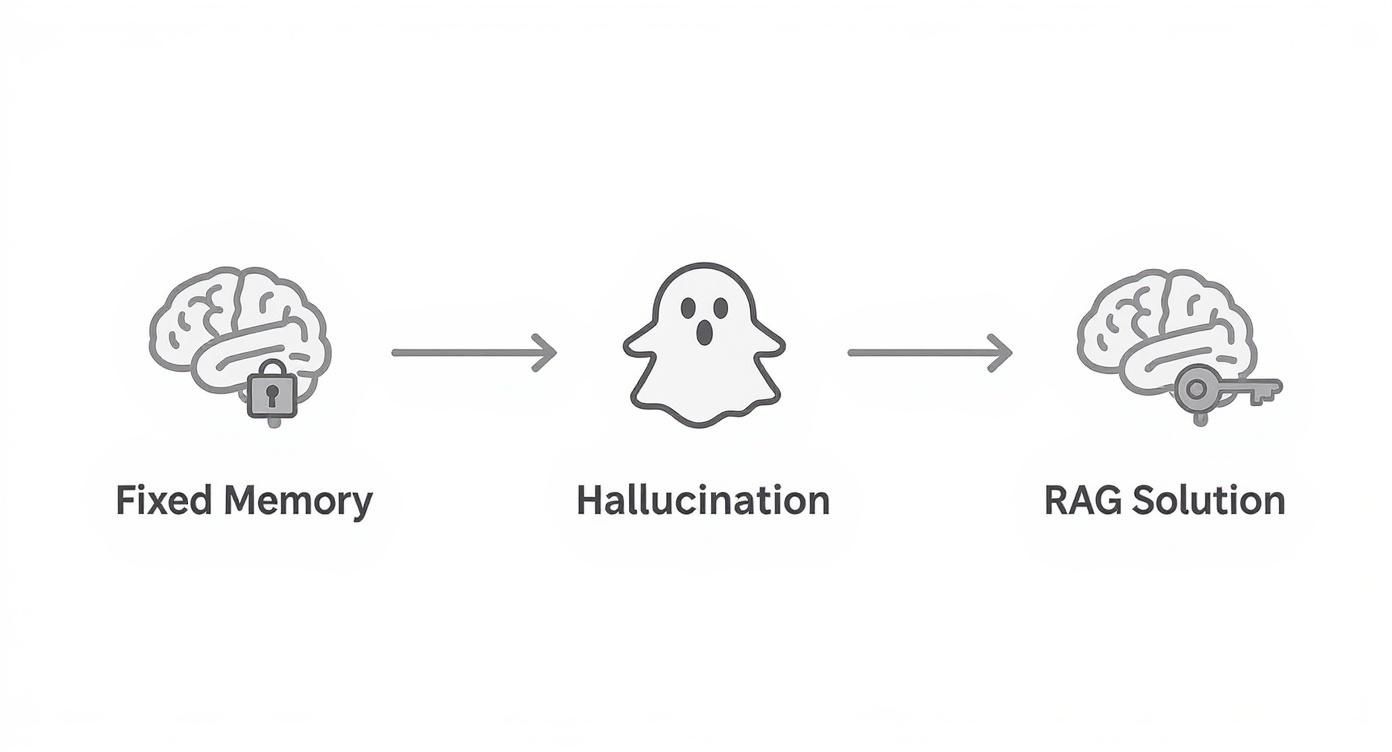
As the diagram shows, RAG acts as the bridge between a static knowledge base and a reliable, data grounded output. The entire workflow breaks down into three core stages: Retrieval, Augmentation, and Generation. Let’s walk through what happens at each step.
Here’s a quick overview of the entire process, breaking down how each component contributes to delivering an accurate, context aware AI response.
The Three Core Stages of a RAG System
| Stage | What It Does | Why It Matters |
|---|---|---|
| Retrieval | Searches a private knowledge base (like a vector database) to find documents or text snippets that are contextually relevant to the user’s query. | This stage finds the raw facts. If it pulls the wrong information, the entire process fails. It ensures the AI has the right source material to work with. |
| Augmentation | Combines the original user query with the relevant information retrieved from the knowledge base, creating a new, enriched prompt. | This step provides the crucial context. It tells the LLM, “Here’s the user’s question, and here are the specific facts you should use to answer it.” |
| Generation | Sends the augmented prompt to the LLM, which then crafts a natural language answer based on the provided context, not its general knowledge. | This is the final step where a coherent answer is formed. By grounding the response in specific, retrieved data, it dramatically reduces hallucinations. |
Now, let’s explore what each of these stages looks like in practice.
Stage 1: Retrieval — Finding the Right Facts
The journey begins with Retrieval. Before your AI can answer anything, your organization’s private data, such as internal wikis, support tickets, product specs, or legal contracts, needs to be prepared. This raw data is processed, broken into chunks, and converted into a machine readable format called embeddings. These are then stored in a specialized database, most often a vector database.
When a user asks a question, the retrieval system springs into action. It converts the user’s query into a similar embedding and scours the vector database to find the most relevant snippets of information. It is not just looking for keywords; it is searching for conceptual and semantic meaning, ensuring it pulls documents that are contextually aligned with what the user is actually asking.
The quality of this retrieval step is the foundation of the entire system. If the retriever fails to find the correct information, the rest of the process is built on a faulty premise. This is why having a clean, well organized knowledge base is absolutely critical for success.
For example, a financial services chatbot receives the query, “What are the investment options available for a retirement plan?” The RAG system retrieves specific, up to date documents detailing 401(k)s, IRAs, and annuity products, ignoring outdated policy documents. The chatbot then provides an accurate, compliant summary, improving customer trust and reducing the workload on human advisors.
Stage 2: Augmentation — Giving the LLM Some Context
Once the retriever has located the most relevant pieces of information, the Augmentation stage kicks in. This is where the real magic happens. The system takes the original user query and combines it with the factual text snippets it just pulled from the knowledge base.
This combined information is then packaged into a new, enriched prompt. This “augmented prompt” now contains both the user’s original question and the specific, relevant context needed to answer it accurately and truthfully.
Think of it as an expert research assistant handing a neatly organized folder to a writer. The folder contains two things:
- The original question.
- A few highlighted paragraphs from the most relevant documents.
This step ensures the LLM does not have to guess or rely on its static, generalized training data. Instead, it gets a concise, up to date briefing tailored specifically to the user’s request.
Stage 3: Generation — Crafting an Intelligent Answer
Finally, we arrive at the Generation stage. The augmented prompt, containing both the query and the retrieved context, is sent to the LLM. With this rich, factual context in hand, the LLM’s job becomes much simpler and far more reliable.
Instead of trying to recall information from its vast but potentially outdated memory, the model synthesizes an answer directly from the facts it was just given. The LLM acts as an eloquent communicator, using its powerful language capabilities to construct a coherent, human like response that is firmly grounded in the retrieved data. This method drastically reduces the risk of hallucinations because the model is explicitly told to formulate its answer based only on the source material provided.
Choosing the Right Retrieval Method
The engine of any great retrieval augmented generation system is its knack for finding the right information, fast. This first step is everything. If your retriever pulls the wrong documents, even the smartest Large Language Model is going to give you a garbage answer. That is why picking your retrieval strategy is a foundational decision that shapes your system’s performance, accuracy, and ability to scale.

There are two main ways to tackle information retrieval in RAG: sparse retrieval and dense retrieval. Each has its own strengths and is built for different kinds of data and questions. Getting the difference is key to building a RAG pipeline that actually solves your business problem.
Sparse Retrieval: The Keyword Matchmaker
Sparse retrieval is the classic way to do search, and it works a lot like the search engines we all grew up with. It is all about matching keywords. Think of it as a super literal librarian who finds books by looking for the exact words from your request in the card catalog.
The most common tool for this is an algorithm called BM25 (Best Matching 25). It ranks documents by looking at how often a keyword shows up in a document (term frequency) and how unique that keyword is across the entire library of documents (inverse document frequency).
Sparse retrieval excels at precision. When a user is searching for a specific product code, an exact error message, or a person’s name, keyword based search is incredibly fast and on the nose. It is perfect when the words in the query are the exact same words you would find in the source documents.
But here is the catch: this method does not really understand language. It can not connect the dots between synonyms, context, or what a user actually means. A search for “ways to make money” would probably miss a document that talks about “revenue generation strategies” just because the keywords don’t line up, even though they are talking about the same thing.
Dense Retrieval: The Meaning Seeker
Dense retrieval comes at the problem from a totally different angle. Instead of just matching keywords, it tries to understand the semantic meaning behind both the user’s query and the documents themselves. It does this using embeddings, which are basically numerical fingerprints of text generated by an AI model.
The process is pretty clever. It turns the user’s query into a vector (a list of numbers) that captures its meaning. Then, it dives into a vector database to find documents with the most similar vectors. This is like asking a research assistant to find articles about a certain topic, not just articles that contain certain words.
This is how a system can find relevant information even when the keywords don’t match at all. For example, a query like “customer satisfaction issues” could pull up a document about “common user complaints and feedback” because the underlying concepts are the same. Building a top tier RAG system often starts with getting your data ready for this, which is a big part of what we do with our data annotation outsourcing services.
To make the choice clearer, here’s a simple breakdown of how these two methods stack up against each other.
Comparing Sparse and Dense Retrieval Methods
| Attribute | Sparse Retrieval (Keyword-Based) | Dense Retrieval (Meaning-Based) |
|---|---|---|
| Core Mechanism | Matches exact keywords (e.g., BM25) | Matches conceptual meaning via embeddings |
| Understands Context | No, it’s literal. | Yes, it grasps synonyms and intent. |
| Best For… | Queries with specific terms, product codes, names, or jargon. | Broad, conceptual, or conversational queries. |
| Speed | Very fast for keyword lookups. | Can be slower, depending on the vector database. |
| Weakness | Misses relevant documents that use different wording. | Can sometimes miss documents with important, specific keywords. |
| Example | Finds a document with the exact term “Project Apollo.” | Finds documents about “lunar missions” and “space race” when asked about “Project Apollo.” |
Ultimately, neither approach is a silver bullet, which brings us to the modern solution.
Hybrid Search: The Best of Both Worlds
Since neither method is perfect on its own, many of the most advanced RAG systems now use a hybrid search approach. It is a simple but powerful idea: combine the strengths of both sparse and dense retrieval to get the most accurate results.
Hybrid search runs both a keyword search and a semantic search at the same time, then intelligently blends the results. This way, you get the laser focused accuracy of keyword matching for specific terms, while also catching all the conceptually related documents that a meaning based search uncovers. It is a balanced strategy that delivers the highest relevance and is quickly becoming the gold standard for serious, enterprise level RAG applications.
Putting Your RAG System into Production
Taking a retrieval augmented generation system from a successful pilot to a full blown production application is a huge leap. The focus shifts from just proving the concept to building something robust, reliable, and secure that people can count on day in and day out. This jump requires serious planning around how the system will scale, perform under pressure, and stay secure.
Getting a RAG system ready for the real world means preparing it for real world demands. An app that works flawlessly for a handful of testers might completely buckle when thousands of users hit it at once. Building for growth from the start is not just a good idea, it is essential.
Designing for Scalability and Performance
As more people use your application, the strain on every part of your RAG architecture grows. Both the retrieval and generation pieces need to handle more and more queries without slowing down. Let’s be honest, a slow AI tool is a tool nobody will use for long.
Here are a few things you absolutely have to get right:
- Load Balancing: Don’t let any single part of your system become a bottleneck. Spread incoming user requests across multiple servers or instances.
- Vector Database Optimization: Your vector database is the heart of your retrieval system. Choose one built for speed and high volume searches, especially if you plan to index millions (or billions) of documents.
- Efficient Indexing: Your knowledge base will change. You need a way to add new information quickly without taking the whole system offline. A good indexing strategy keeps your RAG system up to date.
Low latency is everything for a good user experience. An enterprise RAG system should feel instantaneous, responding to queries in near real time. Even a few seconds of delay can make the tool feel clumsy and ineffective.
To make it fast, you have to streamline every single step, from the moment a user asks a question to the final answer. This might mean caching common queries, picking more efficient embedding models, or fine tuning the LLM for quicker responses. Preparing large datasets efficiently is also foundational, and exploring options like data annotation outsourcing in the USA can help get that done right from the start.
Implementing Robust Security and Compliance
When your RAG system starts pulling from proprietary company data, security immediately becomes the top priority. Your production environment needs ironclad rules to protect sensitive information from getting into the wrong hands, whether internal or external. This isn’t just about tech; it’s about building trust.
Your security checklist should include:
- Access Control: Not everyone should see everything. Use role based access controls to make sure users can only query information they’re actually allowed to see.
- Data Encryption: Encrypt all data, both when it’s moving between different parts of your system and when it’s sitting in your databases.
- Regular Audits: Routinely check your system for weak spots. Security audits help you find and fix vulnerabilities before they become problems.
On top of that, complying with data protection rules like GDPR or CCPA is non negotiable. Your system must handle personal data by the book, including rules for data deletion and user privacy. As companies think about these issues, many are leaning toward on premises solutions for more control. In fact, this trend in the RAG industry highlights a growing demand for data sovereignty.
By tackling these production issues head on, you can build an enterprise grade RAG solution that is not just powerful but also scalable, fast, secure, and compliant.
Ensuring RAG Quality with Human Expertise
Even the most advanced retrieval augmented generation system is only as good as the data it is built on. The old saying “garbage in, garbage out” has never been more true. A powerful RAG architecture can completely fall apart if its knowledge base is messy, outdated, or just plain wrong. This is where the process comes full circle: human expertise is not just helpful; it is the most critical piece for building enterprise AI you can actually trust.
Technology alone can’t guarantee quality. You need a deliberate, human led effort to prepare the data that fuels the retrieval process. You also need a rock solid system to check the AI’s final answers. Without that human oversight, you risk creating a system that confidently spits out incorrect or nonsensical information, which defeats the entire purpose of using RAG in the first place.

Powering Accurate Retrieval with Expert Data Annotation
The bedrock of any high performing RAG system is a clean, structured, and meticulously organized knowledge base. Think of it as the library your AI research assistant uses for every query. If the books are full of errors, mislabeled, or just thrown on the shelves randomly, your assistant will consistently pull the wrong information.
This is where Prudent Partners’ expert data annotation services make all the difference. Our trained analysts manually review, clean, and structure your raw data, transforming it into an effective source of truth for your RAG pipeline.
Our process makes sure your knowledge base is optimized for accuracy:
- Data Cleansing: We find and remove duplicate, irrelevant, or incorrect information that could throw off the retrieval model.
- Structured Labeling: Our teams apply consistent labels and metadata to documents, making it far easier for the retrieval system to understand the context and relevance of each data chunk.
- Entity Recognition: We precisely identify and tag key entities like names, dates, products, and locations within your documents. This single step dramatically improves the precision of fact based queries.
This careful preparation means that when your RAG system goes looking for information, it is pulling from a source that is reliable, accurate, and structured to perform at its best.
Validating AI Outputs with Generative AI Quality Assurance
Once your RAG system is up and running, the job is not over. Far from it. How do you actually know if the answers it generates are correct? Measuring the performance of a generative AI model takes more than just automated metrics; it requires human judgment to assess the nuance, context, and factual accuracy of its responses.
Prudent Partners provides specialized Generative AI Quality Assurance (QA) to act as this critical human in the loop validation layer. Our QA experts behave like discerning end users, systematically evaluating the RAG system’s outputs against key performance indicators.
A successful RAG implementation is not a one time setup. It’s a continuous cycle of evaluation and improvement. Human led QA provides the actionable feedback loop needed to measure performance, identify weaknesses, and systematically make the system more reliable and trustworthy over time.
Our QA process zeroes in on several core metrics:
- Factual Accuracy: Is the information in the generated answer correct and can it be verified against the source documents?
- Relevance: Does the answer directly address the user’s query, or does it wander off into related but unhelpful territory?
- Contextual Precision: Does the AI grasp the subtle intent behind the query and provide a response that is contextually appropriate?
- Completeness: Does the response give a full picture, or does it leave out critical details found in the source material?
By methodically testing and validating these aspects, we provide the clear, data driven insights you need to refine your retrieval algorithms and prompt engineering. You can see exactly how we implement this rigorous validation by exploring our deep dive into a QA-first Generative AI workflow. This human led process is the final, essential step in building a retrieval augmented generation system that delivers measurable impact and earns user trust.
Building a Foundation of Trust with RAG
Throughout this guide, we’ve seen that retrieval augmented generation is more than just a clever piece of tech, it is a strategy for making AI dependable. It takes on the biggest weakness of Large Language Models head on, turning them from unpredictable black boxes into accountable experts.
By forcing every answer to be grounded in a verifiable knowledge base, RAG slashes the risk of AI hallucinations and builds a crucial foundation of trust. Your AI is no longer just “making things up” based on its training data. Instead, it’s finding specific, relevant information from your trusted sources and building its response from that context. This is a game changer for any business that relies on accuracy, whether in customer support, internal decision making, or daily operations.
Unlocking RAG with a Human in the Loop
But here is the catch: even the smartest RAG system is only as good as the data it searches. The most advanced retrieval algorithms will fall flat if the knowledge base they rely on is messy, inaccurate, or incomplete. Likewise, a system can’t get better if you have no way to measure whether its answers are actually any good.
This is where people become essential. Technology alone can’t create trust.
The real power of retrieval augmented generation comes alive when you pair advanced AI with expert human oversight. This combination ensures the data feeding the system is clean and the answers it generates are consistently checked for accuracy and relevance.
At Prudent Partners, we provide that critical human in the loop expertise. Our data annotation services build the clean, structured knowledge bases that make precise retrieval possible. From there, our Generative AI Quality Assurance validates every output, making sure your AI delivers results you can actually measure and depend on.
Ready to build an AI solution that you and your customers can finally trust?
Contact Prudent Partners today to see how our expertise in data preparation and AI quality can help you unlock the true potential of retrieval augmented generation.
A Few Common Questions About RAG
As more teams adopt retrieval augmented generation to build smarter, more reliable AI, a few questions tend to pop up. Here are some straightforward answers to the most common ones we hear.
What’s the Real Difference Between RAG and Fine-Tuning?
The core distinction is how you get new knowledge into the AI model. Fine tuning is like sending your AI to school; it involves retraining a Large Language Model on a new, specialized dataset. It is an intensive process that is expensive, slow, and has to be repeated every single time you need to update the model’s knowledge base.
Retrieval augmented generation, on the other hand, gives the LLM an open book test. It connects the model to an external, dynamic knowledge base that can be updated instantly without any retraining. Think of fine tuning as teaching a student a subject from memory, a process that takes weeks. RAG is like giving that same student a library card to an always current library they can consult for every question.
RAG is the clear winner for business applications that demand real time, factual information, like a customer support bot that needs to know about the latest product updates. Fine tuning is better suited for changing an LLM’s personality, tone, or style.
For most businesses looking to ground their AI in specific, ever changing company data, RAG is a much more practical and cost effective path forward.
How Does RAG Actually Help Reduce AI Hallucinations?
RAG is one of the most effective tools we have for fighting AI hallucinations because it forces the LLM to ground its answers in verifiable facts. Instead of just making things up based on its vast but generalized training data, the model is instructed to build its response using only the specific text snippets the retrieval system provides.
This makes the final answer completely traceable. You can point directly to the source documents that informed the AI’s response, creating a clear audit trail. By essentially forcing the LLM to “show its work,” RAG dramatically limits its ability to fabricate details, leading to far more trustworthy and factually accurate outputs.
What Are the Biggest Challenges of Implementing RAG?
While RAG is incredibly powerful, a successful deployment means getting a few key things right. Ignoring these challenges is a fast track to a system that doesn’t deliver the performance or business value you expect.
The three biggest hurdles we see are:
- Data Quality and Preparation: Your RAG system is only as good as the information it can search. The work of cleaning, structuring, and maintaining that knowledge base is a significant and ongoing effort that requires real expertise.
- Retrieval Relevance: Getting the retriever to consistently pull the most useful and contextually appropriate information for any given query is a complex art and science. It demands continuous testing and optimization to keep accuracy high.
- Performance Evaluation: Measuring success isn’t as simple as checking for basic errors. It requires sophisticated metrics to assess both the retriever’s accuracy and the quality of the generator’s final output, a task that almost always needs a human in the loop QA process for reliable, continuous improvement.
At Prudent Partners, we specialize in solving these exact challenges. Our expertise in high accuracy data annotation and Generative AI QA provides the essential human oversight needed to build, validate, and maintain a RAG system you can actually trust.
Ready to build an AI solution that delivers measurable accuracy and earns user confidence? Contact Prudent Partners today for a customized consultation.