
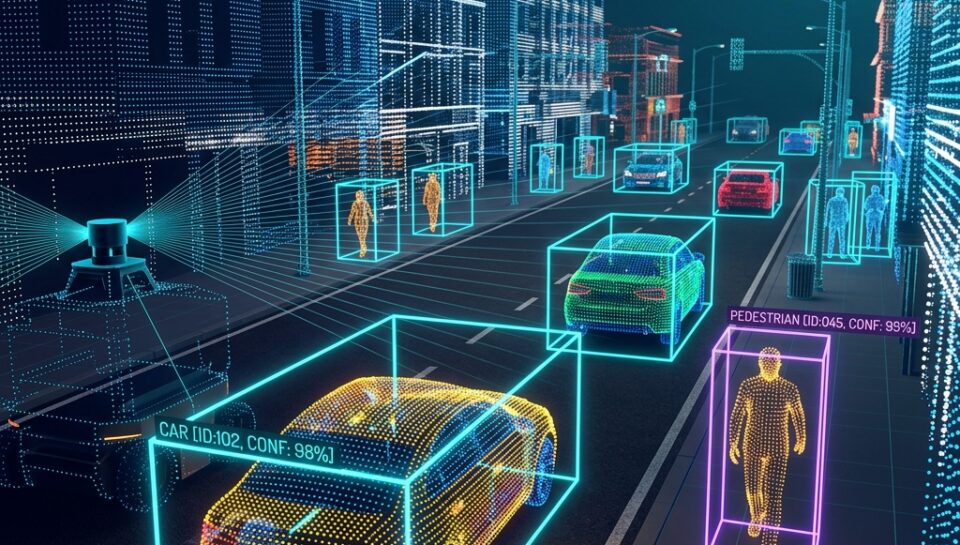
When a robot or an autonomous system needs to understand the shape of the world around it, a flat image is not enough. It needs depth, and depth comes from apoint cloud: a set of points in 3D space, each with a position and often an intensity value, captured by LiDAR or depth sensors. Teaching a model to make sense of that cloud, to know that this cluster of points is a forklift and that one is a person, takes annotated 3D data. Point cloud annotation is one of the harder annotation specialties, and demand for it has grown alongside warehouse robotics, drones, and autonomous machines of every kind.
This guide covers what point cloud annotation involves, the annotation types, why it is harder than 2D, how quality is measured in three dimensions, and what to look for in a partner.
Where the Data Comes From
Point clouds come from sensors that measure distance: spinning LiDAR units, solid-state LiDAR, time-of-flight depth cameras, and structured-light sensors. In an autonomous-vehicle context the framing is usuallyLiDAR annotation, and our piece onhow LiDAR annotation powers autonomous systems covers that side. In robotics more broadly the sensors and the use cases widen out: a warehouse robot building a map of its aisles, a drone modeling a construction site, a manipulator arm locating a part in a bin. The annotation craft is the same even when the platform is not a car.
The Annotation Types
Several label types do the work in 3D.
3D cuboids (bounding boxes). The 3D equivalent of a box around an object, with position, dimensions, and orientation. Used for vehicles, people, pallets, and any discrete object the system needs to locate and size.
Semantic segmentation. Every point assigned a class, so the model learns which points are ground, wall, vegetation, or obstacle. Dense and labor-intensive, but essential for navigation.
Instance segmentation. Like semantic segmentation, but separating individual objects of the same class, so three pallets are three distinct instances rather than one blob of pallet-points.
Object tracking across frames. LiDAR and depth sensors produce sequences, and tracking the same object frame to frame teaches motion and prediction, which a robot needs to avoid collisions.
Sensor fusion annotation. Many systems pair point clouds with camera images, and annotating both consistently so the same object lines up across sensors at the same instant is the highest-value and hardest part of the job.
Why 3D Is Harder Than 2D
Annotating a point cloud is genuinely tougher than drawing a box on a photo, for a few reasons that stack up. The data is sparse, so a distant pedestrian might come through as a dozen points that a human has to recognize and enclose correctly. It is three-dimensional, which means the annotator is rotating and navigating a space rather than working on a flat frame. Objects sit in front of each other and the sensor only catches surfaces, so half of any given object simply is not present in the data at all. On top of all that, the volume is brutal: one LiDAR sweep can hold hundreds of thousands of points, and a single driving log holds thousands of sweeps.
All of that means point cloud annotation needs specially trained annotators, purpose-built tooling, and more review than 2D work. It also means a partner without genuine 3D experience will struggle, regardless of how good they are at images. Tooling that speaks common robotics formats, including the kind used inROS, matters for getting the data in and out cleanly.
Quality in 3D
Measuring quality in three dimensions uses adapted versions of the familiar metrics. Spatial accuracy on cuboids and segmentation is scored with 3DIntersection over Union, measuring how well the annotated volume overlaps the ground truth. Inter-annotator agreement still applies, with multiple annotators labeling the same clouds to surface inconsistency. Gold sets and honeypots work the same way they do in 2D, seeding known-correct clouds into production to track real accuracy. Our guide onannotation quality and inter-annotator agreement covers the measurement discipline; the 3D version just adds a dimension to every metric.
The cases that deserve the most review attention are the sparse and occluded ones, because that is where annotators disagree most and where the downstream model is most likely to fail.
Adjacent Applications
Point cloud annotation shows up across a range of systems beyond pure robotics. Driver-assistance programs use it where LiDAR is part of the sensor suite; ourADAS data annotation guide covers that context. Drones and aerial mapping generate point clouds for survey and inspection. Construction and mining use them for site modeling and volume measurement. Warehouse and logistics robotics use them for navigation and pick-and-place. The annotation craft carries across all of them, which is why a partner with real 3D depth can serve several of these at once. For the broader picture of how this data trains a model, see ourAI training datasets overview.
What to Look For in a Partner
A point cloud annotation partner worth engaging can show a handful of things. Real 3D experience, not a 2D shop stretching to cover work it has not done before. Purpose-built tooling that handles the navigation and the volume without grinding. Fluency with robotics data formats, so integration does not turn into a project of its own. A quality framework adapted to three dimensions, with 3D IoU and proper review on the sparse and occluded cases. And the raw throughput to move the point volumes that 3D work involves. You can usually tell within one conversation: a partner who has done this talks fluently about occlusion and sparsity, and one who has not changes the subject.
Common Questions From US Robotics and AV Teams
What is 3D point cloud annotation?
The process of labeling points in a 3D point cloud, captured by LiDAR or depth sensors, so a model can recognize objects and structure in three dimensions. It uses cuboids, segmentation, and tracking rather than 2D boxes.
How is it different from image annotation?
It works in three dimensions on sparse, occluded data rather than on a flat image. Annotators navigate and rotate a 3D space, objects are only partially visible, and the point volumes are large, all of which make it harder and more specialized.
What annotation types are used for point clouds?
3D cuboids for discrete objects, semantic segmentation for per-point classes, instance segmentation to separate objects of the same class, object tracking across frames, and sensor-fusion annotation pairing point clouds with camera images.
How is point cloud annotation quality measured?
With 3D Intersection over Union for spatial accuracy, inter-annotator agreement across multiple annotators, and gold-set and honeypot accuracy tracking, the same discipline as 2D with an added dimension.
Why is point cloud annotation harder than 2D?
Point clouds are sparse, three-dimensional, and full of occlusion, and the volumes are large. A distant object might be a handful of points, and the annotator works in a navigable 3D space rather than a flat frame.
What sensors produce point clouds?
Spinning and solid-state LiDAR, time-of-flight depth cameras, and structured-light sensors. The annotation craft is similar across them even though the data characteristics differ.
Can point cloud annotation be outsourced?
Yes, to a partner with genuine 3D experience, purpose-built tooling, robotics-format fluency, and a quality framework adapted to three dimensions. A 2D-only shop will struggle with the navigation, occlusion, and volume.
What industries use point cloud annotation?
Robotics, autonomous vehicles and ADAS, drones and aerial mapping, construction and mining site modeling, and warehouse and logistics automation. The annotation skills carry across all of them.
Working With Prudent Partners
Prudent Partners Private Limited annotates 3D point cloud data for robotics and autonomous systems with experienced 3D annotators, purpose-built tooling, robotics-format fluency, and a quality framework adapted to three dimensions including 3D IoU and focused review on sparse and occluded cases. The work spans cuboids, segmentation, tracking, and sensor-fusion annotation across LiDAR and depth-sensor data.
For the full service scope, see ourdata annotation services overview, and for LiDAR-specific context, ourLiDAR annotation page.
To talk it through, reach out through the contact page. The first conversation is a 30-minute scoping call about your sensors, platform, volume, and quality needs. No commitment to go further.