
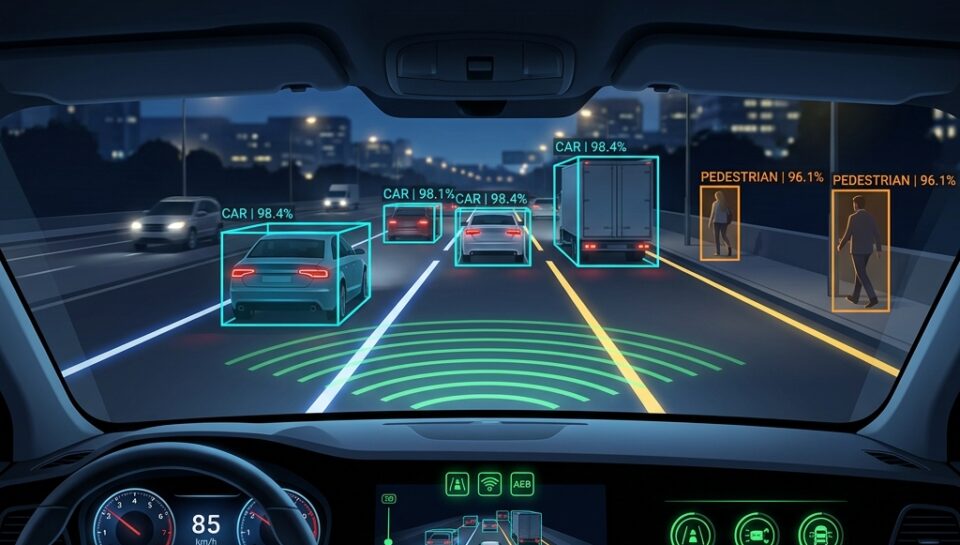
Advanced driver-assistance systems are already on the road in millions of US vehicles. They do the unglamorous work: lane-keeping, automatic emergency braking, adaptive cruise, blind-spot detection. Behind every one of those features sits an enormous volume of annotated sensor data, and the bar for that annotation is steep, because the system it trains can brake a real car on a real highway. That makes it higher-stakes than almost any other commercial AI application. ADAS data annotation is genuinely its own discipline. It is not general computer vision, and it is not full self-driving either, and the teams who do it well stop thinking of the data as a commodity and start treating it as a safety component.
This guide covers what ADAS annotation involves, the sensor modalities and annotation types in play, how it differs from full autonomous-vehicle work, the safety-grade quality it demands, and what US teams should expect from a partner.
What ADAS Covers
ADAS refers to the driver-assistance features that fall roughly atSAE levels 1 and 2: the system assists the human driver but the human stays responsible. That includes adaptive cruise control, lane-keeping and lane-centering, automatic emergency braking, forward-collision warning, blind-spot monitoring, traffic-sign recognition, and driver-monitoring systems that watch for distraction or drowsiness. TheNHTSA overview of driver-assistance technologies is a useful map of the feature set as US regulators frame it.
Every one of those features is a perception problem trained on annotated data, and the annotation has to be correct in conditions that range from clear daylight to rain, glare, night, and snow.
The Sensor Modalities
ADAS perception is multi-sensor, and the annotation work spans all of them.
Camera. The workhorse. Bounding boxes and polygons for vehicles, pedestrians, cyclists, signs, and lane markings, plus semantic segmentation for drivable surface and lane geometry. This is image annotation under demanding conditions; ourimage annotation overview covers the primitives.
Radar. Increasingly fused with camera for range and velocity. Annotation here ties radar returns to the objects they correspond to, which is harder than it sounds because radar is sparse and noisy.
LiDAR. Where it is present, LiDAR gives precise 3D structure. Point-cloud annotation with cuboids and segmentation is its own specialty; see ourLiDAR annotation page for the detail.
Sensor fusion. The hardest and most valuable work is annotating across sensors consistently, so the same object is labeled coherently in camera, radar, and LiDAR at the same moment in time. Fusion-quality annotation is what separates a serious ADAS data operation from a basic one.
Annotation Types in ADAS
The label types that show up most in ADAS programs:
• 2D and 3D bounding boxes for vehicles, pedestrians, cyclists, and obstacles
• Lane and road-marking annotation, often as splines or polylines, for lane-keeping and centering
• Semantic and instance segmentation for drivable area, sidewalks, and road furniture
• Traffic-sign and traffic-light annotation, including state (red, yellow, green)
• Object tracking across video frames, so the system learns motion and not just presence
• Driver-monitoring annotation for gaze, head pose, eye state, and distraction, inside the cabin
Each has its own quality metric, and on a safety system the tolerance for error is tight.
ADAS vs Full Autonomy
The distinction is worth getting straight, because it changes the work. Fullautonomous-vehicle annotation is about systems that take the human driver out entirely, SAE levels 4 and 5, which means staggering data volumes and obsessive edge-case coverage. ADAS sits lower, at levels 1 and 2, where a human is still holding the wheel and the system is helping. Commercially it is the bigger and more settled market, since these features ship in ordinary consumer cars right now while full autonomy is still mostly robotaxi pilots. None of that makes the annotation easier. An automatic-braking system that mistakes a pedestrian for a shadow has consequences, and the fact that a human is theoretically supervising does not undo them.
Safety-Grade Quality
This is where ADAS annotation separates from general commercial labeling. The data feeds systems that can fail dangerously, so the quality framework is built to a safety standard rather than a convenience one. Functional-safety thinking underISO 26262 flows back into data requirements: traceability of every label, configuration control over guidelines and tooling, and documented quality that can withstand scrutiny.
In practice that means tight inter-annotator agreement targets, heavy gold-set and honeypot coverage, multi-tier review with senior adjudication on safety-critical classes like pedestrians and cyclists, and adversarial attention to the hard conditions, since the night-rain-glare cases are exactly where perception fails and where annotation accuracy matters most. Our guide onannotation quality and inter-annotator agreement covers the measurement discipline that underpins all of this.
What US Teams Should Expect From a Partner
An ADAS annotation partner worth engaging can demonstrate a few things. Real multi-sensor capability, not just camera, with genuine fusion-quality output. A safety-oriented quality framework with the traceability and configuration control that automotive programs require. Experience with the specific annotation types your features need, from lane splines to driver-monitoring gaze. And the security posture to handle pre-release vehicle data, which is sensitive commercial IP. For the upstream picture of how this data feeds the model, see ourAI training datasets overview.
Common Questions From US ADAS Teams
What is the difference between ADAS and autonomous vehicle annotation?
ADAS covers driver-assistance features at SAE levels 1 and 2, where a human stays responsible. Autonomous-vehicle annotation targets levels 4 and 5, where the system drives. ADAS is more mature commercially and ships in consumer cars today; both demand high annotation quality.
Which sensors does ADAS annotation cover?
Primarily camera, radar, and LiDAR where present, often fused. The highest-value work is annotating consistently across sensors so the same object is coherently labeled in each at the same timestamp.
Why does ADAS annotation need higher quality than general labeling?
Because the data feeds safety systems that can fail dangerously, like automatic braking. A misclassified pedestrian has real consequences, so the quality framework is built to safety standards with traceability and tight agreement targets.
What annotation types are most common in ADAS?
2D and 3D bounding boxes, lane and road-marking annotation, semantic and instance segmentation, traffic-sign and signal annotation with state, object tracking across frames, and in-cabin driver-monitoring annotation.
How does ISO 26262 affect data annotation?
Functional-safety requirements flow back into the data: traceability of labels, configuration control over guidelines and tooling, and documented, auditable quality. The annotation has to support the safety case for the system it trains.
Can ADAS annotation be outsourced?
Yes, to a partner with genuine multi-sensor capability, a safety-oriented quality framework, and the security posture for pre-release vehicle data. The partner becomes part of the safety pipeline, so the bar is higher than for general labeling.
What are the hardest cases in ADAS annotation?
Adverse conditions: night, rain, glare, snow, and occlusion. These are exactly where perception systems fail, so annotation accuracy in these conditions matters disproportionately and deserves extra review attention.
How is driver-monitoring annotation different?
It looks inward, into the cabin, annotating gaze direction, head pose, eye state, and signs of distraction or drowsiness. It supports the driver-attention features that pair with the outward-facing perception stack.
Working With Prudent Partners
Prudent Partners Private Limited supports US ADAS programs across camera, radar, and LiDAR annotation with fusion-quality output, a safety-oriented quality framework including traceability and senior adjudication on safety-critical classes, and the security posture for pre-release vehicle data. The work spans the full ADAS label set, from lane geometry and traffic-sign state to in-cabin driver-monitoring.
For the full service scope, see ourdata annotation services overview, and for full-autonomy work, ourautonomous vehicle data annotation page.
To talk it through, reach out through the contact page. The first conversation is a 30-minute scoping call about your sensors, features, volume, and quality requirements. No commitment to go further.