
Most US AI teams only start asking hard questions about annotation quality after a model has already disappointed them in production. By then the training data is built and the damage is baked in. Quality is the single biggest factor a team can actually control, and it is also the one most teams take on trust. A vendor says the QA process is rigorous, the buyer nods, and nobody pins down what rigorous is supposed to mean or how anyone would check.
This guide is about pinning that down. We will walk through how annotation quality gets measured in practice, which metrics fit which kinds of labeling work, the QA workflow that stops bad labels before they reach a model, and the questions worth asking a provider who claims to do all of this well.
If your team is still weighing whether labeled data quality even matters this much, our piece onwhy annotations matter covers that ground. Here we take it as given and get straight to measurement.
Why Quality Decides Model Performance
A model learns whatever patterns sit in its training data, and that includes the mistakes. If the labels are inconsistent, the model picks up the inconsistency. If they are wrong in a systematic way, it learns to be wrong the same way. And anything the labeled data never covers tends to show up later as a blind spot in production. Teams often reach for a bigger model or a new architecture when performance stalls, when the real ceiling was the label quality all along. Hand the same raw dataset to two different annotation operations and you can end up with two models that perform noticeably differently. Our overview ofAI training datasets walks through how labeled data feeds into the model, and theNIST AI Risk Management Framework now treats data quality as a real risk category in its own right.
So the practical point is simple enough. You cannot manage what you cannot see, and if there is no measurement of annotation quality, there is no real handle on model risk either.
Guidelines Come First
Before you can measure quality, somebody has to define what correct looks like, and that definition lives in the labeling guideline. A good guideline spells out how each label gets applied, with worked examples and the awkward edge cases written down so two people reading it independently would land in the same place. When the guideline is vague, annotators disagree, and that disagreement gets blamed on the people when the real culprit is undefined policy. Tighten the guideline and the disagreements that remain actually tell you something.
That is why a serious operation puts the work intoannotation guidelines before it measures a thing, and keeps revising them as new edge cases turn up. Get the order wrong and you are not measuring quality at all. You are just putting a number on your own ambiguity.
The Core Metric: Inter-Annotator Agreement
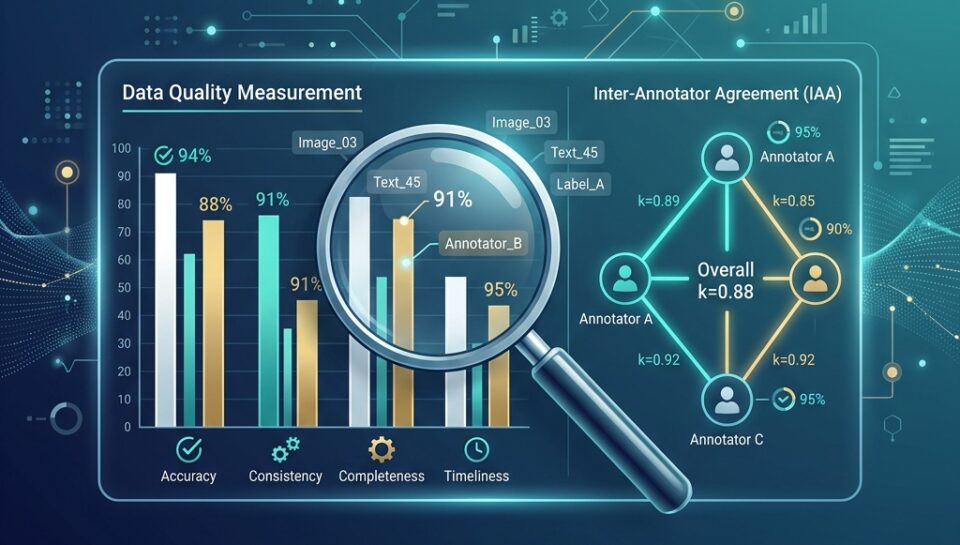
The foundational measure here is inter-annotator agreement, usually shortened to IAA. The idea is straightforward: give the same items to several annotators and see how often they land on the same label. When agreement is high, it usually means the task is well defined and people are applying it the same way. When it is low, you have a problem somewhere, either an ambiguous guideline or annotators who are not consistent, and working out which of the two it is tells you what to fix.
One catch worth knowing about: plain percentage agreement overstates things, because some of that agreement happens purely by chance. The standard metrics all correct for that in different ways.
**Cohen's Kappa** handles two annotators on categorical labels and adjusts for chance agreement. People often read above 0.6 as substantial and above 0.8 as strong, though the target you should actually hold depends on the task and how much label noise your model can tolerate.
**Fleiss' Kappa** takes the same idea and stretches it to more than two annotators, which is closer to how a real production line runs anyway.
Krippendorff's Alpha is the most flexible of the three. It copes with several annotators, missing data, and different data types at once, and that flexibility is why research-grade teams tend to favor it.
Whichever one you use, the job it does is the same: tell you about genuine agreement instead of lucky agreement, and point you at the spots where the guideline is letting people down.
Metrics by Task Type
Categorical agreement metrics are not the right tool for every job. What you measure has to match what is being labeled, and the options below cover the common cases. Our overview oftypes of annotation lays out the full task taxonomy if you need the wider map.
Classification and tagging (categorical): Cohen's or Fleiss' Kappa, plus accuracy and per-class precision and recall against a known-truth set. Watch per-class metrics, since overall accuracy can hide poor performance on rare classes.
Bounding boxes and segmentation (spatial):Intersection over Union (IoU), which measures how well two regions overlap. IoU above 0.8 against ground truth is typical for high-quality spatial annotation. Segmentation masks are scored with mean IoU across classes.
Named entity recognition and span labeling (text spans): span-level F1, which credits exact and partial boundary matches depending on the scoring rules. Boundary disagreement is the most common NER quality issue.
Transcription and translation (sequence): word error rate, edit distance, or human adequacy scoring, since exact-match metrics penalize acceptable variation.
Ranking and preference (relative): agreement on pairwise comparisons, often measured with Kendall's Tau or simple pairwise agreement rate.
Pick the wrong metric and you get a number that looks authoritative while measuring something beside the point. Match it to the actual annotation primitive and it starts telling the truth.
Gold Sets, Honeypots, and Calibration
Agreement only tells you the annotators are consistent with each other. It says nothing about whether they are right. A team can agree beautifully and all be wrong together, which is why correctness needs its own reference point.
Gold sets are items an expert has labeled and that you treat as the truth. You score annotator output against them to get at accuracy, which agreement alone never gives you. Ourdata annotation assessment approach leans on exactly this to qualify people before they ever touch production work.
Honeypots are gold-set items slipped quietly into the production stream. The annotator does not know which items are being scored, so what you measure is real working accuracy and not someone's behavior when they know it is a test. For catching quality that drifts over the life of a project, nothing else comes close.
Calibration is the step that happens before any of the real work. Annotators run through a known set, you measure where they land on both agreement and accuracy, and you fix the guideline while it is still cheap to fix. Teams that skip it pay for it later, because whatever errors are present at the start tend to ride along through the whole dataset.
The QA Workflow That Catches Errors
A metric on its own does not catch anything. It is a reading; the workflow around it is what actually stops bad labels from reaching a model. An operation that catches errors before delivery tends to run a few layers at once. Our overview ofwhat a quality assurance process looks like covers the general shape, and in annotation it usually breaks down like this.
1. Calibration before production, with agreement and accuracy gates that annotators must pass.
2. Multi-tier review: annotator, peer or lead review, and sampled audit, with documented sampling rates and acceptance criteria.
3. Ongoing IAA monitoring on a rolling sample of overlapping items to detect drift.
4. Honeypot accuracy tracking against gold-set items hidden in production.
5. Adjudication of disagreements by a senior reviewer, with the resolution feeding back into the guideline.
6. Quality reporting that actually shows the accuracy, agreement, edge-case rates, and drift over time, including the parts that look bad rather than only the wins.
What separates a real quality operation from one that just says the word is whether all six of these exist and get reported. A provider who can take you through each layer with real numbers from past work is in a different category from one whose answer stops at "we have QA."
What Buyers Should Ask
When evaluating an annotation provider, the quality conversation should be concrete. Strong questions:
• What inter-annotator agreement do you measure, with which metric, and what target do you hold for our task type?
• How do you use gold sets and honeypots, and can you show accuracy as well as agreement?
• What are your review tiers and sampling rates, and what is your acceptance threshold?
• How do you detect and respond to quality drift over an ongoing engagement?
• Can you provide quality reporting on a regular cadence, including the cases you got wrong?
If a provider can answer these with real figures, you have something you can hold them to. If the answer keeps sliding back to "our process is rigorous," they are asking you to take it on faith. Our guide onhow to evaluate a data annotation partner covers the wider evaluation around all of this.
Common Questions From US AI Teams
What is inter-annotator agreement?
A measure of how often multiple annotators assign the same label to the same item. It indicates whether a task is well-defined and consistently applied. The standard chance-corrected metrics are Cohen's Kappa (two annotators), Fleiss' Kappa (more than two), and Krippendorff's Alpha.
What is a good Cohen's Kappa score for annotation?
A common reading is that above 0.6 is substantial and above 0.8 is strong, but the right target depends on the task and how sensitive your model is to label noise. High-stakes tasks demand higher agreement.
What is the difference between agreement and accuracy?
Agreement is about whether your annotators line up with each other. Accuracy is about whether they line up with a known-truth gold set. You want both, because a team can be perfectly consistent and still be consistently wrong.
How do you measure quality for bounding boxes?
Intersection over Union (IoU), which scores how well the annotated region overlaps the ground-truth region. IoU above 0.8 is typical for high-quality spatial annotation; segmentation uses mean IoU across classes.
What is a honeypot in data annotation?
A gold-set item with a known correct label, secretly mixed into production work. Because annotators do not know which items are scored, honeypots measure real ongoing accuracy and are the best way to detect quality drift.
Why does annotation quality affect model performance so much?
A model learns the patterns in its training data, including labeling mistakes and inconsistencies. Poor labels teach the model poor patterns, which is why label quality is often the binding constraint on real-world performance.
How often should quality be measured during a project?
Continuously. Calibration before production, then rolling IAA and honeypot tracking throughout, with drift detection so problems surface within days rather than at delivery.
Can quality be measured if we use AI-assisted labeling?
Yes, and it matters more. AI-assisted labeling can introduce automation bias, where reviewers accept confident-but-wrong predictions. Honeypots and IAA on the human-corrected output detect that bias where a simple throughput metric would hide it.
Working With Prudent Partners
Prudent Partners Private Limited runs annotation with a documented quality framework: calibration and gold-set qualification before production, multi-tier review, rolling inter-annotator agreement and honeypot accuracy monitoring, senior adjudication of disagreements, and transparent quality reporting that includes the errors as well as the wins. The framework spans every task type, from categorical classification through spatial and span annotation, with the metric matched to the task.
For the full service scope, see ourdata annotation services overview.
To talk through an engagement, reach out through the contact page. The first conversation is a 30-minute scoping call about your task type, the quality bar you need to hit, the volume involved, and the agreement and accuracy targets your model actually requires. No commitment to go further.