Most organisations building AI have two groups involved with data and a gap between them. Data engineering owns the pipelines, warehouses, and infrastructure. The AI or data science team owns models. Between the two sits a set of responsibilities that neither fully owns: deciding what data a model needs, getting it into a usable state, keeping it that way, and handling the labeling, evaluation, and refresh work that never quite ends. Projects stall in that gap routinely, and the stall is usually attributed to technical difficulty when it is actually an ownership problem. This guide covers what a standing AI data operation looks like and how the two functions should divide the work.
Why the Gap Exists
Data engineering is built around reliability and structure. Its success measures are pipeline uptime, data freshness, and schema integrity, and it is generally not resourced to make judgment calls about whether data is fit for a specific model.
AI teams are built around modelling. Their strength is in architecture, training, and evaluation, and they are usually neither staffed nor inclined to run the sustained operational work of assembling, labeling, and maintaining datasets.
So the work in between, which is substantial, gets done ad hoc by whoever is blocked by it. It is invisible in planning, uncounted in resourcing, and consistently underestimated. Teams then report that the model took three months longer than expected, and the reason is almost always that this work was performed informally by people whose main job was something else.
What Actually Sits in the Gap
Fitness assessment. Whether the available data can support the intended model, and what would be required to get it there. This is the highest-value early activity and the one most often skipped, because it can conclude that the project is not currently viable.
Dataset assembly. Joining, filtering, and shaping data from multiple systems into a training set, with the decisions about inclusion documented.
Labeling and annotation. The obvious one, and the one most commonly partnered, covered by ourAI data annotation services.
Curation. Deduplication, balancing, and quality control on the assembled set, covered in ourdata curation overview.
Evaluation set construction and maintenance. Building held-out sets that reflect real conditions, and keeping them current as conditions change. Evaluation sets decay quietly and are rarely anyone's explicit responsibility.
Freshness management. Deciding how current data must be for each use, and ensuring it stays that way. For retrieval systems this is a direct accuracy issue rather than a hygiene one.
Feedback loop operation. Capturing production failures, converting them into training or evaluation cases, and closing the loop. Almost universally intended and rarely operationalised.
Ownership That Works
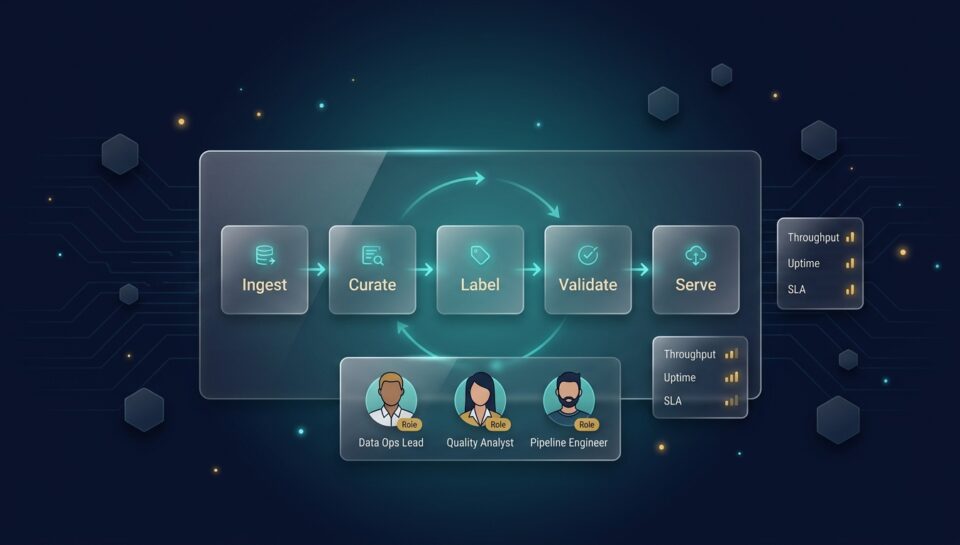
The division that holds up in practice assigns data engineering the infrastructure, pipelines, access, and delivery reliability. It assigns the AI team the model architecture, training, and the definition of what good performance means. And it assigns a named data operations function everything in between: fitness assessment, assembly, labeling, curation, evaluation set maintenance, freshness, and the feedback loop.
The critical part is that the middle layer is named and resourced rather than assumed. Organisations that treat it as a shared responsibility find it becomes nobody's, which is exactly how the gap forms.
Pipelines Need a Second Layer
Standard data pipelines deliver data reliably. AI work needs an additional layer on top with different properties.
It needs versioning of datasets, not just data, so that a model can be traced to the exact dataset it was trained on and results are reproducible. It needs lineage from source through every transformation to the training set, which matters for debugging and increasingly for compliance. It needs the labeling stage as a first-class part of the flow rather than a manual detour. And it needs quality gates that check fitness for the specific use rather than only schema validity, since data can be perfectly valid and entirely unsuitable.
Signals That the Gap Is Costing You
Several patterns indicate the operation is missing rather than the technology failing. Model projects consistently overrun on timelines attributed to data problems. Nobody can say precisely which data a deployed model was trained on. Evaluation sets have not been refreshed since the project began. Production failures are noticed and discussed but never captured into training or evaluation data. And the same data preparation work is repeated for each new project because nothing was made reusable.
That last one is the clearest sign, because reusability is exactly what a standing operation produces and ad hoc work does not.
Build, Partner, or Both
The infrastructure layer stays in-house, since it is tied to systems and access. The modelling stays in-house, since it is the product.
The middle layer is commonly partnered, and for defensible reasons: the work is labor-intensive and spiky, it benefits from a dedicated operation rather than borrowed capacity, and independent quality review is more credible than a team assessing its own data. What matters is that the organisation retains the decisions, what the data must support and what good means, while the partner runs the operation against those decisions. Ourvendor evaluation guide covers selecting for that.
The Practical Starting Point
For teams recognising this gap, the highest-return first step is usually not a tooling decision. It is writing down who owns each item in the list above, and noticing how many are unassigned. That exercise typically explains the last two stalled projects and takes an afternoon.
Common Questions From US Teams
Why do AI projects stall on data rather than modelling?
Because a substantial set of responsibilities sits between data engineering and the AI team, is owned by neither, and is done informally by whoever is blocked. It is invisible in planning and consistently underestimated.
What is AI data operations?
The function covering everything between raw pipelines and model training: fitness assessment, dataset assembly, labeling, curation, evaluation set maintenance, freshness management, and the production feedback loop.
How should data engineering and AI teams divide responsibility?
Data engineering owns infrastructure, pipelines, and delivery reliability. The AI team owns architecture, training, and the definition of good performance. A named operations function owns everything in between.
Why is a named owner so important?
Because shared responsibility for the middle layer reliably becomes nobody's responsibility. Naming and resourcing it is what prevents the gap from forming.
What do AI pipelines need beyond standard data pipelines?
Dataset versioning for reproducibility, lineage from source to training set, labeling as a first-class stage rather than a manual detour, and quality gates that test fitness for use rather than only schema validity.
How do I know if this gap is costing us?
Timelines overrun on data problems, nobody can identify exactly which data a deployed model was trained on, evaluation sets have not been refreshed, production failures never become training data, and preparation work is repeated for each project.
Why do evaluation sets decay?
Because keeping them current is rarely anyone's explicit responsibility. Conditions change, the set stops reflecting reality, and results become progressively less meaningful without anyone noticing.
What should be partnered versus kept in-house?
Infrastructure and modelling stay in-house. The operational middle layer is commonly partnered, with the organisation retaining decisions about what the data must support and what good means.
Working With Prudent Partners
Prudent Partners Private Limited operates the AI data layer for US teams: data fitness assessment, dataset assembly and curation, labeling, evaluation set construction and maintenance, and running the production feedback loop so failures become training and evaluation cases. Decisions about what the data must support stay with you. See ourAI data annotation services anddata curation work.
The first conversation is a 30-minute scoping call about where your AI projects currently stall and which of these responsibilities are unassigned. No commitment to go further.