
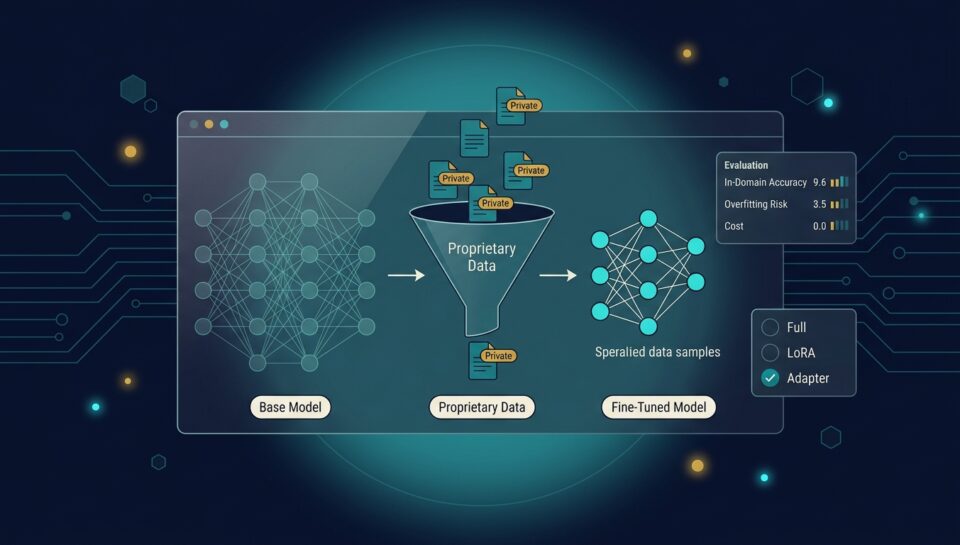
Most organisations sitting on years of proprietary data eventually ask the same question: can we use it to make a model that understands our business? The answer is often yes, and the path there is more constrained than the framing suggests. Fine-tuning is frequently the wrong tool for what teams actually want, and where it is the right tool, the dataset work determines the outcome far more than the training configuration. This guide covers when fine-tuning earns its cost, how the dataset gets built, and the problems teams hit.
Fine-Tuning Solves a Narrower Problem Than People Expect
The most common misconception is that fine-tuning is how you give a model knowledge. It is a poor mechanism for that. Fine-tuning is effective at teaching a model how to behave: what format to produce, what tone to use, how to reason through a domain-specific task, what to refuse. It is inefficient and unreliable at teaching a model facts, because facts learned this way cannot be updated without retraining and cannot be cited or verified.
If the goal is for the model to answer questions using your documents, retrieval is almost always the better approach, since the knowledge stays current, sources can be cited, and access can be controlled. Ourretrieval-augmented generation overview covers that architecture.
The clearest indicators that fine-tuning is genuinely the right tool: you need consistent output format or structure that prompting produces unreliably, you need a specialised tone or style, the task involves domain reasoning patterns the base model handles poorly, or prompt length has grown unwieldy because you are pasting extensive instructions into every request.
The Dataset Is the Work
Once fine-tuning is the right choice, outcome quality is dominated by dataset quality, and specifically by consistency.
A fine-tuning dataset is a set of demonstrations of the task done correctly. The model learns the patterns in those demonstrations, including the inconsistencies. If half your examples format output one way and half another, the model learns to be inconsistent, reliably. This is why a smaller, tightly consistent dataset routinely outperforms a larger inconsistent one, and why the instinct to maximise volume is usually wrong here.
Building it from proprietary data typically involves identifying real examples of the task, which is harder than it sounds because most organisational data is output without the corresponding input; cleaning and normalising them so format and style are consistent; deciding what "correct" looks like where historical examples disagree, which is a decision someone has to make rather than average; and covering the variation the model needs to handle, including the awkward cases rather than only clean ones.
That third point is where most projects stall. Historical data reflects what people actually did, which includes mistakes, outdated practice, and individual idiosyncrasy. Using it uncritically teaches the model to reproduce all of it.
Proprietary Data Brings Its Own Problems
Rights and permitted use. Data collected for operating your business is not automatically licensed for training a model. Customer data, vendor material, and licensed third-party content may all carry terms that constrain this use, and the question should be settled before the dataset is built rather than after.
Personal information. Proprietary datasets frequently contain personal data that was appropriate in an operational system and is not appropriate in training data, particularly given that models can reproduce training content.
Leakage into output. A model fine-tuned on internal material may reproduce it, including customer names, internal commentary, or confidential detail, in output shown to people who should not see it. This is a real and under-tested risk, and it argues for deliberate removal of sensitive specifics from the dataset rather than reliance on the model's discretion.
Embedded historical bias. Historical decisions encode historical patterns, including discriminatory ones. Fine-tuning on them propagates those patterns into future decisions with an appearance of objectivity, which is covered further in our discussion ofbias in machine learning.
Where Human Judgment Enters
Three parts of this cannot be automated. Deciding what a correct demonstration looks like when historical examples disagree is a judgment about standards, not a data-cleaning step. Identifying which historical examples encode outdated or wrong practice requires someone who knows the domain reading them. And reviewing the dataset for sensitive content that should not be learned requires knowing what would be damaging if it surfaced.
This is why fine-tuning dataset construction is closer to curated authoring than to bulk data processing, and why it benefits from measured consistency in the same way annotation does. Ourannotation quality guide covers the method, and ourLLM training data guide covers the broader preparation discipline.
Evaluate Against the Alternative
The discipline that saves teams the most money is holding a fine-tune to a comparison. Before committing, build a reasonable prompted baseline and a retrieval baseline for the same task, then evaluate the fine-tune against both on the same held-out set. A meaningful share of fine-tuning projects do not beat a well-constructed prompt or retrieval approach, and discovering that before the investment is considerably cheaper than after.
Evaluation also has to be built on real held-out examples, never on data used in training, and should measure the specific behaviors fine-tuning was meant to fix rather than general quality.
Maintenance
A fine-tuned model is a snapshot. Practices change, formats change, and the base model underneath gets updated, which can shift behavior in ways that interact unpredictably with your tuning. Plan for periodic re-evaluation and re-tuning rather than treating it as a one-time project, and keep the dataset maintained so re-tuning is a refresh rather than a rebuild.
Common Questions From US Teams
When should we fine-tune instead of using retrieval?
Fine-tune to change behavior: output format, tone, domain reasoning, or refusal patterns. Use retrieval to give a model knowledge, since retrieved knowledge stays current, can be cited, and can be access-controlled.
Can fine-tuning teach a model our company's facts?
Poorly. Facts learned through fine-tuning cannot be updated without retraining and cannot be cited or verified. Retrieval handles knowledge far more reliably.
How much data do we need to fine-tune?
Less than most teams assume, and consistency matters more than volume. A smaller tightly consistent dataset routinely outperforms a larger inconsistent one, because the model learns the inconsistencies too.
What is the hardest part of building a fine-tuning dataset?
Deciding what correct looks like where historical examples disagree. Historical data reflects what people actually did, including mistakes and outdated practice, and using it uncritically teaches the model all of it.
Can we use our customer data to fine-tune a model?
Not automatically. Data collected to operate your business may carry terms that do not permit training use, and it frequently contains personal information inappropriate for a training set. Settle this before building the dataset.
Can a fine-tuned model leak our internal information?
Yes. Models can reproduce training content, including customer names and confidential detail, in output shown to others. Sensitive specifics should be removed from the dataset rather than relying on model discretion.
How do we know whether fine-tuning was worth it?
Compare it against a well-constructed prompted baseline and a retrieval baseline on the same held-out evaluation set. A meaningful share of fine-tunes do not beat those alternatives.
Is a fine-tuned model finished once trained?
No. Practices change and base models get updated, which can shift behavior unpredictably. Plan periodic re-evaluation and re-tuning, and keep the dataset maintained so refreshing is straightforward.
Working With Prudent Partners
Prudent Partners Private Limited builds fine-tuning datasets from proprietary data for US teams: identifying and normalising real task examples, resolving inconsistency in historical practice against a defined standard, reviewing for sensitive content that should not be learned, and measuring consistency across the dataset. See ourLLM training data guide andAI data annotation services overview.
The first conversation is a 30-minute scoping call about the behavior you are trying to change, the data you hold, and whether fine-tuning is actually the right route. No commitment to go further.