US companies building AI have generally treated European regulation as somebody else's problem, and that assumption is becoming expensive. The EU AI Act reaches providers whose systems are placed on the EU market or whose outputs are used there, which captures a large share of US software companies whether or not they have European operations. Meanwhile enterprise buyers have started asking about AI governance in procurement regardless of jurisdiction, which means the practical requirements arrive through customers before they arrive through regulators. This guide is an orientation to what that means operationally.
This is a summary of how the obligations are generally understood rather than legal advice, and the regulatory position continues to develop. Anything with real consequence should go to counsel.
The Structure: Obligations Follow Risk
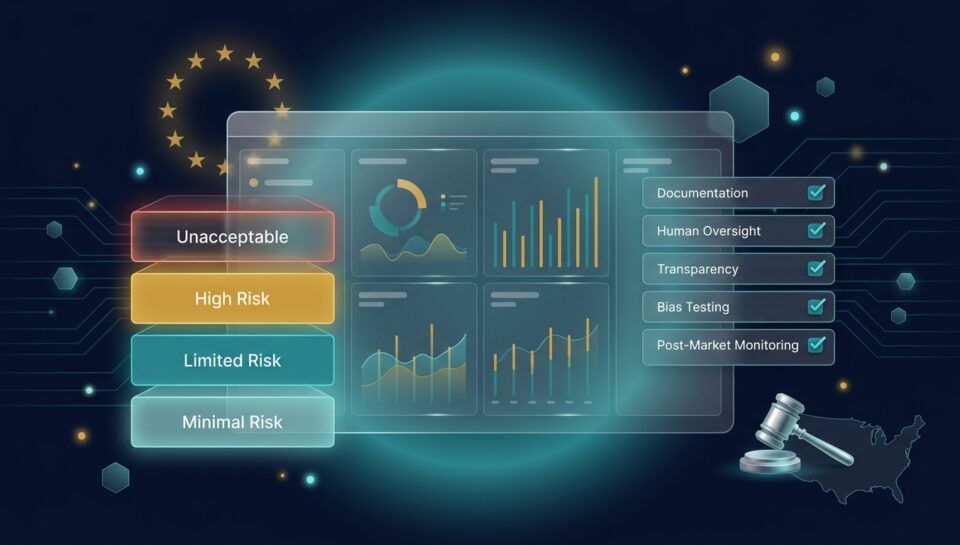
The Act's central design is that obligations scale with the risk a system presents rather than applying uniformly. In broad terms, a small set of uses is prohibited outright, a defined category is treated as high risk and carries substantial obligations, systems that interact with people or generate content carry transparency obligations, and everything else carries little.
The practical consequence for a US team is that the first question is not "are we compliant" but "which category does each of our systems fall into," and that question is answerable only if you know what systems you have.
High Risk Is Broader Than It Sounds
Teams often assume high risk means something dramatic. In practice the category is defined largely by application domain, and it includes areas many companies operate in without thinking of themselves as regulated: employment and worker management including screening and evaluation, access to education, access to essential services including credit assessment, certain uses in law enforcement and migration, and safety components of regulated products.
A recruitment company using AI to rank candidates, or a lender using it in credit decisions, is squarely in scope. Neither necessarily thinks of itself as building high-risk AI.
What High-Risk Obligations Actually Require
The obligations that attach are, notably, mostly things a well-run AI operation should be doing anyway. That is the useful framing for teams that resent the compliance burden.
Data governance. Training, validation, and test data must be relevant, representative, and examined for bias. This is a documentation requirement layered on top of a practice most teams claim to follow and few can evidence. Our discussion ofbias in machine learning covers the underlying discipline.
Technical documentation. A description of the system, its purpose, its data, its performance, and its limitations, maintained rather than written once.
Record keeping. Logging sufficient to trace system behavior, which has practical implications for what you retain and for how long.
Transparency to users. Clear information about capabilities and limitations, in terms a user can actually act on.
Human oversight. Designed-in ability for a person to understand, intervene in, and override the system. This is a design requirement, not a policy statement, and retrofitting it is expensive.
Accuracy, robustness, and security. Appropriate performance and resilience, including against adversarial manipulation.
Post-market monitoring. Ongoing performance monitoring after deployment, which is exactly the practice most teams intend and few operationalise.
Transparency Obligations Are Broader
Beyond high risk, obligations attach to systems that interact with people or produce content: disclosing that a user is dealing with AI rather than a person, and marking synthetic content as artificially generated. These are lighter but wider, and they touch consumer-facing products that carry no high-risk classification at all.
The Governance Work Underneath
Almost every obligation depends on something most organisations lack: knowing what AI they are running.
An AI inventory, listing each system, its purpose, its owner, the data it uses, its risk classification, and its monitoring status, is the prerequisite for everything else. Organisations routinely discover during this exercise that they have more AI in production than anyone believed, frequently embedded in purchased software, and that ownership of several systems is genuinely unclear.
Building that inventory is unglamorous and is the single highest-return governance action available, because it converts an unbounded compliance question into a finite list.
Where the Data Layer Carries the Weight
Several obligations land specifically on data practice: representativeness of training data, examination for bias, documented provenance, and evidence of quality. Meeting them requires the ability to say what is in a dataset, where it came from, how it was labeled, how consistently, and what was done about identified gaps.
Teams that have run disciplined data operations can produce this. Teams that assembled datasets informally often cannot reconstruct it, and reconstruction after the fact is substantially harder than recording it as you go. This is the practical argument for documentation discipline that has nothing to do with regulation: it is required either way and cheaper when done contemporaneously.
Procurement Is the Faster-Moving Pressure
For most US companies the binding constraint arrives before any regulator does, in the form of enterprise customers asking governance questions during procurement: what data trained this, how was bias assessed, what human oversight exists, how is it monitored, can you document it.
Answering those questions credibly is a commercial capability. Answering them poorly loses deals in exactly the enterprise segment most companies are trying to win, which tends to focus attention more effectively than regulatory timelines do.
A Sensible Sequence
For teams starting from nothing: build the inventory first. Classify each system by likely risk category. Take the highest-risk systems and assess what documentation and evidence you could produce today, which is usually a sobering exercise. Close the data documentation gaps, since these are the hardest to fix retrospectively. Establish monitoring on the systems that need it, drawing on ourAI quality assurance work. And route anything genuinely consequential to counsel rather than interpreting it internally.
Common Questions From US Teams
Does the EU AI Act apply to US companies?
It can. It reaches providers whose systems are placed on the EU market or whose outputs are used there, which captures many US software companies regardless of whether they have European operations.
What does high risk mean under the Act?
It is defined largely by application domain and includes employment and worker management, access to education and essential services such as credit, certain law enforcement and migration uses, and safety components of regulated products.
Would a recruitment or lending AI be high risk?
Both fall in domains the Act treats as high risk. Many companies operating in these areas do not think of themselves as building regulated AI, which is part of why classification matters early.
What do high-risk obligations require?
Data governance including representativeness and bias examination, maintained technical documentation, record keeping, user transparency, designed-in human oversight, accuracy and robustness, and post-market monitoring.
What obligations apply to lower-risk systems?
Transparency ones, mainly disclosing that a user is interacting with AI and marking artificially generated content. These are lighter but apply more broadly, including to consumer products with no high-risk classification.
What is the first practical step?
An AI inventory listing each system, its purpose, owner, data, likely risk classification, and monitoring status. Everything else depends on it, and organisations usually find more AI in production than expected.
Why is data documentation the hardest gap to close?
Because reconstructing what was in a dataset, where it came from, and how it was labeled is far harder after the fact than recording it contemporaneously. Teams with informal data practices frequently cannot reconstruct it at all.
What tends to force action first, regulators or customers?
Customers. Enterprise procurement now routinely asks governance questions, so the commercial cost of answering poorly usually arrives before any regulatory deadline does.
Working With Prudent Partners
Prudent Partners Private Limited supports the data layer of AI governance for US teams: documenting dataset composition and provenance, assessing representativeness and bias in training data, maintaining evidence of labeling quality and consistency, and running the ongoing monitoring that post-market obligations and enterprise procurement both expect. See ourAI quality assurance function and our guide tobias in machine learning.
The first conversation is a 30-minute scoping call about your systems, what documentation exists today, and where the evidence gaps are. No commitment to go further.