
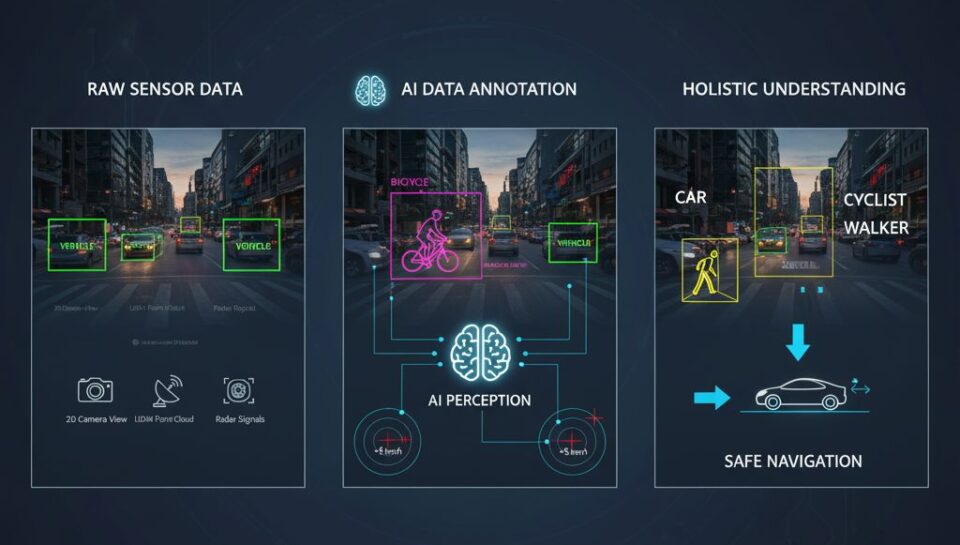
US autonomous vehicle programs are training data programs first and software programs second. The bottleneck for advancing through SAE driving automation levels is rarely algorithm design; it is the volume, diversity, and quality of labeled sensor data the perception stack trains on. AV data annotation is the discipline of producing those labels at production scale, under the security and audit framework that US AV programs require.
This guide covers what AV annotation actually involves in 2026, the SAE levels that drive different annotation requirements, the sensor types and fusion challenges, the US-specific edge cases that matter, and how to structure an engagement with a partner.
Why AV Annotation Is Different From Generic Image Annotation
Three things separate autonomous vehicle annotation from generic image labeling:
- Multi-sensor fusion. AV perception integrates camera, lidar, radar, and sometimes ultrasonic and thermal data. Annotation has to be consistent across sensors and synchronized in time.
- Functional safety implications. Annotation errors translate directly into perception failures. A missed pedestrian in training data is a missed pedestrian on the road.
- Edge case dominance. AV models perform fine on common scenes. They fail on edge cases. The annotation strategy that produces a safe AV stack is the one that systematically covers and labels edge cases, not the one that maximizes routine scene volume.
Generic image annotation vendors handle bounding boxes well. AV annotation requires sensor-specific 3D capability, time synchronization, and edge case strategy that vendors without specific AV domain experience do not bring.
SAE Levels of Driving Automation and What Each Demands of Annotation
The SAE J3016 levels of driving automation define what an autonomous system is expected to do. Annotation requirements differ at each level:
Level 0 (No Automation). Human driver does everything. No production AV annotation.
Level 1 (Driver Assistance). Single function automation (adaptive cruise control, lane keeping). Annotation supports specific perception tasks: lane line detection, vehicle distance estimation. Volume is moderate; complexity is low.
Level 2 (Partial Automation). Combined steering and acceleration under human supervision. Most current commercial ADAS systems sit here. Annotation covers detection, classification, lane geometry, and traffic sign recognition. Volume is high.
Level 3 (Conditional Automation). Vehicle handles all driving in defined operational design domains. Human takes over when the system requests. Annotation must cover handover scenarios, edge case identification, and complex interaction with other road users. Volume is very high; quality bar is significantly higher than Level 2.
Level 4 (High Automation). Vehicle handles all driving within an operational design domain without human handover. Annotation covers every interaction the vehicle could encounter in that ODD. Edge case strategy becomes central.
Level 5 (Full Automation). Vehicle handles all driving in all conditions. Annotation requirements are effectively unlimited.
Most US AV development programs in 2026 are operating at Level 2 with progression toward Level 3 or Level 4 within defined domains. Annotation strategy should be designed for the target level, not the current level.
US Regulatory Landscape for AV Programs
US AV development operates inside a regulatory framework that affects how annotation work is structured:
NHTSA Automated Vehicles policy and the AV TEST Initiative track AV deployment data and incident reporting. NHTSA’s Standing General Order on Crash Reporting requires reporting of crashes involving Level 2 systems and higher.
State-level regulations vary significantly. California DMV requires permits for AV testing and reports disengagements. Arizona, Texas, and several others have specific frameworks. Annotation programs that support compliance reporting need data provenance trails that map to the regulatory environment.
ISO 26262 functional safety governs the safety lifecycle of automotive electronic systems. AV training data and annotation work that supports ISO 26262 compliance requires documented quality processes mapped to the functional safety framework.
NIST 800-171 applies to defense-adjacent AV programs that handle controlled unclassified information.
A serious AV annotation partner understands all of this. A generic vendor does not.
Sensor Types and Annotation Coverage
Production AV programs typically integrate four sensor types:
Camera. RGB imagery from multiple positions on the vehicle (forward, side, rear, surround). Annotation includes bounding boxes for objects (vehicles, pedestrians, cyclists, signs, traffic lights), polygons for irregular shapes, semantic segmentation for road surfaces and free space, polylines for lane markings, and keypoints for cyclist and pedestrian pose.
Lidar. 3D point clouds from rotating or solid-state lidar sensors. Annotation includes 3D cuboids for objects (with orientation), semantic segmentation of point clouds (road, sidewalk, vegetation, building), and ground plane estimation. Point counts per scene can reach hundreds of thousands.
Radar. Range, velocity, and angle returns. Less commonly directly annotated but increasingly used in fusion with camera and lidar. Doppler velocity provides ground truth for object motion.
Ultrasonic and thermal. Used in close-proximity scenarios (parking) and adverse weather. Annotation is workload-specific.
Sensor fusion annotation requires that all sensor labels for the same scene align in time and space. A bounding box on a camera image must correspond to the right cuboid on the lidar point cloud, and both must reflect the same real-world object at the same instant. This synchronization discipline is what separates AV annotation specialists from generalists.
ADAS-Specific Annotation for Tier-1 Suppliers
Advanced Driver Assistance Systems (ADAS) annotation is a substantial subset of AV annotation that supports Tier-1 automotive suppliers and OEMs working on Level 2 features at scale.
ADAS workloads typically include:
- Adaptive cruise control. Vehicle detection and distance estimation in front of the host vehicle.
- Lane keeping assist. Lane line detection and lane geometry estimation.
- Traffic sign recognition. Classification of US traffic signs (stop, yield, speed limit, regulatory, warning).
- Forward collision warning. Object detection and time-to-collision estimation.
- Blind spot detection. Side-mounted camera and radar object detection.
- Pedestrian detection. Bounding box and pose estimation for pedestrians.
- Automatic emergency braking. Object detection with high-precision distance estimation.
ADAS annotation programs run at high volume, with strict accuracy requirements (often 99 percent or higher for safety-critical detection), and with strong functional safety audit trails to support ISO 26262 compliance.
US-Specific Edge Cases That Matter
US AV programs have to handle edge cases specific to American roads, weather, and infrastructure. Annotation programs that systematically cover these are what separate safe AV stacks from unsafe ones:
Weather edge cases. Snow accumulation obscuring lane markings. Heavy rain reducing camera visibility. Fog reducing both camera and lidar range. Glare from low sun angles. Ice patches on road surface.
Infrastructure edge cases. Construction zones with temporary lane shifts. Lane markings partially worn off. Road work with cones, signs, and human flaggers. Bridge expansion joints affecting lidar returns.
Vehicle edge cases. US-specific vehicle types: school buses (with distinct stop arm and flashing red lights), emergency vehicles (with distinct lighting patterns), large pickup trucks, cargo vans, motorcycles in lane filtering positions.
Pedestrian and cyclist edge cases. Children at school crossings. Elderly pedestrians with mobility aids. Cyclists in dedicated bike lanes vs sharing lanes. Skateboarders, scooters, and other micromobility users.
Signage edge cases. Hand-held stop signs from school crossing guards. Construction signage with non-standard wording. Temporary detour signs. Faded or partially obscured permanent signs.
Behavioral edge cases. Aggressive lane changes. Vehicles running red lights. Wrong-way drivers. Police vehicles directing traffic. Funeral processions.
A vendor whose annotation strategy does not include systematic edge case identification, sampling, and labeling is not equipped for production AV work.
Annotation Types Used in AV Programs
Six annotation types cover most AV perception needs:
2D bounding boxes. Rectangles around objects on camera images. Foundation of object detection.
3D cuboids. Oriented 3D boxes around objects on lidar point clouds. Capture position, dimensions, and heading. Foundation of 3D perception.
Semantic segmentation. Pixel-level (camera) or point-level (lidar) class labels for road surface, sidewalk, vegetation, building, vehicle, pedestrian.
Instance segmentation. Like semantic but each individual instance separately tracked.
Polylines. Lane markings, road edges, curbs. Critical for lane keeping and path planning.
Keypoints. Joints on pedestrians and cyclists for pose estimation. Used in intent prediction.
Specialized AV programs may add 4D annotation (time-sequenced labels for tracking), free space annotation, drivable area segmentation, or scenario tagging for systematic edge case coverage. Toolchains often integrate with platforms like Labelbox for workflow management.
Quality Framework for AV Annotation
Production AV annotation runs at higher accuracy thresholds than most other annotation work because the safety stakes are higher. A typical quality framework includes:
- Accuracy benchmarks. 99 percent or higher for safety-critical detection (vehicles, pedestrians, traffic signs at standard distance). Higher for emergency vehicle detection and school bus detection.
- Multi-layer QA. Annotator self-check, peer review, team lead audit, and clinical-equivalent review by trained AV engineers for ambiguous cases.
- Inter-annotator agreement. Above 0.9 for routine objects; above 0.85 for complex edge cases.
- Synchronized validation. Cross-sensor consistency checks (camera bounding box matches lidar cuboid for the same object at the same time).
- Edge case auditing. Periodic dedicated audits of edge case labeling quality, separate from routine sampling.
- Continuous SOP versioning. Annotation guidelines versioned and traceable. Changes triggered by ground-truth disagreements drive retraining.
Common Questions From US AV Programs Buying Annotation
How is annotator training handled for specialized AV work?
Documented training programs covering road geometry, US-specific signage and infrastructure, sensor calibration concepts, and edge case taxonomies. Training is workload-specific (lidar 3D cuboids require different training than camera 2D bounding boxes). Annotators are validated against ground truth before joining production.
Can offshore partners handle ADAS work that supports ISO 26262 compliance?
Yes, when the partner has documented quality processes, ISO 27001 information security, audit trails that survive functional safety review, and the right contractual framework. The Tier-1 supplier or OEM remains responsible for the overall ISO 26262 compliance; the annotation partner provides the documented inputs.
What about ITAR-controlled AV defense work?
Most ITAR-controlled work requires US persons handling. Defense AV programs typically use a US-based prime contractor with offshore support limited to non-ITAR scope. Verify the boundary in the contract.
How long does it take to ramp a serious AV annotation team?
A specialized 3D lidar team with documented training and validated annotators typically takes 30 to 60 days to ramp from contract to production-ready. Camera-only ADAS work ramps faster.
What pricing model fits AV annotation?
Per-frame works for high-volume bounding box work. Per-FTE or per-hour fits 3D lidar work and judgment-heavy edge case annotation. Most mature AV programs use a hybrid: dedicated FTE teams for ongoing work plus per-frame surge capacity for spike volumes.
How does the partner handle scenario tagging?
Scenario tags (weather, lighting, road type, traffic density, edge case category) drive curriculum-based training and gap analysis. A serious partner has a documented scenario taxonomy and tagging methodology.
What about data localization for AV training data?
US training data sometimes must remain in US jurisdiction depending on contractual or regulatory constraints. The partner should support the relevant data residency framework.
Will the audit trail survive a regulatory inquiry?
Verify in the pilot phase. Ask for sample audit trail outputs covering data provenance, annotator qualifications, SOP versions, and quality validation. Pressure-test against your regulatory team’s expectations.
Working with Prudent Partners on AV Annotation
Prudent Partners Private Limited is an ISO 9001 and ISO 27001 certified annotation partner working with US autonomous vehicle and ADAS programs. The operating model includes specialized annotators trained on US road environments, multi-layer quality assurance with cross-sensor consistency checks, scenario-based edge case strategy, and audit trails designed to support functional safety and regulatory inquiry.
For broader context, see our perception AI overview, image annotation services, image annotation companies buyer guide, and data annotation services pages. For buyer-stage content, see our vendor evaluation framework and outsourcing buyer guide.
To explore an AV annotation engagement, get in touch through the contact page. The first conversation is a 30-minute scoping call to understand the SAE level, sensor stack, scenario coverage, and regulatory pathway, with no commitment to proceed.