Ask three data annotation vendors what a project costs and you can get three numbers that are impossible to compare, because they are priced on different models, include different things, and rest on different assumptions about quality. Pricing in this market is genuinely confusing, and the confusion is sometimes used to make a cheap-looking quote that turns expensive once the rework starts. The way out is to understand the pricing models, know what drives cost, and learn to compare quotes on the one number that matters, which is the cost of a label you can actually use.
This guide walks through the common pricing models, the factors that move cost, and how to turn a pile of incomparable quotes into a real comparison.
The Three Common Pricing Models
Most annotation vendors price one of three ways.
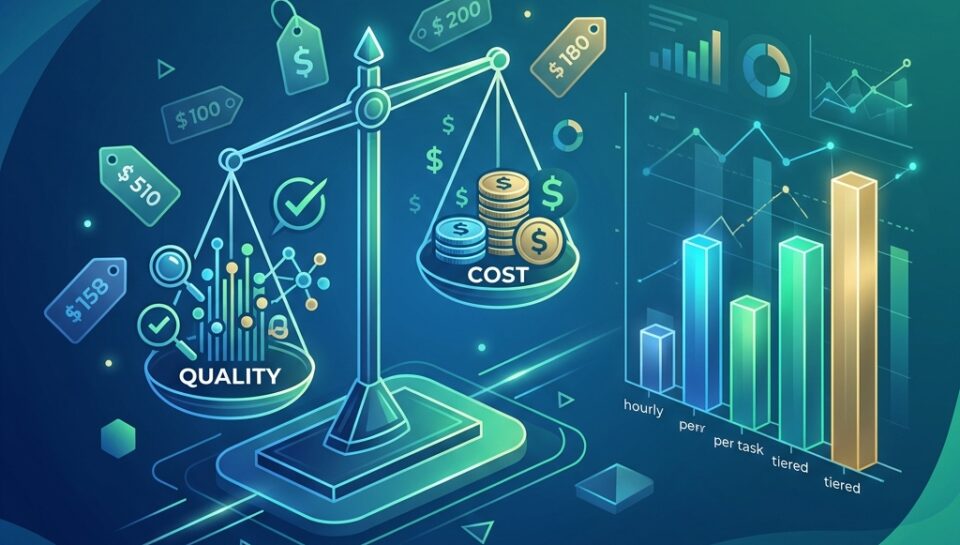
Per-label or per-unit. You pay a fixed amount per labeled item, whether that is per image, per bounding box, per audio minute, or per document. Easy to budget and easy to compare on the surface, which is exactly why it can mislead, since a low per-label rate with high rework is not actually cheap. Best for well-defined, stable tasks with predictable unit economics.
Hourly or time-and-materials. You pay for annotator and reviewer time. This fits tasks that are still evolving, where the unit itself is hard to define or the guideline keeps changing. The risk is hours creeping up without strong project management, so it works best with a vendor who reports time transparently.
Managed or retainer. You pay a fixed monthly fee for an allocated team and a target volume range. This suits steady, ongoing work where the team builds institutional knowledge of your task over time. It trades some flexibility for predictability and usually a better effective rate at scale. For the broader build-buy-partner decision, see ourdata labeling outsourcing guide.
Many mature engagements blend these: a managed baseline for steady work plus per-label or hourly surge capacity for spikes.
What Drives Cost
The same task can vary in price by an order of magnitude depending on a handful of factors.
Task complexity. A simple yes-no classification is cents. A detailed segmentation mask or a clinician-reviewed medical label is dollars. The complexity of the annotation primitive is the single biggest driver; ourtypes of annotation overview maps the range.
Quality bar. Higher required accuracy means more review, more inter-annotator overlap, more QA, and therefore more cost. A research-grade dataset costs more than a rough one because the quality apparatus behind it costs more to run.
Expertise required. General annotators are one price. Domain experts, like clinicians for medical data or linguists for nuanced text, are a premium, and rightly so.
Volume and predictability. Steady, high volume earns better rates because it lets a vendor plan capacity. Spiky, unpredictable work costs more per unit.
Security and compliance overhead. Work requiring HIPAA, SOC 2, on-premises handling, or a cleared workforce carries real overhead that shows up in the price. Defense-grade work can run several times the cost of equivalent commercial work for exactly this reason.
Edge-case density. A dataset full of ambiguous, hard-to-label cases takes longer per item and needs more adjudication than a clean one.
The Number That Actually Matters: Cost Per Accepted Label
Here is the trap, stated plainly. The headline per-label or hourly rate tells you what you pay per unit of work, not per unit of usable output. The number that matters is cost per accepted label, which accounts for everything that happens before a label is good enough to train on.
A worked example makes it concrete. Vendor A quotes ten cents a label but runs a 30 percent rework rate, so for every label you can actually use you are paying for roughly 1.3 attempts, which drags the real cost up toward thirteen cents. Vendor B quotes twelve cents and reworks 5 percent, landing close to thirteen as well, except B's data comes back cleaner and your own team burns less time hunting for the errors that slipped through. On the headline numbers A looked 17 percent cheaper. Once you do the real math it is a wash on price, and B wins on everything that is not price.
This is why quality and price cannot be separated. A rework rate is a price, just an invisible one, and the only way to see it is to ask. Our guide onannotation quality and inter-annotator agreement covers how quality is measured, which is the same apparatus that tells you what your real cost is.
Comparing Quotes
To turn incomparable quotes into a real comparison, normalize them. Ask every vendor to price the same defined sample task, state their typical rework rate for work like yours, and specify exactly what is included versus billed separately, such as QA, project management, and revisions. Then compare on estimated cost per accepted label, not headline rate. A short paid pilot on real data is the most reliable way to get true numbers, since it surfaces the rework rate that no quote will volunteer. Ourvendor vetting checklist covers how to run that procurement process. And remember that the cheapest quote that produces unusable data is the most expensive decision available, because you pay for it twice, once to the vendor and once in your own team's time cleaning up.
TheNIST AI Risk Management Framework frames poor data quality as a model risk, and a pricing decision that optimizes for headline rate over usable output is one of the quieter ways that risk gets introduced. For the bigger picture of how this data feeds your model, see ourAI training datasets overview.
Common Questions From US AI Teams
How much does data annotation cost?
It varies enormously by task. Simple image classification can be cents per item; clinician-reviewed medical labeling can be tens of dollars. The honest answer for any specific project comes from the task complexity, quality bar, expertise needed, and security requirements, not an industry average.
What is the best pricing model for data annotation?
Per-label suits stable, well-defined tasks; hourly suits evolving ones; managed retainer suits steady ongoing work. Many engagements blend a managed baseline with surge capacity. The right model depends on volume predictability and task stability.
Why do annotation quotes vary so much?
Because vendors price on different models, include different things, and assume different quality levels. A low per-label rate often hides a high rework rate. Normalizing quotes to cost per accepted label is the only fair comparison.
What is cost per accepted label?
The true cost of a label good enough to train on, accounting for rework, QA cycles, and management overhead. It is the number that matters, because a cheap headline rate with high rework can cost more than a higher rate with clean output.
What makes annotation more expensive?
Task complexity, a higher quality bar, domain expertise, low or unpredictable volume, security and compliance overhead, and edge-case density. Each adds real cost that shows up in the price.
Is cheaper data annotation worth it?
Only if the quality holds. A cheap rate that produces a high rework rate or unusable data is the most expensive option, since you pay the vendor and then pay your own team to fix it. Compare on usable output, not headline rate.
How do I get an accurate quote?
Provide a clear task definition and a representative data sample, then run a short paid pilot. The pilot surfaces the real rework rate and gives you a true cost per accepted label that no upfront quote can.
Does security increase annotation cost?
Yes, meaningfully. HIPAA, SOC 2, on-premises handling, or a cleared workforce all carry overhead. Defense-grade work can run several times the cost of equivalent commercial work because of the workforce and security requirements.
Working With Prudent Partners
Prudent Partners Private Limited prices transparently across per-label, hourly, and managed models, matched to the task rather than forced into one shape. The quality framework means the cost per accepted label stays close to the headline rate, because the rework rate is kept low by design, and a paid pilot lets you see the real numbers on your own data before any commitment.
For the full service scope, see ourdata annotation services overview.
To get a scoped quote, reach out through the contact page. The first call is a 30-minute discussion covering your task, volume, quality bar, and security needs, after which we can scope a pilot. No commitment to go further.