
A large language model is, in a real sense, a compression of its training data. Everything it knows traces back to what it was trained on. So does every bias it carries, every capability it has, and every gap where it falls down. For US teams building or fine-tuning foundation models in 2026, the data work has stopped being an afterthought to the modeling. It is increasingly where the differentiation lives, because the architectures are converging and data is what is left to compete on. And a surprising share of that data work is human: curating corpora, writing demonstrations, sitting down and judging which of two model outputs is actually better.
This guide covers the stages of LLM training data, what happens at each, where human labeling fits, and how quality is maintained across a pipeline that runs from billions of raw tokens down to a few thousand carefully judged comparisons. For general machine-learning training data beyond LLMs, ourAI training datasets overview is the broader piece; this one is LLM-specific.
The Stages of LLM Training Data
LLM data is not one dataset. It is several, each with its own purpose, scale, and quality requirements.
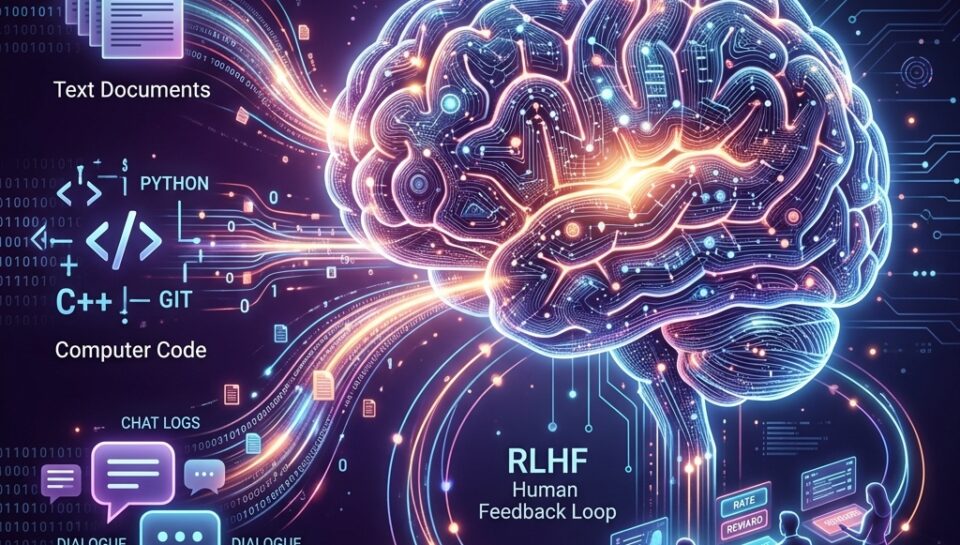
Pre-training data. The enormous corpus, often trillions of tokens, that the base model learns language from. Sourced from web text, books, code, and other large collections. The work here is curation at scale: deduplication, quality filtering, removing harmful or low-value content, and balancing the mix. Mostly automated by necessity given the volume, but the filtering rules and quality heuristics are human decisions with large downstream effects.
Fine-tuning data. A much smaller, much higher-quality set, often thousands to millions of examples, that adapts the base model to a task or domain or teaches it to follow instructions. This is where careful human labeling pays off most directly, because at this scale every example matters and quality dominates quantity.
Preference data for RLHF.Reinforcement learning from human feedback trains the model on human judgments of which output is better. Annotators compare model responses and rank them, and the quality of those judgments shapes the model's behavior, tone, and safety directly. Small in volume, enormous in influence.
Evaluation data. The held-out set used to measure whether the model is improving. Treated with extra care because contamination of evaluation data into training data is a common and silent failure that makes a model look better than it is.
Where Human Labeling Fits
It is tempting to think of foundation models as trained by machines on machine-scraped data, and the pre-training stage is largely that. But the stages that make a base model actually useful are deeply human.
Instruction demonstrations, where people write examples of good responses to prompts, are human-authored. Preference comparisons for RLHF are human judgments. Red-team data, the adversarial prompts and the labeled examples of bad output, comes from people deliberately probing the model. Domain fine-tuning data often needs experts, since teaching a model medicine or law well requires examples written or vetted by people who know the field. This human-feedback work sits alongside the broadergenerative AI quality analysis function, and it is some of the highest-leverage labeling in all of AI, because a few thousand good judgments can reshape how a model behaves.
Quality at Each Stage
The quality bar shifts as you move down the pipeline. At pre-training scale, quality is about filtering and balance, applied through automated rules whose design is the human contribution. At fine-tuning and RLHF scale, quality is about the correctness and consistency of individual examples, which is where the familiar annotation discipline comes back in full force: clear guidelines, calibration, inter-annotator agreement, and adjudication of disagreements. Our guide onannotation quality and inter-annotator agreement covers that measurement, and it applies directly to preference and demonstration data.
RLHF data has a particular challenge: the judgments are subjective, so agreement is harder to reach and more important to measure. Two annotators ranking the same pair of outputs may genuinely disagree, and whether that disagreement reflects unclear guidelines or legitimate ambiguity is exactly the kind of thing inter-annotator agreement helps diagnose. Documenting the data thoroughly, in the spirit ofDatasheets for Datasets, matters more here than almost anywhere, because the influence of this small dataset on model behavior is so large.
Beyond Training: Where RAG Fits
Not every LLM data problem is a training problem. Many teams improve model output at inference time through retrieval-augmented generation, which grounds responses in a retrieved corpus rather than baking everything into the weights. That is a different kind of data work, focused on building and maintaining the retrieval corpus rather than training data, and ourretrieval-augmented generation piece covers it. It is worth distinguishing, because teams sometimes reach for fine-tuning when RAG would solve their problem more cheaply, or vice versa. Understanding the model'scontext window is part of making that call.
Security and Governance
LLM training data raises governance questions that smaller ML projects often avoid. Provenance and rights matter, since the legal landscape around training data is actively contested and teams increasingly favor data with clear rights. PII handling matters, since large corpora can contain personal data that needs detection and removal. And documentation matters, since a model trained on poorly-documented data is a model whose behavior is hard to explain later. TheNIST AI Risk Management Framework and its generative-AI guidance are the references most US teams use to structure this governance across the data lifecycle.
Common Questions From US LLM Teams
What are the stages of LLM training data?
Pre-training data (the massive base corpus), fine-tuning data (smaller, higher quality, task-adapting), preference data for RLHF (human judgments of output quality), and evaluation data (the held-out measurement set). Each has its own scale and quality needs.
What is RLHF data?
Reinforcement learning from human feedback data is human judgments comparing and ranking model outputs. Annotators decide which response is better, and those judgments train the model's behavior, tone, and safety. It is small in volume but very influential.
How much fine-tuning data do I need?
Usually far less than people expect, often thousands to tens of thousands of high-quality examples rather than millions. At this stage quality dominates quantity, so careful labeling beats raw volume.
What is the difference between fine-tuning and RAG?
Fine-tuning changes the model's weights using training data. RAG leaves the model unchanged and grounds its responses in a retrieved corpus at inference time. They solve different problems, and the cheaper fit depends on whether your need is new behavior or access to current information.
Who labels LLM training data?
Pre-training is largely automated curation. Fine-tuning, RLHF, demonstrations, and red-teaming are human work, sometimes requiring domain experts for specialized fields. The human-feedback stages are among the highest-leverage labeling in AI.
Why does preference data quality matter so much?
Because a small set of human judgments shapes the model's behavior across everything it does. Inconsistent or low-quality preference data teaches inconsistent behavior, which is why agreement measurement and clear guidelines matter as much here as anywhere.
How do I handle PII in training data?
Detect and remove or pseudonymize it before training where the task does not require it, and work only with partners whose security posture matches the data sensitivity where it does. Large corpora especially need systematic PII detection.
What about copyright in training data?
The legal landscape is actively contested in 2026. The prudent posture for most teams is to favor data with clear rights or licenses and to document the basis for any data relied on under fair-use arguments.
Working With Prudent Partners
Prudent Partners Private Limited supports US LLM and foundation-model teams across the human side of the training-data pipeline: instruction demonstrations, preference data for RLHF, red-team data, and domain fine-tuning data, with the quality discipline these high-leverage stages demand, including calibration, inter-annotator agreement on subjective judgments, and thorough documentation. The work runs with the security posture matched to the data sensitivity.
For the full service scope, see ourdata annotation services overview.
To talk it through, reach out through the contact page. The first call is a 30-minute scoping discussion covering your model stage, the data work you need, volume, and quality bar. No commitment to go further.