Defense AI programs run on training data that doesn't fit standard commercial annotation pipelines. The data is sensitive, the workforce posture is regulated, the contracts include flow-down requirements from prime contractors, and the partners that can legitimately participate are the ones whose operations were architected for the requirements rather than the ones who treat it as another vertical.
This piece covers what defense data annotation actually requires in 2026, the federal frameworks that govern the work (CMMC,NIST 800-171,ITAR where applicable, plus relevant FedRAMP postures), the workforce and security posture that survives a prime's vendor due diligence, and how programs structure annotation engagements with external partners.
What Defense Data Annotation Covers
The category covers annotation services for AI and ML systems in defense and defense-adjacent applications:
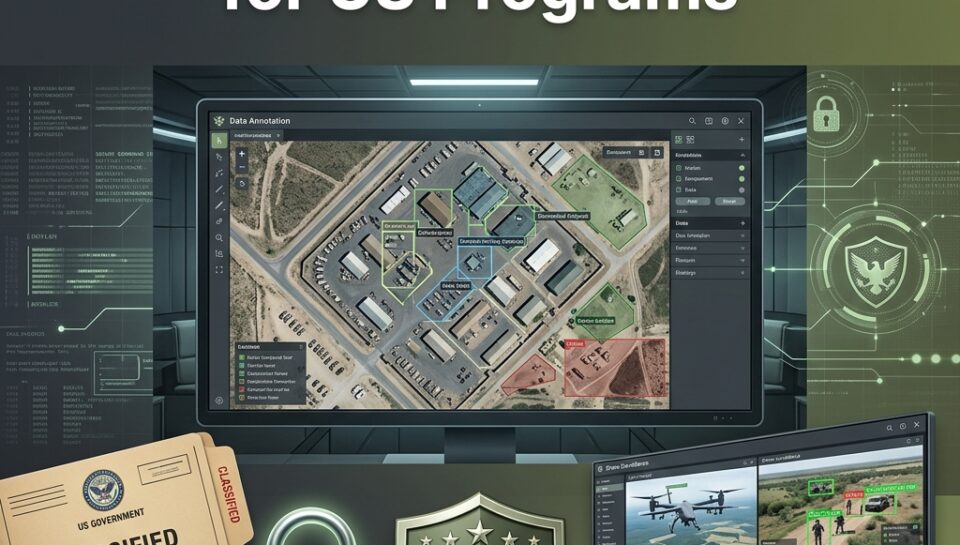
- Geospatial intelligence (GEOINT) including satellite imagery, aerial imagery, and drone/UAV imagery for object detection, classification, change detection, and target identification. Cross-link: ourgeospatial data annotation USA page.
- Sensor fusion combining electro-optical, infrared, synthetic aperture radar, and LiDAR data. Cross-link: ourlidar annotation page.
- Signals and audio including communications signal classification and audio analysis.
- Maritime and air domain awareness annotation for vessel and aircraft tracking, classification, and behavior modeling.
- Autonomous platforms annotation for ground, air, and underwater autonomous systems. Cross-link: ourAV annotation USA page.
- Document and OCR for declassified or training-only document processing.
The data sensitivities range from Controlled Unclassified Information at the lower end through controlled programs that require additional clearances. The right partner posture depends on the specific program's data classification.
The Compliance Frameworks
Five frameworks govern defense annotation work in 2026, applied in combinations depending on the program.
CMMC 2.0
TheCybersecurity Maturity Model Certification program is the Department of Defense's framework for assessing contractor cybersecurity. The 2.0 version operates at three levels:
- Level 1 (Foundational) for handling Federal Contract Information. Self-assessment, 17 practices.
- Level 2 (Advanced) for handling Controlled Unclassified Information. Third-party assessment for most contracts, 110 practices aligned with NIST SP 800-171 Rev 2.
- Level 3 (Expert) for the most sensitive programs. Government-led assessment.
A partner working on CUI-bearing programs is operating at CMMC Level 2 minimum, with documented compliance across the 110 practices and a defensible System Security Plan.
NIST SP 800-171
NIST SP 800-171 defines the security requirements for protecting CUI in non-federal systems. CMMC Level 2 effectively operationalizes NIST 800-171 with assessment overlay. Even programs that don't require formal CMMC certification often require contractual flow-down of NIST 800-171 controls.
ITAR
TheInternational Traffic in Arms Regulations restrict the export, transfer, and disclosure of items on the United States Munitions List. For annotation work that touches ITAR-controlled technical data, the workforce, infrastructure, and process must comply with ITAR registration and access restrictions, including U.S. Person requirements for personnel handling controlled data.
FedRAMP
TheFederal Risk and Authorization Management Program is the standardized approach for cloud security in federal contexts. Annotation operations that flow data through cloud infrastructure for federal use cases typically need FedRAMP Authorization at the Moderate or High level depending on the data type.
Program-specific frameworks
Some programs (Special Access Programs, certain intelligence community work) have program-specific requirements that go beyond the standard frameworks. These are typically negotiated contract-by-contract.
The right combination of frameworks for any specific engagement depends on the data classification, the prime contractor's flow-down requirements, and the end-customer's specific security posture.
Workforce Posture Requirements
The single biggest difference between defense and commercial annotation is the workforce posture.
U.S. Person requirements. Many defense programs restrict access to U.S. citizens or U.S. permanent residents (the legal definition of "U.S. Person" under ITAR and similar frameworks). For annotation operations, that means the labelers, reviewers, and project managers working on the data all meet the U.S. Person requirement.
Background investigations. Depending on the program, additional background checks ranging from standard employment background to formal federal investigations.
Clearance levels. Some programs require labelers and reviewers to hold federal security clearances at Confidential, Secret, or Top Secret levels, with the corresponding investigation and adjudication processes.
Insider threat program. CMMC Level 2 requires an established insider threat program with monitoring, training, and incident response.
Continuous evaluation. Active monitoring of cleared personnel for events that affect clearance eligibility.
The workforce posture is what distinguishes a partner that can legitimately do defense annotation work from one that says it can. This is also where many commercial-first partners struggle to extend into defense markets.
Security Architecture for Defense Annotation
Three architectural patterns dominate in 2026:
On-premises operations. The annotation workforce operates from a controlled physical facility with documented physical security, network isolation, and monitoring. Most defensible posture for the most sensitive work; highest operating overhead.
FedRAMP-authorized cloud operations. The annotation infrastructure runs in FedRAMP Moderate or High cloud environments with access through controlled endpoints. Suitable for CUI-level work; combines security with operational flexibility.
Hybrid model. Sensitive data and review operations on-premises; less sensitive workflow components in FedRAMP cloud. Common pattern for complex programs.
The right architecture depends on the data classification, the prime's specific requirements, and the operating economics. Partners with established defense practice operate the architecture they need for the program; partners extending from commercial often struggle to retrofit it.
How Programs Structure Annotation Engagements
Five common engagement structures:
1. Subcontractor under a prime contract. The annotation partner works under flow-down terms from a prime contractor's federal contract. Most common structure. The prime takes on the customer-facing relationship; the annotation partner delivers labels under the prime's contractual framework.
2. Direct federal contract. Less common but growing. The annotation partner holds a direct contract with the federal customer, typically through a vehicle like SeaPort or specific agency contracts.
3. SBIR or research collaboration. Annotation work attached to specific research programs, often time-boxed and tied to specific deliverables.
4. Federal research center work. Annotation work supporting Federally Funded Research and Development Centers (FFRDCs) and University Affiliated Research Centers (UARCs).
5. Allied program work. Work for allied government programs (Five Eyes partners typically) operating under analogous frameworks.
Most US defense annotation work flows through structure 1, with the prime managing the federal customer and the annotation partner operating under prime's flow-down requirements.
Quality Frameworks for Defense Programs
Defense annotation quality frameworks include the standard commercial elements (calibration, multi-tier QA, inter-annotator agreement monitoring, active learning loops) plus defense-specific additions:
Auditability for prime contractor due diligence. Records demonstrating who annotated what, when, and how, retained per the program retention requirements.
Configuration control of guidelines, workflows, and tools, with formal change management.
Traceability from raw data through annotation to delivered training set, with provenance preserved.
Independent QA by personnel not involved in production annotation, often with elevated clearance.
Adversarial testing against deliberately challenging cases that simulate operational adversarial conditions.
For framework on partner quality evaluation more broadly, see our piece onhow to evaluate data annotation companies, with the additional defense-specific dimensions layered on top.
How to Evaluate a Defense Annotation Partner
Six criteria distinguish a serious defense annotation partner from a commercial partner attempting to extend into defense.
1. Demonstrated CMMC posture. Either a current CMMC Level 2 (or higher) certification, or a defensible plan with timeline and external assessment scheduled. "We're working toward it" without specifics is not a posture.
2. NIST 800-171 implementation. A documented System Security Plan with the 110 controls implemented. The partner should be able to walk through their SSP at a high level during evaluation.
3. U.S. Person workforce capability. For ITAR-controlled work or any program with U.S. Person flow-downs, the partner needs an established U.S. Person workforce, not a willingness to staff one. This includes the labelers, reviewers, and project managers.
4. Defense program references. Specific examples of prior defense work, with details that can be verified through the relevant primes or federal customers (subject to classification constraints).
5. Documented security architecture. A clear architectural pattern (on-premises, FedRAMP cloud, or hybrid) appropriate to the data sensitivity, with documentation that survives a prime's due diligence.
6. Insider threat and continuous monitoring programs. Active programs with documented procedures, not paper compliance.
A partner that can speak to all six with specifics has been doing this work. A partner that can speak to one or two is in the early stages of capability development.
Common Questions From US Defense AI Programs
Can the annotation work be done outside the US? For most CUI-bearing or ITAR-controlled work, no. The U.S. Person requirement effectively requires U.S.-based operations. For unclassified work without ITAR controls, the answer depends on the specific program and prime requirements.
What's the difference between CMMC Level 1 and Level 2? Level 1 covers Federal Contract Information with 17 baseline practices, self-assessed. Level 2 covers Controlled Unclassified Information with 110 practices aligned with NIST 800-171, third-party assessed for most contracts. The work involving model training on CUI-class data typically requires Level 2.
How long does CMMC Level 2 certification take? Typical timelines run 12 to 18 months from initial gap assessment to certified status, depending on the partner's starting posture. Partners claiming faster timelines without a credible plan are typically not on a credible path.
What about cleared workforce? Clearance levels (Confidential, Secret, Top Secret) are required for some programs. The clearance investigation process for new personnel takes months to years depending on the level. Partners with established cleared workforce can scale faster than partners building one.
Can I use my commercial annotation partner for defense work? Only if they have the documented CMMC posture, NIST 800-171 implementation, U.S. Person workforce, and security architecture appropriate to the program. Commercial partners that haven't built this posture cannot be brought up for a single program; the posture takes substantial time to establish.
How is pricing different from commercial annotation? Defense annotation typically costs 2-5x commercial annotation for equivalent work due to the workforce posture (U.S. Person, often cleared), security architecture (on-premises or FedRAMP), and quality framework overhead (configuration control, audit trails). The premium is real and reflects the operating cost.
What about synthetic data for defense applications? Synthetic data generation is increasingly used for defense applications, particularly for cases where real-world data collection is constrained or where coverage gaps need to be filled. The data still goes through annotation; the synthetic generation reduces the sourcing burden but doesn't eliminate the labeling work.
How do classification levels affect the engagement structure? Unclassified work runs through standard contract structures. Confidential and above require facility security clearances, cleared personnel, and program-specific access controls. The cost and timeline scale up significantly at each level.
Working with Prudent Partners
Prudent Partners Private Limited supports US defense AI programs through annotation operations sized for the workforce, security, and quality posture each program requires. The model includes documented quality frameworks with calibration, multi-tier QA, and inter-annotator agreement monitoring; security architecture matched to the program's data classification; ISO 27001 information security operations as the baseline; and engagement structures that work as subcontractor flow-downs from prime contractors or as direct partnerships.
For an overview of defense-specific service offerings, see ourdefense data annotation USA page. For broader data annotation context, see ourdata annotation services overview. For training data workflow framework, see ourAI training data piece.
To explore an engagement, get in touch through the contact page. The first conversation is a 30-minute scoping call covering the program, data classification, security framework requirements, and operating model fit, with appropriate non-disclosure on both sides.