Every US machine learning team that ships a model in 2026 has solved (or is currently solving) the training data problem: where the data came from, how it was annotated, what quality bar it meets, and what happens when the model needs more of it. The teams that get this right ship models that perform predictably in production. The teams that don't ship models with quiet failure modes that surface only when customers find them.
This piece covers what AI training data actually is, the four-stage workflow that turns raw data into useful training sets, the quality and security frameworks that distinguish serious operations from casual ones, and how US ML teams partner with external services across the workflow.
What AI Training Data Is
In 2026 usage, AI training data refers to the curated, annotated dataset that a machine learning model learns from. It includes:
- Raw data — images, text, audio, video, sensor readings, structured records — collected from sources the model needs to generalize across
- Annotations — the ground-truth labels that tell the model what each piece of raw data represents
- Metadata — provenance, collection conditions, quality flags, splits (train/val/test), versions
- Documentation — how the dataset was assembled, what its known limitations are, what it should and should not be used for
For traditional supervised learning, training data is the curated set the model fits to. For foundation models and large language models, "training data" means the multi-stage corpus including pre-training data, fine-tuning data, and reinforcement-learning-from-human-feedback data, each with its own sourcing and quality requirements. OurLLM context window piece covers the foundation model side; this guide covers the broader training data workflow that applies across model types.
The Four-Stage Training Data Workflow
A useful training set goes through four stages between raw collection and model consumption.
Stage 1: Sourcing
Where the data comes from. Three categories:
First-party data. Collected by the ML team or its parent organization through product instrumentation, customer interactions, or operational sensors. Strongest provenance and rights position; often the highest-value training signal because it matches the operating environment. Limited by what the product or operation actually captures.
Second-party data. Collected through partnerships with other organizations who own the data. Useful for expanding domain coverage. Requires careful contract structure on rights, retention, and downstream use.
Third-party data. Purchased datasets, public datasets, scraped or crawled data. Useful for bootstrapping or filling coverage gaps. Variable quality and rights position; legal review of provenance is non-optional.
The sourcing decision sets the upper bound on everything that follows. A poorly-sourced dataset cannot be rescued by good annotation.
Stage 2: Curation
Raw data is rarely useful as-is. Curation includes:
- Deduplication to avoid the same example appearing many times
- Filtering to remove items that don't match the target distribution
- Sampling to reduce volume to a tractable size while preserving coverage
- Stratification to ensure rare categories are sufficiently represented
- Splitting into train, validation, and test sets with documented criteria
The curation step often produces a 10x reduction from raw collection to curated training set. Skipping it produces datasets that are large but unfocused.
Stage 3: Annotation
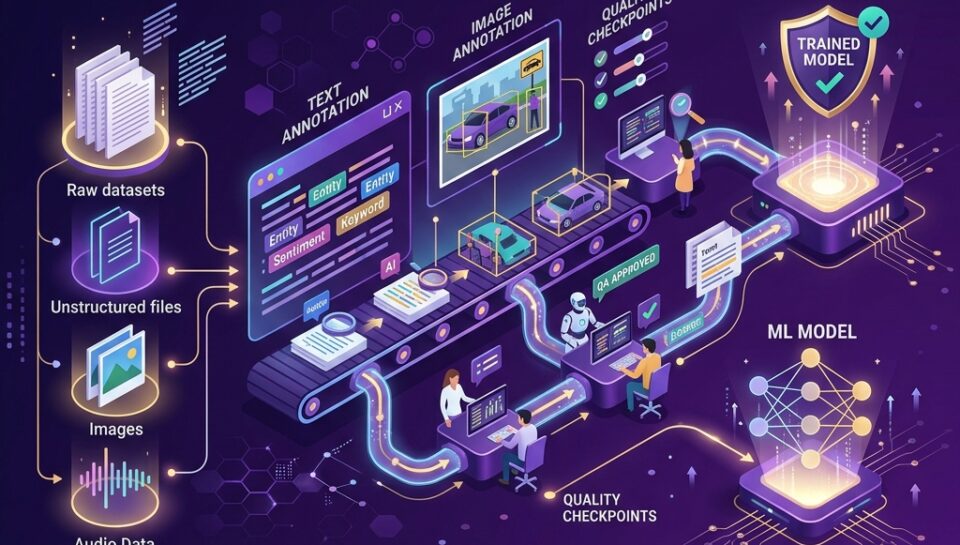
This is where labeling services and internal annotation teams do their work. The output of Stage 3 is the curated dataset with ground-truth labels attached. The quality of Stage 3 determines model performance more than any other single factor.
The annotation pipeline runs through four substages:
- Guideline development (with examples and counter-examples)
- Calibration (labelers practice on a known set)
- Production labeling (with multi-tier QA)
- Iteration (edge cases route back to guideline updates)
For the operational detail on annotation pipelines and partner selection, see our piece ondata labeling services for US AI teams.
Stage 4: Validation
Before training data is used, it goes through validation:
- Statistical checks for class balance, label distribution, length distribution, missing fields
- Spot audits by domain experts on samples drawn at random
- Inter-annotator agreement analysis to surface guideline ambiguity
- Bias and coverage analysis to detect systematic gaps
The validation step often surfaces issues that send the pipeline back to Stage 1 (more sourcing for an underrepresented class) or Stage 3 (re-annotation with updated guidelines). Skipping validation is the most expensive shortcut available.
For the model-side validation that follows training, see our piece onAI quality assurance and the GenAI-specific workflow atgenerative AI quality analysis.
Quality Dimensions That Matter
Six dimensions that distinguish a useful training set from a bad one:
Coverage. Does the dataset represent the full distribution the model will operate in? A dataset that's strong in the easy cases and thin in the edge cases produces a model that fails in production.
Accuracy. Are the labels correct? Inter-annotator agreement, expert spot audits, and known-truth calibration all contribute.
Consistency. Are similar items labeled the same way across the dataset? Inconsistent labels confuse the model and produce non-deterministic failure modes.
Balance. Are rare classes adequately represented? Severe imbalance pushes the model toward the majority class and degrades performance on the minority.
Provenance. Where did each item come from? What are the rights and consent terms? When does the data need to be re-collected or refreshed?
Documentation. Is the dataset documented well enough for the team to understand it 12 months from now, after the original creators have moved on? SeeDatasheets for Datasets andData Cards for established documentation patterns.
A team that tracks all six dimensions ships better models. A team that tracks accuracy alone ships models that look fine on benchmarks and break in production.
Security and Compliance Considerations
US ML teams handle training data that ranges from public web text to internal customer records to medical scans to vehicle sensor data. The security posture has to match the data sensitivity.
Baseline expectations for training data operations:
- ISO 27001 information security operations
- Documented data handling procedures with role-based access controls
- Encrypted storage and transmission
- Defined retention and destruction policies
- Workforce-level controls including NDAs, background checks where appropriate, and training on the specific data handling requirements
For specific data categories, additional frameworks apply:
- Healthcare: HIPAA Business Associate Agreements, with downstream constraints on what data can be used for training and how
- Federal-adjacent: FedRAMP and equivalent baselines
- Defense: CMMC, NIST 800-171, ITAR where applicable
- Consumer data: US state privacy laws (CCPA, CPRA, and the various state laws now active across more than 15 states), GDPR for any EU citizen data
- Sector-specific: FCRA for credit data, GLBA for financial data, FERPA for education data
TheNIST AI Risk Management Framework is the umbrella reference most US ML teams now use to organize training data governance across the model lifecycle.
Coverage and Bias as Training Data Problems
Two failure modes deserve specific attention because they show up most often in production:
Coverage gaps. The training set was missing or thin on a category that turns out to matter. Mitigation: deliberate stratification during curation, deliberate over-sampling of rare categories, and explicit coverage analysis as part of validation.
Bias. The training set systematically over- or under-represented certain populations or contexts, producing a model that performs unevenly across those groups. Mitigation: sourcing strategy that includes diverse data, annotation workforce that includes diverse perspectives, evaluation sets that explicitly test cross-group performance.
Both problems are addressable, but only if the team is looking for them. Models trained on accidental data without coverage and bias analysis will reproduce whatever biases exist in the source.
How US ML Teams Partner With External Services
Five categories of work where US ML teams typically engage external partners:
1. Annotation operations. Most common. Either pay-per-label, dedicated team retainer, or hybrid managed services. Covered in detail in ourdata labeling services buyer's guide.
2. Curation and pre-processing. Less common, but growing. Outsourced cleaning, deduplication, and stratification on raw data the buyer doesn't have time to process internally.
3. Synthetic data generation. Either fully synthetic (procedurally generated) or augmentation of real data. Useful for bootstrapping and for filling coverage gaps where real data collection is expensive or constrained.
4. Quality assurance services. Independent QA on internally-annotated data. The buyer's labelers do the work; the partner audits and reports.
5. Specialized expert labeling. Domain experts (clinicians, lawyers, engineers) for tasks where general labelers can't produce useful annotations. Premium pricing; specific use cases.
The right mix depends on team size, internal capacity, data sensitivity, and unit economics. A common pattern is in-house annotation for the most sensitive or task-specific work, plus a partner for volume work and surge capacity. For framework on partner evaluation, see our piece onvendor management best practices.
Foundation Model Era Considerations
For US ML teams working on foundation models, fine-tuning, or RAG pipelines, training data has additional dimensions:
Pre-training data scale. Foundation models train on billions to trillions of tokens or items. Sourcing and curation operate at a scale where automated pipelines dominate manual work, but quality issues at this scale compound into model issues.
Fine-tuning data quality. Smaller volumes (typically thousands to millions of examples), much higher per-example quality matters. This is where careful annotation and validation pay off most directly.
Preference data for RLHF. Human-judged comparisons between model outputs. Quality depends entirely on annotator selection, calibration, and consistency. The economics favor smaller-but-better over larger-but-noisier.
Evaluation data. The dataset the team uses to measure whether the model is improving. Treated with extra care because contamination of evaluation data into training data is a frequent silent failure.
The training data workflow scales differently across these stages, but the four-stage structure (sourcing, curation, annotation, validation) holds.
Common Questions From US ML Teams
How much training data do we need? Depends on task complexity, model size, and target performance. For traditional supervised tasks, a useful starting heuristic is "10x more than feels like enough" for the first model, then iterate based on validation performance. For foundation model fine-tuning, the answer often skews smaller-and-better than larger-and-noisier.
What does it cost to label 100,000 items? Highly variable by modality and complexity. Simple image classification can be cents per item; medical image segmentation by a clinician can be tens of dollars per item. Plan around the unit economics of the specific task, not industry averages.
Should we build labeling in-house or outsource? Both, usually. In-house for the most sensitive, task-specific, or evolving work. Outsource for volume work, surge capacity, and tasks that have stabilized into well-defined operations.
How do we handle PII in training data? Three-step framework: (1) determine whether you need PII for the task at all, (2) if not, redact or pseudonymize before annotation, (3) if yes, work only with partners whose security posture matches the data sensitivity, with documented controls and access logs.
What about copyrighted training data? A live legal area in 2026. The honest answer is that the law is evolving, multiple cases are pending, and the right posture for most US ML teams is to favor data with clear rights or licenses over data with ambiguous rights. Where the team relies on fair use arguments, document the basis explicitly.
How do we handle data versioning? Treat training data the same way as code: versioned, with changes documented, with a reproducible build process from sources to training set. The teams that do this catch issues earlier than the teams that don't.
How often should we refresh training data? Depends on the rate of distributional change in the production environment. Some models are trained once and run for years; others need quarterly or monthly refresh as customer behavior or content evolves.
What's the most common training data failure mode? Coverage gaps that go undetected. The model performs well on the validation set, ships to production, and fails on the cases that weren't represented in the training data. Mitigation: deliberate edge-case sourcing, evaluation sets that explicitly cover known coverage risks, and production monitoring that detects shifts in input distribution.
Working with Prudent Partners
Prudent Partners Private Limited supports US ML teams across the training data workflow with annotation operations, quality assurance services, and specialized labeling teams trained on specific modalities (image, text, audio, video, 3D sensor). Engagements run with documented quality frameworks, ISO 27001 information security operations, US-overlap shifts, and the security posture matched to the buyer's data sensitivity.
For an overview of the AI training data service set, see ourAI training datasets page. For the broader data annotation portfolio, see ourdata annotation services overview. For deeper context on annotation operations, see ourdata labeling services buyer's guide.
To explore an engagement, get in touch through the contact page. The first conversation is a 30-minute scoping call covering the modality, volume, security posture, and operating model fit, with no commitment to proceed.