Generative AI Services: A 2026 Guide for US Teams
Every company wants generative AI in its product, and most quickly discover that the model is the easy part. What actually determines whether a generative AI feature works is everything around the model: the data it learns from, the tuning that shapes its behavior, the evaluation that proves it is ready, and the quality assurance that keeps it safe in production. Generative AI services are the work that surrounds the model and makes it usable. This guide breaks down what those services cover, how they fit together across the lifecycle of a generative AI system, and how US teams decide what to build and what to bring in.
What "Generative AI Services" Actually Means
Generative AI services is a broad label, and it helps to be specific about what sits under it. In practice it covers the data-and-quality work that a team needs at each stage of building a generative AI system: preparing the data a model learns from, shaping the model's behavior through tuning and human feedback, evaluating whether it is good enough, and assuring its quality once it is live. It is deliberately distinct from model-building itself. The value is in the surrounding disciplines that most teams cannot staff fully in-house.
The Generative AI Lifecycle, and Where Services Fit
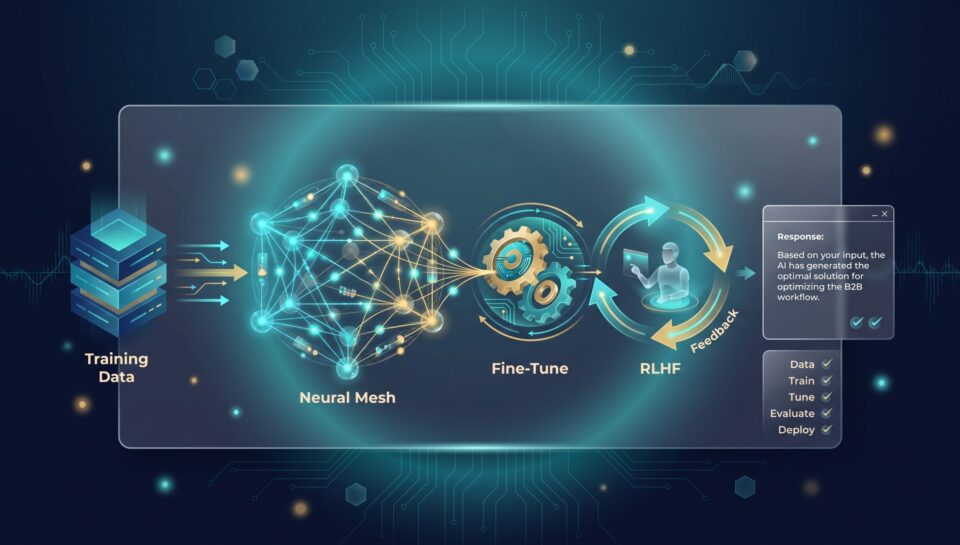
Training and fine-tuning data. Generative models are shaped by their data, and most real applications need more than a base model: they need fine-tuning data specific to the domain and the task. Preparing that data, curated, labeled, and representative, is foundational. OurLLM training data guide covers the foundation-model preparation side.
Data labeling across modalities. Generative AI is increasingly multimodal, and the labeling work spans text, image, video, and audio. Each modality has its own demands, and US teams building generative products routinely need all of them: labeled text for language tasks, labeled images and video for visual generation and understanding, labeled audio for speech.
Human feedback and alignment (RLHF). A base model produces plausible output; a useful one produces helpful, safe, on-brand output. Closing that gap takes human feedback, ranking and rating model outputs so the model learns what "good" looks like for the application. This is skilled annotation work, not simple labeling, and it sits at the heart of making a generative model behave.
Evaluation. Before a generative feature ships, it has to be evaluated, and generative output is hard to evaluate because there is rarely one correct answer. This is its own discipline, combining automatic metrics with structured human judgment.
Quality assurance and safety. Once live, a generative system needs ongoing QA: monitoring output for accuracy, safety, and drift as the model and its inputs change. This connects directly to ourgenerative AI quality analysis andAI quality assurance work.
Why Data Quality Decides Generative AI Outcomes
The through-line across all of it is that generative AI quality is downstream of data quality. A model fine-tuned on inconsistent data, aligned with sloppy human feedback, or shipped without real evaluation will disappoint no matter how strong the base model is. This is not a slogan; it is the practical reasondata quality is the real competitive edge in AI. The teams that get generative AI right are usually the ones that took the surrounding data work seriously.
Security and Compliance
Generative AI data work often touches sensitive material: proprietary documents for fine-tuning, customer data, and in regulated sectors, protected information. A services partner should carryISO 27001 information security operations, SOC 2 where downstream customers expect it, and documented handling for whatever regulated data the application involves.
Build, Buy, or Partner
Most teams building generative AI keep the model and product decisions in-house and bring in a partner for the surrounding data-and-quality work, because that work is labor-intensive, spiky, and specialized. Fine-tuning data preparation, RLHF, evaluation panels, and ongoing QA are all functions a partner can run at quality while the team focuses on the product. The alternative, staffing all of it internally, is justified mainly at large scale or when the work is so core it cannot be externalized.
How to Choose a Generative AI Services Partner
The questions worth asking: can you handle our modalities (text, image, video, audio), not just one; do you do skilled work like RLHF and evaluation, or only basic labeling; how do you measure quality; what is your security posture for sensitive fine-tuning data; and will you prove it on a paid pilot. Ourvendor evaluation guide covers the full procurement checklist.
Common Questions From US Teams
What are generative AI services?
The data-and-quality work that surrounds a generative AI model: preparing training and fine-tuning data, labeling across modalities, human feedback and alignment (RLHF), evaluation, and ongoing quality assurance. It is distinct from building the model itself.
What is the difference between generative AI services and building a model?
Building a model is the engineering of the model itself. Generative AI services are the surrounding disciplines, data, tuning feedback, evaluation, and QA, that make a model actually usable and safe. Most teams build or license the model and bring in services for the rest.
What is RLHF and why does it matter?
Reinforcement learning from human feedback: people rank and rate model outputs so the model learns what "good" looks like for the application. It is what turns a plausible base model into a helpful, safe, on-brand one, and it is skilled annotation work.
Do generative AI services cover more than text?
Yes. Generative AI is increasingly multimodal, so the work spans text, image, video, and audio. Teams building generative products routinely need labeling and evaluation across all of them.
Why does data quality matter so much for generative AI?
Because generative AI quality is downstream of data quality. A model fine-tuned on inconsistent data or aligned with sloppy feedback will disappoint regardless of the base model's strength. The surrounding data work is what separates good generative products from bad ones.
How is generative AI output kept safe in production?
Through ongoing quality assurance: monitoring output for accuracy, safety, and drift as the model and inputs change, using human review against clear policies. This is a continuous function, not a one-time check.
Should we build generative AI data work in-house or partner?
Most teams keep model and product decisions in-house and partner for the surrounding data-and-quality work, which is labor-intensive, spiky, and specialized. Full in-house staffing is justified mainly at large scale.
How do we choose a generative AI services partner?
Confirm they handle your modalities, do skilled work like RLHF and evaluation rather than only basic labeling, measure quality transparently, carry appropriate security for sensitive data, and will prove it on a paid pilot.
Working With Prudent Partners
Prudent Partners Private Limited provides generative AI services for US teams across fine-tuning data preparation, multimodal labeling, human feedback and alignment, evaluation, and quality assurance, withISO 27001 information security operations. The work connects ourAI data annotation services andgenerative AI quality analysis into one lifecycle.
The first conversation is a 30-minute scoping call about your generative AI application, the data and quality work it needs, and your security requirements. No commitment to go further.