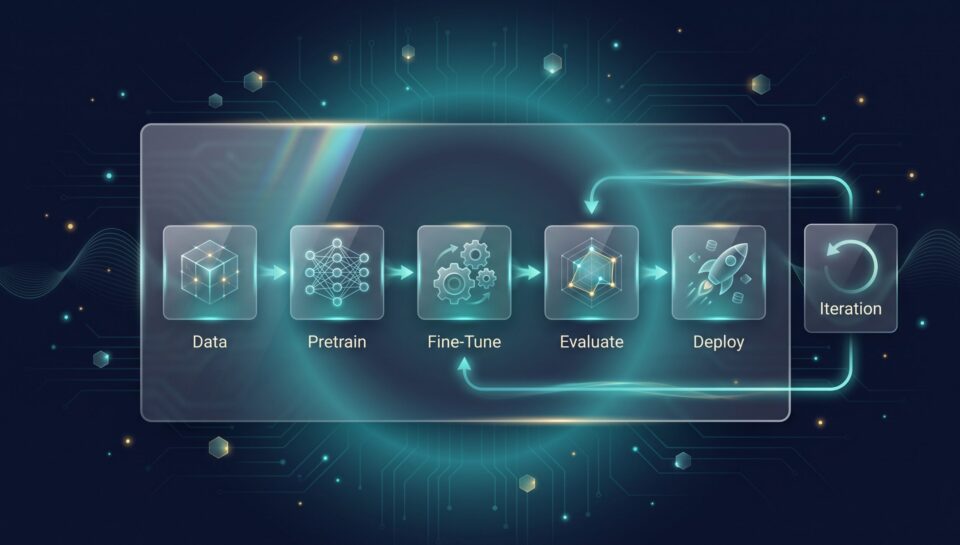
There is a wide gap between a generative AI demo and a generative AI product. The demo takes an afternoon. The product takes months, and most of that time is spent on things that have nothing to do with model architecture: getting the data right, deciding whether to tune or retrieve, proving the output is good enough to ship, and keeping it good once real users arrive. This guide walks the actual stages of generative AI development, what each one requires, and where teams most often stall.
For an overview of what generative AI services cover as a category, ourgenerative AI quality analysis work covers the quality dimension. This piece is about the build journey.
Stage 1: Define What Good Looks Like
The stage most teams skip, and the reason many projects drift. Before any building, the team needs a concrete definition of success: what the system should do, what output counts as good, what counts as unacceptable, and how that will be judged. For generative systems this is harder than for traditional software because output is open-ended, so "good" has to be described as criteria and examples rather than expected values. Teams that skip this end up rebuilding repeatedly against a moving target.
Stage 2: Get the Data Right
Generative AI products are shaped far more by data than by model choice. This stage covers what data the system will draw on and what state it needs to be in.
For systems that retrieve from company knowledge, this means preparing that knowledge base: cleaning documents, chunking them sensibly, and structuring metadata so retrieval is precise. Ourretrieval-augmented generation overview covers the architecture this feeds.
For systems that are tuned on domain data, it means preparing training and fine-tuning datasets: curated, consistently labeled, and representative of the task. OurLLM training data guide covers foundation model preparation.
Most projects that stall late stalled here early. Data problems surface as model problems, and teams often spend weeks tuning around an issue that was in the dataset all along.
Stage 3: Choose the Approach
A genuine decision point with cost consequences: prompt engineering alone, retrieval augmentation, fine-tuning, or a combination. Prompting is fastest and cheapest to iterate. Retrieval suits systems that need current or proprietary knowledge and keeps that knowledge updatable without retraining. Fine-tuning suits systems that need consistent behavior, tone, or domain-specific reasoning that prompting cannot reliably produce. The common mistake is fine-tuning first, when a retrieval approach would have been cheaper, faster, and easier to maintain.
Stage 4: Shape Behavior With Human Feedback
A base model produces plausible output. A useful product produces helpful, safe, on-brand output, and closing that gap takes human feedback: people rating and ranking outputs so the system learns what good looks like in your specific context. This is skilled work, not simple labeling, and it is where much of the perceived quality of a generative product comes from.
Stage 5: Evaluate Before Shipping
Generative output resists simple testing because there is rarely one correct answer, so evaluation combines automatic metrics for regression tracking with structured human review against the criteria defined in stage one. This should measure correctness, relevance, faithfulness to source, safety, tone, and consistency as separate signals rather than a single blended score that hides which dimension is failing. Shipping without real evaluation is the most common cause of a product that demos well and disappoints in production.
Stage 6: Deploy, Then Keep Watching
Deployment is not the finish line for generative AI in the way it is for conventional software. Model providers update their models, user behavior shifts, and source knowledge goes stale, so a system that performed well at launch can quietly degrade. Production needs ongoing quality monitoring, sampling real output and reviewing it against the same criteria, plus a route for problems found in production to flow back into the data and evaluation sets. This continuous loop is the practical difference between a generative product that improves over time and one that erodes. OurAI quality assurance function covers this monitoring discipline.
Where Teams Get Stuck
Three patterns recur. Teams underestimate the data stage and spend months tuning around dataset problems. They fine-tune prematurely when retrieval would have served better, locking in cost and inflexibility. And they treat evaluation as a launch gate rather than a permanent function, then discover quality problems through customer complaints instead of monitoring.
What to Build and What to Bring In
Most teams keep the product decisions, the architecture, and the model integration in-house, since these are close to the product and hard to externalize. The work that more often moves to a partner is the surrounding data and quality layer: preparing knowledge bases and fine-tuning datasets, running human feedback programmes, standing up evaluation panels with rubrics and measured agreement, and monitoring production output. That work is labor-intensive, spiky, and benefits from a disciplined operation, which is exactly what makes it suitable to partner on while the core team focuses on the product itself.
Common Questions From US Teams
What are generative AI development services?
Services covering the journey from data to a deployed generative AI product: defining success criteria, preparing data, choosing between prompting, retrieval, and fine-tuning, shaping behavior with human feedback, evaluating before launch, and monitoring in production.
Why does a generative AI demo not become a product easily?
Because the demo skips the parts that take the time: getting the data right, proving output quality is good enough to ship, and keeping it good once real users and model updates arrive.
Should we fine-tune or use retrieval?
Retrieval suits systems needing current or proprietary knowledge and keeps that knowledge updatable without retraining. Fine-tuning suits systems needing consistent behavior, tone, or domain reasoning. Fine-tuning first, when retrieval would serve, is a common and costly mistake.
What is the most common reason generative AI projects stall?
Data problems discovered late. They surface as model problems, so teams spend weeks tuning around an issue that was in the dataset from the start.
How do you evaluate a generative AI system before launch?
By combining automatic metrics for regression tracking with structured human review against defined criteria, measuring correctness, relevance, faithfulness, safety, tone, and consistency as separate signals rather than one blended score.
Does a generative AI product need monitoring after launch?
Yes. Model providers update models, user behavior shifts, and source knowledge goes stale, so quality degrades quietly without ongoing sampling and review of real production output.
What is human feedback used for in generative AI?
People rate and rank outputs so the system learns what a good answer looks like in your context. It is what shapes helpfulness, tone, and refusal behavior, and much of a product's perceived quality comes from it.
What should we build in-house versus bring in?
Most teams keep product decisions, architecture, and model integration in-house, and partner for the data and quality layer: dataset and knowledge base preparation, human feedback programmes, evaluation panels, and production monitoring.
Working With Prudent Partners
Prudent Partners Private Limited supports US teams across the generative AI build journey with the data and quality layer: knowledge base and fine-tuning data preparation, human feedback programmes, evaluation against defined criteria with measured reviewer agreement, and ongoing production quality monitoring. The work connects ourgenerative AI quality analysis andAI quality assurance functions.
The first conversation is a 30-minute scoping call about what you are building, which stage you are at, and where it is currently stuck. No commitment to go further.