When an AI team sends data to a partner, the data usually leaves the environment it was governed in. Customer records, medical images, legal documents, internal knowledge, and recorded conversations all travel to people outside the organisation, and the obligations attached to that data travel with it. This is why security has become one of the most common questions US buyers ask when comparing AI data providers, and why the answers vary so much more than the marketing suggests. This guide covers what to actually compare.
Certifications: Necessary, and Frequently Misread
Certifications are the starting point and the most commonly misunderstood signal.
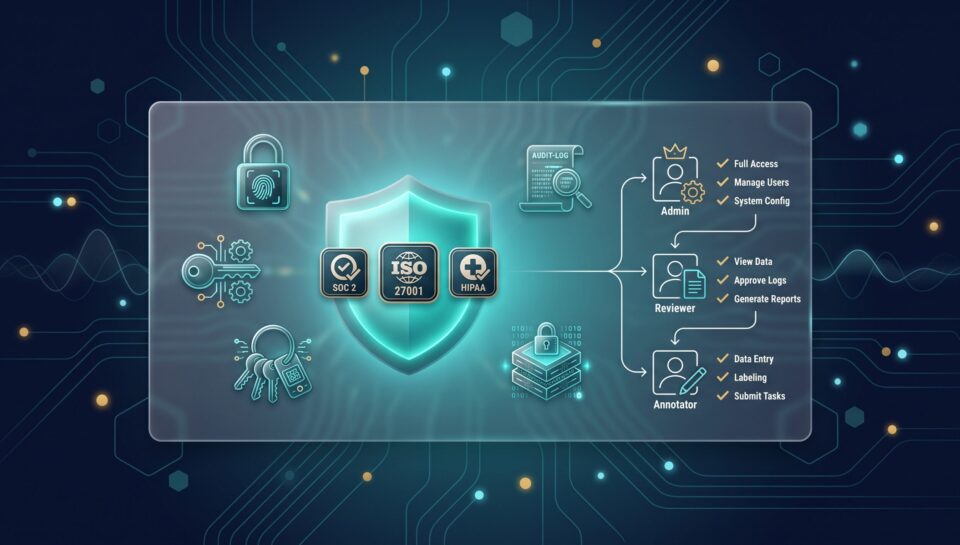
ISO 27001 certifies an information security management system: that the organisation has a documented, audited approach to managing security risk. It is a strong baseline and says nothing specific about your data type.
SOC 2 reports on controls relevant to security, availability, confidentiality, processing integrity, and privacy. It is common in US procurement and often requested by downstream enterprise customers.
GDPR is a regulation, not a certification. A provider cannot be "GDPR certified," though they can be GDPR-compliant in how they handle EU personal data, with the appropriate agreements in place.
HIPAA similarly is not a certification. What matters is whether the provider will sign a Business Associate Agreement and operate under it.
The critical detail buyers routinely miss is scope. A certification covers a defined set of systems, locations, and processes. A provider certified for one delivery centre and one workflow can accurately say they are certified while your work runs somewhere outside that scope. Ask for the scope statement, not the badge.
Access Control Is Where Theory Meets Practice
Certifications describe a system. Access control describes what actually happens to your files.
Ask who can see your data, and how that is enforced rather than promised. Ask whether annotators access data through a controlled environment or download it locally. Ask whether access is role-based and logged at the individual level, so any access to a specific item is traceable. Ask how access is revoked when someone leaves a project.
For sensitive work, the practical questions matter more than the certificate: can annotators screenshot, copy, or export? Is work done on their infrastructure or in your environment? Is there device control?
Data Handling Through the Lifecycle
Security posture should be describable at every stage. How is data transmitted, and is it encrypted in transit and at rest? Where is it stored, and in which jurisdiction, since location has legal consequences under several frameworks. How long is it retained, and what triggers deletion? What happens at the end of the engagement, and will they certify deletion? Are backups included in that deletion, which is a common gap.
Workforce Controls
The people are usually the least examined part of the security posture and often the most relevant. Ask about background checks, individual confidentiality agreements, security training, and whether work is done from controlled facilities or from home. None of these is automatically wrong, but home-based work on regulated data requires compensating controls that should be explicit rather than assumed.
Framework by Data Type
Different data carries different obligations, and the right question is framework-specific.
Health data: a Business Associate Agreement is a hard gate, plus PHI-appropriate access control. Ourmedical data annotation work covers this domain.
EU personal data: lawful basis, data processing agreements, transfer mechanisms, and defined retention.
Legal documents: confidentiality and privilege considerations, plus increasingly SOC 2 and ISO expectations from law firm clients.
Financial data: sector-specific obligations and often the client's own regulator-driven requirements passed down.
Proprietary business data: less regulated but commercially critical, where the real risks are retention, reuse, and whether your data could train models used for other clients.
The Question Almost Nobody Asks
Will our data be used to train your models, or any model, other than ours? This matters more each year, and the answer should be unambiguous and contractual rather than reassuring and verbal. Related: what happens to the labels and the derived artifacts, not just the source data.
Security in Retrieval and Generative Systems
Newer AI architectures introduce newer exposure. A retrieval system can surface sensitive content in an answer to a user who should not see it, which makes access scoping in the knowledge base a security control rather than a data-modelling choice. Ourretrieval-augmented generation overview covers the architecture where this applies. Generative systems can also leak training content in output, which is a reason to be deliberate about what enters fine-tuning data in the first place.
How to Compare Providers Efficiently
Request the certification scope statement, not the certificate. Ask for a description of access control in operational terms. Ask the training-use question explicitly. Ask what happens to data and derived artifacts at the end of the engagement. And ask them to walk through how they would handle your specific data type, since a provider who has genuinely done it will describe it concretely and one who has not will speak in generalities. Ourvendor evaluation guide covers the wider procurement checklist.
Common Questions From US Teams
What security should I compare across AI data providers?
Certification scope rather than the badge, operational access control, encryption and jurisdiction, retention and deletion including backups, workforce controls, and an explicit answer on whether your data trains their models.
Is ISO 27001 or SOC 2 enough on its own?
No. Both are strong baselines describing a security system, but neither guarantees your specific data type is covered. Check the scope statement and the framework applying to your data.
Can a vendor be GDPR or HIPAA certified?
Neither is a certification. GDPR compliance is demonstrated through practices and agreements; HIPAA is addressed through a Business Associate Agreement and appropriate safeguards.
Why does certification scope matter so much?
Because a certification covers defined systems, locations, and processes. A provider can be accurately certified while your work runs outside that scope, which is a common and easily missed gap.
Should I ask whether my data trains their models?
Yes, explicitly and contractually. Ask about derived artifacts like labels too, not only the source data. The answer should be unambiguous rather than reassuring.
What security questions apply to RAG systems specifically?
Access scoping in the knowledge base, because a retrieval system can surface sensitive content to users who should not see it. In retrieval architectures, access design is a security control.
Is home-based annotation work acceptable for sensitive data?
It can be, with explicit compensating controls around device management, environment, and access. What matters is that the controls are stated rather than assumed.
How do I verify a provider's claims rather than trust them?
Request scope statements and control descriptions in writing, ask them to walk through handling your specific data type, and include security requirements in a paid pilot so the posture is tested in practice.
Working With Prudent Partners
Prudent Partners Private Limited operates certified information security processes for US AI teams, with role-based access control, individual-level logging, defined retention and deletion, and workforce controls including confidentiality agreements and security training. We answer the training-use question contractually and can describe our handling for your specific data type rather than in generalities. For regulated healthcare data, see ourmedical data annotation work.
The first conversation is a 30-minute scoping call about your data type, the framework governing it, and the controls you require. No commitment to go further.