
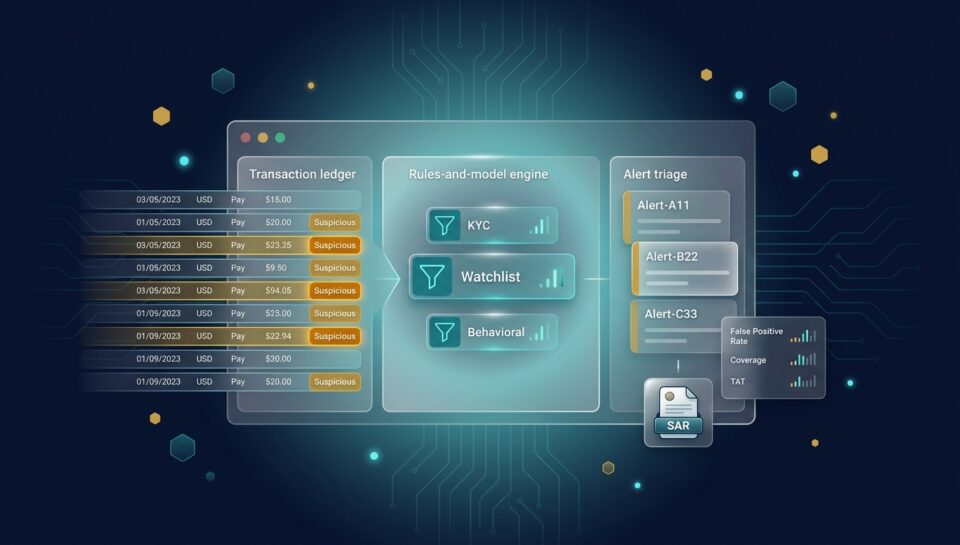
Financial crime compliance has a structural problem that automation has changed but not solved. Transaction monitoring systems generate enormous alert volumes, the large majority of which are false positives, and every alert has to be reviewed by someone because the consequences of missing a real one are regulatory and severe. Adding AI to this has helped considerably in some places and created new risks in others. This guide covers where automation genuinely improves financial crime operations, where human judgment remains mandatory, and how teams structure the work.
The Alert Volume Problem
Transaction monitoring rules are deliberately tuned toward sensitivity, because a missed suspicious transaction carries far more downside than an unnecessary review. The predictable consequence is that most alerts are not suspicious. Teams then face a volume of review work that scales with transaction growth rather than with actual risk.
The naive response is to tighten the rules, which reduces volume and increases the risk of missing something. The better response is to improve how alerts are triaged and reviewed, so attention concentrates where risk actually is.
Where Automation Genuinely Helps
Alert prioritisation. Ranking alerts by likelihood of genuine suspicion so reviewers work the highest-risk items first. This does not remove any alert from the queue, which matters for defensibility, and it materially changes how quickly real cases surface.
Information gathering. Assembling the context a reviewer needs, customer history, related parties, prior alerts, adverse media, so the reviewer spends time deciding rather than searching. This is often the largest efficiency gain available and carries little risk.
Pattern detection beyond rules. Identifying behavior that rule-based systems miss because it does not match a predefined pattern. Useful as an additional signal rather than a replacement for rules.
Documentation drafting. Producing first drafts of case narratives from the reviewer's findings, which are then reviewed and corrected. Documentation quality matters enormously in this domain and drafting is time-consuming.
Consistency checking. Flagging cases where similar facts produced different outcomes, which surfaces training gaps and reviewer drift.
Where Human Judgment Remains Mandatory
The suspicion decision. Determining whether activity is suspicious requires weighing context, plausibility, and customer knowledge in a way that automated scoring approximates rather than replicates. It is also the decision that carries regulatory consequence.
Explainability. Regulators expect institutions to explain decisions. A model output that cannot be explained in the terms a regulator expects is not a usable basis for a filing decision, regardless of accuracy.
Novel typologies. Financial crime methods evolve deliberately to avoid detection, so systems trained on historical patterns are structurally behind. Human reviewers noticing something unfamiliar remain the primary route by which new typologies get identified.
Edge cases and context. Activity that appears anomalous but has a legitimate explanation, and activity that appears normal in a context that makes it suspicious. Both require judgment.
The Risk Nobody Plans For
The most serious risk in automating financial crime review is not that the automation is wrong. It is that it is wrong in a consistent, invisible direction.
A model that systematically deprioritises a category of genuine suspicion will produce a queue that looks well-managed while the risk accumulates. Because the alerts are still technically in the queue, the gap is not obvious until an examination or an incident. This is why any risk scoring layer needs its own assurance: sampled human review of low-scored alerts specifically to test whether the scoring misses things, rather than only reviewing what it flags. The principle is the same one covered in our discussion ofbias in machine learning: a model reproduces the patterns in its training data, including the cases historical reviewers got wrong.
KYC and Onboarding Operations
Adjacent to monitoring, customer due diligence carries its own volume challenge: document collection and verification, entity resolution across inconsistent records, beneficial ownership mapping, and periodic refresh of existing customers. Much of this is document-intensive work where extraction and structuring can be substantially automated while verification decisions remain human. Ouroptical character recognition capability covers the extraction layer, and structured data work sits alongside it.
Periodic refresh in particular tends to be under-resourced relative to onboarding, because it lacks the forcing function of a new customer waiting. It is also where stale risk assessments accumulate.
Structuring the Operation
The pattern that works in practice is layered. Automation handles gathering, prioritising, and drafting. Trained reviewers make the substantive decisions, working the highest-risk items first. Complex cases escalate to experienced investigators. A sample of low-priority and closed items receives independent review specifically to test whether the prioritisation is missing things. And quality is measured through agreement between reviewers on the same cases, which surfaces inconsistency before an examiner does.
Consistency measurement deserves emphasis because financial crime review is judgment work performed at volume by many people, which is precisely the situation where standards drift silently. The method is the same as any structured review programme, covered in ourquality assurance process overview.
Building Versus Partnering
Institutions retain the regulatory obligation regardless of who performs the work, which shapes the decision. What is commonly partnered is the operational capacity: alert triage, information gathering, documentation drafting, KYC refresh, and quality review, with the institution retaining decision authority and oversight. What partners can add beyond capacity is measured consistency and independent quality review, which internal teams find difficult to run on themselves.
Common Questions From Financial Services Teams
Why are most AML alerts false positives?
Because monitoring rules are deliberately tuned toward sensitivity, since missing genuine suspicious activity carries far greater consequence than an unnecessary review. High false positive volume is a design consequence, not a defect.
Can AI decide whether activity is suspicious?
No. The suspicion decision requires weighing context and plausibility, must be explainable to regulators, and carries regulatory consequence. Automation can prioritise and gather; the decision stays human.
Where does automation help most in AML operations?
Alert prioritisation, assembling context so reviewers decide rather than search, detecting patterns rules miss, drafting case documentation, and flagging inconsistent outcomes on similar facts.
What is the biggest risk in automating alert triage?
Consistent invisible error. If scoring systematically deprioritises a category of genuine suspicion, the queue looks well-managed while risk accumulates, and it is not obvious until an examination.
How do you test whether prioritisation is missing cases?
By sampling low-scored and closed alerts for independent human review, specifically to find what the scoring missed, rather than only reviewing what it flagged.
Why does explainability matter more here than elsewhere?
Because regulators expect institutions to explain decisions. A model output that cannot be explained in expected terms is not a usable basis for a filing decision regardless of its accuracy.
What KYC work can be automated?
Document extraction, structuring, and entity matching can be substantially automated. Verification and risk decisions remain human. Periodic refresh is commonly under-resourced and is where stale assessments accumulate.
Can financial crime operations be outsourced?
The operational capacity commonly is, including triage, information gathering, documentation, and quality review. The regulatory obligation and decision authority stay with the institution.
Working With Prudent Partners
Prudent Partners Private Limited supports US financial services teams with financial crime operations capacity: alert triage and information gathering, case documentation, KYC document processing and periodic refresh, and independent quality review with measured reviewer consistency. Decision authority and oversight remain with the institution. See ourquality assurance process overview.
The first conversation is a 30-minute scoping call about your alert volumes, your current process, and where the operational pressure sits. No commitment to go further.