
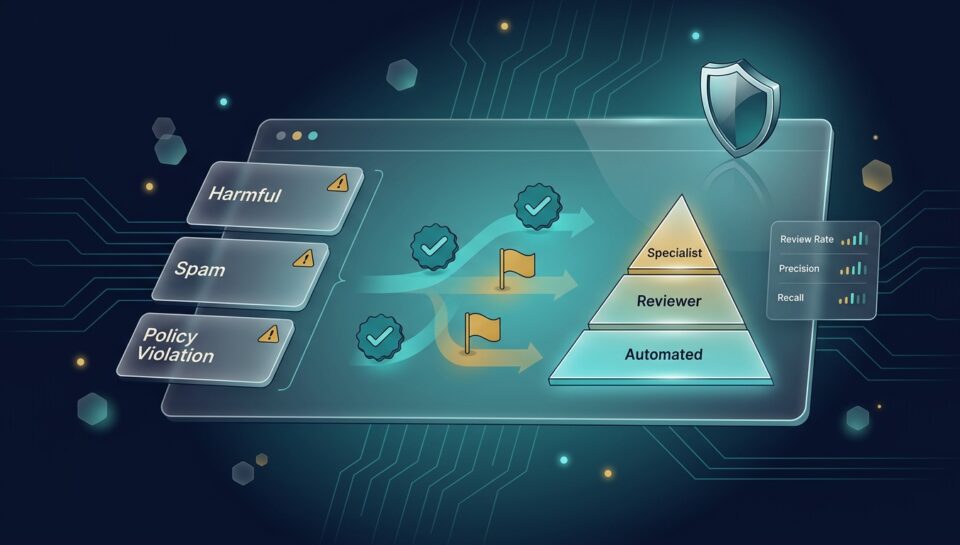
Every platform that hosts user content or deploys generative AI eventually builds a trust and safety function, usually later than it should have. The trigger is typically an incident: something harmful published, a regulator's letter, or press coverage. What gets built in a hurry after an incident tends to be a moderation queue, which addresses the symptom. The function that actually works is broader: policy that can be applied consistently, enforcement that is proportionate, escalation that catches the hard cases, and measurement that proves any of it is working. This guide covers what that function involves.
Policy Comes Before Moderation
The most common failure in trust and safety is enforcing rules that were never properly written. Reviewers are given a short list of prohibited categories and asked to apply judgment, and because the categories are vague, different reviewers reach different conclusions on similar content. The platform then appears arbitrary to its users, which is corrosive in a way that individual bad decisions are not.
Workable policy is specific enough that two trained reviewers reach the same conclusion on the same content. That requires defining the categories precisely, stating what is in and out at the boundary, and providing worked examples of hard cases rather than obvious ones. Policy written only with obvious cases in mind fails at exactly the boundary where decisions are actually made.
Policy also has to be maintained. New behaviors appear, terminology shifts, and enforcement patterns drift. Policy that is not revisited becomes progressively less aligned with what reviewers actually do.
Enforcement Should Be Tiered
Binary enforcement, allow or remove, is blunt and drives poor outcomes at both ends. A proportionate function has intermediate options: reducing distribution, adding context or warnings, restricting features, limiting reach for a period, and removal as one option among several. Repeat behavior should escalate differently from a first occurrence, and severity should govern the response rather than category alone.
The design question is who decides. High-volume, clear-cut decisions can follow rules. Ambiguous or high-impact decisions need human judgment with a route to someone senior. A function where every decision is treated identically will be either too slow for volume or too crude for the hard cases.
Escalation Paths
The cases that damage platforms are rarely the ones the policy anticipated. They are novel, contextual, or coordinated, and they require someone with authority to decide quickly.
A working escalation path defines what triggers escalation, who receives it, what the response time is, and how the resulting decision feeds back into policy. That last step is what turns an incident into an improvement rather than a recurring surprise. Functions without it re-litigate the same edge case every few months.
Generative AI Changes the Shape
Platforms deploying generative AI face a second trust and safety problem alongside user content: the platform itself is now producing content, at volume and at speed.
That shifts some of the work upstream. What the system should refuse is a policy question before it is an engineering one, and refusal behavior needs to be specified with the same care as content rules. Output review has to run continuously rather than only on user reports, since nobody reports content that only one user saw. And adversarial pressure is constant, because users will probe what the system will produce. Ourcontent moderation for generative AI output safety work covers this layer, and ourAI quality assurance function covers the ongoing monitoring.
Measuring Whether It Works
Volume metrics dominate trust and safety reporting and reveal very little. Items reviewed and actions taken measure activity, not effectiveness.
More useful measures include consistency, meaning agreement between independent reviewers on the same content, which is the direct test of whether policy is applicable; accuracy against a reviewed sample, in both directions, since over-enforcement is a real failure and under-enforcement is not the only one; appeal outcomes, where a high overturn rate indicates a policy or training problem; and time to action on severe categories, where delay carries the most cost.
Consistency measurement uses the same method as any structured review programme, covered in ourannotation quality guide. It is the single most diagnostic metric in trust and safety and the least commonly tracked.
Reviewer Wellbeing Is an Operational Requirement
Trust and safety work exposes people to distressing material, and this has to be handled deliberately rather than left to individual resilience. Practical measures include limiting exposure duration and volume, rotating people off the hardest queues, providing genuine access to support, and designing tooling that reduces unnecessary exposure such as defaulting to blurred or muted content with the option to reveal.
This is an ethical obligation and also an operational one. Reviewer burnout degrades decision quality before it shows up as attrition, so a function that neglects wellbeing produces worse enforcement as well as worse outcomes for its people. Any partner running this work should be able to describe their approach without prompting.
Building Versus Partnering
Platforms usually keep policy ownership in-house, since it reflects the platform's values and carries the accountability. The operational layer, staffing review at volume across time zones, maintaining consistency, and absorbing spikes, is commonly partnered because it is difficult to run at scale internally. The workable split is that the platform owns what the rules are and the partner owns applying them consistently, with measurement flowing back so policy improves. Ourcontent moderation services cover this operational layer.
Common Questions From Platform Teams
What does a trust and safety function actually do?
Defines enforceable policy, applies it consistently at volume, escalates hard cases to people with authority, measures whether enforcement is consistent and accurate, and feeds findings back into policy.
Why do moderation decisions seem inconsistent?
Usually because the policy is too vague to apply consistently. If two trained reviewers reach different conclusions on similar content, the problem is the rule rather than the reviewers.
Should enforcement be more than allow or remove?
Yes. Proportionate functions use intermediate options such as reduced distribution, added context, feature restrictions, and time-limited limits, with severity and repeat behavior governing the response.
How does generative AI change trust and safety?
The platform becomes a content producer, so refusal behavior must be specified as policy, output review must run continuously rather than on user reports, and adversarial probing is constant.
What metrics actually indicate a healthy function?
Consistency between independent reviewers, accuracy against a reviewed sample in both directions, appeal overturn rates, and time to action on severe categories. Volume metrics measure activity, not effectiveness.
Why is inter-reviewer agreement so important here?
Because it directly tests whether policy is applicable in practice. It is the most diagnostic trust and safety metric and among the least commonly tracked.
How should reviewer wellbeing be handled?
Through limited exposure duration, rotation off the hardest queues, genuine support access, and tooling that reduces unnecessary exposure. Burnout degrades decision quality before it shows up as attrition.
What should be kept in-house versus partnered?
Platforms typically own policy, since it reflects their values and accountability. The operational layer of consistent application at scale is commonly partnered, with measurement flowing back so policy improves.
Working With Prudent Partners
Prudent Partners Private Limited provides trust and safety operations for US platforms: policy application at volume with measured reviewer consistency, tiered enforcement, defined escalation, and reporting that distinguishes policy problems from application problems. Reviewer wellbeing is managed through exposure limits, rotation, and support. See ourcontent moderation services andgenerative AI output safety work.
The first conversation is a 30-minute scoping call about your platform, your policy maturity, and where enforcement currently breaks down. No commitment to go further.