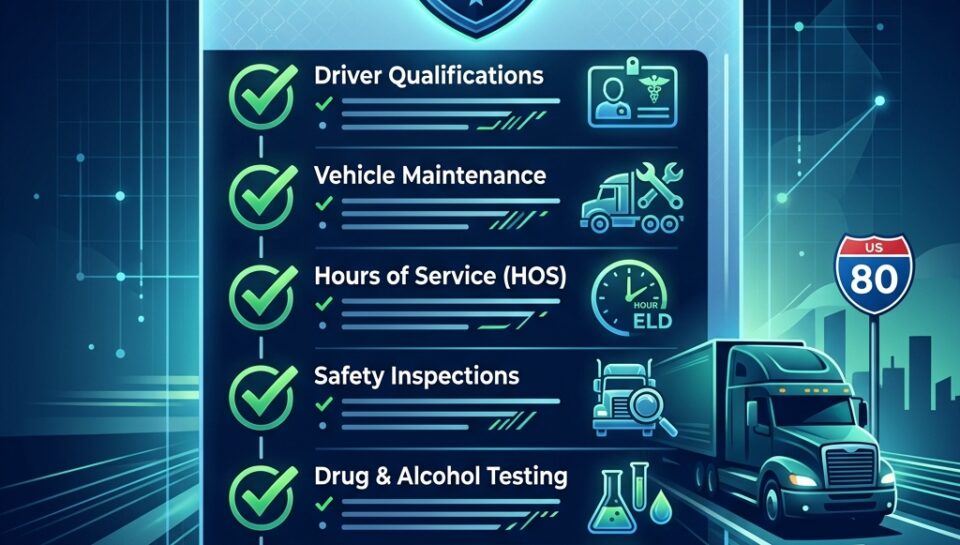
For a US trucking carrier, "DOT compliance" is shorthand for staying in good standing with theDepartment of Transportation and its enforcement arm for motor carriers, theFederal Motor Carrier Safety Administration. It covers everything from initial operating authority to driver qualifications, vehicle maintenance, hours of service, drug and alcohol testing, recordkeeping, and audit response.
The carriers that make it look easy are not running a leaner program than the carriers that struggle. They are running the same program with stronger documentation discipline and a clearly assigned compliance owner. This guide lays out a practical 2026 checklist organized by domain, plus the operational workflow that holds the program together.
How DOT and FMCSA Fit Together
DOT is the cabinet-level federal department; FMCSA is the agency within DOT that regulates commercial motor vehicles. When carriers refer to "DOT compliance" in everyday usage, they typically mean compliance with the Federal Motor Carrier Safety Regulations administered by FMCSA, found in49 CFR Subchapter B. For a deeper look at the FMCSA-specific framework, see ourFMCSA compliance handbook. This piece covers DOT compliance as the broader category as it shows up in operations.
The Six-Domain Checklist
A DOT-compliant carrier in 2026 is in good standing across six domains simultaneously.
Domain 1: Operating Authority and Registration
This is the foundation. Without active authority, nothing else matters because the carrier cannot legally operate.
- Active USDOT number, displayed on every commercial motor vehicle
- FMCSA Operating Authority (MC number) for for-hire interstate carriers
- Biennial USDOT update filed (Form MCS-150 or equivalent)
- Unified Carrier Registration filed annually
- BOC-3 process agent designation on file
- State operating authority where required
- Hazmat registration where applicable
- Form 2290 Heavy Vehicle Use Tax current with the IRS
Domain 2: Insurance and Financial Responsibility
- Federal minimum liability coverage in force (typically $750K for non-hazmat, higher for hazmat and passenger)
- BMC-91 or BMC-91X cargo insurance filing on file with FMCSA
- State-level coverage where the operation requires it
- Workers' compensation coverage per state requirements
- Active monitoring for any policy lapse or non-renewal that would suspend authority
Domain 3: Driver Compliance
This is where most audit findings originate.
- Driver Qualification File complete for every CDL driver, retained for employment plus 3 years
- Motor vehicle records pulled for every state where each driver was licensed in the prior 3 years
- Annual MVR review documented for every driver
- Medical examiner's certificate current and on file
- Road test certificate or equivalent on file
- Pre-employment drug test verified negative before driver was put in service
- FMCSA Drug and Alcohol Clearinghouse pre-employment query on file with driver consent
- Annual Clearinghouse limited query completed for every driver
- Reasonable suspicion training completed for every supervisor (60+60 minute requirement)
- Hours of Service records (typically ELD) retained for 6 months
- Driver violation reporting current
For the operational detail on hours of service and the audit-side workflow, see our pieces onUSDOT Hours of Service rules anddriver log verification.
Domain 4: Drug and Alcohol Program
- Written DOT drug and alcohol testing policy distributed to every safety-sensitive employee with signed acknowledgment
- Designated Employer Representative named and trained
- Qualified Medical Review Officer engaged
- Random testing pool managed at FMCSA-required minimums (currently 50% drug, 10% alcohol)
- Pre-employment, post-accident, reasonable suspicion, return-to-duty, and follow-up testing categories all running
- FMCSA Clearinghouse reporting current
- Records retained per the federal retention periods
For the operational deep-dive, see our piece onDOT drug and alcohol testing for carriers.
Domain 5: Vehicle Compliance
- Daily DVIRs (Driver Vehicle Inspection Reports) completed and retained
- Annual inspection completed and documented for every commercial motor vehicle
- Systematic preventive maintenance program documented and followed
- Maintenance records retained for the duration of operation plus 6 months
- ELD installed and operational on every covered vehicle
- ELD malfunction protocol documented and trained
- Vehicle markings (USDOT number, MC number where applicable) current and visible
Domain 6: Tax and Registration Adjacencies
These are not strictly FMCSA but sit alongside DOT compliance and produce audit exposure if mishandled.
- IFTA quarterly fuel tax returns filed on time
- IRP apportioned registration current for every covered vehicle
- Mileage records retained per IFTA and IRP requirements
- State and federal tax filings (Form 2290, state fuel taxes where applicable) current
- Trip permits where the carrier operates outside its registered jurisdictions
CSA Score Management
The Compliance, Safety, Accountability program scores every carrier on seven BASIC categories using the Safety Measurement System. CSA scores have direct commercial impact: insurers, brokers, and shippers all useSMS data as a vendor risk filter independent of regulatory enforcement.
Practical CSA management:
- Monthly review of CSA scores across all seven BASICs
- DataQs challenges filed for any inspection record errors within 60 days
- Trends analysis: which BASICs are deteriorating, which are improving
- Targeted interventions on the BASICs heading the wrong direction
- Inspection performance tracked at the driver and vehicle level
A carrier that misses CSA score deterioration for two consecutive months can find FMCSA paying attention. A carrier that catches it early and remediates rarely sees enforcement action.
Audit Readiness
A DOT compliant carrier should be able to respond to an audit notice within 24 hours with the requested records. Practically, that means:
- Records organized by domain and stored in a system that survives staff turnover
- Retention periods understood and followed for each record category
- An internal audit cycle running quarterly to catch gaps before federal investigators do
- A designated audit response owner who knows where every record lives
- A process for filing corrective action plans within audit-defined timelines
Most audit failures are not the result of bad operating practice. They are the result of records that exist somewhere but cannot be produced quickly enough or completely enough during the investigation window.
The Operational Workflow
A checklist alone does not make a carrier compliant. The workflow that holds the program together has five elements.
Compliance owner. A named individual, internal or contracted, accountable end-to-end for the DOT program. Without a named owner, items fall through.
Documented procedures. Written procedures for each domain, reviewed and updated as regulations change.
Recordkeeping system. A document management system (cloud or otherwise) where every required record lives, organized by category, with role-based access controls and audit logs.
Calendar of obligations. Biennial updates, annual MVR reviews, annual inspections, IFTA filings, IRP renewals, UCR renewals, Clearinghouse annual queries, and the dozens of other recurring obligations on a single calendar with reminders.
Internal audit cadence. Quarterly internal review against the checklist. Findings logged, owners assigned, remediation tracked to closure.
When all five are working, a DOT compliance program runs without drama. When any one is missing, the program shows symptoms within a few months.
What DOT Compliance Failures Cost
Three categories of consequence:
Civil penalties. Per-violation fines published annually. A pattern of recordkeeping violations across an audit cycle can reach six figures.
Operating authority impact. Conditional or unsatisfactory ratings, combined with failure to remediate, can lead to revocation of authority and the practical end of the operation.
Commercial impact. Insurers, brokers, and shippers all use CSA scores and audit history as filters. A carrier with elevated scores or unsatisfactory ratings sees insurance premiums climb, broker access narrow, and shipper relationships sour. The downstream commercial cost frequently exceeds the regulatory penalties.
Common Questions From US Carriers
Is DOT compliance the same as FMCSA compliance? In everyday usage, yes. DOT is the cabinet department; FMCSA is the agency within DOT that handles motor carrier regulation. When carriers and brokers say "DOT compliance," they generally mean FMCSA-administered Federal Motor Carrier Safety Regulations.
Do I need DOT compliance if I only operate intrastate? Most states have adopted the FMCSR for intrastate commerce as well, often with state-specific modifications. The right answer depends on the state and the operation. Confirm with state-level guidance.
How long should records be retained? Each record category has its own retention period. DQ files: employment plus 3 years. HOS: 6 months. Drug and alcohol testing: typically 5 years. Maintenance: operation plus 6 months. The conservative rule of thumb is 5 years across the board, which is typically defensible.
What does "satisfactory" rating mean? Following an audit, FMCSA issues a safety rating: Satisfactory, Conditional, or Unsatisfactory. Satisfactory is the goal; Conditional triggers required corrective action; Unsatisfactory can lead to revocation if not remediated.
What happens during a roadside inspection? A DOT inspector reviews driver credentials, HOS logs, the vehicle, and any cargo. Inspections are graded by levels (1 through 6). Violations recorded during inspections feed CSA scores. A clean inspection improves the score; violations hurt it. Annual inspection sticker is checked at Level 1 and 2 inspections.
What's the difference between safety audits and compliance reviews? A New Entrant Safety Audit covers carriers in their first 12 months of operation, focused on baseline awareness. A Compliance Review is the full investigation, usually triggered by elevated CSA scores or specific incidents.
Can I outsource DOT compliance? The administrative components can be outsourced (recordkeeping, drug and alcohol program administration, IFTA filings, log auditing, Clearinghouse workflows, CSA score monitoring, audit response). The carrier remains the licensed entity and retains regulatory responsibility, but the operational workflow can run through a qualified compliance partner.
What's the most common audit finding? Driver Qualification File gaps, particularly missing or stale MVRs and medical examiner certificates. Random drug testing rate gaps come second. ELD and HOS errors third. The pattern: most findings are administrative, not operational.
Working with Prudent Partners
Prudent Partners Private Limited operates a DOT compliance support program for US trucking carriers covering the full six-domain checklist with audit-grade documentation, an integrated obligations calendar, internal quarterly review cycles, and proactive CSA score management. The model includes Driver Qualification File administration, drug and alcohol program administration with Clearinghouse query and reporting, IFTA quarterly filings, IRP renewals, biennial USDOT updates, ELD audit support, DVIR oversight, and audit response coordination.
For an overview, see ourfleet compliance and safety management services. For broader context on outsourced compliance, see ourfleet management outsourcing piece.
To explore a DOT compliance support engagement, get in touch through the contact page. The first conversation is a 30-minute scoping call covering current compliance posture, fleet size, and pain points, with no commitment to proceed.