US enterprises shipping generative AI features in 2026 have learned what AI teams already knew: a model that scores well on offline benchmarks can still produce outputs that embarrass the company in production. The failure modes are different from traditional ML — hallucination, prompt injection, prompt leakage, jailbreaks, biased generation, copyright reproduction, and silent quality drift as upstream models update. The teams that ship safely treat quality assurance as a structured discipline with humans in specific roles, not as a vibe-check before launch.
This piece covers what generative AI quality assurance actually requires in 2026, the failure modes it has to catch, the workflow that combines automated evaluation with human review, the security framework that protects sensitive content during evaluation, and how US enterprises partner with external services to operate the QA function at scale.
What Generative AI Quality Assurance Covers
GenAI QA is the practice of systematically evaluating model outputs against quality, safety, and accuracy criteria, before shipping to production and continuously after. The category covers:
Pre-deployment evaluation. Testing the model against curated evaluation sets, red-team scenarios, and acceptance criteria before launch. Determines whether the model meets the bar to ship.
Production monitoring. Sampling production outputs at runtime to detect quality drift, new failure modes, and emerging risks. Determines whether the model continues to meet the bar after launch.
Human review of high-stakes outputs. For applications where the cost of a bad output is too high to risk automated handling alone (medical, legal, financial, safety-critical decisions), humans review some or all outputs before they reach the end user.
Adversarial testing. Deliberate attempts to break the model through prompt injection, jailbreaks, data extraction attempts, and edge-case probing. Determines what the failure surface looks like under stress.
Compliance and audit. Documentation that demonstrates the model was evaluated against applicable frameworks (NIST AI RMF,ISO/IEC 42001, industry-specific frameworks), with traceability for regulatory or audit response.
The five components run in parallel for any serious GenAI application. Skipping any one of them creates risk that surfaces in production rather than in evaluation.
The Failure Modes GenAI QA Catches
Six failure modes dominate generative AI risk in 2026:
1. Hallucination. The model produces output that looks correct and authoritative but is factually wrong. The most pervasive and costliest failure mode. Mitigation requires ground-truth comparison, retrieval grounding for factual claims, and human review on high-stakes outputs.
2. Prompt injection. Adversarial input causes the model to ignore its instructions and follow attacker-supplied instructions instead. Mitigation requires input sanitization, output filtering, and adversarial testing against known injection patterns.
3. Prompt leakage. The model reveals system prompts, internal instructions, or sensitive context that should remain hidden. Mitigation requires output filtering and explicit testing of leakage scenarios.
4. Jailbreaks. The model produces output that violates its safety guardrails through clever prompting. Mitigation requires structured red-teaming and continuous evaluation against new jailbreak patterns as they emerge.
5. Biased generation. The model produces output that systematically reflects bias in training data, harming users from specific groups or contexts. Mitigation requires evaluation sets that explicitly test cross-group performance and human review with diverse perspectives.
6. Copyright and IP issues. The model produces output that reproduces copyrighted material or protected IP, creating legal exposure. Mitigation requires output filtering, ground-truth comparison, and documented training data provenance.
The QA workflow has to address all six. A workflow that catches only hallucination but misses prompt injection (or vice versa) leaves substantial risk on the table.
The Hybrid Workflow: Automated Evaluation + Human Review
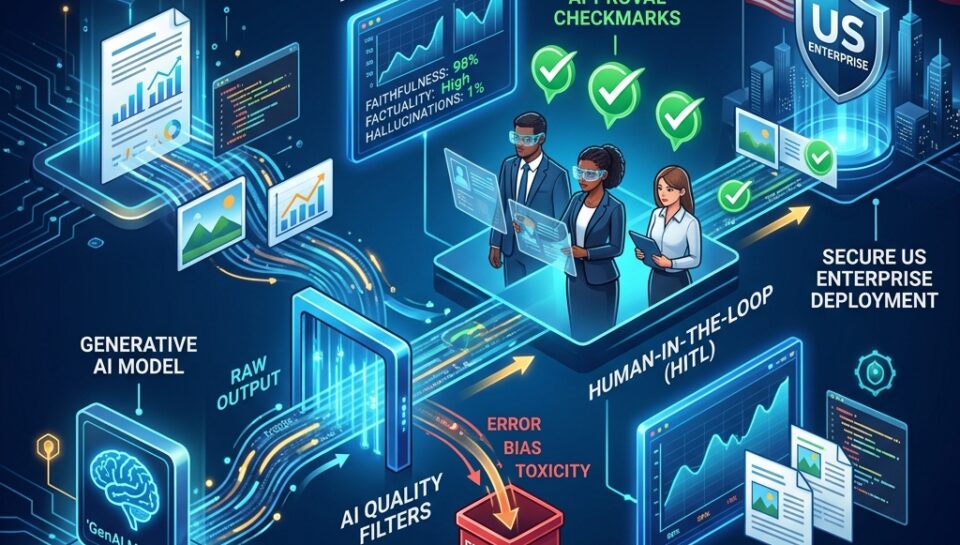
Modern GenAI QA combines automated and human evaluation in a structured workflow.
Automated Evaluation
Operates at scale, runs continuously, catches the failures that have known patterns. Six automated approaches in common use:
Reference-based scoring. Output compared against reference answers using metrics like BLEU, ROUGE, BERTScore, or semantic similarity. Useful for tasks with stable ground truth.
Reference-free scoring. Output evaluated using a separate model (often called LLM-as-judge) against criteria like factuality, coherence, helpfulness. Scales better than human review but introduces correlation risk between evaluator and evaluated models.
Constraint checking. Output checked against structural rules: format compliance, prohibited content filters, required disclaimers, length constraints, schema validation. Catches a meaningful slice of failures cheaply.
Retrieval consistency. For RAG applications, output grounded against retrieved passages with consistency checks. Catches hallucination on factual claims.
Adversarial probe suites. Curated test sets covering known prompt injection patterns, jailbreak templates, edge cases, and red-team scenarios. Run on every model update.
Safety classifiers. Output run through specialized classifiers for toxicity, bias, sensitive content, PII leakage. Cheap to run; catches most obvious failures.
Human Review
Catches the failures that don't have known patterns. Three roles for human reviewers in a mature GenAI QA operation:
Sample review. Random or stratified samples of production outputs reviewed by trained reviewers, with findings logged and rolled up into quality reports.
Targeted review. Outputs flagged by automated evaluation for human review. Higher review rate; focuses human time on the cases automated evaluation can't resolve.
Red team and adversarial review. Trained adversarial reviewers actively trying to break the model, surfacing new failure modes that get added to the automated probe suite over time.
The right balance between automated and human depends on the application's stakes. A consumer-facing creative writing application can run with light human review; a medical decision-support application runs with substantially heavier human review and often human-in-the-loop on every output.
Specialized Classification Tasks Within GenAI QA
Many GenAI QA workflows include specialized classification tasks that draw on the same skill set as traditional NLP annotation. Four common categories:
Text classification. Output classified by quality dimension, factual accuracy, helpfulness, safety, or task-specific criteria. See ourtext classification services.
Sentiment analysis. Output evaluated for sentiment alignment with intent, useful for customer-facing applications. See oursentiment analysis services.
Translation review. For multilingual GenAI applications, output evaluated for translation quality, cultural appropriateness, and source-fidelity. See ourtranslation review services.
Named entity recognition. Output checked for correct entity references, particularly for applications where entity accuracy is high-stakes (medical, legal, financial). See ournamed entity recognition services.
These tasks bridge traditional annotation and GenAI QA. The same teams that operate well on classification annotation often operate well on GenAI QA when trained on the specific evaluation criteria.
Compliance and Documentation Requirements
US enterprises operating GenAI in regulated contexts face specific documentation requirements:
NIST AI Risk Management Framework is the umbrella reference most US enterprises use. The Generative AI Profile published in 2024 extends the core RMF with GenAI-specific guidance.
ISO/IEC 42001 is the international standard for AI management systems, increasingly referenced in enterprise procurement.
Industry-specific frameworks apply on top:
- Healthcare: FDA guidance on AI/ML SaMD, plus HIPAA for data handling
- Financial services: model risk management under SR 11-7 (federal) and similar state-level frameworks
- Federal contracting: emerging federal AI requirements including AI Bill of Rights elements
- US state-level: New York City Local Law 144 for automated employment decision tools, California regulations for AI in hiring, and an expanding state-level patchwork
The QA workflow has to produce documentation that satisfies the relevant frameworks: evaluation methodology, sample sets used, results, mitigation actions, residual risk acceptance.
Security Framework for GenAI QA Operations
The data that flows through GenAI QA is often sensitive: customer interactions, internal documents, healthcare records, financial information, proprietary content. The security posture must match.
Baseline expectations:
- ISO 27001 information security operations
- Documented data handling procedures with role-based access controls
- Encrypted storage and transmission
- Defined retention and destruction policies
- Workforce-level controls including NDAs, background checks where appropriate, and training on the specific data handling requirements
For specific data categories, additional controls layer on top: HIPAA Business Associate Agreements for healthcare, SOC 2 Type II for SaaS-side enterprises, FedRAMP for federal-adjacent work, and the cross-cuttingNIST AI RMF Generative AI Profile framing for GenAI-specific risk management.
How US Enterprises Engage External Partners
Three engagement patterns dominate in 2026:
1. Annotation operations partner. External team performs the human review work under documented quality frameworks, integrating with the buyer's evaluation infrastructure. Most common pattern. Lower per-review cost than building internal review at scale; higher quality than crowd-sourced platforms for sensitive applications.
2. Red team and adversarial testing. External specialists perform structured red-teaming on a periodic basis (quarterly is common for production systems). Lower volume; higher specialization; often complementary to in-house QA rather than replacing it.
3. Specialized expert review. Domain experts (clinicians, lawyers, financial professionals) review high-stakes outputs in their domain. Premium pricing; specific use cases where general reviewers can't substitute.
A common pattern is to combine all three: in-house automated evaluation for scale, external annotation operations partner for ongoing human review at volume, and external red team for periodic adversarial testing. For framework on the broader training data and annotation services that adjacent to GenAI QA, see our piece onAI training data.
Common Questions From US Enterprises
Can't we just use LLM-as-judge for everything? LLM-as-judge scales well and catches a meaningful slice of failures, but introduces correlation risk between evaluator and evaluated models, and consistently misses certain failure types (subtle factual errors, domain-specific issues, novel adversarial patterns). The right answer is LLM-as-judge for scale plus humans for what LLM-as-judge can't reliably catch, not either alone.
How much human review is enough? Depends on the stakes of bad outputs. Consumer-facing creative writing might tolerate 1% sample review. Medical decision support runs much heavier, often human-in-the-loop on every output. The framework: estimate the cost of a bad output reaching production, set the human review rate to keep that risk acceptable.
What about hallucination — is there a real solution? There is no complete solution to hallucination in 2026. Mitigation includes retrieval grounding, output filtering, ground-truth comparison, and human review on high-stakes outputs. The combination reduces hallucination risk to acceptable levels for many applications but does not eliminate it.
How do we evaluate a GenAI QA partner? Look for documented evaluation methodologies, prior engagement examples (subject to confidentiality), trained reviewers with documented calibration and inter-reviewer agreement, security posture matched to your data sensitivity, and integration capability with your evaluation infrastructure rather than requiring migration to proprietary platforms.
Do we need to do this if we're using a hosted model? Yes. The hosted model provider handles model-level safety; the QA work covers your application-level failure modes (your specific prompts, your specific RAG context, your specific output handling). Even with a strong hosted model, the application-layer failures are yours to catch.
How does this scale as the model updates? Treat model updates as triggers for full re-evaluation: probe suite, evaluation sets, sample human review on production-equivalent tasks. Production monitoring should detect quality drift between formal re-evaluations.
What's the relationship to traditional ML QA? Traditional ML QA focuses on labeled prediction accuracy, calibration, and bias. GenAI QA includes those and adds output evaluation against open-ended criteria, adversarial robustness, and content safety. The skill set overlaps substantially; the workflow is broader.
How do we document this for compliance? Document the evaluation methodology, sample sets, results, mitigation actions, and residual risk acceptance, organized against the relevant framework (NIST AI RMF Generative AI Profile is the most common umbrella). Maintain version-controlled records that survive personnel turnover.
Working with Prudent Partners
Prudent Partners Private Limited operates a generative AI quality assurance service for US enterprises covering text classification, sentiment analysis, translation review, named entity recognition, and broader output evaluation against custom criteria. The model includes documented quality frameworks with calibration and inter-reviewer agreement monitoring; ISO 27001 information security operations; US-overlap shifts; and integration with the buyer's evaluation infrastructure rather than requiring migration to proprietary tools.
For an overview of the service portfolio, see ourgenerative AI quality analysis page. For broader AI quality assurance context, see ourAI quality assurance overview. For the upstream training data workflow, see ourAI training data piece.
To explore an engagement, get in touch through the contact page. The first conversation is a 30-minute scoping call covering the application, the failure modes that matter most, the volume, security posture, and operating model fit, with no commitment to proceed.