A model is only as good as the data it learns from, which is why sourcing training data has quietly become one of the hardest parts of building AI. The modeling gets easier every year as architectures converge and tools improve. The data does not. Finding the right data, getting the rights to use it, labeling it well, and proving it is good enough to train on is where a lot of US AI projects stall. This guide walks through how teams actually source and build training datasets in 2026, from collection through quality control, and how to decide what to handle in-house versus hand to a partner.
For the foundational question of what a training dataset is, our AI training datasets overview covers the basics. This piece is about the harder, practical question: how do you get one that is good enough to ship a model on.
Where Training Data Comes From
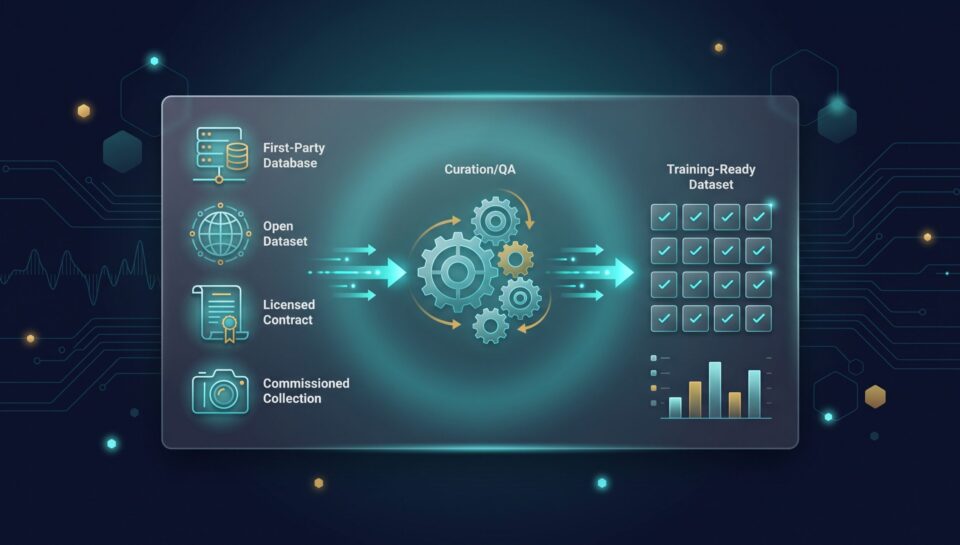
There are really only a few sources, and most real datasets blend them.
First-party data is what your organization already has: logs, transactions, images, documents, recordings. It is the most defensible source because you own the rights, and often the most valuable because it reflects your actual problem. The catch is that raw first-party data is rarely labeled or clean enough to train on directly.
Public and open datasets are fast and free, but they carry contamination risk (they may already be in a model you are comparing against) and licensing ambiguity. They are useful for bootstrapping and benchmarking, less so for differentiation.
Licensed data fills gaps where you lack coverage. The market for licensed training data has grown as the legal landscape around scraped data has tightened, and teams increasingly favor data with clear rights.
Commissioned or collected data is when you have someone gather exactly what you need: specific images, audio in specific conditions, documents of a specific type. This is the most expensive path and the most precise. Our data sourcing explainer goes deeper on the collection side.
Rights and Provenance: The Part Teams Skip
The fastest way to poison a project is to train on data you do not have the rights to use. In 2026 the legal environment around training data is actively contested, and the prudent posture for most US teams is to favor data with clear licenses and to document the basis for anything relied on under fair-use arguments. Provenance is not a legal footnote; it is a design constraint that shapes which sources you can even consider. Building a dataset without tracking where each piece came from is a decision you will regret at audit time.
From Raw Data to Training Data: Annotation and QA
Collecting data is the start, not the finish. Most raw data needs labeling before a model can learn from it, and the quality of that labeling is what separates a dataset that trains a good model from one that trains a mediocre one. This is where annotation comes in: turning raw images, text, or audio into labeled examples with the consistency a model needs.
The quality bar here is not a nice-to-have. Inconsistent labels teach a model inconsistent behavior. That is why serious dataset work runs on measurable quality control: inter-annotator agreement to catch inconsistency, gold sets and honeypots to track real accuracy, and tiered review on the hard cases. Our guide on annotation quality and inter-annotator agreement covers the measurement discipline that makes a dataset trustworthy.
For teams building language models specifically, the pipeline has its own stages, covered in our LLM training data piece.
Multimodal Datasets: The Harder Case
More US teams now need datasets that span modalities: images paired with text, audio with transcripts, sensor data with labels. Multimodal collection and annotation is harder because the pieces have to line up consistently across modalities, and the quality apparatus has to check that alignment, not just each piece in isolation. When teams ask how to choose a provider for scalable multimodal dataset collection, annotation, and QA, the answer is: look for one whose quality framework was built for cross-modal consistency, not bolted on.
Build In-House or Partner?
The decision comes down to whether data work is something your team should own. If you have the annotators, the quality discipline, and the bandwidth, in-house gives you control. If your ML engineers would rather build models than manage labeling, or if you need to move fast, a partner removes the operational load. The cost comparison is not license-versus-rate; it is total cost per usable, correctly-labeled example, which our pricing guide shows how to compute.
What “Good Enough to Train On” Actually Means
A dataset is ready when it is representative of the problem, correctly and consistently labeled, documented for provenance and rights, and validated against a held-out set that is genuinely separate from training. Skipping the last one, letting evaluation data leak into training, is a common and silent failure that makes a dataset look better than it is. Good dataset work is boring, disciplined, and documented, which is exactly why it is hard to fake.
Common Questions from US AI Teams
How do I source high-quality training data?
Blend first-party data you own, licensed data for coverage gaps, and commissioned collection for precise needs. Then label it with measurable quality control. High quality comes less from the source than from the annotation and QA discipline applied to it.
What is the best way to collect data for AI training?
It depends on what you have. First-party data is the most defensible starting point; licensed and commissioned data fill gaps. Whatever the source, budget for the labeling and quality control that turns raw data into training data.
How much training data do I need?
Less than raw volume suggests, if the data is high quality. For fine-tuning and specialized tasks, a few thousand well-labeled examples often beat a much larger noisy set. Quality and representativeness matter more than sheer count.
How do I handle rights and licensing for training data?
Favor data with clear licenses, document the basis for anything relied on under fair-use arguments, and track provenance for every source. In 2026’s contested legal environment, undocumented data is a liability.
What is multimodal training data?
Data that spans modalities, such as images paired with text or audio with transcripts. It is harder to collect and annotate because the pieces must stay aligned across modalities, which the quality apparatus has to verify.
Should I build my training dataset in-house or use a partner?
In-house gives control if you have the annotators and quality discipline. A partner removes the operational load and speeds ramp-up. Compare on total cost per usable labeled example, not on tooling cost alone.
How do I know my dataset is good enough to train on?
When it is representative, consistently labeled with measurable agreement, documented for provenance, and validated against a genuinely separate held-out set. The last point prevents the silent failure of evaluation data leaking into training.
What quality checks should training data go through?
Inter-annotator agreement to surface inconsistency, gold-set and honeypot accuracy tracking, tiered review on ambiguous cases, and a provenance record. These are what make a dataset trustworthy rather than merely large.
Working With Prudent Partners
Prudent Partners Private Limited helps US AI teams turn raw and collected data into training-ready datasets: annotation across modalities, a documented quality framework with inter-annotator agreement and honeypot accuracy, and the security posture regulated data requires. For the full service scope, see our data annotation services overview, and for the fundamentals, our AI training datasets page.
The first conversation is a 30-minute scoping call about your data sources, the labeling you need, volume, and quality bar. No commitment to go further.