Speech and audio models have quietly become some of the most demanding AI systems to train. A voice assistant, a call-center analytics tool, a transcription engine, or a sound-detection system all learn from labeled audio, and the labeling is harder than it looks. Audio has no visual frame to anchor on, speakers overlap, accents vary, background noise interferes, and the same word can carry different meaning depending on tone. Audio annotation services exist to turn raw sound into the structured, labeled data these models need. This guide covers what that work involves, the main types of audio annotation, how quality is measured, and how a US AI team chooses a partner.
For the concept-level overview of what audio annotation is, our audio annotation page covers the basics. This guide is the practical, buyer-facing version.
What Audio Annotation Services Cover
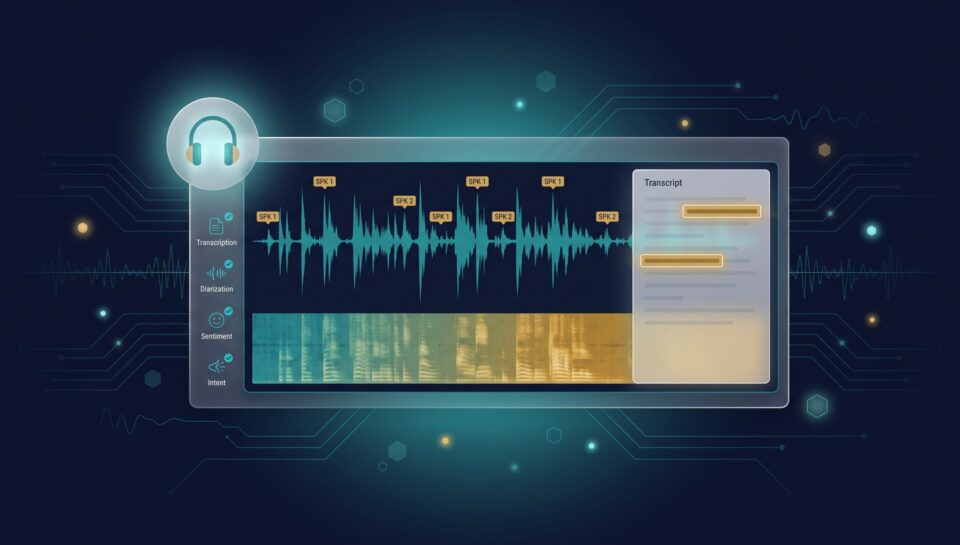
Audio annotation is the labeling of sound data so a machine learning model can learn from it. The raw input is audio: recorded speech, phone calls, voice commands, environmental sound, or music. The output is that audio marked up with the labels a model needs, whether that is a transcript, speaker identities, emotion tags, or time-stamped events.
A capable service handles the full range, from simple transcription through complex multi-speaker, multi-label work, along with the quality control that keeps the labels consistent across hours of audio and many annotators.
The Main Types of Audio Annotation
Transcription. Converting speech to text, the foundation of most speech AI. Sounds simple, but accurate transcription of real-world audio with accents, crosstalk, and domain jargon is genuinely hard.
Speaker diarization. Labeling who spoke when, so a model can tell speakers apart. Essential for call analytics, meeting tools, and any multi-speaker application.
Speaker identification. Attaching identity or role labels to speakers (agent versus customer, for example), a step beyond diarization.
Event and sound labeling. Tagging non-speech sounds: a door closing, a machine fault, a siren. Used for security, industrial monitoring, and environmental sound models.
Emotion and sentiment labeling. Marking the emotional tone of speech, used in call-center quality and conversational AI. This overlaps with the text-side sentiment analysis work but adds the acoustic dimension of tone and prosody.
Time-stamped segmentation. Marking exactly when each label starts and ends, which most downstream models require rather than a single label for a whole clip.
Intent and utterance labeling. Tagging what a speaker is trying to do, used for voice assistants and command systems.
Where Audio Annotation Gets Used
Voice assistants and speech recognition, call-center analytics and quality monitoring, medical transcription, conversational AI and chatbots with voice, industrial and security sound detection, and accessibility tools like live captioning. Each has its own accuracy bar and its own hard cases.
Why Audio Is Harder Than It Looks
A few things make audio annotation genuinely difficult, and a serious service is built around them. Accents and dialects mean a model trained on one population fails on another. Background noise and crosstalk make even transcription ambiguous. Domain vocabulary (medical terms, product names, industry jargon) trips up general annotators. And tone carries meaning that the words alone miss. A service that treats audio as simple transcription will produce data that trains a brittle model.
Quality Control in Audio Annotation
The quality apparatus matters as much here as anywhere. Serious audio annotation runs on measurable inter-annotator agreement, gold-standard clips seeded into the work, and review tiers for the hard cases. Our guide on annotation quality and inter-annotator agreement covers the measurement discipline. For audio specifically, watch for how a partner handles accent and noise variation, since that is where quality quietly slips.
Security and Compliance
Audio data is often sensitive: recorded calls contain personal information, medical audio falls under HIPAA, and financial calls carry compliance obligations. A partner should carry ISO 27001 information security operations, SOC 2 where your customers expect it, and documented workforce controls including NDAs. For regulated audio, confirm the specific framework your data requires.
How to Choose an Audio Annotation Partner
The questions that separate a real partner from a transcription vendor: can you handle our audio types and languages, not just clean speech; how do you handle accents, noise, and domain vocabulary; what inter-annotator agreement do you measure; what is your security posture for sensitive audio; and will you prove it on a paid pilot with our real recordings. Our broader vendor evaluation guide covers the rest of the procurement discipline.
Common Questions From US AI Teams
What are audio annotation services?
They are services that label sound data so machine learning models can learn from it, covering transcription, speaker diarization, event labeling, emotion tagging, and time-stamped segmentation, along with the quality control that keeps labels consistent.
What is the difference between transcription and audio annotation?
Transcription is one type of audio annotation, converting speech to text. Full audio annotation also covers who spoke when, emotional tone, non-speech sounds, and precise timing, depending on what the model needs.
What is speaker diarization?
Labeling who spoke when in an audio recording so a model can tell speakers apart. It is essential for call analytics, meeting tools, and any multi-speaker application.
How do you annotate audio with background noise or accents?
With annotators trained on the relevant accents and domains, clear guidelines for ambiguous cases, and quality control that specifically tracks accuracy across noise and accent variation. This is where cheap transcription services tend to fail.
Is audio annotation used for more than speech?
Yes. Event and sound labeling tags non-speech audio like machine faults, sirens, or environmental sounds, used in security, industrial monitoring, and environmental sound models.
How is audio annotation quality measured?
Through inter-annotator agreement, gold-standard clips seeded into the work, and tiered review of hard cases, with particular attention to consistency across accents, noise, and domain vocabulary.
What compliance applies to audio data?
It depends on the content. Recorded calls carry personal data obligations, medical audio falls under HIPAA, and financial audio has its own rules. Confirm your partner carries ISO 27001 and the specific framework your audio requires.
How do I choose an audio annotation service?
Confirm they handle your audio types and languages, ask how they manage accents, noise, and domain vocabulary, check their inter-annotator agreement and security posture, and require a paid pilot on your real recordings before committing.
Working With Prudent Partners
Prudent Partners Private Limited provides audio annotation for US AI teams across transcription, speaker diarization, event labeling, and emotion tagging, with a documented quality framework, accent and noise handling, and ISO 27001 information security for sensitive audio. For the full scope, see our data annotation services overview and our audio annotation page.
The first conversation is a 30-minute scoping call about your audio types, languages, volume, and quality bar. No commitment to go further.