AI Model Evaluation Services: Benchmarking LLMs in 2026
Building a model is no longer the hard part. Knowing whether it is actually good, and good enough to ship, is. As US teams move generative AI from demo to production, the question that stalls them is evaluation: how do you measure a model's quality when the output is open-ended, the failure modes are subtle, and the automatic scores do not capture what users will actually experience. AI model evaluation is the discipline of answering that question with evidence instead of vibes. This guide covers what model evaluation involves, the metrics that matter, why human review is unavoidable, and how US teams run it in-house or bring in a partner.
Why Model Evaluation Is Suddenly Hard
Traditional machine learning had clean metrics. A classifier was right or wrong, and accuracy told you most of what you needed. Generative models broke that. When a model writes a paragraph, answers a question, or summarizes a document, there is rarely a single correct output, and the ways it can fail are open-ended: it can be subtly wrong, confidently wrong, biased, off-tone, or unsafe. A single automatic score cannot capture that, which is why serious evaluation in 2026 combines automatic metrics with structured human judgment.
The Layers of Model Evaluation
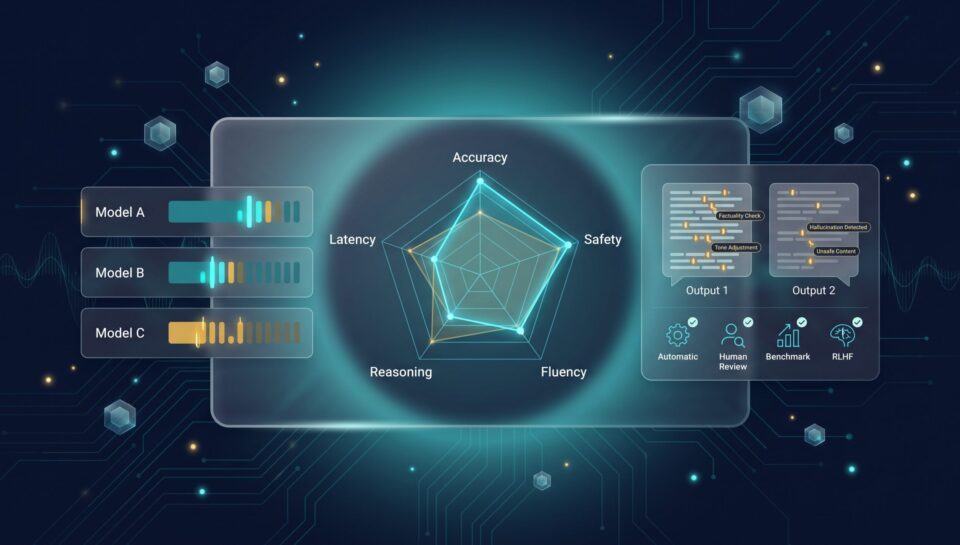
A rigorous evaluation program usually works in layers, from cheap-and-automatic to expensive-and-human.
Automatic metrics. Fast, cheap, and useful for tracking regressions, but limited. Perplexity, exact-match, and reference-based scores like BLEU or ROUGE tell you something narrow and miss most of what matters for open-ended output. Useful as a first filter, not a verdict.
Benchmark suites. Standardized task sets that let you compare a model against known baselines. Benchmarks are how the field talks about model quality at a high level, and they are a reasonable starting point, but public benchmarks can leak into training data and rarely match your specific use case.
Model-graded evaluation. Using a strong model to judge another model's output ("LLM-as-a-judge"). Scalable and increasingly common, but it inherits the judge model's biases and blind spots, so it needs to be validated against human judgment rather than trusted blindly.
Human evaluation. Trained reviewers scoring output against a rubric: correctness, helpfulness, tone, safety, and task-specific criteria. This is the layer that catches what the others miss, and it is the anchor that tells you whether the automatic and model-graded scores actually track real quality.
The discipline is not picking one layer. It is using the cheap layers for scale and the human layer to keep the cheap layers honest.
The Metrics That Actually Matter
Which metrics matter depends on the application, but a few dimensions recur across serious evaluations. Correctness and factual accuracy, whether the output is actually right. Relevance, whether it answers what was asked. Faithfulness, whether it stays grounded in the source material rather than inventing. Safety, whether it avoids harmful or policy-violating output. Tone and style fit for the intended use. And consistency, whether it behaves reliably across similar inputs rather than getting it right once and wrong the next time. A good evaluation reports these as separate signals, not a single blended score that hides which dimension is failing.
Evaluating RAG Systems
A large share of production AI in 2026 is retrieval-augmented, and RAG systems need their own evaluation because they have two failure points, not one. The retrieval step can fetch the wrong context, and the generation step can misuse even the right context. Evaluating a RAG system means measuring both: retrieval quality (did it find the relevant material) and generation faithfulness (did the answer stay grounded in what was retrieved). For teams building on retrieval, ourretrieval-augmented generation overview covers the architecture that this evaluation targets.
Why Human Review Is Unavoidable
There is a strong pull toward fully automated evaluation because it scales cheaply, and for regression-tracking that is fine. But every automatic and model-graded metric is a proxy, and proxies drift from reality in exactly the cases that matter most: the subtle errors, the edge cases, the outputs that are plausible but wrong. Human evaluation is what grounds the whole system. It is the same discipline that underpins goodannotation quality measurement, applied to model output instead of training labels: trained reviewers, clear rubrics, and measured agreement between them so the scores are consistent rather than one person's opinion.
Build or Partner
Model evaluation can be run in-house, and teams with a mature ML organization often do. The reasons teams bring in a partner are the familiar ones: standing up a trained human-evaluation panel with rubrics and measured agreement is real operational work, evaluation demand is spiky (heavy around a release, light between), and independent evaluation carries more weight than a team grading its own model. A partner brings the reviewer workforce, the rubric discipline, and the measurement, while the team keeps ownership of what "good" means for their product.
How to Choose a Model Evaluation Partner
The questions that matter: can you evaluate our specific application, not just run generic benchmarks; how do you combine automatic, model-graded, and human evaluation; how do you measure inter-reviewer agreement so the scores are reliable; can you evaluate RAG systems on both retrieval and generation; and will you show your rubrics and a sample evaluation before we commit. Our broadervendor evaluation guide covers the rest of the procurement discipline.
Common Questions From US AI Teams
What is AI model evaluation?
It is the process of measuring whether an AI model is good enough to use, combining automatic metrics, benchmark suites, model-graded scoring, and human review across dimensions like correctness, relevance, faithfulness, and safety.
What is LLM benchmarking?
Running a language model against standardized task sets to compare its quality against known baselines. Benchmarks are a useful high-level starting point but can leak into training data and rarely match your specific use case, so they supplement rather than replace application-specific evaluation.
What metrics are used to evaluate LLMs?
Correctness and factual accuracy, relevance, faithfulness to source material, safety, tone and style fit, and consistency across similar inputs. A good evaluation reports these separately rather than as a single blended score.
Can AI model evaluation be fully automated?
Partly. Automatic and model-graded metrics scale cheaply and are good for tracking regressions, but they are proxies that drift from reality in the subtle cases. Human evaluation is what keeps them honest, so serious evaluation combines both.
What is LLM-as-a-judge?
Using a strong model to score another model's output. It scales well but inherits the judge model's biases, so it should be validated against human judgment rather than trusted on its own.
How do you evaluate a RAG system?
By measuring both failure points separately: retrieval quality (did it fetch the relevant context) and generation faithfulness (did the answer stay grounded in what was retrieved). Evaluating only the final answer hides which step failed.
Should we evaluate our model in-house or use a partner?
Teams with a mature ML organization often run it in-house. Teams bring in a partner for the trained human-evaluation workforce, for spiky release-driven demand, and because independent evaluation carries more weight than grading your own model.
How do you choose a model evaluation partner?
Confirm they can evaluate your specific application, combine automatic and human evaluation, measure inter-reviewer agreement, handle RAG evaluation on both retrieval and generation, and show their rubrics and a sample evaluation before you commit.
Working With Prudent Partners
Prudent Partners Private Limited provides AI model evaluation for US teams, combining automatic metrics with trained human review against clear rubrics, measured inter-reviewer agreement, and RAG evaluation across both retrieval and generation. The work is grounded in the same quality discipline as ourAI data annotation services andAI quality assurance functions.
The first conversation is a 30-minute scoping call about your model, your use case, and the quality bar you need. No commitment to go further.