AI Quality Assurance Services: QA for AI Systems in 2026
Software QA has a well-worn playbook: define the expected output, write tests, and check that the code produces it. AI systems break that playbook, because the output is probabilistic. The same input can produce different responses, "correct" is often a judgment rather than a fact, and the failure modes are open-ended: a model can be subtly wrong, unsafe, off-tone, or simply inconsistent. AI quality assurance is QA rebuilt for systems that do not behave deterministically. This guide covers what AI QA involves, how it differs from traditional software QA, the specific case of conversational AI, and how US teams run it or bring in a partner.
Why AI Needs a Different Kind of QA
Traditional QA assumes determinism: given an input, the software should produce a known output, and a test passes or fails cleanly. AI systems violate that assumption. A generative model can give a good answer, a slightly worse answer, or a subtly wrong one to the same question on different runs. You cannot write a simple assertion for "the answer should be helpful and safe." So AI QA replaces pass/fail assertions with structured evaluation against rubrics, sampling and human review, and continuous monitoring, because a model that behaves well today can drift as it is updated or as its inputs change. The underlying discipline is the same one behind any rigorousquality assurance process, adapted for non-deterministic output.
What AI Quality Assurance Covers
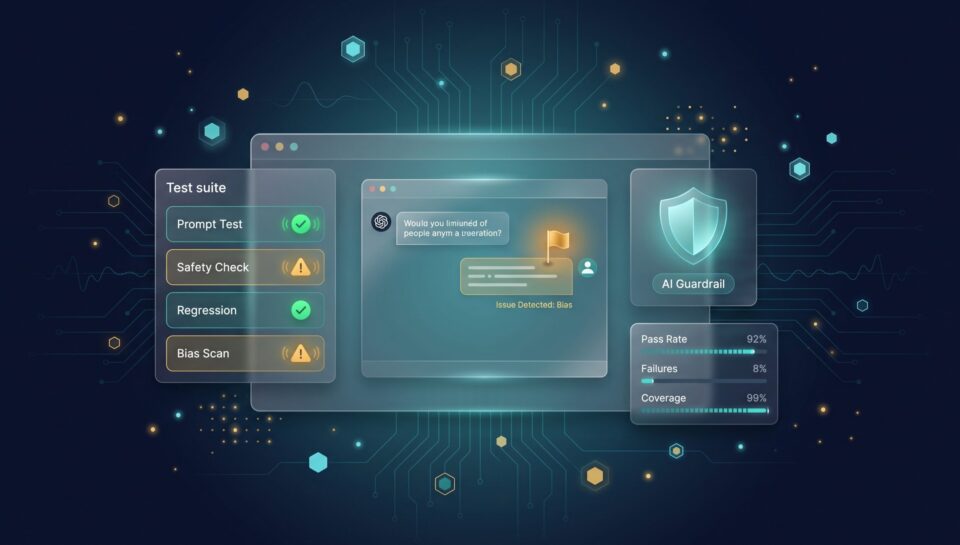
Output quality review. Sampling model outputs and scoring them against a rubric: correctness, relevance, tone, and task-specific criteria. This is the core of AI QA and the part that catches what automated checks miss.
Safety and policy review. Checking output for harmful, biased, or policy-violating content. For any public-facing AI, this is not optional, and it connects to the broader safety work covered in ourAI quality assurance overview.
Regression and drift monitoring. Catching when a model update or a shift in inputs quietly degrades quality. A model that passed review last month can fail this month, so QA is continuous, not a one-time gate.
Consistency testing. Checking that the system behaves reliably across similar inputs rather than getting it right once and wrong the next time. Inconsistency is one of the most common and most under-tested AI failure modes.
Adversarial and edge-case testing. Deliberately probing the inputs that push a model somewhere unsafe or wrong, so the failures are found in testing rather than by users.
Conversational AI QA
The fastest-growing slice of AI QA is conversational: chatbots, voice assistants, and support agents. These are harder to test than a single prompt-and-response because quality lives in the whole conversation, not one turn. Does the assistant stay on topic across a multi-turn exchange, handle a user who changes their mind, recover gracefully when it does not know, and stay safe under pressure. A mature conversational AI QA program tests all of that: multi-turn conversation quality, escalation and fallback behavior, safety under adversarial prompting, and consistency across the range of ways real users phrase things. Testing a chatbot only on clean single questions tells you almost nothing about how it behaves in the wild.
Human Review at the Center
There is a persistent hope that AI QA can be fully automated, and some of it can: automated checks are good for regression-tracking and obvious violations. But the judgments that matter most, is this subtly wrong, is this the right tone, is this safe in context, are exactly the ones automation handles worst. Human review is the center of serious AI QA, using trained reviewers, clear rubrics, and measured agreement between them so the QA is consistent rather than one person's opinion. It is the same measurement discipline asinter-annotator agreement in data annotation, applied to model behavior.
Build or Partner
AI QA can run in-house, and teams with a mature quality function often do. Teams bring in a partner for the reasons QA is usually outsourced: a trained review workforce is real operational overhead, QA demand spikes around releases, and independent QA is more credible than a team signing off on its own model. A partner brings the reviewers, the rubrics, and the measurement while the team keeps ownership of the quality standard.
How to Choose an AI QA Partner
The questions that matter: can you test our type of AI system, especially conversational AI if that is what we run; how do you combine automated checks with human review; how do you measure reviewer agreement so the QA is reliable; do you cover safety and adversarial testing, not just happy-path; and will you show your rubrics and a sample QA report before we commit. Ourvendor evaluation guide covers the rest.
Common Questions From US Teams
What is AI quality assurance?
QA rebuilt for systems that do not behave deterministically. Instead of pass/fail assertions, it uses structured evaluation against rubrics, human review, and continuous monitoring to check that an AI system is correct, safe, and consistent.
How is AI QA different from software QA?
Software QA assumes a known output for each input and tests pass or fail cleanly. AI output is probabilistic and often a matter of judgment, so AI QA replaces simple assertions with rubric-based evaluation, sampling, human review, and ongoing drift monitoring.
What is conversational AI QA?
Testing chatbots, voice assistants, and support agents across whole conversations, not single turns: multi-turn quality, escalation and fallback behavior, safety under adversarial prompting, and consistency across how real users phrase things.
Can AI quality assurance be automated?
Partly. Automated checks handle regressions and obvious violations well, but the judgments that matter most, subtle correctness, tone, and in-context safety, are exactly what automation handles worst. Human review stays at the center.
Why does AI need continuous QA rather than a one-time check?
Because models drift. A model update or a shift in inputs can quietly degrade quality, so a system that passed review last month can fail this month. QA has to be continuous to catch that.
What is adversarial testing for AI?
Deliberately probing the inputs that push a model somewhere unsafe or wrong, so those failures are found in testing rather than by real users. It is a standard part of QA for any public-facing AI.
How is AI QA quality kept consistent?
Through trained reviewers, clear rubrics, and measured agreement between them, the same discipline as inter-annotator agreement in data annotation, applied to model behavior so scores are reliable rather than one person's opinion.
Should we run AI QA in-house or use a partner?
Teams with a mature quality function often run it in-house. Others partner for the trained review workforce, for spiky release-driven demand, and because independent QA is more credible than a team signing off on its own model.
Working With Prudent Partners
Prudent Partners Private Limited provides AI quality assurance for US teams, covering output quality review, safety and policy review, conversational AI testing, and drift monitoring, with trained reviewers, clear rubrics, and measured agreement. The work builds on ourAI quality assurance andgenerative AI quality analysis functions.
The first conversation is a 30-minute scoping call about your AI system, the QA it needs, and your safety requirements. No commitment to go further.