RAG Data Services: Preparing Data for Retrieval AI
Retrieval-augmented generation has become the default way to put a language model to work on a company's own knowledge. Instead of hoping the model memorized the right facts, a RAG system retrieves relevant documents at query time and generates an answer grounded in them. The appeal is obvious, and the disappointment is common: teams stand up a RAG system, point it at their documents, and get answers that are confidently wrong. Almost always, the problem is not the model or the retrieval code. It is the data. RAG data services are the work of preparing a knowledge base that a RAG system can actually retrieve from reliably. This guide covers what that work involves and why it decides whether RAG succeeds.
For the concept of how retrieval-augmented generation works, ourretrieval-augmented generation overview covers the architecture. This guide is about the data layer underneath it.
Why RAG Succeeds or Fails on Data
A RAG system has two jobs: retrieve the right material, then generate a grounded answer from it. Both depend on the knowledge base being clean, well-structured, and chunked sensibly. If the source documents are messy, duplicated, outdated, or split into unhelpful pieces, retrieval fetches the wrong context and the model generates a wrong answer from it, fluently and confidently. This is the quiet reason so many RAG projects underdeliver: teams treat the knowledge base as a dump of existing documents rather than a prepared dataset. RAG quality is downstream of data quality, the same principle that holds acrossall of AI.
What RAG Data Preparation Involves
Document processing and cleaning. Turning raw source material (PDFs, web pages, internal docs, scanned files) into clean, usable text. Removing boilerplate, fixing extraction errors, and handling tables and structure that naive extraction mangles.
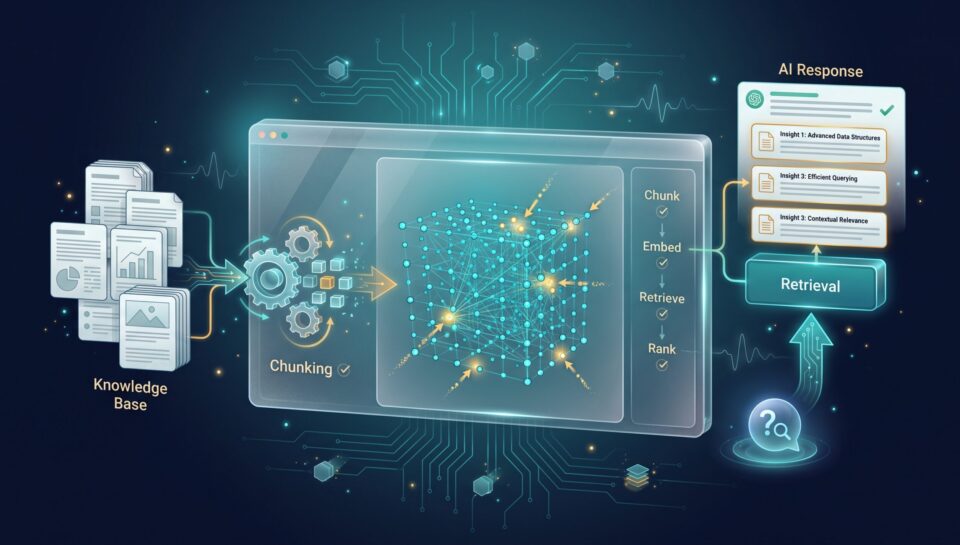
Chunking. Splitting documents into retrievable pieces. This is subtle and consequential: chunks that are too big dilute retrieval, chunks that are too small lose context, and chunks split in the wrong place break meaning. Good chunking respects the structure and semantics of the content rather than cutting at arbitrary lengths.
Metadata and structuring. Tagging chunks with the metadata that makes retrieval precise: source, date, section, document type, access level. Rich metadata is often the difference between a RAG system that retrieves the right thing and one that returns plausible-but-wrong context.
Deduplication and freshness. Removing duplicate and outdated content so the system does not retrieve stale or conflicting information. A knowledge base with three versions of the same policy will confidently cite the wrong one.
Quality control. Checking that the prepared knowledge base actually supports good retrieval, with the same measurement discipline as anydata quality work.
Evaluating a RAG System
Preparing the data is half the job; knowing whether the RAG system works is the other half, and RAG needs its own evaluation because it has two failure points. Retrieval can fetch the wrong context, and generation can misuse even the right context. Evaluating a RAG system means measuring both: retrieval quality (did it find the relevant material) and generation faithfulness (did the answer stay grounded in what was retrieved). Evaluating only the final answer hides which step failed, which is why teams that evaluate RAG properly separate the two.
Compliance in RAG
For regulated US teams, RAG raises a specific concern: the knowledge base often contains sensitive or regulated content, and the system can surface it in answers. Preparing RAG data responsibly means handling access controls, keeping regulated content appropriately scoped, and documenting provenance. A partner working on your knowledge base should carryISO 27001 information security operations and be able to speak to how it handles sensitive source material.
Build or Partner
The engineering of a RAG system, the retrieval code and the model integration, usually stays in-house or with an AI engineering team. The data preparation is where a services partner fits: document processing, chunking, metadata, and knowledge-base quality are labor-intensive, benefit from a disciplined data operation, and are often the actual bottleneck to a working RAG system. Teams that partner for the data layer while owning the engineering tend to get to a reliable RAG system faster.
How to Choose a RAG Data Partner
The questions worth asking: how do you handle document processing and chunking for our content types; how do you structure metadata for precise retrieval; how do you handle deduplication and freshness; can you evaluate retrieval and generation separately; and what is your security posture for our source material. Ourvendor evaluation guide covers the broader procurement discipline.
Common Questions From US Teams
What are RAG data services?
The work of preparing a knowledge base that a retrieval-augmented generation system can retrieve from reliably: document processing, chunking, metadata structuring, deduplication, and quality control. It is distinct from building the RAG system's engineering.
Why do RAG systems give wrong answers?
Usually because of the data, not the model. If the knowledge base is messy, duplicated, outdated, or badly chunked, retrieval fetches the wrong context and the model generates a confident wrong answer from it. RAG quality is downstream of knowledge-base quality.
What is chunking and why does it matter?
Splitting documents into retrievable pieces. Chunks that are too big dilute retrieval, too small lose context, and split in the wrong place break meaning. Good chunking respects the structure of the content, and it strongly affects retrieval quality.
How do you evaluate a RAG system?
By measuring its two failure points separately: retrieval quality (did it fetch the relevant material) and generation faithfulness (did the answer stay grounded in what was retrieved). Evaluating only the final answer hides which step failed.
What role does metadata play in RAG?
Metadata like source, date, section, and access level makes retrieval precise. Rich metadata is often the difference between a system that retrieves the right chunk and one that returns plausible but wrong context.
How is sensitive data handled in RAG?
Through access controls, scoping regulated content appropriately, and documenting provenance, since the knowledge base often contains sensitive material the system could surface. A partner should carry ISO 27001 and handle source material securely.
Should we prepare RAG data in-house or partner?
The engineering usually stays in-house; the data preparation, document processing, chunking, metadata, and knowledge-base quality, is labor-intensive and often the real bottleneck, so many teams partner for that layer while owning the engineering.
How do we choose a RAG data partner?
Ask how they handle document processing and chunking for your content, how they structure metadata, how they manage deduplication and freshness, whether they evaluate retrieval and generation separately, and what their security posture is for your source material.
Working With Prudent Partners
Prudent Partners Private Limited provides RAG data services for US teams: document processing, chunking, metadata structuring, deduplication, and knowledge-base quality control, plus retrieval-and-generation evaluation, withISO 27001 information security operations. The work builds on the same quality discipline as ourAI data annotation services.
The first conversation is a 30-minute scoping call about your source material, your RAG use case, and your security requirements. No commitment to go further.