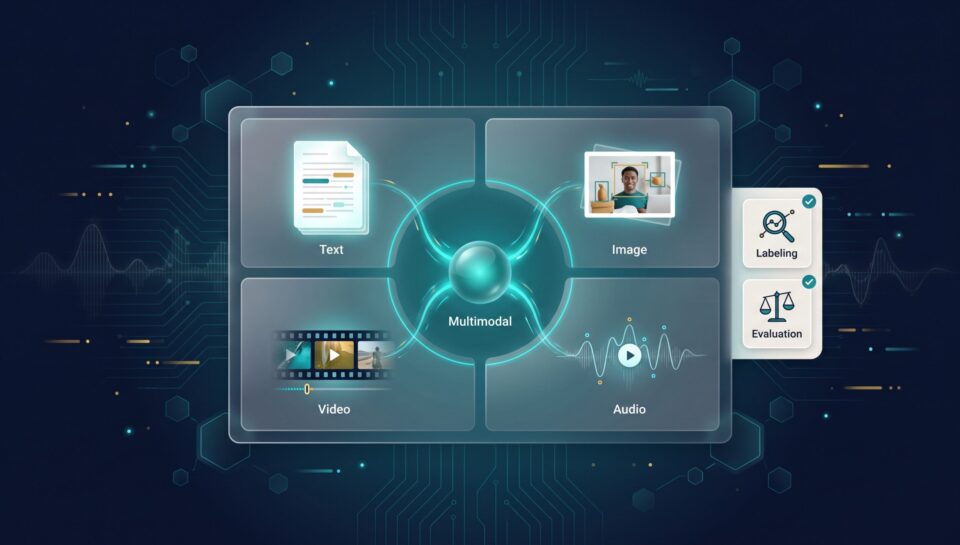
AI models used to specialize. One model read text, another looked at images, another processed speech. That separation has largely collapsed. Models now take an image and a question and answer in text, watch video with audio and describe what happened, or read a document containing charts, tables, and prose and reason across all of it. This shift changes what the data layer has to deliver, because multimodal models need multimodal data, and multimodal data is meaningfully harder to produce than four separate single-modality datasets. This guide covers what that difficulty actually consists of and what to look for in a partner.
Why Multimodal Is Harder Than the Sum of Its Parts
The intuitive assumption is that multimodal data work is image work plus text work plus audio work plus video work. It is not, for one central reason: the relationships between modalities carry the meaning, and those relationships have to be labeled too.
Consider a video of a person speaking. Labeling the audio gives you a transcript. Labeling the video gives you objects and actions. Neither tells you whether the speaker's tone contradicts their words, whether they are pointing at the thing they mention, or whether the on-screen text supports or undercuts the narration. Those are cross-modal labels, and they are what a multimodal model actually needs to learn. Producing them requires annotators who work across modalities at once, guidelines that define cross-modal relationships, and quality control that can assess them.
The Alignment Problem
The most consequential technical challenge in multimodal data is alignment: connecting the right piece of one modality to the right piece of another, at the right moment. In video with audio this means precise temporal alignment between what is heard and what is seen. In documents it means connecting a chart to the paragraph that discusses it. In image and text pairs it means confirming the caption actually describes the image rather than approximately relating to it.
Misalignment is corrosive because it is invisible in aggregate statistics. A dataset can look complete, with every item labeled in every modality, while the connections between them are subtly wrong. The model learns those wrong connections confidently.
What Multimodal Work Covers
Text. Classification, entity extraction, and sentiment, applied both standalone and in relation to other modalities. Ourtext annotation work covers the foundations.
Image. Detection, segmentation, and description, including the descriptive labeling that image-and-text models learn from. See ourimage annotation capability.
Video. Object tracking across frames, event labeling with timing, and action recognition, which ourvideo annotation work covers.
Audio. Transcription, speaker diarization, event and emotion labeling, covered in ouraudio annotation capability.
Cross-modal. The layer that only exists in multimodal work: temporal alignment, correspondence labeling, agreement and contradiction between modalities, and grounded references connecting language to what it points at.
Evaluating Multimodal Models
Evaluation inherits the same complexity. A multimodal model can fail in ways single-modality evaluation never surfaces: it can describe an image accurately while ignoring the question asked, answer from the text while disregarding the image, or produce a fluent description of something not present. Evaluating properly means testing whether the model actually uses each modality rather than leaning on one and confabulating the rest. That requires human reviewers assessing output against all the inputs together, with rubrics designed for cross-modal judgment.
The Case for One Partner Across Modalities
Teams often assemble multimodal datasets from several specialist vendors, one per modality. It seems sensible and it introduces a specific problem: no one owns the relationships between modalities. Each vendor delivers correct work within its own lane, the pieces are combined, and the cross-modal layer is either missing or inconsistent because nobody was responsible for it.
A single provider across modalities addresses this because guidelines are consistent, annotators can be trained to work across modalities, and cross-modal quality can actually be measured. The trade-off is that the provider must be genuinely capable in every modality rather than strong in one and thin in the others, which is the thing to probe when evaluating.
Quality Control Across Modalities
Measurement is harder here and matters more. Beyond per-modality accuracy, a serious operation measures cross-modal agreement between reviewers, since judgments about relationships between modalities are more subjective than object labels and drift faster without discipline. The underlying method is the same as any rigorousannotation quality programme, extended to cover relationships rather than only items.
How to Evaluate a Multimodal Partner
Ask which modalities they genuinely handle in-house versus subcontract. Ask how they label cross-modal relationships and temporal alignment specifically, because a partner who only describes per-modality work is not doing multimodal work. Ask how they measure agreement on cross-modal judgments. Ask whether they can evaluate multimodal model output, not just label training data. And require a paid pilot on your real multimodal data. Ourvendor evaluation guide covers the wider checklist.
Common Questions From US AI Teams
What are multimodal data services?
Services covering labeling and evaluation across text, image, video, and audio together, including the cross-modal layer that connects them: temporal alignment, correspondence, and grounded references.
Why is multimodal data harder than single-modality data?
Because the relationships between modalities carry the meaning and have to be labeled too. That requires annotators working across modalities at once, guidelines defining cross-modal relationships, and quality control able to assess them.
What is the alignment problem in multimodal data?
Connecting the right piece of one modality to the right piece of another at the right moment. Misalignment is dangerous because it is invisible in aggregate statistics: everything looks labeled while the connections are subtly wrong.
Should we use one partner or several for multimodal data?
Several specialists each deliver correct work in their own lane, but nobody owns the relationships between modalities, so the cross-modal layer ends up missing or inconsistent. One capable partner avoids that, provided they are genuinely strong in every modality.
How do you evaluate a multimodal model?
By testing whether it actually uses each modality rather than leaning on one and confabulating the rest, using human reviewers assessing output against all inputs together with rubrics built for cross-modal judgment.
What cross-modal labels do multimodal models need?
Temporal alignment between what is seen and heard, correspondence between elements across modalities, agreement or contradiction between them, and grounded references connecting language to what it points at.
How is quality measured in multimodal annotation?
Through per-modality accuracy plus measured agreement between reviewers on cross-modal judgments, which are more subjective than object labels and drift faster without deliberate measurement.
How do we choose a multimodal data partner?
Ask which modalities are handled in-house versus subcontracted, how cross-modal relationships and alignment are labeled, how agreement on cross-modal judgments is measured, whether they can evaluate model output as well as label data, and run a paid pilot on real data.
Working With Prudent Partners
Prudent Partners Private Limited works across every modality,text,image,video, andaudio, with the cross-modal alignment and correspondence labeling that multimodal models require, consistent guidelines across modalities, and measured agreement on cross-modal judgments. For the full scope, see ourAI data annotation services overview.
The first conversation is a 30-minute scoping call about your modalities, the cross-modal relationships your model needs to learn, and your quality bar. No commitment to go further.