Most AI agent failures look like model failures and are not. An agent forgets what it was doing, contradicts an earlier step, ignores a document it was given, or confidently uses stale information. The instinct is to blame the model or reach for a larger context window. Usually the real cause is what was placed in the context, in what order, and what was left out. That discipline has a name now, context engineering, and it has become one of the highest-leverage skills in building agentic systems.
For the underlying concept, ourLLM context window guide covers what a context window is and how it works. This piece is about using it well.
Context Is Everything the Model Sees
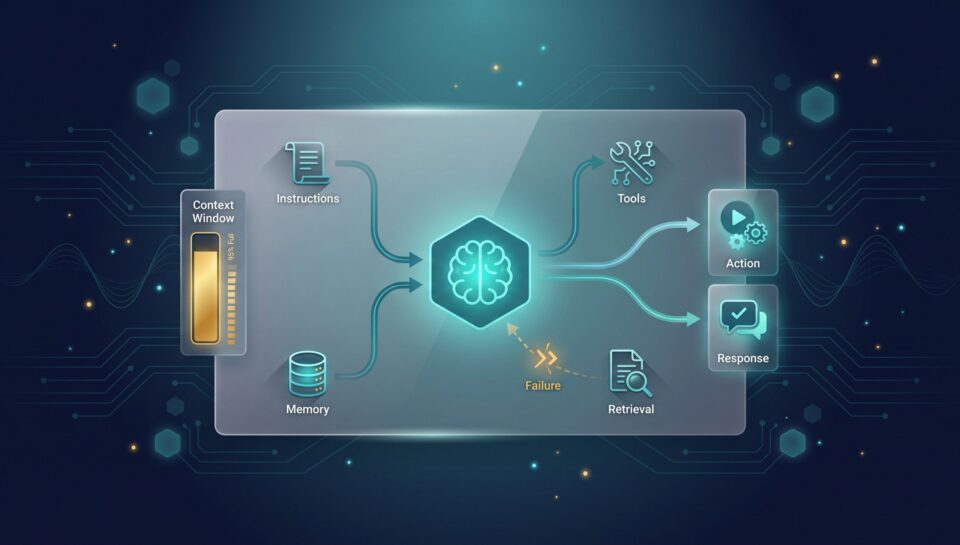
The context is the complete set of information passed to a model for a given turn: the system instructions, the user's message, the conversation history, retrieved documents, tool outputs, and any memory carried forward. The model has no other awareness. It does not remember the last session, know your database, or recall a document you showed it an hour ago unless something put that in the context now.
This has a blunt implication. If the model behaved badly, the first question is not "is the model good enough" but "what exactly did it see."
Why Bigger Windows Did Not Solve It
Context windows have grown enormously, which created a tempting shortcut: put everything in. It does not work well, for several reasons.
Models attend unevenly across a long context, and material buried in the middle of a large context receives less effective attention than material at the edges. Irrelevant content actively competes with relevant content, so adding a mostly unrelated document can degrade performance on a question the model previously answered correctly. Cost and latency scale with what you include. And a large context filled with near-duplicates gives the illusion of thorough grounding while adding little information.
The goal is not filling the window. It is fitting the right things in.
The Failure Modes
Context dilution. Too much marginally relevant material, so the signal is buried. Common when teams retrieve generously "just in case."
Missing context. The model was never given what it needed, and answers from general knowledge instead, fluently and wrongly.
Stale context. Carried-forward information that is no longer true, particularly damaging in long-running agents where an early assumption persists after it stops being valid.
Contradictory context. Two retrieved documents disagree and nothing indicates which is authoritative. The model picks one, usually without flagging the conflict.
Lost history. In long agent runs, early steps fall out of the window and the agent repeats work or contradicts itself.
Unstructured dumps. Raw web pages or whole documents pasted in, carrying navigation, boilerplate, and formatting noise that occupies the window without informing the answer.
Principles That Hold Up
Curate, do not accumulate. Decide deliberately what enters the context for each turn rather than appending everything available.
Structure beats prose. Clearly delineated sections, sources, and roles help the model use material correctly. An unlabeled wall of text invites misattribution.
Mark authority and recency. When multiple sources could conflict, indicate which is authoritative and how current each is, so the model is not guessing.
Summarise history rather than truncating it. For long-running agents, compress earlier steps into a durable summary rather than letting them silently drop out.
Externalise memory. Anything that must persist beyond a session belongs in an external store that can be retrieved deliberately, not in the hope that the window retains it.
Retrieve precisely. The quality of retrieval determines the quality of context, which is why knowledge base preparation matters so much. Ourretrieval-augmented generation overview covers the architecture this depends on.
Evaluating a Context Strategy
Teams rarely test context deliberately, which is why the failures persist. A workable approach: take cases where the agent failed and inspect the exact context it received, which usually explains the failure immediately. Test whether the agent uses provided material by asking questions answerable only from it. Test with deliberately conflicting sources to see whether it flags or silently picks. Test long runs specifically, since short-conversation testing never surfaces context loss.
The measurement discipline is the same as any structured evaluation: reviewers assessing behavior against clear criteria, with measured agreement so results are reliable rather than anecdotal. Ourannotation quality guide covers the method.
Where Human Judgment Enters
Two parts of this are irreducibly human. Deciding what should be authoritative in a given domain is a judgment call, not a retrieval parameter. And assessing whether an agent used its context appropriately requires someone who understands the domain reading the trace and the output together. Our work onAI agent workflow validation covers this in practice.
The Practical Takeaway
When an agent misbehaves, look at the context before looking at the model. Most of the time the answer is there, and the fix is cheaper than the alternatives teams reach for first.
Common Questions From US Teams
What is context engineering?
The practice of deliberately deciding what information a model receives for each turn: instructions, history, retrieved documents, tool outputs, and memory. It determines agent behavior more than model choice does.
Why do AI agents fail when context is poorly engineered?
Because the model has no awareness beyond what is in its context. Dilution, missing information, stale carried-forward assumptions, contradictions, and lost history all produce failures that look like model failures.
Do larger context windows solve these problems?
No. Models attend unevenly across long contexts, irrelevant material competes with relevant material, and cost and latency scale with size. The goal is fitting the right things in, not filling the window.
Why can't I just paste whole web pages into the context?
Because they carry navigation, boilerplate, and formatting noise that occupies the window without informing the answer, and they dilute the material that matters.
How do I handle long-running agents that lose earlier steps?
Summarise earlier history into a durable form rather than letting it silently drop out, and externalise anything that must persist beyond the session into a store you retrieve from deliberately.
What happens when retrieved documents contradict each other?
The model usually picks one without flagging the conflict. Mark which source is authoritative and how current each is, and test explicitly with conflicting sources to see how the system behaves.
How do I evaluate whether my context strategy is working?
Inspect the exact context in failure cases, test whether the agent uses provided material by asking questions answerable only from it, test with conflicting sources, and test long runs rather than short conversations.
Is context engineering a technical or a judgment problem?
Both. The mechanics are technical, but deciding what should count as authoritative in a domain, and assessing whether an agent used context appropriately, require human domain judgment.
Working With Prudent Partners
Prudent Partners Private Limited supports US teams building agentic systems with the human judgment layer context engineering depends on: reviewing agent traces against outputs, testing context strategies including conflicting and long-run cases, and preparing the retrieval material agents draw on. See ourAI agent workflow validation work and ourAI quality assurance function.
The first conversation is a 30-minute scoping call about your agent, where it currently fails, and what its context actually contains. No commitment to go further.