
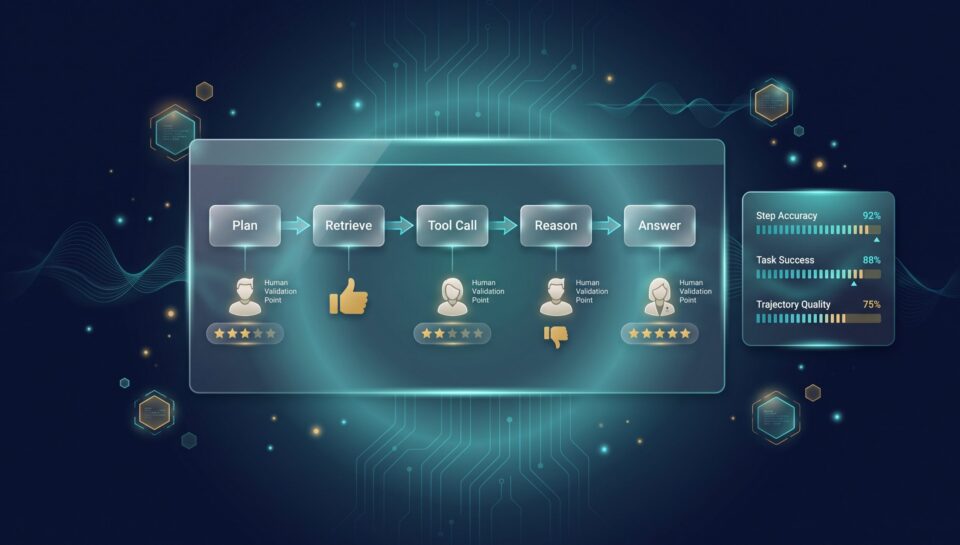
Evaluating a chatbot is hard. Evaluating an agent is harder, because an agent does not just answer, it acts. It calls tools, retrieves documents, takes multiple steps, and produces an outcome that depends on every decision along the way. A final answer can be correct while the path to it was wrong, and a path can be sensible while the outcome is wrong. Judging only the last message misses most of what matters. This guide covers how to evaluate agentic systems properly and where human review is genuinely required.
Why Output-Only Evaluation Breaks Down
With a single-turn model, the output is the behavior. With an agent, the output is the end of a chain of decisions: which tool to call, what arguments to pass, whether to retry after a failure, when to stop, whether to ask the user rather than guess. Two agents producing identical final answers can have behaved completely differently, one efficiently and safely, the other by making six wasteful calls and one dangerous one that happened not to matter this time.
Output-only evaluation also hides the failures that matter most operationally: the agent that succeeds while burning enormous cost, or that succeeded this time by luck and will fail on the next similar input.
What to Evaluate in an Agent Trace
Goal interpretation. Did the agent correctly understand what was being asked before acting? Misinterpretation at step one produces a confidently wrong chain.
Plan quality. Was the approach sensible, or did it take a convoluted route to a simple goal?
Tool selection and use. Did it choose appropriate tools and pass correct arguments? Wrong-tool and malformed-argument errors are extremely common and invisible in the final answer when the agent recovers.
Grounding. Did it use what it retrieved, or answer from general knowledge while ignoring the material it fetched? This connects directly to how its context was assembled.
Error recovery. When something failed, did it recover sensibly, retry blindly, or proceed as though the failure had not happened? Recovery behavior is one of the strongest signals of a mature agent.
Stopping behavior. Did it stop at the right point, or keep going, or stop prematurely leaving the task incomplete?
Escalation. Did it ask when it should have asked, rather than guessing on an ambiguous or high-stakes decision?
Safety of actions. For agents that take real actions, did it do anything it should not have? This is the dimension where the cost of a miss is highest.
Outcome, Process, and Cost
A useful evaluation separates three questions that are easy to blur. Did it achieve the goal? Was the path sound? What did it consume in steps, tokens, time, and tool calls? A system can score well on one and badly on another, and averaging them into a single score hides exactly the information you need to improve it.
Why Automation Is Insufficient Here
Automated checks handle some of this well: whether a tool call was malformed, whether the run exceeded a step budget, whether the final answer matches a known result on cases where one exists. What automation handles poorly is judgment: whether the plan was reasonable, whether escalation was appropriate, whether an action was risky given context. Those require someone who understands the domain reading the trace.
This is why human evaluation remains central for agents specifically, more so than for simpler generative systems. The judgments are about process and appropriateness, which are exactly the things proxies approximate badly. The measurement discipline is the same as any rigorous review programme: clear rubrics, trained reviewers, and measured agreement so the assessments are reliable rather than one person's opinion, as covered in ourannotation quality guide.
Building an Agent Evaluation Set
A durable evaluation set for agents needs more than a list of prompts. It needs realistic tasks spanning easy, hard, and ambiguous cases; tasks requiring multiple steps and tools rather than single lookups; cases where the right behavior is to ask rather than act; cases where a tool fails, to test recovery; and cases where retrieved material is missing or contradictory.
The most valuable additions come from production. Failures found by real users should be captured, converted into evaluation cases, and kept permanently so the same failure cannot silently return.
Human Annotation in the Iteration Loop
Human review does more than grade. Reviewers labeling agent traces produce the data that drives improvement: which failure modes are most frequent, which tools are misused, where the agent should have escalated. That labeled trace data is what turns a vague sense that the agent is unreliable into a ranked list of specific things to fix, and it feeds directly into prompt changes, tool descriptions, and guardrails.
Continuous, Not One-Time
Agents are especially prone to silent regression because they depend on models, tools, and retrieved content that all change independently. An agent working well today can degrade because a tool response format changed or a model was updated. Ongoing evaluation against a stable set, plus sampling of real production runs, is the only reliable way to notice. OurAI quality assurance function covers this monitoring discipline, and ourAI agent workflow validation work covers agentic evaluation specifically.
Common Questions From US Teams
How is evaluating an AI agent different from evaluating a chatbot?
An agent acts across multiple steps, so the trace matters as much as the output. A correct final answer can follow a wrong or unsafe path, and output-only evaluation misses that entirely.
What should be evaluated in an agent trace?
Goal interpretation, plan quality, tool selection and arguments, grounding in retrieved material, error recovery, stopping behavior, escalation decisions, and the safety of any real actions taken.
Can agent evaluation be automated?
Partly. Automation catches malformed tool calls, step budget overruns, and known-answer mismatches. It handles judgment poorly, including whether a plan was reasonable or an action was risky in context.
What is the role of human annotation in improving agents?
Reviewers labeling traces produce the data that ranks failure modes: which tools are misused, where escalation should have happened, which failures recur. That turns vague unreliability into a specific fix list.
Why do agents regress silently?
Because they depend on models, tools, and retrieved content that change independently. A tool response format change or model update can degrade behavior with no code change on your side.
What belongs in an agent evaluation set?
Realistic multi-step tasks across easy, hard, and ambiguous cases, cases where asking is the right behavior, cases where a tool fails, cases with missing or contradictory material, and every failure found in production.
Should outcome and process be scored together?
No. Score goal achievement, path soundness, and resource consumption separately. Averaging them hides which dimension is failing, which is the information you need to improve.
How often should agents be evaluated?
Continuously. Evaluate against a stable set after any change, and sample real production runs on an ongoing basis, because dependencies shift without warning.
Working With Prudent Partners
Prudent Partners Private Limited provides human evaluation for agentic AI systems: reviewing traces against structured rubrics covering plan quality, tool use, grounding, recovery, and escalation, with measured reviewer agreement and labeled failure data you can act on. See ourAI agent workflow validation work and ourAI quality assurance function.
The first conversation is a 30-minute scoping call about your agent, what it does, and where it currently goes wrong. No commitment to go further.