
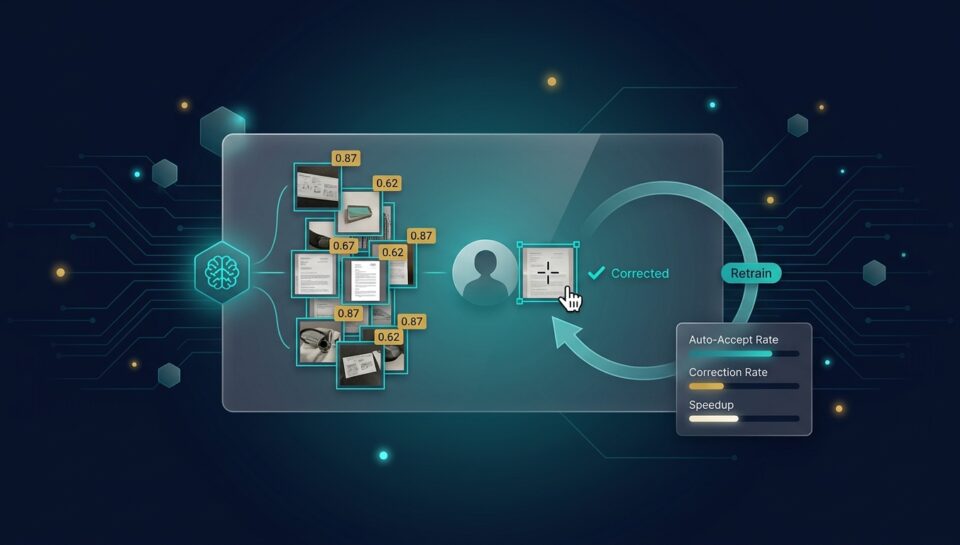
Nearly every annotation operation now uses models to assist human annotators, and the productivity gains are real. They are also easier to overstate than to sustain, because the mechanisms that make assisted labeling fast are the same ones that can quietly degrade quality. This guide covers how assisted labeling actually works, where the gains come from, and the failure mode that most operations do not measure.
For the broader argument about where automation fits, our guide toAI-assisted data labeling tradeoffs covers the strategic picture. This piece is about running it well.
The Three Mechanisms
Pre-labeling. A model produces candidate labels and humans correct them. This is the most common approach and the source of most of the productivity gain, because correcting is faster than creating for most annotation types.
Active learning. The model identifies which unlabeled items would most improve it if labeled, and those get prioritised. Instead of labeling randomly, effort concentrates where it changes the model most. The gains here can be substantial on large unlabeled pools, since a well-chosen subset often matches the performance of a much larger random sample.
Automated quality checking. Models flag likely errors in completed labels for human review, catching mistakes that random sampling would miss.
These are independent and can be used separately. Teams frequently adopt pre-labeling and never adopt active learning, which leaves the larger gain on the table for large-pool problems.
Where the Gains Are Real
Pre-labeling helps most where the label is laborious to produce and easy to verify. Drawing a segmentation mask from scratch is slow; adjusting a nearly correct one is fast. Bounding boxes, segmentation, transcription, and dense annotation all benefit substantially.
It helps least where the label is a judgment. If the hard part is deciding which category applies, a suggested category does not save meaningful time and introduces a specific risk discussed below.
Active learning helps most where unlabeled data is abundant and labeling budget is the constraint, which describes most large-scale projects.
The Failure Mode: Automation Bias
Here is the mechanism that matters and that most operations do not measure.
When a human reviews a machine suggestion, they are systematically more likely to accept it than they would be to produce the same answer independently. This is well documented across domains and it is not a matter of laziness; it is how human review of plausible suggestions works. The consequence in labeling is specific and serious: the annotator becomes a checker rather than a labeler, and the dataset inherits the model's errors instead of correcting them.
It gets worse where it matters most. The model's suggestions are most confident and most plausible on cases resembling its training data, and most wrong on the unusual cases. Those unusual cases are precisely the ones the new dataset is supposed to teach it about. So assisted labeling can systematically fail on the highest-value examples while appearing to work well overall.
There is a compounding version: if the assisting model was trained on data produced by assisted labeling, its biases feed forward through successive rounds, and the dataset converges toward the model's existing view rather than reality.
Designing Against It
The mitigations are practical and are the difference between assisted labeling that helps and assisted labeling that quietly degrades data.
Measure the acceptance rate. If annotators accept the great majority of suggestions unchanged, that is a signal to investigate rather than a success metric. It may mean the model is genuinely good, and it may mean nobody is really looking.
Blind-label a sample. Have annotators label a portion of items without seeing suggestions, then compare. The difference between assisted and unassisted labels on the same items is the most direct measure of automation bias available, and almost nobody runs it.
Suppress low-confidence suggestions. Where the model is unsure, showing no suggestion produces better labels than showing a doubtful one, because it forces independent judgment on exactly the hard cases.
Route hard cases away from assistance. Items flagged as unusual or previously disagreed on should be labeled unassisted.
Track quality by suggestion status. Measure agreement separately on items that were pre-labeled and items that were not. Divergence indicates the assistance is influencing outcomes rather than accelerating them. Ourannotation quality guide covers the measurement discipline this builds on.
Judgment Tasks Deserve Caution
For subjective or judgment-based annotation, sentiment, quality rating, preference comparison, assisted labeling is riskiest. A suggested judgment anchors the annotator's own judgment, and the whole value of the human is independent assessment. Consistency will appear to improve, because everyone is converging on the model's view, while the data becomes less informative. For preference and rating work, unassisted labeling is usually the right default.
What to Ask a Provider
If a provider uses assisted labeling, and most do, the useful questions are: what proportion of labels are pre-labeled, what is the acceptance rate, do you measure quality separately for assisted and unassisted items, do you suppress low-confidence suggestions, and do you ever blind-label to check for anchoring. Providers who have thought about this answer readily. Providers treating assistance purely as a throughput lever usually have not measured any of it, which is itself informative. Ourvendor evaluation guide covers the wider procurement questions.
The Balanced Position
Assisted labeling is worth using. It genuinely reduces cost and time on laborious annotation types, and active learning genuinely reduces how much data needs labeling at all. The gains are real and should be taken. What should not be assumed is that the human in the loop is providing the same quality of judgment they would provide unassisted, because measurably they are not, unless the operation is designed and monitored to preserve it.
Common Questions From US AI Teams
What is AI-assisted labeling?
Using models to support human annotators through pre-labeling candidate labels for correction, active learning to prioritise which items to label, and automated flagging of likely errors for review.
Where does pre-labeling save the most time?
Where labels are laborious to produce and easy to verify, such as segmentation, bounding boxes, and transcription. It saves little on judgment tasks where deciding the category is the hard part.
What is active learning and why is it underused?
The model selects which unlabeled items would most improve it, concentrating effort where it matters. Teams frequently adopt pre-labeling and skip active learning, leaving the larger gain unused on large unlabeled pools.
What is automation bias in labeling?
Human reviewers accept machine suggestions more readily than they would produce the same answer independently, so the annotator becomes a checker and the dataset inherits the model's errors rather than correcting them.
Why is automation bias worst on important cases?
Because model suggestions are most plausible on familiar cases and most wrong on unusual ones, and unusual cases are exactly what the new dataset should teach. Assisted labeling can fail on the highest-value examples while appearing fine overall.
How do you measure whether assistance is degrading quality?
Blind-label a sample without showing suggestions and compare against assisted labels on the same items. Also track agreement separately for pre-labeled and unassisted items and look for divergence.
Should suggestions always be shown?
No. Suppressing low-confidence suggestions produces better labels than showing doubtful ones, and hard or previously disputed cases should be routed to unassisted labeling.
Is assisted labeling appropriate for subjective tasks?
Generally not. A suggested judgment anchors the annotator, so consistency appears to improve while the data becomes less informative. For preference and rating work, unassisted labeling is usually the better default.
Working With Prudent Partners
Prudent Partners Private Limited uses model assistance where it genuinely accelerates work and designs against its failure modes: suppressing low-confidence suggestions, routing hard cases to unassisted labeling, tracking quality separately for assisted and unassisted items, and blind-labeling samples to test for anchoring. See our guide toAI-assisted data labeling tradeoffs and ourAI data annotation services overview.
The first conversation is a 30-minute scoping call about your data, your volume, and where assistance would genuinely help. No commitment to go further.