
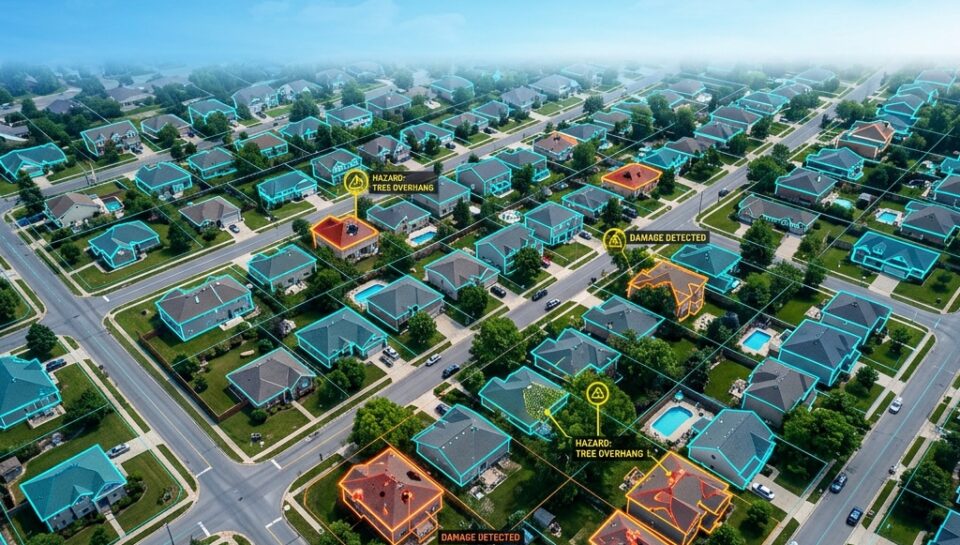
US property insurers are increasingly underwriting and settling claims with help from models that read aerial and satellite imagery. A carrier can assess a roof's condition before binding a policy, flag wildfire or flood exposure across a portfolio, or triage storm damage across a whole county without sending an adjuster to every address. None of that works without annotated imagery teaching the models what a damaged roof, an overhanging tree, or a flood-prone parcel actually looks like from above. Annotation for property risk is a vertical with its own quirks, its own quality stakes, and a direct line to dollars, since a model that misreads a roof costs a carrier real money.
This guide covers the data behind property-risk AI, the annotation types involved, the applications driving demand, and why quality matters so much when the output feeds an underwriting or claims decision.
The Data Behind It
Property-risk models train on imagery shot from above, the domain ofremote sensing, and the source matters because altitude and resolution shape what the model can learn. Satellite imagery covers a lot of ground at lower resolution, which is what you want for screening hazard across a whole portfolio. Go lower with aerial and fixed-wing capture and the resolution climbs while still covering regions at a time. Drone imagery is the close-up end, detailed enough to inspect a single property. The annotation tracks the resolution: a satellite model is learning coarse parcel-level features, while a drone model is learning whether one specific roof has hail bruising on it. The wider geospatial framing lives in ourgeospatial data annotation overview; here we stay inside the insurance and property-risk vertical.
Annotation Types in Property Risk
The label work spans several types, drawn from theimage annotation toolkit but applied to an overhead view.
• Roof condition and material annotation, labeling roof type, age indicators, and damage like missing shingles, hail bruising, tarps, or rust
• Building footprint and structure segmentation, outlining structures and distinguishing main dwelling from outbuildings
• Hazard and exposure annotation, marking vegetation overhang, defensible space for wildfire, proximity to water for flood, and pool or trampoline presence for liability
• Change detection, comparing imagery across time to flag new construction, new damage, or encroaching vegetation
• Damage severity classification, grading storm or fire damage for claims triage
Each connects to a concrete insurance decision, which is what makes the vertical distinct from generic object detection.
Real Applications
The demand is not theoretical. US carriers and insurtechs are using annotated imagery for underwriting assessment, scoring a property's risk before binding a policy, sometimes catching a roof or hazard condition that changes the price or the decision. Ourroof damage annotation case study shows that work in practice. Portfolio risk management is another, where carriers screen exposure across thousands of policies for wildfire, flood, or hail concentration, the kind of predictive work ourproperty risk intelligence case study covers. And catastrophe response is a third, where after a storm or fire a carrier triages damage across a region from imagery, prioritizing adjusters and speeding payouts to the worst-hit policyholders.
Quality Matters More Here
When an annotation feeds an underwriting or claims decision, an error is not an abstract quality-metric problem. It is a mispriced policy or a wrong claim outcome. That raises the stakes on annotation quality in a specific way.
Spatial accuracy on building footprints and damage regions is scored withIntersection over Union, and the tolerance is tight when the output drives money. Consistency matters across the huge volume a portfolio represents, so inter-annotator agreement and clear guidelines keep a thousand annotators labeling hail damage the same way. Hard cases deserve extra review: faded damage, shadow that mimics damage, and the boundary between wear and genuine harm are exactly where annotators disagree and where a wrong label costs the most. Our guide onannotation quality and inter-annotator agreement covers the measurement discipline, and it applies with extra force when each label has a dollar value attached. TheNIST AI Risk Management Framework is a useful structure for the model-risk governance carriers increasingly expect.
Common Questions From US Insurers and Insurtechs
What imagery is used for property risk AI?
Satellite for broad portfolio screening, aerial and fixed-wing for regional coverage at higher resolution, and drone imagery for fine-detail individual-property inspection. The annotation adapts to the resolution of each.
What gets annotated in property risk imagery?
Roof condition and material, building footprints, hazards like vegetation overhang and flood proximity, change between time periods, and damage severity for claims. Each ties to an underwriting or claims decision.
How is aerial annotation used in insurance underwriting?
Models trained on annotated imagery assess a property's risk before a policy is bound, scoring roof condition, hazards, and exposure. This can catch conditions that change the price or the decision without a physical inspection.
What is change detection in property risk?
Comparing imagery of the same property across time to flag new construction, new damage, or encroaching vegetation. It supports both underwriting updates and post-event claims assessment.
Why does annotation quality matter so much in insurance?
Because each label can feed a pricing or claims decision with real money attached. A misread roof means a mispriced policy or a wrong claim outcome, so the quality bar and review intensity are higher than for generic object detection.
How is quality measured for aerial annotation?
Spatial accuracy with Intersection over Union on footprints and damage regions, inter-annotator agreement across the large annotator pool, and gold-set accuracy tracking, with extra review on ambiguous damage and shadow cases.
Can property risk annotation be outsourced?
Yes, to a partner with geospatial and overhead-imagery experience, a quality framework suited to decision-grade output, and the consistency to label at portfolio scale. Insurance stakes make the quality apparatus the deciding factor.
What are the hardest cases to annotate?
Faded or partial damage, shadows that mimic damage, and the line between normal wear and genuine harm. These are where annotators disagree most and where a wrong label is most costly, so they deserve focused review.
Working With Prudent Partners
Prudent Partners Private Limited annotates aerial, satellite, and drone imagery for US property-risk and insurance AI, covering roof condition, building footprints, hazard and exposure features, change detection, and damage severity. The quality framework is built for decision-grade output, with Intersection over Union targets, inter-annotator agreement monitoring, and focused review on the ambiguous damage cases that matter most when each label carries a dollar value.
For the full service scope, see ourdata annotation services overview, and for the broader geospatial context, ourgeospatial data annotation page.
To talk it through, reach out through the contact page. The first call is a 30-minute scoping discussion covering your imagery sources, the features you need labeled, volume, and quality bar. No commitment to go further.