Conversational AI has quietly become the most visible form of AI most people encounter: support agents, voice assistants, internal helpdesks, and increasingly full agentic assistants that take actions on a user's behalf. Building one that works is less about the model than most teams expect. The model is largely a commodity. What separates an assistant people trust from one they route around is the data it was trained and tuned on, and the testing that catches its failures before customers do. This guide covers what to look for when choosing a partner for conversational AI data and testing, and the questions that separate a capable partner from a vendor selling chatbot buzzwords.
What Conversational AI Partners Actually Do
The category is broad, and the first job is knowing which kind of partner you need. Some companies build the assistant itself: the platform, the integrations, the deployment. Others provide the data and quality layer that makes it work: intent taxonomies, training utterances, annotated conversations, human feedback, and structured testing. Many teams already have the platform and need the second kind. Being clear about which gap you are filling avoids paying a build partner for work you do not need.
This guide is about the data and quality layer, which is where most conversational AI projects actually succeed or fail.
The Data That Makes an Assistant Work
Intent taxonomies. The structure of what users might want. Getting this wrong is the most common root cause of a bad assistant: too few intents and it cannot distinguish real requests, too many and it collapses into confusion. Building a taxonomy that matches how your users actually speak is design work, not data entry.
Training utterances. Real examples of how people phrase each intent, in the range of ways they actually phrase it. Assistants fail on the phrasings nobody thought to include, and the fix is coverage across the real variety of user language rather than a tidy list written by the product team.
Annotated conversations. Labeling real conversations for intent, entities, sentiment, and outcome. This connects to established text work likenamed entity recognition,text classification, andsentiment analysis, applied to dialogue.
Human feedback for tuning. Rating and ranking assistant responses so the model learns what a good answer looks like in your context. This is what shapes tone, helpfulness, and refusal behavior.
Edge case and failure data. The conversations where the assistant struggled. This is the highest-value data most teams never systematically collect.
The Testing That Catches Failures
Conversational AI is hard to test because quality lives in the whole conversation, not one exchange. A partner worth hiring tests accordingly.
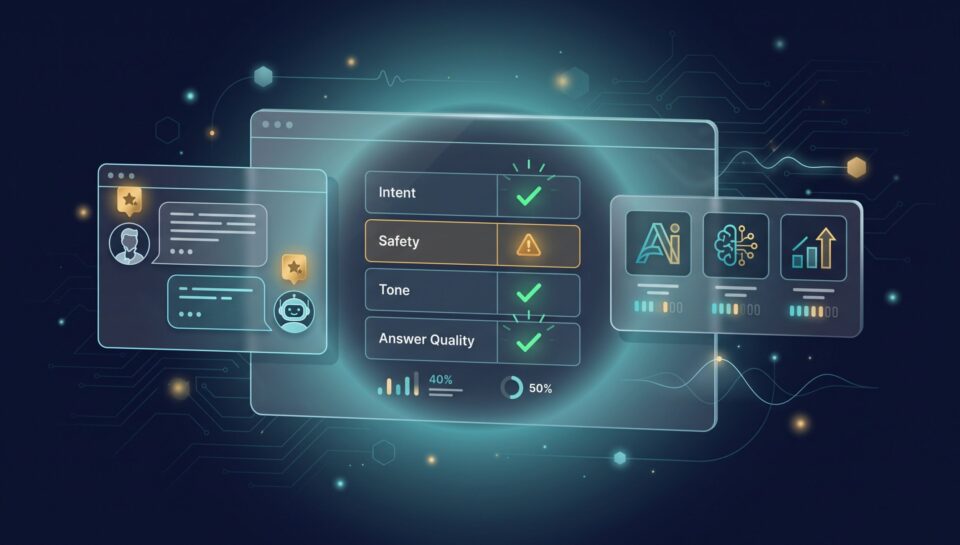
Multi-turn conversation quality. Does the assistant hold context, handle a user changing their mind, and stay coherent across a real exchange? Single-turn testing tells you almost nothing about this.
Intent coverage and confusion. Which intents does it miss, and which does it confuse with each other? Confusion pairs are where most user frustration originates.
Escalation and fallback. What happens when it does not know. A good assistant fails gracefully and hands off cleanly; a bad one invents an answer. This behavior needs deliberate testing.
Safety under pressure. How it behaves with adversarial, abusive, or manipulative input. For anything customer-facing this is not optional.
Consistency. Whether it gives the same quality of answer to the same question phrased five different ways. Inconsistency is one of the most common and least tested failure modes.
Regression after updates. Models and prompts change. Testing has to be continuous, because an update that improves one behavior routinely degrades another. The broader discipline is covered in ourAI quality assurance work.
What Separates a Real Partner
A few questions cut through quickly. Can you build an intent taxonomy from our real conversation logs, or do you expect us to supply one? How do you source training utterances that reflect how our users actually speak? Do you test multi-turn conversations or only single exchanges? How do you handle escalation, safety, and adversarial testing? How do you measure agreement between your reviewers so the quality scores are reliable rather than one person's judgment? And will you run a paid pilot on our real conversation data before we commit?
A partner who answers these concretely is doing the work. A partner who talks about the platform and the model rather than the data and the testing is selling something else.
Domain Understanding Matters
One factor is easy to underweight: whether the partner understands your domain. A healthcare assistant, a financial services assistant, and a retail assistant fail in different ways and carry different obligations. Reviewers who understand the domain catch problems that generalists miss, and in regulated sectors the difference is material. Ask specifically about the domain experience of the people doing the labeling and testing, not just the company's client list.
Build or Partner
Teams with a mature conversational AI operation often keep this in-house, close to the product. The reasons to bring in a partner are the familiar ones: annotating conversations and running structured testing is labor-intensive, demand spikes around launches and model updates, and independent testing is more credible than a team assessing its own assistant. Ourvendor evaluation guide covers the wider procurement discipline.
Common Questions From US Teams
What do conversational AI companies do?
Some build the assistant itself, the platform and deployment. Others provide the data and quality layer: intent taxonomies, training utterances, annotated conversations, human feedback, and testing. Knowing which you need avoids paying for the wrong thing.
What data does a chatbot need to work well?
An intent taxonomy matching how users actually speak, training utterances covering the real range of phrasings, annotated conversations, human feedback for tuning, and systematically collected edge case and failure data.
Why do chatbots fail on real users?
Most often because the training data covered a tidy set of phrasings rather than the messy variety real users produce, or because intents were poorly structured, causing confusion between similar requests.
How do you test conversational AI properly?
Across whole conversations rather than single turns: multi-turn context handling, intent coverage and confusion, escalation and fallback behavior, safety under adversarial input, consistency across phrasings, and regression after updates.
What is intent confusion and why does it matter?
When an assistant mistakes one user intent for a similar one. Confusion pairs are where most user frustration originates, and identifying them is a core part of conversational AI testing.
How important is domain expertise in a conversational AI partner?
Very. Healthcare, financial services, and retail assistants fail differently and carry different obligations. Ask about the domain experience of the people doing the labeling and testing, not just the company's client list.
Should conversational AI testing be continuous?
Yes. Models and prompts change, and an update that improves one behavior routinely degrades another. One-time testing before launch leaves you blind to regressions.
How do I choose a conversational AI data and testing partner?
Ask whether they can build an intent taxonomy from your real logs, how they source realistic training utterances, whether they test multi-turn conversations, how they handle safety and escalation testing, how they measure reviewer agreement, and whether they will run a paid pilot on your data.
Working With Prudent Partners
Prudent Partners Private Limited provides the data and quality layer for conversational AI: intent taxonomy design, training utterance development, conversation annotation, human feedback for tuning, and structured multi-turn testing including escalation and safety. The work builds on ourAI quality assurance function and established text capabilities acrosstext classification andsentiment analysis.
The first conversation is a 30-minute scoping call about your assistant, where it currently struggles, and the quality bar you need. No commitment to go further.