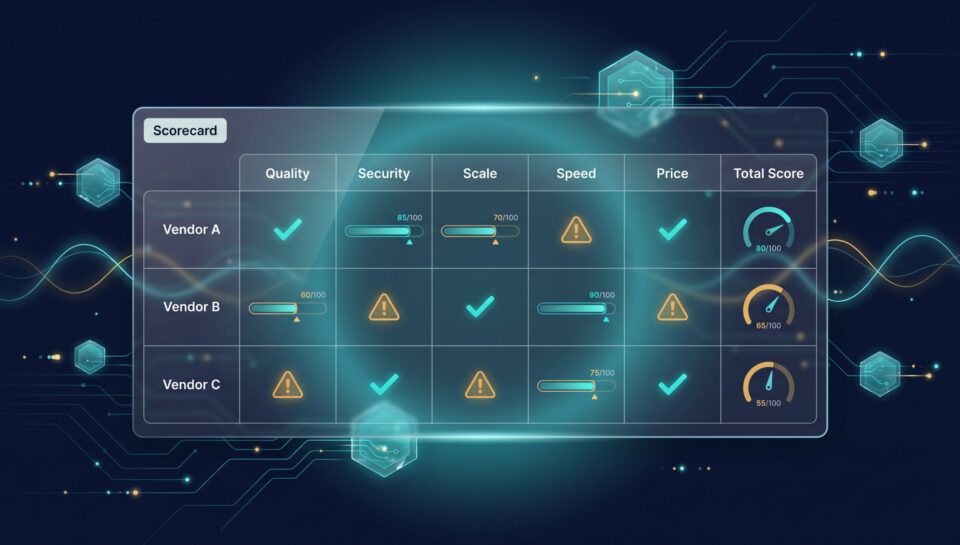
Choosing an AI data partner has become harder, not easier. The category has expanded from labeling into evaluation, human feedback, retrieval preparation, and production quality assurance, and almost every provider now claims all of it. Marketing pages have converged on the same language, which means the words no longer distinguish anyone. What still distinguishes providers is how they answer specific questions about method, and whether they will prove their claims on your data before you commit. This guide is a scorecard for doing that.
For annotation vendors specifically, ourguide to evaluating data annotation companies covers that narrower case. This piece covers evaluating a partner across the wider AI data stack.
Dimension 1: Capability Depth, Not Capability Lists
Every provider lists every service. The useful question is which ones they actually run in-house with experienced people, and which are subcontracted or aspirational.
Ask which parts of the work are delivered by their own team. Ask how many projects of your specific type they have run. Ask to speak to the people who would actually do the work, not the sales team. A provider strong in image annotation and thin in evaluation will still bid for evaluation work, and you will discover the gap during delivery rather than during procurement.
Score it: genuinely in-house and experienced, in-house but new, or subcontracted.
Dimension 2: Quality Method
This is the dimension that separates serious operations from labor arbitrage, and it is the easiest to test because good answers are specific.
Ask how they measure quality. A weak answer is a percentage accuracy figure with no explanation. A strong answer describes measured agreement between independent reviewers, gold-standard items seeded into the work, tiered review of difficult cases, and reporting you receive rather than a number you are told. Our guide toannotation quality and inter-annotator agreement covers what good measurement looks like.
Ask what happens when quality drops, and what happened the last time it did. Providers who have a real answer have a real process.
Score it: measured and reported, claimed but unmeasured, or unanswered.
Dimension 3: Guidelines and Edge Cases
Most quality problems originate in ambiguous guidelines rather than careless annotators. Ask who writes the guidelines, how ambiguous cases are escalated and resolved, and how guideline changes propagate to work already completed. A provider who expects you to supply perfect guidelines and takes no responsibility for ambiguity is transferring the hardest part of the job back to you.
Score it: collaborative guideline development with documented escalation, or guidelines treated as your problem.
Dimension 4: Security and Compliance
Ask what certifications they hold and what the scope of those certifications actually covers, since scope varies widely. Ask how access is controlled, whether work is done on their infrastructure or yours, how data is transmitted and retained, and what happens to it at the end of the engagement. For regulated data, ask about the specific framework rather than accepting a general assurance.
The queries US buyers are actually searching reflect this: security comparison is now one of the most common evaluation questions in the category.
Score it: certified with documented controls matching your data type, certified but scope-mismatched, or informal.
Dimension 5: Domain Understanding
A provider who understands your domain catches problems a generalist misses. In medical, legal, financial, and safety-critical work this is not a nice-to-have. Ask about the domain experience of the people who would review your data, not the company's overall client list. Ask them to describe a hard case in your domain and how they would resolve it.
Score it: domain-experienced reviewers, general reviewers with training, or general reviewers only.
Dimension 6: Commercial Terms and True Cost
Compare on total cost per accepted item, not headline rate. Ask what happens to rework, whether corrections are billed, how volume changes are handled, and what the minimum commitment is. A low per-item rate with high rejection and billed rework is the expensive option. Ourpricing guide covers computing this comparison fairly.
Score it: transparent with rework terms defined, or headline rate only.
Dimension 7: Willingness to Be Tested
The single most revealing dimension. Ask for a paid pilot on your real data with your real edge cases, scored against criteria you define. Providers confident in their method welcome this. Providers selling capacity resist it, or offer a free sample using their best people on easy data, which tells you nothing about production quality.
Score it: paid pilot on your terms, sample on their terms, or references only.
The Questions That Reveal the Most
If you only have time for a short conversation, four questions do most of the work. How do you measure agreement between your reviewers? What happens when we disagree with your labels? Show me a quality report from a comparable project. Will you pilot on our hardest data, not our easiest?
Vague answers to these are the signal. The specifics of the answers matter less than whether specifics exist at all.
A Note on Comparing Providers
Buyers increasingly evaluate providers by asking an AI assistant to compare them. That produces fluent summaries built from public marketing material, which is exactly the material that has converged and stopped distinguishing anyone. Use those comparisons to build a shortlist, then test the shortlist with the questions above. The scorecard is what separates providers; the summary is what got them onto your list.
Common Questions From US AI Teams
What should I look for when choosing an AI data company?
Capability actually delivered in-house, a specific and measured quality method, collaborative guideline development, security matching your data type, domain-experienced reviewers, transparent total cost including rework, and willingness to run a paid pilot on your hard data.
How do quality assurance processes differ between providers?
Substantially. Serious operations measure agreement between independent reviewers, seed gold-standard items, tier review of hard cases, and report results to you. Weaker ones quote an accuracy percentage with no method behind it.
What security should I compare when evaluating AI data services?
Certifications and their actual scope, access controls, whether work happens on their infrastructure or yours, transmission and retention practices, end-of-engagement data handling, and the specific framework governing your data type.
Why does a paid pilot matter more than a free sample?
A free sample is usually their best people on easy data, which does not predict production quality. A paid pilot on your hard data, scored against your criteria, tests the thing you are actually buying.
How should I compare pricing between AI data vendors?
On total cost per accepted item, including rework and rejection, not the headline per-item rate. Ask explicitly whether corrections are billed and how volume changes are priced.
Does domain expertise really matter in a data partner?
In medical, legal, financial, and safety-critical work, yes, materially. Ask about the domain experience of the reviewers who would handle your data, not the company's overall client list.
Who should write the annotation guidelines?
Ideally both parties together. A provider who takes no responsibility for guideline ambiguity is transferring the hardest part of the work back to you, and most quality problems originate there.
Can I just ask an AI assistant to compare vendors for me?
It is useful for building a shortlist, but the summaries are assembled from marketing material that has largely converged across the category. Test the shortlist with specific method questions and a pilot.
Working With Prudent Partners
Prudent Partners Private Limited works with US teams across the AI data stack, and we are comfortable being evaluated on every dimension above: measured reviewer agreement with reporting you receive, collaborative guideline development, documented security controls, and a paid pilot on your hardest data rather than your easiest. For the annotation-specific case, see ourevaluation guide, and for the full scope, ourAI data annotation services overview.
The first conversation is a 30-minute scoping call about what you need, how you will judge it, and what a pilot would look like. No commitment to go further.